Your favorite-looking warships?

OT: anything goes!

Moderator: Edi

User avatar
atg
Jedi Master
Posts: 1418
Joined: 2005-04-20 09:23pm
Location: Adelaide, Australia

Post by atg »

Isolder74 wrote:
Stuart Mackey wrote:
Isolder74 wrote:snip Rodney

I wonder who thought up that one....
Nelson and Rodney are a result of certain design compromises on an existing plan to fit within the 3500 ton limit inflicted by the Washington Naval Treaty of 1922, which resulted in two warships that were slow, ungainly with difficult arcs for a third of the main armament and ruined a reputation in RN ships for good looks.
Still doesn't explain why the third turret isn't located on the back of the ship where it might actually be useful. The impression I get from the design of the Rodney was to have a ship that "crossing the T' would be mainly academic. Sadly the design is such that Rodney can't fire its third turret forward other then at high angles.
The turrets are all forward because they were trying to come within the required tonnage limitations and having the turrets together reduced the amount of armour needed to protect the magazines and hence saved weight. See also the French Dunkerque and Richelieu class ships (IIRC the G3 battlecruiser and N3 battleship designs also had all the guns up front).

Perhaps you should really take a look at the Washington Naval Treaty as it influenced the designs of all warships until WWII.
User avatar
Stark
Emperor's Hand
Posts: 36169
Joined: 2002-07-03 09:56pm
Location: Brisbane, Australia

Post by Stark »

atg wrote:The turrets are all forward because they were trying to come within the required tonnage limitations and having the turrets together reduced the amount of armour needed to protect the magazines and hence saved weight. See also the French Dunkerque and Richelieu class ships (IIRC the G3 battlecruiser and N3 battleship designs also had all the guns up front).

Perhaps you should really take a look at the Washington Naval Treaty as it influenced the designs of all warships until WWII.
Their low speed made them marginal units, though. I'm not sure, but I've read that the wheeling and dealing at the WNT allowed Britain to build two new ships, but that they were compelled somehow to be WW1-BB speed, rather than a useful modern speed (and the compulsion to the lightest possible machinery didn't help). 46,000hp for a battleship of 35,000t? Pffft. Mere heavy cruisers had more, even at the time!
User avatar
atg
Jedi Master
Posts: 1418
Joined: 2005-04-20 09:23pm
Location: Adelaide, Australia

Post by atg »

Stark wrote:
atg wrote:The turrets are all forward because they were trying to come within the required tonnage limitations and having the turrets together reduced the amount of armour needed to protect the magazines and hence saved weight. See also the French Dunkerque and Richelieu class ships (IIRC the G3 battlecruiser and N3 battleship designs also had all the guns up front).

Perhaps you should really take a look at the Washington Naval Treaty as it influenced the designs of all warships until WWII.
Their low speed made them marginal units, though. I'm not sure, but I've read that the wheeling and dealing at the WNT allowed Britain to build two new ships, but that they were compelled somehow to be WW1-BB speed, rather than a useful modern speed (and the compulsion to the lightest possible machinery didn't help). 46,000hp for a battleship of 35,000t? Pffft. Mere heavy cruisers had more, even at the time!
What is the 'modern' standard you refer to though? WWII-era? The low speed definately made them marginally usefull during WWII, but during the 1920s when they were designed and built their speed was the standard going around, nothing so shady needed.
It needs to be kept in mind what they were designed against. Britain was allowed to build the Nelsons as a counter to the Japanese Nagato class and the American Maryland/Colorado class. The Nelsons were arguably better than both classes, having a greater operational range, more armour, and having an extra 16-inch gun then either of it competitors, whilst also having a slight speed advantage over its American rival. All this on a standard tonnage only one thousand or so greater than the Colorado and much less than the Nagato.
User avatar
CaptHawkeye
Sith Devotee
Posts: 2939
Joined: 2007-03-04 06:52pm
Location: Korea.

Post by CaptHawkeye »

atg wrote: What is the 'modern' standard you refer to though? WWII-era? The low speed definately made them marginally usefull during WWII, but during the 1920s when they were designed and built their speed was the standard going around, nothing so shady needed.
It needs to be kept in mind what they were designed against. Britain was allowed to build the Nelsons as a counter to the Japanese Nagato class and the American Maryland/Colorado class. The Nelsons were arguably better than both classes, having a greater operational range, more armour, and having an extra 16-inch gun then either of it competitors, whilst also having a slight speed advantage over its American rival. All this on a standard tonnage only one thousand or so greater than the Colorado and much less than the Nagato.
Having "one more" 16 inch gun was pretty worthless for Nelson since all of its 16 inch guns had laughable performance which was only slightly above that of the british 15 inch. Even the slight firepower advantage they had was negated by their obscenely short barrel life and shitty accuracy. Compare this to Colorado's Mark 1 16 inch guns which had a more than 50% improvement in firepower over the previous 14 inch guns common on the other Standards.

That was just the Colorado's Mark 1 guns anyway. They were all upgraded prior to the war and received the much superior Mark 8 gun. The Mark 1 had roughly similar destructive performance to Nelson's 16 inch guns, and even outranged them slightly. The Mark 8 had more the twice the armor penetration capability of Nelson's guns at short range. The Mark 8's also made use of high angle drop shot fire that Nelson wasn't very efficient with.

And Nelson having better protection than Colorado just isn't true. Colorado's armor is generally the same thickness, but has a much better layout, and is supplemented by better compartmentalization and one of the best torpedo defense systems ever devised.

As for slow speed, Nelson was actually 2 knots faster than Colorado. Though 23 knots is still pretty slow by World War 2. Asking the builders of the Standard Types to factor in carrier warfare is pretty unfair since the ships were thought up and planned before World War 1 even got started. I'm not sure how open to this excuse Nelson was during the 20s though.

Besides, the Standards were not designed to be "fast battleships". To do so would defeat the very purpose of their design. Which was to be a line of homogeneous battleships that the Navy needed to replace its aging Pre Dreadnoughts.
Best care anywhere.
User avatar
atg
Jedi Master
Posts: 1418
Joined: 2005-04-20 09:23pm
Location: Adelaide, Australia

Post by atg »

CaptHawkeye wrote: Having "one more" 16 inch gun was pretty worthless for Nelson since all of its 16 inch guns had laughable performance which was only slightly above that of the british 15 inch. Even the slight firepower advantage they had was negated by their obscenely short barrel life and shitty accuracy. Compare this to Colorado's Mark 1 16 inch guns which had a more than 50% improvement in firepower over the previous 14 inch guns common on the other Standards.
An extra gun means an extra shell in the air that can be aimed at an enemy ship, it can be the difference between getting a hit and missing altogether so I wouldn't dismiss it out of hand. Considering that the BL 15 inch Mark I gun on the Queen Elizabeth/Revenge classes was quite a good gun then even a 'small' performance gain going to the 16 inch isn't too bad. What does the performance increase from the British 15inch to 16inch as compared to the gain of the American 14inch to 16inch matter with this anyway?
CaptHawkeye wrote:That was just the Colorado's Mark 1 guns anyway. They were all upgraded prior to the war and received the much superior Mark 8 gun. The Mark 1 had roughly similar destructive performance to Nelson's 16 inch guns, and even outranged them slightly. The Mark 8 also had more the twice the armor penetration capability of Nelson's guns at short range. The Mark 8's also made use of high angle drop shot fire that Nelson wasn't very efficient with.
So you say that the 16 inch on the Nelson was "laughable", but then admit that Mark 1 on the Colorado had "similar destructive performance", what is your point? The Mark8s weren't installed until the 1930s, I was refering to specs at design stage/first build of the Nelsons. The information I've got on the Mark8s is that they had the same performance as previous but had new materials for a longer firing life. So if we're going to bring in refits then we might as well give the Nelson the redesigned APC shell that was to address performance issues, though never actually used.
CaptHawkeye wrote: And Nelson having better protection than Colorado just isn't true. Colorado's armor is generally the same thickness, but has a much better layout, and is supplemented by better compartmentalization and one of the best torpedo defense systems ever devised.
The figures I have at hand indicate that the Nelson had greater armour thickness at any point as compared to the Colorado, except for turret faces. This was especially true of the deck armour which was something along the lines of 1.5-3.5 inches (min-max) for the Colorados compared to 3-6.25 inches for the Nelsons. Exact armour layouts of the belts, etc, is something I cannot comment on but if anyone has any details it would be appreciated.
CaptHawkeye wrote: As for slow speed, Nelson was actually 2 knots faster than Colorado.
Which was exactly my point, though only a slight speed advantage it would still allow the Nelson to dictate the range of an engagement between the two.
CaptHawkeye wrote:Though 23 knots is still pretty slow by World War 2. Asking the builders of the Standard Types to factor in carrier warfare is pretty unfair since the ships were thought up and planned before World War 1 even got started. I'm not sure how open to this excuse Nelson was during the 20s though.
Again that was my point, the speed factor applied equally to the Nelson as to the Colorado in terms of usefulness. Who said that the designers of the standards should account for Carrier warfare? They're not expected to have, nor should the designers of the Nelsons have had to. During the 20s the battleship was by far still considered the arbiter of naval warfare.
CaptHawkeye wrote: Besides, the Standards were not designed to be "fast battleships". To do so would defeat the very purpose of their design. Which was to be a line of homogeneous battleships that the Navy needed to replace its aging Pre Dreadnoughts.
The Nelsons weren't designed to be fast battleships either, such a term didn't even come about until much later anyway when Battleships and Battlecruisers essentially merged. The Nelsons were also designed to work with a battlefleet consiting of the Revenge class at 21knt and the Queen Elizabeth class at 24knt

Essentially the two ships boil down to this:
Nelson is slightly faster.
Nelson has thicker armour but Colorado may have better placement plus better torp defence.
Both have similar firepower, with Nelson having an extra gun.
Nelson has double the sailing range (~16500nm @ 12kts compared to ~8000nm @ 10kts)

User avatar
Isolder74
Official SD.Net Ace of Cakes
Posts: 6767
Joined: 2002-07-10 01:16am
Location: Weber State of Construction University
Contact:

Post by Isolder74 »

atg wrote:
Isolder74 wrote:
Stuart Mackey wrote: Nelson and Rodney are a result of certain design compromises on an existing plan to fit within the 3500 ton limit inflicted by the Washington Naval Treaty of 1922, which resulted in two warships that were slow, ungainly with difficult arcs for a third of the main armament and ruined a reputation in RN ships for good looks.
Still doesn't explain why the third turret isn't located on the back of the ship where it might actually be useful. The impression I get from the design of the Rodney was to have a ship that "crossing the T' would be mainly academic. Sadly the design is such that Rodney can't fire its third turret forward other then at high angles.
The turrets are all forward because they were trying to come within the required tonnage limitations and having the turrets together reduced the amount of armour needed to protect the magazines and hence saved weight. See also the French Dunkerque and Richelieu class ships (IIRC the G3 battlecruiser and N3 battleship designs also had all the guns up front).

Perhaps you should really take a look at the Washington Naval Treaty as it influenced the designs of all warships until WWII.
I know about the Washington Arms Treaty.

It still does not excuse the bad design of the ship. Also saying the French had two ships just like it does not help much either. Under the same Treaty the US seemed to manage to produce decent ships. Even under the limitations, there is no excuse for the terrible placement of the third turret. I wonder how much armor they'd have to give up to have placed higher then turret two. A turret positioned forward and too close to the turret in front of it to be used forward is a waste of it completely. Sure it has a larger broadside but I still have to wonder if they used dual turrets instead of triples if they'd have been able to have mounted the gun in a better position.

Also it is still the ugliest battleship design ever.
Hapan Battle Dragons Rule!
When you want peace prepare for war! --Confusious
That was disapointing ..Should we show this Federation how to build a ship so we may have worthy foes? Typhonis 1
The Prince of The Writer's Guild|HAB Spacewolf Tank General| God Bless America!
User avatar
Raesene
Jedi Master
Posts: 1341
Joined: 2006-09-09 01:56pm
Location: Vienna, Austria

Post by Raesene »

The USA produced its treaty battleships 10 years later than Nelson and Rodney, these ships should be compared to the KGVs, not the Nelsons.

The turret arrangement is a leftover of the G3 battlecruisers, whose armour scheme required better protection for the magazines than for the engines. Nelson had a belt armour of 35,6 cm besides the magazines and 33 cm for the machinery space.

The most ugly battleships are the german dreadnoughts with hexagonal turret layout and the US ships with cage masts. The rebuilt russian battleships follow up closely.

"In view of the circumstances, Britannia waives the rules."

"All you have to do is to look at Northern Ireland, [...] to see how seriously the religious folks take "thou shall not kill. The more devout they are, the more they see murder as being negotiable." George Carlin

"We need to make gay people live in fear again! What ever happened to the traditional family values of persecution and lies?" - Darth Wong
"The closet got full and some homosexuals may have escaped onto the internet?"- Stormbringer

User avatar
CaptHawkeye
Sith Devotee
Posts: 2939
Joined: 2007-03-04 06:52pm
Location: Korea.

Post by CaptHawkeye »

atg wrote:
An extra gun means an extra shell in the air that can be aimed at an enemy ship, it can be the difference between getting a hit and missing altogether so I wouldn't dismiss it out of hand. Considering that the BL 15 inch Mark I gun on the Queen Elizabeth/Revenge classes was quite a good gun then even a 'small' performance gain going to the 16 inch isn't too bad. What does the performance increase from the British 15inch to 16inch as compared to the gain of the American 14inch to 16inch matter with this anyway?
Granted it is a bit of a non-sequitor.
So you say that the 16 inch on the Nelson was "laughable", but then admit that Mark 1 on the Colorado had "similar destructive performance", what is your point?
Read the post again. Nelson's 16 inch gun was hampered with performance issues Colorado's Mk 1s didn't suffer from. They were similar only in pure damage per hit.
The Mark8s weren't installed until the 1930s, I was refering to specs at design stage/first build of the Nelsons. The information I've got on the Mark8s is that they had the same performance as previous but had new materials for a longer firing life.
The information i've got, says they were better weapons than Nelson's 16 inch guns.

http://www.navweaps.com/Weapons/WNUS_16-45_mk5.htm

-Colorado's Mark 8 guns.

http://www.navweaps.com/Weapons/WNBR_16-45_mk1.htm

-Nelson's Mark 1 guns.

Iowa's 16 inch guns were essentially an evolution of the guns used on Colorado. Colorado's guns were not compatible with Iowa's ammunition and had performance just beneath Iowa's.
So if we're going to bring in refits then we might as well give the Nelson the redesigned APC shell that was to address performance issues, though never actually used.
Have you got any information showing their performance in tests?

The figures I have at hand indicate that the Nelson had greater armour thickness at any point as compared to the Colorado, except for turret faces. This was especially true of the deck armour which was something along the lines of 1.5-3.5 inches (min-max) for the Colorados compared to 3-6.25 inches for the Nelsons. Exact armour layouts of the belts, etc, is something I cannot comment on but if anyone has any details it would be appreciated.
Sources differ but most agree that refit Colorado's minimums were 3.5 inches at deck ends. For what ever reason, information on Tenn/Colorado armor thickness is rare. Much less agreeing sources.
CaptHawkeye wrote:
Which was exactly my point, though only a slight speed advantage it would still allow the Nelson to dictate the range of an engagement between the two.
That's fine, considering Colorado, like the other standards, was designed knowing full well an enemy would be faster than it and attempt to engage it as it pleased. These ships were designed back in World War 1 when battle cruisers were all the rage, after all. Besides, a 2 knot difference doesn't matter much in a purely tactical sense. It matters if Nelson is attempting to pursue/flee from Colorado over the course of days, but not so much in a straight up fight. Another interesting note is Colorado's Turbo -Electric propulsion, which allows it a more reliable propulsion system than Nelson's.


The Nelsons weren't designed to be fast battleships either, such a term didn't even come about until much later anyway when Battleships and Battlecruisers essentially merged. The Nelsons were also designed to work with a battlefleet consiting of the Revenge class at 21knt and the Queen Elizabeth class at 24knt
So they were essentially envisioned for the same purpose.

Essentially the two ships boil down to this:
Nelson is slightly faster.
Nelson has thicker armour but Colorado may have better placement plus better torp defence.
"All or nothing" was never given a be-all, end-all test in combat, though Sodak's protection performed quite well against Kirishima and its escorts and it was based on the same principle.

Another example was the canceled hulk of the Colorado Class Washington. It was used in live fire tests and managed to withstand repeated impacts from bombs and torpedoes over the course of 3 days sustaining only a 5 degree list in the end. And it was just a hulk, incomplete and receiving precisely zero damage control.
Both have similar firepower, with Nelson having an extra gun.
Except Nelson's guns suffered from jams and break downs often. Colorado's Mark 1s, which had similar firepower, did not. They had better accuracy as well. So Nelson's one extra gun is offset by poor loading systems, and disastrous accuracy.
Nelson has double the sailing range (~16500nm @ 12kts compared to ~8000nm @ 10kts)

The biggest factor going against Colorado.
Best care anywhere.
User avatar
Stuart Mackey
Drunken Kiwi Editor of the ASVS Press
Posts: 5946
Joined: 2002-07-04 12:28am
Location: New Zealand
Contact:

Post by Stuart Mackey »

Isolder74 wrote:
Stuart Mackey wrote:
Isolder74 wrote:snip Rodney

I wonder who thought up that one....
Nelson and Rodney are a result of certain design compromises on an existing plan to fit within the 3500 ton limit inflicted by the Washington Naval Treaty of 1922, which resulted in two warships that were slow, ungainly with difficult arcs for a third of the main armament and ruined a reputation in RN ships for good looks.
Still doesn't explain why the third turret isn't located on the back of the ship where it might actually be useful. The impression I get from the design of the Rodney was to have a ship that "crossing the T' would be mainly academic. Sadly the design is such that Rodney can't fire its third turret forward other then at high angles.
Irrc turret location had to do with the "All or Nothing" principle of armouring then in vogue, and this was how the Brits developed that principle in a given tonnage. Besides, one of HM ships has no business in placing the stern to the enemy :wink:
Via money Europe could become political in five years" "... the current communities should be completed by a Finance Common Market which would lead us to European economic unity. Only then would ... the mutual commitments make it fairly easy to produce the political union which is the goal"

Jean Omer Marie Gabriel Monnet
--------------
User avatar
CJvR
Sith Devotee
Posts: 2926
Joined: 2002-07-11 06:36pm
Location: K.P.E.V. 1

Post by CJvR »

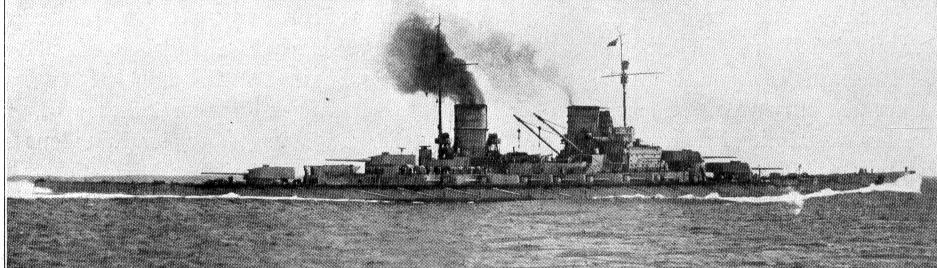
The German Derfflinger class BCs
Image
Pre Tri-pod, after they lost something...

http://www.sms-navy.com/bc/sms_bc_derfflinger.htm
I thought Roman candles meant they were imported. - Kelly Bundy
12 yards long, two lanes wide it's 65 tons of American pride, Canyonero! - Simpsons
Support the KKK environmental program - keep the Arctic white!
User avatar
Stuart Mackey
Drunken Kiwi Editor of the ASVS Press
Posts: 5946
Joined: 2002-07-04 12:28am
Location: New Zealand
Contact:

Post by Stuart Mackey »

Isolder74 wrote:
I know about the Washington Arms Treaty.

It still does not excuse the bad design of the ship. Also saying the French had two ships just like it does not help much either. Under the same Treaty the US seemed to manage to produce decent ships. Even under the limitations, there is no excuse for the terrible placement of the third turret. I wonder how much armor they'd have to give up to have placed higher then turret two. A turret positioned forward and too close to the turret in front of it to be used forward is a waste of it completely. Sure it has a larger broadside but I still have to wonder if they used dual turrets instead of triples if they'd have been able to have mounted the gun in a better position.

Also it is still the ugliest battleship design ever.
I think that you have to understand that the UK was broke at the time of the WNT, yet they needed to replace a huge tonnage of obsolete ships.
The UK was under pressure to get something in the water that would match the US/Japanese designs and maintain numerical parity with the US, so instead of designing a whole new ship, they adapted what they had. It was not ideal, what ship is, but it did the job and it cost less than the alternative of a whole new design, and it was available more or less immediately.
In hindsight, which is always 20/20, they should have started from a clean slate and got better vessels when their design teams were still available, but then what would have been the political impact of having less ships than the nearest competitor, the US, and how would the soon to arrive Great Depression affect the new design, suspended for years?, cancelled out right?
Via money Europe could become political in five years" "... the current communities should be completed by a Finance Common Market which would lead us to European economic unity. Only then would ... the mutual commitments make it fairly easy to produce the political union which is the goal"

Jean Omer Marie Gabriel Monnet
--------------
User avatar
Stuart Mackey
Drunken Kiwi Editor of the ASVS Press
Posts: 5946
Joined: 2002-07-04 12:28am
Location: New Zealand
Contact:

Post by Stuart Mackey »

CaptHawkeye wrote:
Read the post again. Nelson's 16 inch gun was hampered with performance issues Colorado's Mk 1s didn't suffer from. They were similar only in pure damage per hit.
What do you expect? the Brit triple 16's were a brand new design, probably rushed and obviously not well tested before introduction, whereas the US had been using triple main gun turrets for years, knew what they were doing, and had more money, to do a better job of it from the get go.
Via money Europe could become political in five years" "... the current communities should be completed by a Finance Common Market which would lead us to European economic unity. Only then would ... the mutual commitments make it fairly easy to produce the political union which is the goal"

Jean Omer Marie Gabriel Monnet
--------------
User avatar
Sidewinder
Sith Acolyte
Posts: 5466
Joined: 2005-05-18 10:23pm
Location: Feasting on those who fell in battle
Contact:

Post by Sidewinder »

CaptHawkeye wrote:Having "one more" 16 inch gun was pretty worthless for Nelson since all of its 16 inch guns had laughable performance which was only slightly above that of the british 15 inch. Even the slight firepower advantage they had was negated by their obscenely short barrel life and shitty accuracy. Compare this to Colorado's Mark 1 16 inch guns which had a more than 50% improvement in firepower over the previous 14 inch guns common on the other Standards.
This makes me wonder: is the ammo between the USN 16-inch gun and the RN 16-inch gun interchangeable? Or will firing a British 16-inch shell from an American 16-inch gun do more damage to the ship it's mounted on than to the target, and vice versa?
Please do not make Americans fight giant monsters.

Those gun nuts do not understand the meaning of "overkill," and will simply use weapon after weapon of mass destruction (WMD) until the monster is dead, or until they run out of weapons.

They have more WMD than there are monsters for us to fight. (More insanity here.)
User avatar
Fingolfin_Noldor
Emperor's Hand
Posts: 11834
Joined: 2006-05-15 10:36am
Location: At the Helm of the HAB Star Dreadnaught Star Fist

Post by Fingolfin_Noldor »

Sidewinder wrote:
CaptHawkeye wrote:Having "one more" 16 inch gun was pretty worthless for Nelson since all of its 16 inch guns had laughable performance which was only slightly above that of the british 15 inch. Even the slight firepower advantage they had was negated by their obscenely short barrel life and shitty accuracy. Compare this to Colorado's Mark 1 16 inch guns which had a more than 50% improvement in firepower over the previous 14 inch guns common on the other Standards.
This makes me wonder: is the ammo between the USN 16-inch gun and the RN 16-inch gun interchangeable? Or will firing a British 16-inch shell from an American 16-inch gun do more damage to the ship it's mounted on than to the target, and vice versa?
Probably not. There's the issue of propellant which was separate from the shell and the British barrels might not be able to handle the increased pressure. Also British shells are lighter if I am not wrong.
Image
STGOD: Byzantine Empire
Your spirit, diseased as it is, refuses to allow you to give up, no matter what threats you face... and whatever wreckage you leave behind you.
Kreia
User avatar
Stark
Emperor's Hand
Posts: 36169
Joined: 2002-07-03 09:56pm
Location: Brisbane, Australia

Post by Stark »

Stuart Mackey wrote: What do you expect? the Brit triple 16's were a brand new design, probably rushed and obviously not well tested before introduction, whereas the US had been using triple main gun turrets for years, knew what they were doing, and had more money, to do a better job of it from the get go.
They'd been able to rush the 15" into service before WW1, although doubtless much of that was luck.

And saying 'the US built better BBs under the Treaty' is wrong; the US built NO BB's under the treaty (well, barring the Colorados that were already begun). The SoDaks etc were all post 1936, after new construction was allowed post 1936. From my understanding, as ATG said the British were allowed to build two new BBs beyond what they had on hand, to match Colorado and Nagatos, but they had to be under 35,000t and the other treaty limits, so they scaled down an existing ~45,000t design to get them in the water as fast as they could. Aside from the terrible gun and the (arguably) low speed, they were fine for the time they were designed, just awful in WW2 before the KGVs were deployed. Let's chase the Bismarck at 23kt! OH NO SHE'S GETTING AWAY. :lol:
User avatar
Stuart Mackey
Drunken Kiwi Editor of the ASVS Press
Posts: 5946
Joined: 2002-07-04 12:28am
Location: New Zealand
Contact:

Post by Stuart Mackey »

Stark wrote:
Stuart Mackey wrote: What do you expect? the Brit triple 16's were a brand new design, probably rushed and obviously not well tested before introduction, whereas the US had been using triple main gun turrets for years, knew what they were doing, and had more money, to do a better job of it from the get go.
They'd been able to rush the 15" into service before WW1, although doubtless much of that was luck.

snip
The gun was, but they knew all about twin turrets, a base of knowledge and experience they could work from and apply. Another example was some of the issue they had with the quad 14's on the KGV's, another new system.
Via money Europe could become political in five years" "... the current communities should be completed by a Finance Common Market which would lead us to European economic unity. Only then would ... the mutual commitments make it fairly easy to produce the political union which is the goal"

Jean Omer Marie Gabriel Monnet
--------------
User avatar
Sea Skimmer
Yankee Capitalist Air Pirate
Posts: 37390
Joined: 2002-07-03 11:49pm
Location: Passchendaele City, HAB

Post by Sea Skimmer »

Stark wrote: Their low speed made them marginal units, though. I'm not sure, but I've read that the wheeling and dealing at the WNT allowed Britain to build two new ships, but that they were compelled somehow to be WW1-BB speed, rather than a useful modern speed (and the compulsion to the lightest possible machinery didn't help). 46,000hp for a battleship of 35,000t? Pffft.
The treaty did not limit speed in any way, but on 35,000 tons the British HAD to cut something from the G3 design, and it had to be speed. Unless you think 7in belt armor would be good enough for 1922 anyway.
Mere heavy cruisers had more, even at the time!
Umm, yeah, so? You know even the near 72,000 ton Yamato had less horsepower then some Japanese heavy cruisers of less then a forth her size. That just goes to show how expensive in power it is to increase ship speed. In fact the Japanese even had one DESTROYER which actually had more then half the power of Yamato (80,000shp vs. 150,000shp).
CaptHawkeye wrote: Having "one more" 16 inch gun was pretty worthless for Nelson since all of its 16 inch guns had laughable performance which was only slightly above that of the british 15 inch.
That one extra 16in gun didn’t cost any tonnage though, compared to the American ships inefficient four turret arrangement.

And Nelson having better protection than Colorado just isn't true. Colorado's armor is generally the same thickness, but has a much better layout, and is supplemented by better compartmentalization and one of the best torpedo defense systems ever devised.
Actually Nelson has way better deck armor, 3.75in on machinery, and 6.25 inches on her magazines, which is actually a thicker single deck then any of the later American fast battleships had (including Montana, which would have had a 6.2in main deck on 20,000 extra tons). When the angle is taken into account, Nelson also has equal or better belt armor. I cannot see how you can claim the American ship has a better layout, both ships are all or nothing, and the thinner Brit machinery armor is still in all reality just as good as what Colorado has anywhere.

Eventually after several upgrades all the way up through 1944 some Colorado’s had about 7in of amour over the magazines, about 4.5in over machinery, but this armor was a quilt of multiple thin layers added over the years, and thus far less effective then a single thick plate like Nelson had.

The American TDS was very good, but unfortunately it was still only designed against a 400lb charge of TNT, which was not strong enough even by 1922. The WW2 blistering helped, but not by much. British torpedo defense was poor, but not the worst around by any means, failure to provide diesel auxiliary power was a much more serious issue in terms of surviving underwater hits.
Last edited by Sea Skimmer on 2008-06-06 04:06am, edited 1 time in total.
"This cult of special forces is as sensible as to form a Royal Corps of Tree Climbers and say that no soldier who does not wear its green hat with a bunch of oak leaves stuck in it should be expected to climb a tree"
— Field Marshal William Slim 1956
User avatar
Sea Skimmer
Yankee Capitalist Air Pirate
Posts: 37390
Joined: 2002-07-03 11:49pm
Location: Passchendaele City, HAB

Post by Sea Skimmer »

They'd been able to rush the 15" into service before WW1, although doubtless much of that was luck.
The 15in twin was for the most part a direct scale up of the 13.5in twin, that’s the main reason rushing it into service worked. The 16in triple turret meanwhile was an all new concept, and the first turret of its size in the world, which was also required to be very lightweight. Not a good combination. It certainly helped that the US started with a smaller 14in triple turret.

Also note that the first US 14in triple turrets sucked. The things worked, but they had all guns are mounted in a single cradle, causing serious issues with splitting salvos and vulnerability to battle damage or breakdowns. The designs used one cradle specifically because it was too complicated and heavy for the time to design each gun with its own sleeve to independently elevate.

The poor performance of the 16in gun was directly related to flawed firing trials which led to the acceptance of an underweight shell. Heavier ammo was later proposed but not funded. None the less the guns and mountings proved accurate and reliable by the time WW2 rolled around.

And saying 'the US built better BBs under the Treaty' is wrong; the US built NO BB's under the treaty (well, barring the Colorados that were already begun). The SoDaks etc were all post 1936, after new construction was allowed post 1936.
Nope. The 35,000 ton limit remained in force during the design of the North Carolina and South Dakota Class. In fact the 14in gun limit was in effect for the design of North Carolinian too, and as laid down the ships would have had 14in quad turrets (the barbette diameter was specifically chosen to allow a swap with triple 16in turrets, which is what ultimately happened) The design of the Iowa was also actually treaty limited, abet under the 45,000 ton escalator clause invoked upon Japans withdrawal from the treaty system in 1937, the treaty system did not totally lapse until 1939 and the outbreak of war in Europe.

The only true post treaty design the US had was Montana.

Anyway everyone remember that in practice many of the differences between ships in basic raw specifications don’t matter, detail design features (like fire control, pumping arrangements), crew experience and similar factors are often more important factors in a battle and yet very difficult to compare. Even a poor battleship was still an extremely powerful weapon system if competently handled.
"This cult of special forces is as sensible as to form a Royal Corps of Tree Climbers and say that no soldier who does not wear its green hat with a bunch of oak leaves stuck in it should be expected to climb a tree"
— Field Marshal William Slim 1956
User avatar
Stark
Emperor's Hand
Posts: 36169
Joined: 2002-07-03 09:56pm
Location: Brisbane, Australia

Post by Stark »

Yeah, my language was bad; they built no BBs during the 'battleship holiday', but the 35k limit still applied (kinda, since even the KGVs were overweight apparently). Comparing Nelson to ships designed more than a decade later is still lame. :)
User avatar
CaptHawkeye
Sith Devotee
Posts: 2939
Joined: 2007-03-04 06:52pm
Location: Korea.

Post by CaptHawkeye »

Input is always welcome Skimmer. The Standards are difficult to find agreeing information on because they're pretty much the forgotten battleships and went through so many refits that you never know about what model you could be specifically reading about. :)
Best care anywhere.
User avatar
Vanas
Jedi Council Member
Posts: 1808
Joined: 2005-03-12 05:31pm
Location: Surfing the Moho
Contact:

Post by Vanas »

Still find it ironic that I really like the look of the Nelson and Rodney. Sure, they're not exactly the best, but certainly distinctive, and better looking than the George V class. Those quad turrets just don't do it for me.

And hey, at least firing a broadside didn't take the decking off. Unlike before the refit.

On a side note, while complaining about the quad turrets, I came across the French Richelieu, which looks pretty decent. No really good photos that I've seen though, just the ones on Wiki.
According to wikipedia, "the Mohorovičić discontinuity is the boundary between the Earth's crust and the mantle."
According to Starbound, it's a problem solvable with enough combat drugs to turn you into the Incredible Hulk.
User avatar
Sea Skimmer
Yankee Capitalist Air Pirate
Posts: 37390
Joined: 2002-07-03 11:49pm
Location: Passchendaele City, HAB

Post by Sea Skimmer »

The quads on Richelieu are interesting, the arrangement was calculated to weigh about 25% less then four twins during paper studies, and since the turret is divided in half by a 40mm armor bulkhead, the chances of losing the whole mount to one hit are reduced. However the mounts did suffer from dispersion problems, and delay circuits had to be installed postwar so that the guns would not fire quite simultaneously. Each gun did have its own cradle, a very nice feature.

However rate of fire was low, and in actuality the quad arrangement saved the French little weight. This was because of the center bulkhead, and because the French got concerned that one hit could jam both turrets (Bismarck actually had both fore turrets disabled by one 16in hit from those ‘poor’ guns on Rodney) and so they increased the spacing between the turrets beyond the minimal required. That meant that having both quad turrets grouped together actually didn’t end up saving much belt length. The French eventually realized this, and didn’t like the all forward arrangement anyway, so the fourth ship of the Richelieu class Gascogne would have switched to having a quad at each end of the superstructure. The third ship Clemenceau, which was laid down and reached a fairly advanced stage of construction, kept the main turrets forward, but it had a rearranged secondary battery.

Pic of Gascogne
http://base13.glasnet.ru/text/rich/2-8.gif

Interesting the ship was to use an enclosed quad 37mm turret, something which is pretty rare. Just about everyone else everywhere mounted automatic AA weapons in open mountings, except for the enclosed 25mm triples on the Yamato class.


The quads on Dunkerque also had problems BTW, the rate of fire was poor as well, they had dispersion problems, and each pair of guns was in a common cradle which meant the ship couldn’t solve its dispersion problems by simply firing alternating guns in alternating salvos. Still, ton for ton the Dunkerque class was an excellent ship in terms of speed, armor and firepower, unfortunately the ships didn’t have enough tons total to compete with real battleships.
CaptHawkeye wrote:Input is always welcome Skimmer. The Standards are difficult to find agreeing information on because they're pretty much the forgotten battleships and went through so many refits that you never know about what model you could be specifically reading about. :)
Friedman’s US battleships is very nice in this regard, it deals with each ship individual and documents many of the myriad uparmorings. In general the USN did try to upgrade ships of the same class at around the same time ot the same standards… but when it comes to the deck armor improvements all bets are off. If you want I oculd crack open the book later and give you a list of all the different armor layers they built up.
"This cult of special forces is as sensible as to form a Royal Corps of Tree Climbers and say that no soldier who does not wear its green hat with a bunch of oak leaves stuck in it should be expected to climb a tree"
— Field Marshal William Slim 1956
User avatar
atg
Jedi Master
Posts: 1418
Joined: 2005-04-20 09:23pm
Location: Adelaide, Australia

Post by atg »

Sea Skimmer wrote:The quads on Richelieu are interesting
I've heard that the French quad-15inch turrets were two dual 15-inch turrets joined together with a new shell, is this correct?

EDIT: That is to say basically joining them together rather than redesigning a whole new turret.
User avatar
Sea Skimmer
Yankee Capitalist Air Pirate
Posts: 37390
Joined: 2002-07-03 11:49pm
Location: Passchendaele City, HAB

Post by Sea Skimmer »

atg wrote: I've heard that the French quad-15inch turrets were two dual 15-inch turrets joined together with a new shell, is this correct?

EDIT: That is to say basically joining them together rather than redesigning a whole new turret.
It was all new. The internal arrangement and equipment fittings where similar to simply placing two twins side by side, but the mounting and the guns carried where developed entirely for the Richelieu class. France had never had an actual twin 15in turret design to start with.
"This cult of special forces is as sensible as to form a Royal Corps of Tree Climbers and say that no soldier who does not wear its green hat with a bunch of oak leaves stuck in it should be expected to climb a tree"
— Field Marshal William Slim 1956
User avatar
Siege
Sith Marauder
Posts: 4108
Joined: 2004-12-11 12:35pm

Post by Siege »

For some reason I've always liked the HNLMS De Zeven Provinciën

Image

Today's ship of the same name is all stealthed-up and stuff, but there's just something about that built-up superstructure that I prefer above the sleek lines of contemporary ships...
Image
SDN World 2: The North Frequesuan Trust
SDN World 3: The Sultanate of Egypt
SDN World 4: The United Solarian Sovereignty
SDN World 5: San Dorado
There'll be a bodycount, we're gonna watch it rise
The folks at CNN, they won't believe their eyes
Post Reply