I meant precisely what I stated and what is consensus amongst mainstream scholars. There is no evidence of Demic Diffusion of farming into the Nile Valley from the Middle East:Broomstick wrote: Did you even watch the videos you linked to? Keita specifically mentions domesticates such as goats coming from the Levant.
"Furthermore, the archaeology of northern Africa DOES NOT SUPPORT demic diffusion of farming from the Near East. The evidence presented by Wetterstrom indicates that early African farmers in the Fayum initially INCORPORATED Near Eastern domesticates INTO an INDIGENOUS foraging strategy, and only OVER TIME developed a dependence on horticulture. This is inconsistent with in-migrating farming settlers, who would have brought a more ABRUPT change in subsistence strategy. "The same archaeological pattern occurs west of Egypt, where domestic animals and, later, grains were GRADUALLY adopted after 8000 yr B.P. into the established pre-agricultural Capsian culture, present across the northern Sahara since 10,000 yr B.P. From this continuity, it has been argued that the pre-food-production Capsian peoples spoke languages ancestral to the Berber and/or Chadic branches of Afroasiatic, placing the proto-Afroasiatic period distinctly before 10,000 yr B.P."
Source: The Origins of Afroasiatic
Christopher Ehret, S. O. Y. Keita, Paul Newman;, and Peter Bellwood
Science 3 December 2004: Vol. 306. no. 5702, p. 1680
No one is denying that some domesticated livestock were incorporated into the Nile Valley. What you seem to be implying is that merely the incorporation of these animals is somehow evidence to place Middle Easterners into the Upper Nile Valley during Pre-Dynastic times. This is "reaching" at best and unfounded at worst. The same source that I presented earlier confirming the Upper Egyptian origins of Dynastic culture that you attempted to flip on me, clearly states Pre-Dynastic Lower Egypt through direct contact and trade with the Levant "filtered" ideas and goods further up the Nile Valley.It does not require an invasion of Levantine people in order for a cultural meme such as domestication of animals to spread to other groups. It doesn't make the Egyptians somehow less African to adopt a Levantine technology.
Again no one is denying that those traits came from the Levant, what has been dismissed by Keita and other scholars are that the idea that the incorporation of these animals into the already in place foraging system was the result of mass settlement. The fact that these words did not stem from Near Eastern languages is simply evidence of the latter, not that cultural exchange did not occur.Loan words are not always indicative of adoption of foreign technology or cultural memes.
Check the source above from Christopher Ehret. Just like in the article that I posted earlier on this page he states that Egypt's foraging system was already in place and entered the Nile through migration from people in various areas (namely the ancient Sahara) further south.This is possible but you have not provided proof of it.
Again no one is denying that Goat as well as other livestock did not filter into the Nile from the Levant. What I am arguing against are the implications made by you that this places Levantine people into the Upper Nile.There might well have been an indigenous tradition of domesticating animals, that doesn't prove domestic goats did not come from the Levant rather than Africa.
Keita points out that there aren't plentiful human sites in the Nile Valley prior to Dynastic Egypt.
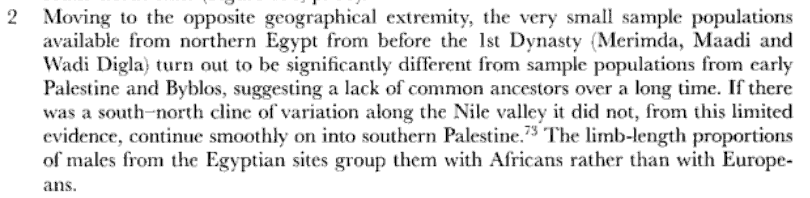
That is irrelevant to findings that he and just about every other anthropologist studying Egyptian remains have already made and have concluded about skeletal remains found in the region. As Mentuhotep has stated above Keita maintains that based on those skeletal remains the ancient Egyptians biologically resembled modern Horn African populations (which he states in the article that I posted on page one). If I'm not mistaking somewhere in either his literature or an email to a student he states that the ancient Egyptians would have been "Somali like" in appearance, based on their skeletal remains. In fact a French anthropologist actually made those comments in a study conducted in the early 90's:
"Black populations of the Horn of Africa (Tigré and Somalia) fit well into Egyptian variations." (Froment, Alain, Origines du peuplement de l’Égypte ancienne: l’apport de l’anthropobiologie, Archéo-Nil 2 (Octobre 1992), 79-98)
I agree that you MUST look at other lines of evidence before coming to a conclusion such as this. As you can see above however both genetic and linguistic evidence (as you note) are confirming a migration from the Horn, which only validate what we and Keita have been maintaining. Archaeological as well as linguistic evidence also points to Nilo-Saharan speakers from the Sahara combining with the Afro-Asiatic Horn Africans to create the heterogeneity that Keita stresses was the basis of Egypt's origin.That's why other means of studying history, like language study and genetics, have been developed. You can't always rely on the skeletal evidence because it is often so scanty.
North Africans are still Africans and they unquestionably contributed to Ancient Egypt. That doesn't mean they were in the majority numerically.
By North Africans do you mean the Maghreb? The Maghreb including parts of the Sahara and the Sahel which has already been noted as a major contributor to the original populating of the Nile. The article that I posted above by Christopher Ehret gives great examples of how these Nilo-Saharan speaking African populations contributed greatly to Egypt's origins. In fact I'll post a clip from Basil Davidson's documentary in which he further details the ancient Saharans:
No one denying that the Egyptians are African, I think the dispute is the proportion of southern vs. northern and indigenous vs. foreign influences.
There in my opinion is no dispute for the issues that you listed. The vast majority of Egypt's early population was Upper Egyptian in origin and it is Upper Egypt where the Dynastic culture has been confirmed to have originated.
The Indigenous aspects of Egypt are overwhelming and are considered African in origin by most contemporary scholars:
I presented the above earlier on this page:"What is truly unique about this state is the integration of rule over an extensive geographic region, in contrast to other contemporaneous Near Easter polities in Nubia, Mesopotamia, Palestine and the Levant. Present evidence suggests that the state which emerged by the First Dynasty had its roots in the Nagada culture of Upper Egypt, where grave types, pottery and artifacts demonstrate an evolution of form from the Predynastic to the First Dynasty, This cannot be demonstrated for the material culture of Lower Egypt, which was eventually displaced by that which originated in Upper Egypt. Hierarchical society with much social and economic differentiation, as symbolized in the Nagada II cemeteries of Upper Egypt, does not seem to have been present, then, in Lower Egypt, a fact which supports an Upper Egyptian origin for the unified state. Thus archaeological evidence cannot support earlier theories that the founders of Egyptian civilization were an invading Dynastic race from the east.."
"Egyptian contact in the 4th millennium B.C. with SW Asia is undeniable, but the effect of this contact on state formation is Egypt is less clear... The unified state which emerged in Egypt in the 3rd millenium B.C. however, was unlike the polities in Mesopotamia, the Levant, northern Syria, or Early Bronze Age Palestine- in sociopolitical organization, material culture, and belief system. There was undoubtedly heightened commercial contact with SW Asia in the 4th millennium B.C., but the Early Dynastic state which emerged in Egypt is unique and religious in character."(Bard, Kathryn A. 1994 The Egyptian Predynastic: A Review of the Evidence. Journal of Field Archaeology 21(3):265-288.)
"From Petrie onwards, it was regularly suggested that despite the evidence of Predynastic cultures, Egyptian civilization of the 1st Dynasty appeared suddenly and must therefore have been introduced by an invading foreign 'race'. Since the 1970s however, excavations at Abydos and Hierakonpolis have clearly demonstrated the indigenous, Upper Egyptian roots of early civilization in Egypt. (Ian Shaw ed. (2003) The Oxford History of Ancient Egypt By Ian Shaw. Oxford University Press, page 40-63)
I gave a link earlier that showed the similarities in ancient Egypt's religious beliefs and social customs and those of inner Africa.
This is where the “afro-centric” argument starts to look extreme, with a denial that there were and always have been non-African influences at work on Egypt.
I really take offense to anyone attempting to label me an "afro-centric" as it tends to be associated with negative "racist" connotations. I see nothing "afro-centric" at all about asserting the African origins or ancient Egypt, which has for centuries been fought tooth and nail against by truly and overtly "racist" individuals for obvious social and political reasons. Below is what Keita noted about such labeling when it comes to this subject:
"It is not a question of "African" "influence"; ancient Egypt was organically African. Studying early Egypt in its African context is not "Afrocentric," but simply correct"-Keita
Check my source above or the one below:Well, sir, if it's indeed a recent finding it may be I was unaware of it. Please provide a cite for that, if you have not already done so (occasionally the thread gets ahead of my replies).
Gene Study Traces Cattle Herding in Africa, by Ben Harder, National Geographic News, April 11, 2002, retrieved April 7, 2008 from
http://news.nationalgeographic.com/news ... attle.html
Brief excerpt:
"But new evidence, reported in the April 12 issue of the journal Science, suggests that Africans independently domesticated cattle.
Belgian geneticist Olivier Hanotte, who headed the new study, said the research "reconciles the two schools of thought" about how cattle domestication occurred in Africa.
"There were Near Eastern influences" on African herds, he said, "but they came after local domestication."
Since then, there has been considerable mixing of African and Asian breeds
Well what I got from your statement was that through the fact that all non African descend from Northeast Africans and for that reason resemble Northeast Africans in some biological aspects that it created some superficial relationship between the Egyptians (who are Northeast Africans) and non Africans. The only way in which I can think of off the top of my head in which non Africans are closer to Northeast Africans than other Africans are is crania morphology. Yet as you noted above relying on this practice alone is not enough to come to such a conclusion. Therefore I referred to an unpresented genetic study of Africans in which it refutes such a notion that Northeast Africans are closer to non Africans than other Africans.OK, let's take this one more time, just a bit slower. A bit of data like “non-Africans are more closely related to Egyptians than to all other Africans” does not negate another bit of data like “Egyptians are African” or even “Egyptians are more closely related to other Africans than to non-Africans”. Saying my cousin is more closely related to me than, oh, the current Emperor of Japan in no way negates that my sister is more closely related to me than my cousin.
One would expect some gene flow from Egypt to the Middle East just given geography.
With gene flow from the Middle East or a foreign area in general comes a biological affinity towards the population from which it's coming from. So far I have come across no evidence that earlier Egyptian biological affinity lies with Middle Eastern populations. I have only come across empirical evidence that both Northern and Southern Egyptians were indigenous tropically adapted African populations.
Not necessarily! Modern Upper Egyptians (such as the man in the video that I posted earlier) while they along with some Lower Nubian populations have absorbed somewhat substantial gene flow from the Near East and Europe over time are still primarily African genetically and group with other African populations before they do non Africans.it makes sense that the genetics would reflect that, with Egyptians showing a closer relationship to non-Africans than any other Africans.
Northern Egyptians on the other hand have received the brunt of every European and Asian migration or invasion into the Nile Valley, and for this reason Keita and others find that out of the two they are the least likely to resemble their early Egyptian ancestors. They as you noted above do tend to group genetically and craniometrically with non African populations.
How so? If Upper Egyptian culture from which Dynastic Egyptian culture came is confirmed to be "indigenous" (meaning locally African) then how would the "other influences" which you indicate as being "foreign" to Africa and Egypt make them "distinctly Egyptian"?Those other influences are part of what make them distinctly Egyptian.
It's Nationalism no doubt! The same way that modern Greeks and Romans tend to view their ancient heritage as Greek and Roman rather than European as some others seem to get worked up over when they aren't included collectively.The Ancient Egyptians themselves seemed pretty comfortable with all that, it's various modern people who seem to get their panties in a twist over it.
Good point!and proximity to Europe it would be odd if there wasn't some mixing going on, but you could just as easily argue that North Africa influenced southern Europe as much as vice versa.
Because you consistently deny the contributions of those who did not originate south of Egypt in making up what we know as Dynastic Egypt. Again, those other groups don't ever have to be a majority by numbers to have a significant impact.
The problem that I have with this assertion on your behalf is that you have presented no evidence biological evidence even suggesting that they were present in Pre-Dynastic Upper Egypt. You seem to base your belief that they were somehow in Upper Egypt on the presence of goats in the Nile Valley and nothing more than speculation beyond that. There is no cold hard evidence for your claim.