I have nothing further to add. I think the convention's delegates did my job quite well enough one hundred fifty years ago.A Declaration of the Immediate Causes which Induce and Justify the Secession of the State of Mississippi from the Federal Union.
In the momentous step which our State has taken of dissolving its connection with the government of which we so long formed a part, it is but just that we should declare the prominent reasons which have induced our course.
Our position is thoroughly identified with the institution of slavery-- the greatest material interest of the world. Its labor supplies the product which constitutes by far the largest and most important portions of commerce of the earth. These products are peculiar to the climate verging on the tropical regions, and by an imperious law of nature, none but the black race can bear exposure to the tropical sun. These products have become necessities of the world, and a blow at slavery is a blow at commerce and civilization. That blow has been long aimed at the institution, and was at the point of reaching its consummation. There was no choice left us but submission to the mandates of abolition, or a dissolution of the Union, whose principles had been subverted to work out our ruin.
That we do not overstate the dangers to our institution, a reference to a few facts will sufficiently prove.
The hostility to this institution commenced before the adoption of the Constitution, and was manifested in the well-known Ordinance of 1787, in regard to the Northwestern Territory.
The feeling increased, until, in 1819-20, it deprived the South of more than half the vast territory acquired from France.
The same hostility dismembered Texas and seized upon all the territory acquired from Mexico.
It has grown until it denies the right of property in slaves, and refuses protection to that right on the high seas, in the Territories, and wherever the government of the United States had jurisdiction.
It refuses the admission of new slave States into the Union, and seeks to extinguish it by confining it within its present limits, denying the power of expansion.
It tramples the original equality of the South under foot.
It has nullified the Fugitive Slave Law in almost every free State in the Union, and has utterly broken the compact which our fathers pledged their faith to maintain.
It advocates negro equality, socially and politically, and promotes insurrection and incendiarism in our midst.
It has enlisted its press, its pulpit and its schools against us, until the whole popular mind of the North is excited and inflamed with prejudice.
It has made combinations and formed associations to carry out its schemes of emancipation in the States and wherever else slavery exists.
It seeks not to elevate or to support the slave, but to destroy his present condition without providing a better.
It has invaded a State, and invested with the honors of martyrdom the wretch whose purpose was to apply flames to our dwellings, and the weapons of destruction to our lives.
It has broken every compact into which it has entered for our security.
It has given indubitable evidence of its design to ruin our agriculture, to prostrate our industrial pursuits and to destroy our social system.
It knows no relenting or hesitation in its purposes; it stops not in its march of aggression, and leaves us no room to hope for cessation or for pause.
It has recently obtained control of the Government, by the prosecution of its unhallowed schemes, and destroyed the last expectation of living together in friendship and brotherhood.
Utter subjugation awaits us in the Union, if we should consent longer to remain in it. It is not a matter of choice, but of necessity. We must either submit to degradation, and to the loss of property worth four billions of money, or we must secede from the Union framed by our fathers, to secure this as well as every other species of property. For far less cause than this, our fathers separated from the Crown of England.
Our decision is made. We follow their footsteps. We embrace the alternative of separation; and for the reasons here stated, we resolve to maintain our rights with the full consciousness of the justice of our course, and the undoubting belief of our ability to maintain it.
The Civil War at 150: Mississippi Secession
Moderator: K. A. Pital
-
Rogue 9

- Scrapping TIEs since 1997
- Posts: 18644
- Joined: 2003-11-12 01:10pm
- Location: Classified
- Contact:
The Civil War at 150: Mississippi Secession
On this date in 1861, the state of Mississippi declared its secession from the United States, part of the inexorable buildup to the American Civil War. Today, there are Mississippians who are celebrating that fateful decision. For myself, I will simply let those who made the decision to secede speak for themselves. To that end, I present the full, unabridged Declaration of Causes from the Mississippi secession convention.
It's Rogue, not Rouge!
HAB | KotL | VRWC/ELC/CDA | TRotR | The Anti-Confederate | Sluggite | Gamer | Blogger | Staff Reporter | Student | Musician
HAB | KotL | VRWC/ELC/CDA | TRotR | The Anti-Confederate | Sluggite | Gamer | Blogger | Staff Reporter | Student | Musician
-
Rogue 9
- Scrapping TIEs since 1997
- Posts: 18644
- Joined: 2003-11-12 01:10pm
- Location: Classified
- Contact:
The Civil War at 150: The Star of the West
Rather than make a second thread, I will add a post to this one.
On this date in 1861, the unarmed steamship Star of the West, transporting troops and supplies for the garrison of Fort Sumter, was fired on from the Morris Island battery by cadets from the Citadel. She turned back from the harbor mouth after the first warning shot across her bow, but the batteries continued to fire, scoring three hits against the fleeing vessel before she got out of range. These are widely recognized as the first shots of the American Civil War, though the shelling of Fort Sumter itself is more famous.
On this date in 1861, the unarmed steamship Star of the West, transporting troops and supplies for the garrison of Fort Sumter, was fired on from the Morris Island battery by cadets from the Citadel. She turned back from the harbor mouth after the first warning shot across her bow, but the batteries continued to fire, scoring three hits against the fleeing vessel before she got out of range. These are widely recognized as the first shots of the American Civil War, though the shelling of Fort Sumter itself is more famous.
It's Rogue, not Rouge!
HAB | KotL | VRWC/ELC/CDA | TRotR | The Anti-Confederate | Sluggite | Gamer | Blogger | Staff Reporter | Student | Musician
HAB | KotL | VRWC/ELC/CDA | TRotR | The Anti-Confederate | Sluggite | Gamer | Blogger | Staff Reporter | Student | Musician

Re: The Civil War at 150: Mississippi Secession
Damn...how can anyone think the secession happened because of "states rights" after reading that declaration? It's as blatant as possible, ranting about slavery at length...

It suddenly struck me that that tiny pea, pretty and blue, was the Earth. I put up my thumb and shut one eye, and my thumb blotted out the planet Earth. I didn't feel like a giant. I felt very, very small.
- NEIL ARMSTRONG, MISSION COMMANDER, APOLLO 11
Signature dedicated to the greatest achievement of mankind.
MILDLY DERANGED PHYSICIST does not mind BREAKING the SOUND BARRIER, because it is INSURED. - Simon_Jester considering the problems of hypersonic flight for Team L.A.M.E.

Re: The Civil War at 150: Mississippi Secession
I once debated a Southern Apologists and upon linking him to the individual declarations of secession that mentioned slavery explicitely as a reason he said "That proves absolutely nothing". How can one repel denial of such magnitude? And that's when they bother to acknowledge those declarations and not just ignore them wholesale.
People at birth are naturally good. Their natures are similar, but their habits make them different from each other.
-Sanzi Jing (Three Character Classic)
Saddam’s crime was so bad we literally spent decades looking for our dropped monocles before we could harumph up the gumption to address it
-User Indigo Jump on Pharyngula
O God, please don't let me die today, tomorrow would be so much better!
-Traditional Spathi morning prayer
-Sanzi Jing (Three Character Classic)
Saddam’s crime was so bad we literally spent decades looking for our dropped monocles before we could harumph up the gumption to address it
-User Indigo Jump on Pharyngula
O God, please don't let me die today, tomorrow would be so much better!
-Traditional Spathi morning prayer
Re: The Civil War at 150: Mississippi Secession
I actually find this a strange cause to go to war: did southerners in general really feel this strongly about the issue of slavery? I know American politics can get extreme sometimes (hopefully they'll never get THIS extreme again  ), but one would think secession would require popular support as well as legislative will.
I suppose the fact most voters in the South were slave owners had something to do with it, when they perceived their livelihood to be threatened (the declaration even mentions that they fear for their economy). Were the southern armies generally composed of eglible voters, though? How was their morale?
), but one would think secession would require popular support as well as legislative will.I suppose the fact most voters in the South were slave owners had something to do with it, when they perceived their livelihood to be threatened (the declaration even mentions that they fear for their economy). Were the southern armies generally composed of eglible voters, though? How was their morale?
It suddenly struck me that that tiny pea, pretty and blue, was the Earth. I put up my thumb and shut one eye, and my thumb blotted out the planet Earth. I didn't feel like a giant. I felt very, very small.
- NEIL ARMSTRONG, MISSION COMMANDER, APOLLO 11
Signature dedicated to the greatest achievement of mankind.
MILDLY DERANGED PHYSICIST does not mind BREAKING the SOUND BARRIER, because it is INSURED. - Simon_Jester considering the problems of hypersonic flight for Team L.A.M.E.
-
Simon_Jester
- Emperor's Hand
- Posts: 30165
- Joined: 2009-05-23 07:29pm
Re: The Civil War at 150: Mississippi Secession
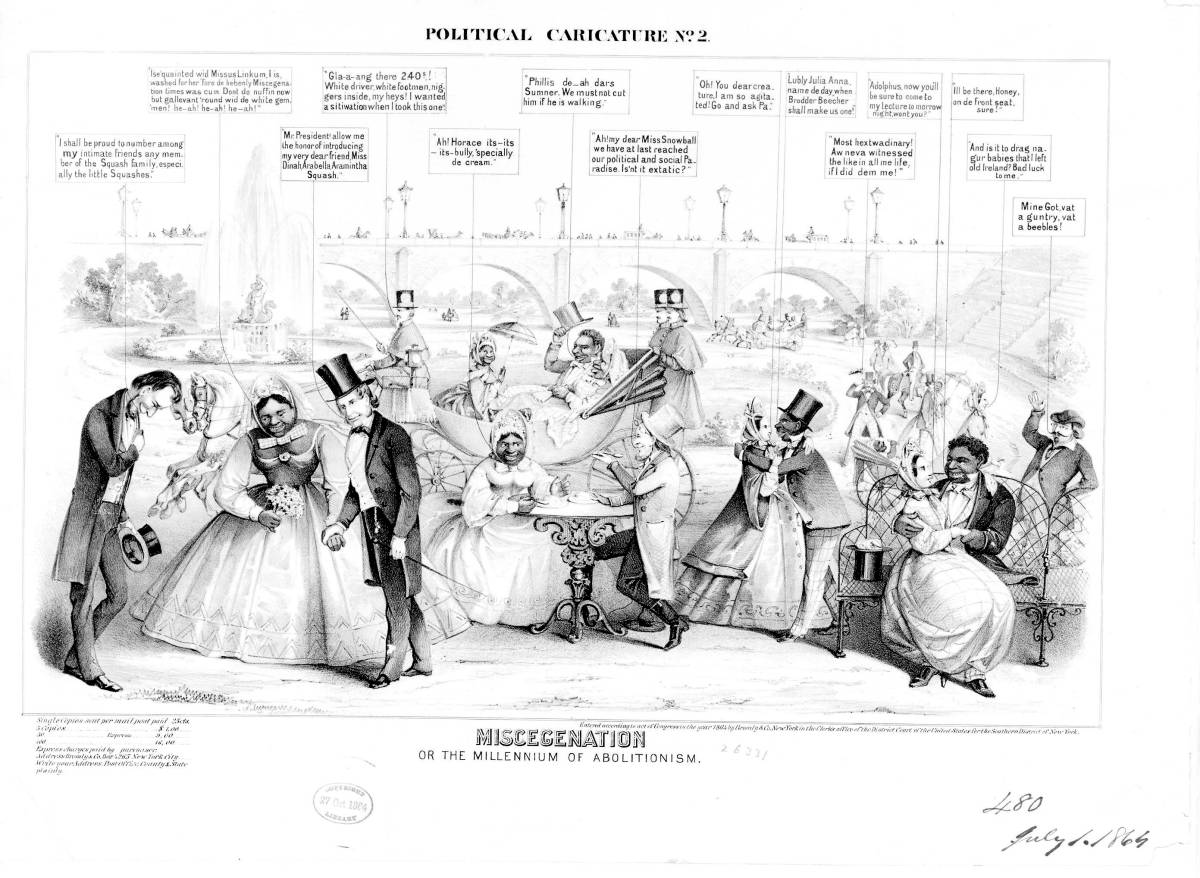
The issues of slavery and race in general were seen as closely tied in that era: abolitionists were often accused of favoring, well, equality between the races. See, for instance, this political cartoon (too large for me to want to post it in-line):
http://elections.harpweek.com/1864/cart ... ion12w.jpg
And since the idea of racial equality really bothered a lot of whites (not just in the south, either), support for slavery was strengthened by this fear of black people participating in a post-abolition society on equal terms.
http://elections.harpweek.com/1864/cart ... ion12w.jpg
And since the idea of racial equality really bothered a lot of whites (not just in the south, either), support for slavery was strengthened by this fear of black people participating in a post-abolition society on equal terms.
This space dedicated to Vasily Arkhipov

Re: The Civil War at 150: Mississippi Secession
Pretty much. I'll talk about this more below.PeZook wrote:I actually find this a strange cause to go to war: did southerners in general really feel this strongly about the issue of slavery?
I'm pretty sure that's not true. Looking at wikipedia's article on the election (too lazy to get a real source), approximately 840,000 people cast ballots in the states that seceded (including West Virginia but not including South Carolina). As an aside, that's about equal to the number of votes Breckenridge, the Southern Democrat, got, which totals about 18% of the vote. Anyway, discounting slaves, the population of the Confederate states was about 5.5 million. Halved (assuming it wasn't already) to account for women not being able to vote, that would mean about thirty percent of the male white population of the South voted in 1860.I suppose the fact most voters in the South were slave owners had something to do with it
By comparison, the "North" had a population of roughly 22 million. So, even if every vote in 1860 were cast in those states, only about 42% of the male population voted. This, it should be noted, does not take into account slaves in the border states, which I assume were counted for that tally. And, of course, this makes no effort to account for things like people not being old enough to vote.
So, even if just half of that 840,000 were slave owners, there would only be an average 6 slaves per owner, which doesn't strike me as particularly viable, given the use of slaves as a labor force on plantations.
Still, I don't think it's a coincidence that the one state that still let the legislature pick its electors was also the first to secede and always the most insanely pro-slavery of them all.
Southerners who fought seem to have generally perceived themselves as defending their homeland from aggressors (I remember some quotes in a thread here awhile back warning of the North's "abolitionist host" coming to rape and pillage). Slavery was inextricably wedded to Southern society, so any threat to slavery (however illusory it was, as in the case of 1860) was a threat to the Southern way of life. It would be overly simplistic, though not entirely unjustified, to portray Confederate armies as great mobs of impoverished, uneducated "white trash" (it's interesting that Grant states in his autobiography several times that this pretty much encompassed all working class whites) tricked into fighting for the interests of the wealthy. Still, the people who owned slaves were invariably the politicians who held power before the war and ultimately ratified the secession.when they perceived their livelihood to be threatened (the declaration even mentions that they fear for their economy). Were the southern armies generally composed of eligible voters, though? How was their morale?
Generally, yes, the armies were made up of eligible voters (since, I'm pretty sure, most white men could vote since the Jacksonian era), though quite a substantial number were probably underage teenagers. Returning back to Grant's autobiography, he generally recognizes that Confederate armies had superb morale, trending toward a tendency for boldness and impetuosity in battles that, as time went on, could be worn down and cracked by superior Union discipline and determination.
"He may look like an idiot and talk like an idiot, but don't let that fool you. He really is an idiot."
"Carpe diem, quam minimum credula postero."
"Carpe diem, quam minimum credula postero."
Re: The Civil War at 150: Mississippi Secession
Keegan, in "The American Civil War", states outright that the majority of Southerners owned no slaves at all. And most owners only owned one or two as a helper.
It was only a small minority of people in the South (who were also often the local leaders) who owned entire plantations which required hundreds of slaves. There was also a "middle class" of white slave "managers" who served as the intermediary between the owners and the slaves.
That being said, Keegan also notes that the Southern, slave-owning aristocracy persistently depicted an image that the only way to get rich was to own more slaves. Leading the rest of the population to believe that abolishing slavery will mean taking away their only hope at becoming rich short of moving to the north with the yankees.
It was only a small minority of people in the South (who were also often the local leaders) who owned entire plantations which required hundreds of slaves. There was also a "middle class" of white slave "managers" who served as the intermediary between the owners and the slaves.
That being said, Keegan also notes that the Southern, slave-owning aristocracy persistently depicted an image that the only way to get rich was to own more slaves. Leading the rest of the population to believe that abolishing slavery will mean taking away their only hope at becoming rich short of moving to the north with the yankees.
-
Patrick Degan

- Emperor's Hand
- Posts: 14847
- Joined: 2002-07-15 08:06am
- Location: Orleanian in exile
Re: The Civil War at 150: Mississippi Secession
The times change, the details change, but the tactics of the plutocracy remain essentially the same. In our time, it's tax cuts for the rich instead of slavery the bulk of the population have been bilked into supporting as "their only hope" of riches. Same with the shape of the fears inculcated into the common citizenry: Swap "socialist" for "yankee" and "welfare state, etc..." for "miscegenation" and there is no fundamental difference —it's still conservatives waging class warfare upon the rest of society, as they have been doing since the time of Calhoun, with the common yokels conned into always acting against their own interests.Zinegata wrote:Keegan, in "The American Civil War", states outright that the majority of Southerners owned no slaves at all. And most owners only owned one or two as a helper.
It was only a small minority of people in the South (who were also often the local leaders) who owned entire plantations which required hundreds of slaves. There was also a "middle class" of white slave "managers" who served as the intermediary between the owners and the slaves.
That being said, Keegan also notes that the Southern, slave-owning aristocracy persistently depicted an image that the only way to get rich was to own more slaves. Leading the rest of the population to believe that abolishing slavery will mean taking away their only hope at becoming rich short of moving to the north with the yankees.
When ballots have fairly and constitutionally decided, there can be no successful appeal back to bullets.
—Abraham Lincoln
People pray so that God won't crush them like bugs.
—Dr. Gregory House
Oil an emergency?! It's about time, Brigadier, that the leaders of this planet of yours realised that to remain dependent upon a mineral slime simply doesn't make sense.
—The Doctor "Terror Of The Zygons" (1975)
—Abraham Lincoln
People pray so that God won't crush them like bugs.
—Dr. Gregory House
Oil an emergency?! It's about time, Brigadier, that the leaders of this planet of yours realised that to remain dependent upon a mineral slime simply doesn't make sense.
—The Doctor "Terror Of The Zygons" (1975)

Re: The Civil War at 150: Mississippi Secession
Interesting document, and certainly puts to rest any arguments about erosion of 'states rights' being the primary justification for secession. Still, taken from the point of view of a wealthy cultures and legal owner of slaves of the time, all the causes noted seem both reasonable and justified.
In today's atmosphere of political correctness though, slavery is seen as such a horrendous evil that a bit of denial in those proud of their history and culture (even if not of the institution or its related bigotry) is easily understood.
The degree to which slavery is currently regarded (at least in the west) as such an absolute and self-evident wrong though, does give me some pause, considering the institution's lengthy and almost universal acceptance in the past.
The fact that freedom (defined as non-slave) has only come to be regarded (by some) and an unquestionably inalienable right in the past 1 or 2 percent of human history makes me wonder if its not more of a recent fad than a natural state.
In today's atmosphere of political correctness though, slavery is seen as such a horrendous evil that a bit of denial in those proud of their history and culture (even if not of the institution or its related bigotry) is easily understood.
The degree to which slavery is currently regarded (at least in the west) as such an absolute and self-evident wrong though, does give me some pause, considering the institution's lengthy and almost universal acceptance in the past.
The fact that freedom (defined as non-slave) has only come to be regarded (by some) and an unquestionably inalienable right in the past 1 or 2 percent of human history makes me wonder if its not more of a recent fad than a natural state.
"Those who cannot defend their freedom are not truly free.
At best they are merely fortunate."
At best they are merely fortunate."

Re: The Civil War at 150: Mississippi Secession
You know as a German, I can be proud of some of Germany's history, while at the same time condemning other parts of Germany's history. I do not need to whitewash parts of that history in order to be proud of our history and culture. In fact, how Germans and Germany has handled its responsibility for horrendous evil in the past can in itself be a cause for being proud of our (current) culture.In today's atmosphere of political correctness though, slavery is seen as such a horrendous evil that a bit of denial in those proud of their history and culture (even if not of the institution or its related bigotry) is easily understood.
If we would deny our history (like many do in the former CSA), it would make me less proud and even shameful of our (current) culture.
As for the change in perception of the acceptability of slavery, it doesn't make me question that acceptability (which you do by describing it as a "fad"), but rather make me proud that we - as almost the whole of humanity - have made progress.
Re: The Civil War at 150: Mississippi Secession
But one should also remember that the type and form in which slavery functioned has varied significantly over time. People remember slavery in its most recent form, with all its dehumanizing brutality and racist undercurrents.Gurachn wrote:The degree to which slavery is currently regarded (at least in the west) as such an absolute and self-evident wrong though, does give me some pause, considering the institution's lengthy and almost universal acceptance in the past.
"He may look like an idiot and talk like an idiot, but don't let that fool you. He really is an idiot."
"Carpe diem, quam minimum credula postero."
"Carpe diem, quam minimum credula postero."

Re: The Civil War at 150: Mississippi Secession
The war was not nearly as popular among the lower classes of Confederate society as it was among the slave owners. Even though West Virginia was the only part of the Confederacy to successfully secede from it, parts of northern Alabama, western Tennessee, northern Georgia, and other areas in the mountainous regions of the CSA all wanted to secede as well (they were usually violently quashed and had a lot of men forcibly conscripted), but they never got a charismatic leader to force the issue, nor any real unified attempts. It was all local and most people went up to hide in the mountains.PeZook wrote:I suppose the fact most voters in the South were slave owners had something to do with it, when they perceived their livelihood to be threatened (the declaration even mentions that they fear for their economy). Were the southern armies generally composed of eglible voters, though? How was their morale?
There are a few other things I'd mention, but I don't have the book on me that I'd like to cite about it, however, it did mention things like Sherman's army having to turn away Southern volunteers because his ranks were so full, his army getting fed by the locals (who did so willingly), and other similar situations.
SDNet: Unbelievable levels of pedantry that you can't find anywhere else on the Internet!
-
Isolder74

- Official SD.Net Ace of Cakes
- Posts: 6762
- Joined: 2002-07-10 01:16am
- Location: Weber State of Construction University
- Contact:
Re: The Civil War at 150: Mississippi Secession
Indeed what the 3/5 Compromise did was unfairly inflate the power of the slave holder over that of someone who doesn't. The ones most interested in perpetuating the institution of slavery were those who had hundreds of slaves under their control. To put it in perspective, if someone owned 100 slaves that meant that their voice in the political arena equals 60.6 people who aren't slave holders. That is quite a bit of extra power for one of them and means any part of the state not featuring any plantations will have a much smaller voice in that's state's legislature.
One of the problems that the South was facing in the lead up to the Civil War was the fact that the population of the North was quickly outpacing theirs even with the compromise. Many of the political fights and debates in this period were about keeping the Senate 50/50 slave/free to try and limit the growing power in the House of the growing population of the North.
It's telling that one reason that they rushed to succession included the fact that with Lincoln elected they no longer would have the Executive in their pocket to block any anti-slavery legislation. Whether or not that fear was justified or not.
One of the problems that the South was facing in the lead up to the Civil War was the fact that the population of the North was quickly outpacing theirs even with the compromise. Many of the political fights and debates in this period were about keeping the Senate 50/50 slave/free to try and limit the growing power in the House of the growing population of the North.
It's telling that one reason that they rushed to succession included the fact that with Lincoln elected they no longer would have the Executive in their pocket to block any anti-slavery legislation. Whether or not that fear was justified or not.
Hapan Battle Dragons Rule!
When you want peace prepare for war! --Confusious
That was disapointing ..Should we show this Federation how to build a ship so we may have worthy foes? Typhonis 1
The Prince of The Writer's Guild|HAB Spacewolf Tank General| God Bless America!
When you want peace prepare for war! --Confusious
That was disapointing ..Should we show this Federation how to build a ship so we may have worthy foes? Typhonis 1
The Prince of The Writer's Guild|HAB Spacewolf Tank General| God Bless America!
Re: The Civil War at 150: Mississippi Secession
On a somewhat related note to the Civil War, is it true that the South planned to expand into Central America assuming they'd manage to hold onto their independence?
What can change the nature of Man?
-Ravel Puzzlewel, Planescape: Torment
-Ravel Puzzlewel, Planescape: Torment
-
Isolder74
- Official SD.Net Ace of Cakes
- Posts: 6762
- Joined: 2002-07-10 01:16am
- Location: Weber State of Construction University
- Contact:
Re: The Civil War at 150: Mississippi Secession
Well based on the Constitution of the CSA it indicated that any land new or current land would be considered slave territory and it was fielded as a goal by some high up in the Confederacy to invade Mexico.Talhe wrote:On a somewhat related note to the Civil War, is it true that the South planned to expand into Central America assuming they'd manage to hold onto their independence?
So it is possible that would have been a future goal. The thing with an economy based on the cash crops of Tobacco and Cotton is that they deplete the land making it necessary to carefully rotate crops or move to a new land to continue ranking in the money from then as the land dwindles in productivity.
Hence why George Washington Carver and peanuts and soybeans, and his research into products making them highly profitable, was so important for Southern farming.
Hapan Battle Dragons Rule!
When you want peace prepare for war! --Confusious
That was disapointing ..Should we show this Federation how to build a ship so we may have worthy foes? Typhonis 1
The Prince of The Writer's Guild|HAB Spacewolf Tank General| God Bless America!
When you want peace prepare for war! --Confusious
That was disapointing ..Should we show this Federation how to build a ship so we may have worthy foes? Typhonis 1
The Prince of The Writer's Guild|HAB Spacewolf Tank General| God Bless America!
-
CaiusWickersham
- Padawan Learner
- Posts: 301
- Joined: 2008-10-11 08:24am
Re: The Civil War at 150: Mississippi Secession
While I don't deny that slavery was an issue in the lead-up to the Civil War, I will say it was really an issue that framed what was the larger concern of the southern states at the time -- the increasing power of the federal government under the influence of northern states with an eye towards abolition.
Look at the 4th through 11th statements in the Declaration Rogue9 posted. It's not just "Slavery, fuck yeah!" it's "We know slavery was a hot button topic since the beginning and now we're seeing Congress taking steps against it and, at the same time, marginalizing our ability to weigh in on the measures being taken."
Congress had precedent for ending slavery by legislation since 1819 and the south was scared to death of Congress possibly doing that and they would be powerless to stop it. When the slave states were on equal footing with free states, this could be postponed. But as the northern states increased in number and population, the south realized the end of slavery was inevitable.
While there were certainly some who felt this was just something the south would have to accept and should begin to adapt to, there were also others who adopted an intellectual fad that the states were somehow supreme to the federal government. These were oftentimes the most vocal in the conversation and helped lead to the ruin we had.
I'm not saying you're wrong, I'm saying there's more background information that feeds into what inspired the south to rebel than just someone looked at the institution of slavery funny in 1860. It was being looked at funny since 1776 and maybe even earlier and those whose livelihoods were too bound to it for them to easily change finally got desperate enough to try violence to preserve it.
Look at the 4th through 11th statements in the Declaration Rogue9 posted. It's not just "Slavery, fuck yeah!" it's "We know slavery was a hot button topic since the beginning and now we're seeing Congress taking steps against it and, at the same time, marginalizing our ability to weigh in on the measures being taken."
Congress had precedent for ending slavery by legislation since 1819 and the south was scared to death of Congress possibly doing that and they would be powerless to stop it. When the slave states were on equal footing with free states, this could be postponed. But as the northern states increased in number and population, the south realized the end of slavery was inevitable.
While there were certainly some who felt this was just something the south would have to accept and should begin to adapt to, there were also others who adopted an intellectual fad that the states were somehow supreme to the federal government. These were oftentimes the most vocal in the conversation and helped lead to the ruin we had.
I'm not saying you're wrong, I'm saying there's more background information that feeds into what inspired the south to rebel than just someone looked at the institution of slavery funny in 1860. It was being looked at funny since 1776 and maybe even earlier and those whose livelihoods were too bound to it for them to easily change finally got desperate enough to try violence to preserve it.
-
Rogue 9
- Scrapping TIEs since 1997
- Posts: 18644
- Joined: 2003-11-12 01:10pm
- Location: Classified
- Contact:
Re: The Civil War at 150: Mississippi Secession
Which is a hypocritical gripe at the very best; Southern majorities in Congress acted ruthlessly to expand federal power and use it to advance slaveholding interests whenever they could do so. The Fugitive Slave Act, as well as later expansions of the powers it granted to the federal head (and denied to the free states) stands as stark testimony to that.
It's Rogue, not Rouge!
HAB | KotL | VRWC/ELC/CDA | TRotR | The Anti-Confederate | Sluggite | Gamer | Blogger | Staff Reporter | Student | Musician
HAB | KotL | VRWC/ELC/CDA | TRotR | The Anti-Confederate | Sluggite | Gamer | Blogger | Staff Reporter | Student | Musician
-
Isolder74
- Official SD.Net Ace of Cakes
- Posts: 6762
- Joined: 2002-07-10 01:16am
- Location: Weber State of Construction University
- Contact:
Re: The Civil War at 150: Mississippi Secession
Indeed. As far as it seems the only reason that they opted for secession at all was their paranoia that those laws they forced into being created could possibly be overturned and the simple fact that they no longer have a yes man in the White House to Veto any of them on demand.
So they are only for the subject of States Rights only when demanding those States Rights be preserved benefits their own political agenda. The moment they feel they might have any of that power taken away they threaten secession. Every single time.
The very definition of Hypocrisy.
So they are only for the subject of States Rights only when demanding those States Rights be preserved benefits their own political agenda. The moment they feel they might have any of that power taken away they threaten secession. Every single time.
The very definition of Hypocrisy.
Hapan Battle Dragons Rule!
When you want peace prepare for war! --Confusious
That was disapointing ..Should we show this Federation how to build a ship so we may have worthy foes? Typhonis 1
The Prince of The Writer's Guild|HAB Spacewolf Tank General| God Bless America!
When you want peace prepare for war! --Confusious
That was disapointing ..Should we show this Federation how to build a ship so we may have worthy foes? Typhonis 1
The Prince of The Writer's Guild|HAB Spacewolf Tank General| God Bless America!
Re: The Civil War at 150: Mississippi Secession
I seriously doubt there was any major plans actually formulated, given they never actually got beyond winning their independence. That said, there were antebellum attempts to seize control of Central American states by Southern mercenaries/adventurers.Talhe wrote:On a somewhat related note to the Civil War, is it true that the South planned to expand into Central America assuming they'd manage to hold onto their independence?
"He may look like an idiot and talk like an idiot, but don't let that fool you. He really is an idiot."
"Carpe diem, quam minimum credula postero."
"Carpe diem, quam minimum credula postero."
Re: The Civil War at 150: Mississippi Secession
Keegan notes that there were actually many southern cities with very strong Union sympathies, and liberating these cities were in fact key war aims especially in the Western Theater.Akhlut wrote:The war was not nearly as popular among the lower classes of Confederate society as it was among the slave owners. Even though West Virginia was the only part of the Confederacy to successfully secede from it, parts of northern Alabama, western Tennessee, northern Georgia, and other areas in the mountainous regions of the CSA all wanted to secede as well (they were usually violently quashed and had a lot of men forcibly conscripted), but they never got a charismatic leader to force the issue, nor any real unified attempts. It was all local and most people went up to hide in the mountains.
There are a few other things I'd mention, but I don't have the book on me that I'd like to cite about it, however, it did mention things like Sherman's army having to turn away Southern volunteers because his ranks were so full, his army getting fed by the locals (who did so willingly), and other similar situations.
That being said, Keegan notes that most people from the South who joined the Union Army were from the Border States. Sherman's army got a lot of volunteers too, but the majority of these volunteers were actually African-Americans formerly living in slavery.
-
Isolder74
- Official SD.Net Ace of Cakes
- Posts: 6762
- Joined: 2002-07-10 01:16am
- Location: Weber State of Construction University
- Contact:
Re: The Civil War at 150: Mississippi Secession
There were those who fought on both sides even from the same families.
The Civil War really was brother vs brother, father vs son, etc.
The Civil War really was brother vs brother, father vs son, etc.
Hapan Battle Dragons Rule!
When you want peace prepare for war! --Confusious
That was disapointing ..Should we show this Federation how to build a ship so we may have worthy foes? Typhonis 1
The Prince of The Writer's Guild|HAB Spacewolf Tank General| God Bless America!
When you want peace prepare for war! --Confusious
That was disapointing ..Should we show this Federation how to build a ship so we may have worthy foes? Typhonis 1
The Prince of The Writer's Guild|HAB Spacewolf Tank General| God Bless America!
Re: The Civil War at 150: Mississippi Secession
I appreciate your sentiments, but am not sure if they are universally applicable. Living in Japan, I can assure you that there does not seem to be a great level shame in the overall populace, or at the government level, over denial for past war wrongs.D.Turtle wrote:You know as a German, I can be proud of some of Germany's history, while at the same time condemning other parts of Germany's history. I do not need to whitewash parts of that history in order to be proud of our history and culture. In fact, how Germans and Germany has handled its responsibility for horrendous evil in the past can in itself be a cause for being proud of our (current) culture.
If we would deny our history (like many do in the former CSA), it would make me less proud and even shameful of our (current) culture.
There is more of a feeling that, yes, we acknowledge there may have been some unpleasant 'incidents' in the past, but we don't want to rub the noses of our youth in them for fear that it may damage their national pride and confidence.
In the case of current residents of the American south, I guessing that rather than attempting to deny the unpleasant realities of their slaveholding past, they are attempting to emphasize what they see as the positive elements of antebellum Dixie.
Definitely true.TC Pilot wrote:But one should also remember that the type and form in which slavery functioned has varied significantly over time. People remember slavery in its most recent form, with all its dehumanizing brutality and racist undercurrents.Gurachn wrote:The degree to which slavery is currently regarded (at least in the west) as such an absolute and self-evident wrong though, does give me some pause, considering the institution's lengthy and almost universal acceptance in the past.
I'm not sure that all slavery didn't have an equal measure of dehumanizing brutality, but it definitely wasn't always so clearly racially divided.
Most importantly perhaps, is that at no time in history has a recently emancipated group had such extensive ability to document and communicate it's experiences to such a wide audience.
I wonder if the emancipation of American slaves had happened a few centuries earlier, before the rise of mass media, whether general attitudes towards the institution wouldn't be significantly different?
"Those who cannot defend their freedom are not truly free.
At best they are merely fortunate."
At best they are merely fortunate."
Re: The Civil War at 150: Mississippi Secession
I can't say, and I doubt it's possible to prove given the comparative paucity of material from Antiquity. However, I don't think there was ever any sort of perception amongst slave owners in, say, ancient Rome, that their slaves were subhuman, or that they could perpetually hold a slave and all its descendants in bondage. Basically, they were just people who happened to be in the wrong place at the wrong time because their city or village figured it was better to fight than surrender to the legions. Hell, slaves could buy their own freedom.Gurachn wrote:I'm not sure that all slavery didn't have an equal measure of dehumanizing brutality, but it definitely wasn't always so clearly racially divided.
A fair observation, though freed slaves and their descendants were not exactly uplifted out of their plight. Given that most blacks couldn't even so much as vote in many cases, I seriously question their ability to spread the word on the evils of slavery.Most importantly perhaps, is that at no time in history has a recently emancipated group had such extensive ability to document and communicate it's experiences to such a wide audience.
I doubt it. It's not like there was a mass-media back in the 1860's. Regardless, it's worth looking at the case of Britain, which, despite slavery never being practiced there, boasted a popular and influential anti-slavery movement that was instrumental in ending the global slave trade and ultimately emancipation in places like Brazil.I wonder if the emancipation of American slaves had happened a few centuries earlier, before the rise of mass media, whether general attitudes towards the institution wouldn't be significantly different?
"He may look like an idiot and talk like an idiot, but don't let that fool you. He really is an idiot."
"Carpe diem, quam minimum credula postero."
"Carpe diem, quam minimum credula postero."
Re: The Civil War at 150: Mississippi Secession
I see what you are saying, but the last 150 years is a miniscule amount of time in the history of slavery.TC Pilot wrote:A fair observation, though freed slaves and their descendants were not exactly uplifted out of their plight. Given that most blacks couldn't even so much as vote in many cases, I seriously question their ability to spread the word on the evils of slavery.Gurachn wrote:Most importantly perhaps, is that at no time in history has a recently emancipated group had such extensive ability to document and communicate it's experiences to such a wide audience.
I doubt it. It's not like there was a mass-media back in the 1860's. Regardless, it's worth looking at the case of Britain, which, despite slavery never being practiced there, boasted a popular and influential anti-slavery movement that was instrumental in ending the global slave trade and ultimately emancipation in places like Brazil.I wonder if the emancipation of American slaves had happened a few centuries earlier, before the rise of mass media, whether general attitudes towards the institution wouldn't be significantly different?
The reports we have of the conditions of slavery in the American south were transmitted to those currently alive by those who experienced them first hand. Mass media in the 1860s was certainly not as advanced as we are used to today, but it was certainly in existance, especially after the laying of the first transatlantic telegraph lines in the mid 1860's.
Less than a decade after the Civil war, India and Australia were also telegraphically linked, so it is definitely a mistake to think that there wasn't already a fairly well developed mass media system in place to carry the stories of the recently emancipated slaves (or at least their highly motivated and often fanatical supporters).
All of this information was immediately and freely available during to movements in the middle of the 20th century when mass media was even further developed.
Contrast this with the degree to which a freed Helot, Thrall or Zanj slave was able to disseminate their histories.
Ending? From what I have read it is likely that more people are being trafficked across borders against their will now than at any point in the past.TC Pilot wrote:...boasted a popular and influential anti-slavery movement that was instrumental in ending the global slave trade ...
"Those who cannot defend their freedom are not truly free.
At best they are merely fortunate."
At best they are merely fortunate."