Crazedwraith wrote:Except, they clearly did. As Ackbar did, in fact, survive the Battle Of Endor.
With a minimum casualty rate of something like 70%. The Rebel fleet was a complete wreck after the battle.
All of this is actually irrelevant. PainRack was using the above quote to justify the claim that rebels had never previously engaged the Imperials in close range naval combat prior to the Battle Of Endor, when in facd said quote implies no such thing. It's Ackbar summing up their current situation in the Battle OF Endor not a treaties on the history of naval combat.
The quote is actually also in the novelization, where Ackbar explicitely states that neither Rebel nor Imperial crews were trained to fight at such close ranges, suggesting that they, in fact, didn't engage at such close ranges.
"He may look like an idiot and talk like an idiot, but don't let that fool you. He really is an idiot."
Crazedwraith wrote:Except, they clearly did. As Ackbar did, in fact, survive the Battle Of Endor.
With a minimum casualty rate of something like 70%. The Rebel fleet was a complete wreck after the battle.
Eh? I thought the figure was 25% per Truce of Bakura.
STGOD: Byzantine Empire Your spirit, diseased as it is, refuses to allow you to give up, no matter what threats you face... and whatever wreckage you leave behind you.
Kreia
NoogDeNoog wrote:From WEG's Dark Force Rising sourcebook, p.137. " Before the Clones Wars shook the galaxy, the Dreadnaught-class heavy cruiser was the largest warship to patrol the space lanes. It was the backbone of the Old Republic fleet, the warship that kept the galaxy safe and the space lanes open."
I'm assuming that they mean the largest warship (600 meters) that was produced in any sort of large numbers.
WEG has quite simply been retconned and that quote is no longer factual. The Centurion-class was 1200m long and was the replacement for the Old Republic's standard command ship the Inexpungable-class (3100m).
Fingolfin_Noldor wrote:Eh? I thought the figure was 25% per Truce of Bakura.
From what I've heard, it's either 25% outright destroyed, or refers only to starfighters. According to the TaB sourcebook, only 25% of the fleet was combat capable, which doesn't preclude damaged but still operational ships
"He may look like an idiot and talk like an idiot, but don't let that fool you. He really is an idiot."
fractalsponge1 wrote:I don't think you can consider Endor at all representative of SW fleet combat.
The imperial fleet was hamstrung by its rules of engagement; block the Rebel fleet from escaping and wait for the DS2 to destroy it piecemeal. Thus it was forced to allow the Rebels to close to point blank range and thus endure far more punishment than if it had simply shot at them with everything they had at the beginning of the engagement. This continued until the chain of command broke down and the fleet scattered, by which time it had already lost its main unit of force (though admittedly if the DS2 wasn't there the Executor might well have been brought under control and back into action).
Running the numbers of known assets and it's freakishly improbable that the Rebels would have survived, let alone been victorious, if both sides had been allowed maximum freedom of action.
And, ugh, that WEG source.
That would be true. I recall the explanation given by Timothy Zahn via Thrawn in "Heir to the Empire" when he talks about how the Emperor's death affected the coordination and fighting moral of the fleet. And while it is nice to say that they wouldn't have survived if both sides had been allowed maximum freedom of action, that is simply an example of how real war works. No one side is ever going to have the supreme advantage.
Using some of the recommended sources I'll be editing the theory at what time I am able to give it. And while some of my analogies may be ill chosen, they were the only ones that I could conceive four years ago.
"Does the walker choose the path, or the path the walker?"
Eleventh Century Remnant wrote:After the initial Imperator- I, there is the Imperial- II, interdictor variants of both hulls (with damnably awkwardly placed domes, showing that the naval architects don't get it right every time- or the domes are considered much more important to the function of the ship than the main battery),
Arguably yes. After all, Interdictors have two major uses: to prevent enemies from retreating in a fleet action, and to interdict (as per class name) commerce. Neither role requires that the ship be heavily armed, so it makes quite a bit of sense for the Interdictors' gravity well generators to be considered as more important than their main battery. They have enough armament so that they can deal with the frigate-weight units typically used for convoy escort, but they're never going to be able to trade fire with anything else in their weight class anyway, so having a well organized alpha arc isn't their top priority.
Now, they need decent shielding to be survivable in fleet battles, but that's another issue.
...the Virulence, later Errant Venture;
Which actually managed to mount a superlaser, a weapon that by all rights and sanity would force them to rip half the guts out of the ship and rearrange the thing... that's probably the best single support for your argument, I'd say.
The Rebel strategy to engage at point-blank range was effective in part due to the fact that crews were not trained to engage at such close proximity. In the end though, it was a crucial contribution in destroying Imperial morale, moreso than actually destroying it in combat. Had the Imperial fleet maintained cohesion and not routed, it's likely that there wouldn't have been a Rebel fleet left to fight with.
The decision to close with the Star Destroyers had nothing to do with the effectivness of the Rebel ships against the Imperial warships, they were using the Imperial vessels as a shield against furhter DS fire. They close with the Imperials knowing they have little chance as Ackbar said, but then Lando justifies the suicide move by pointing out that "We'll last longer than we will against that Death Star! And we might just take a few of them with us!" I took that to mean they were going to force the DS to shoot into the combined formations probably taking out some of their own ships in the process.
Patroklos wrote:The decision to close with the Star Destroyers had nothing to do with the effectivness of the Rebel ships against the Imperial warships
I didn't say it did. Quite the opposite, in fact.
I took that to mean they were going to force the DS to shoot into the combined formations probably taking out some of their own ships in the process.
That's a rather odd way of interpreting the exchange. More likely, it means that both sides will lose ships in the ensuing ship-to-ship duels. The fact that we never see the superlaser firing again is telling, to say the least.
"He may look like an idiot and talk like an idiot, but don't let that fool you. He really is an idiot."
That's a rather odd way of interpreting the exchange. More likely, it means that both sides will lose ships in the ensuing ship-to-ship duels. The fact that we never see the superlaser firing again is telling, to say the least.
It is clear Ackbar had no real expectation of taking any of them with them. Not only does he pretty much say that, given what we know about the Executor and its escorts nobody in their right might would expect that either. Ackbar had no knowledge of the fact that the Imperials were holding back, which is the only reason any Imperial ships were lost in the first place.
They closed with the Imperials to make themselves less of a target for the DS, and they were successful in that. Lando said "And we might just take a few of them with us!" or in other words we will not take some out, they might be destroyed by the DS while we are being destroyed by the DS.
There really is no other motivation to close the Imperial fleet other than avoiding fire from the DS.
That's a rather odd way of interpreting the exchange. More likely, it means that both sides will lose ships in the ensuing ship-to-ship duels. The fact that we never see the superlaser firing again is telling, to say the least.
It is clear Ackbar had no real expectation of taking any of them with them. Not only does he pretty much say that, given what we know about the Executor and its escorts nobody in their right might would expect that either. Ackbar had no knowledge of the fact that the Imperials were holding back, which is the only reason any Imperial ships were lost in the first place.
They closed with the Imperials to make themselves less of a target for the DS, and they were successful in that. Lando said "And we might just take a few of them with us!" or in other words we will not take some out, they might be destroyed by the DS while we are being destroyed by the DS.
There really is no other motivation to close the Imperial fleet other than avoiding fire from the DS.
Sure the DS will shot in the middle of their own formation to take out some Rebels. But there are even better way to destroy the Rebel Fleet: detonate the core of the Death Star, that would surely do the business.
No Lando meant what every sane person would think: the DS was defended by an unpenetrable shield so they can do nothing against it, the same does not holds for the star destroyers. They can be knocked out, so the have a chance for a fight.
Patroklos wrote:It is clear Ackbar had no real expectation of taking any of them with them. Not only does he pretty much say that, given what we know about the Executor and its escorts nobody in their right might would expect that either. Ackbar had no knowledge of the fact that the Imperials were holding back, which is the only reason any Imperial ships were lost in the first place.
That's a patently ludicrous statement to make. Are you seriously saying that the Imperial fleet would have utterly destroyed the Rebel fleet on its own?
They closed with the Imperials to make themselves less of a target for the DS, and they were successful in that.
No one is disputing this. Please stop strawmanning my argument.
Lando said "And we might just take a few of them with us!" or in other words we will not take some out, they might be destroyed by the DS while we are being destroyed by the DS.
I take it English isn't your first language? bz249 nicely covered how silly your claim is.
"He may look like an idiot and talk like an idiot, but don't let that fool you. He really is an idiot."
bz249 wrote:
Sure the DS will shot in the middle of their own formation to take out some Rebels. But there are even better way to destroy the Rebel Fleet: detonate the core of the Death Star, that would surely do the business.
That was obviously what Lando was thinking. The fleet needs to stay in the fight in order to buy time for Han to take down the shield. They can either take their chances with the Star Destoyers, the Death Star, or both. They decide to close with the Star Destroyers on the chance that the DS would not be able to continue firing at them but at least if it did they "might just take a few of them with us!" They chose correctly.
No Lando meant what every sane person would think: the DS was defended by an unpenetrable shield so they can do nothing against it, the same does not holds for the star destroyers. They can be knocked out, so the have a chance for a fight.
The decision to close to point blank range was not made when presented with the decision to fight Star Destroyers or an impenetrable shield. And remember also that Akbar didn't know that he was going to have to fight Star Destroyers, the Imperial fleet snuck up on and "trapped" him. Trapped implies he couldn't get away, and was FORCED to fight Star Destroyers not chose to.
The decsion to close to pont blank range was made when presented with the choice of fighting an operational DS or retreat. The prospect of fighting a winning battle with Star Destroyers was never even mentioned in the decision making process anywhere in the films. The closed with the Star Destoyers for the sole purpose of preventing the DS from obliterating them outright and thus buying more time for the shield to be dropped. Just because Star Destroyers might take more time to destroy the Rebel fleet than the DS does not mean that the Rebel fleet ever had a reasonable chance against the Star Destoyers. It was a calculated decision on who would kill them faster, the rebel capital ships being nothing more than expendable cover so the fighters could survive as long as possible.
This conversation I explain above is EXACTLY the one that Lando and Ackbar have, they simply don't have to parse semantics for posters who can't accept the reality that the Rebels were hopelessly outgunned by either Imperial force.
TC Pilot wrote:
That's a patently ludicrous statement to make. Are you seriously saying that the Imperial fleet would have utterly destroyed the Rebel fleet on its own?
Thats and Executor-class and a least 21 ISDs or ISD scale warships. There was no chance, if it hadn't been for the order not to open fire on the Rebels they probably wouldn't have even made it anywhere near Death Squadron in the first place.
No one is disputing this. Please stop strawmanning my argument.
Thats not a strawman, its an observation that is relevant to the rest of what is being said. If you really want to make a point about the Rebels being able to expect to damage Death Squadron despite Ackbar's pronouncement and what we know about the relative strength of the two formations, do so instead of making pointless one liner posts.
I take it English isn't your first language? bz249 nicely covered how silly your claim is.
I take it you simply don't have a position to articulate, which is hardly surprising given what you have said thus far.
EDIT: Correction to earlier, the quote is actual "It's a trap" not " trapped"
Patroklos wrote:Thats and Executor-class and a least 21 ISDs or ISD scale warships. There was no chance, if it hadn't been for the order not to open fire on the Rebels they probably wouldn't have even made it anywhere near Death Squadron in the first place.
Sorry, "I say so" doesn't cut it. So what if the Imperials brought Executor and "at least 21 ISDs"? Han and company didn't so much as blink when they saw Executor running inspections. In the novelization, the Rebel fleet is said to stretch beyond visual range. Let's also not forget that the Rebels expect to blockade the Death Star with their "cruisers" and that they don't even contemplate retreat until the Death Star opens fire.
But I guess Patroklos knows more than Ackbar and Lando. Stupid Rebels, clearly they have absolutely no chance against the Imperial fleet.
I take it you simply don't have a position to articulate, which is hardly surprising given what you have said thus far.
Answer the question. Is English your first language or not?
"He may look like an idiot and talk like an idiot, but don't let that fool you. He really is an idiot."
I don't think the Imperials would try to surround the rebel fleet if they were outnumbered.
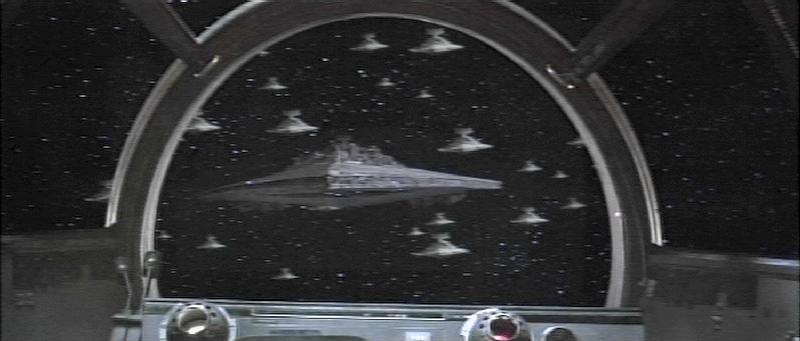
"Now the MASSIVE Imperial fleet could be seen flying in perfect, regimental formation, out from behind Endor in two BEHEMOTH flanking waves - heading to surround the Rebel fleet from both sides, like the pincers of a deadly scorpion."
In addition to the two flanking groups, there seems to be another group of ships, maybe the ones shown in the pic that was posted.
"Some distance from the main area of battle, coasting safely in the center of the blanket of ships that constituted the Imperial fleet, was the flagship super Star Destroyer."
The Imperial fleet must have at least been as powerful as the rebel fleet because Captain Piett's fleet captains expected to attack the rebel formation.
"The second stepped up to the window, beside the admiral. "We aren't going to attack?""
It seems the rebels knew they had no chance against the main part of the Imperial fleet.
"Sir, we don't stand much of a chance against those Star Destroyers. They out-gun us, and they're more heavily armored."
These passages suggest that, in fact, the Imperial fleet was much larger and much more powerful than the rebel fleet. The only reason the rebels attacked is because they had no other choice. Either try to escape and be destroyed in short order or attack and try to make something positive happen.
NoogDeNoog wrote:The Imperial fleet must have at least been as powerful as the rebel fleet because Captain Piett's fleet captains expected to attack the rebel formation.
That's really the key, isn't it? Both the Imperials and Rebels expected them to attack. So if the Rebels were completely outmatched as Patroklos likes to think, then they wouldn't be contemplating a retreat only after the Death Star opened fire.
"He may look like an idiot and talk like an idiot, but don't let that fool you. He really is an idiot."
NoogDeNoog wrote:The Imperial fleet must have at least been as powerful as the rebel fleet because Captain Piett's fleet captains expected to attack the rebel formation.
That's really the key, isn't it? Both the Imperials and Rebels expected them to attack. So if the Rebels were completely outmatched as Patroklos likes to think, then they wouldn't be contemplating a retreat only after the Death Star opened fire.
Like I already stated, what other choice did they have. They couldn't successfully retreat, they had no other option than to attack. At least by attacking, they could open a hole in the Imperial cordon and then possibly escape.
Endor was certainly not a typical battle, but neither was the Clone Wars Battle of Coruscant- and I wonder if there isn't a fleet in being thing happening here. The numbers would seem to suggest that ships are more important than planets; that it's not worth defending a planet if you lose a frigate or better doing it.
Twenty- five thousand (minimum, usual caveats apply) line destroyers- that is to say destroyers that count as a complete line in the order of battle in their own right, nominally Imperator/Imperial class, and counting the variant types I reckon you could add another fifteen thousand to that- and at least a hundred thousand, probably more, light destroyers, Victory-class and the others in the same weight class, as divided across fifty-one million inhabited worlds minimum.
Lose the naval force, and you've lost an enormous proportion of your ability to affect trade between the worlds, and to attack and defend them directly. I know, pot and kettle, analogies, but this really is sounding like the century or so on either side of the Thirty Years War- small professional forces only, much rarer and more important than any non- capital target, and the object of combat is to kill as much of the enemy's fighting strength as possible beause then the territory is ripe.
So, normally, battle is only risked when the odds are or can be manufactured to be in your favour, and potentially losing fights are things to be run away from. I think it may be that only the freak cases like Endor and Coruscant actually result in large pitched battles, when the weaker side has to stand and fight or suffer strategic disaster.
Normative combat may be a running fight, it being fairly obvious to the stronger and weaker party who is which, the weaker side attempting to disengage through hyperspace before they can be destroyed, the stronger party trying to kill the weaker before they can succeed.
At least, thus is theory before pride, stupidity, higher orders and Murphy get involved, and no doubt there are many battles fought that should not have been and more than a few that should not have been but were, but this is the model the respective abundance of ships and planets suggests to me.
In the light of that, and of the false intelligence Palpatine planted about the relatively thin defences of the construction site, the almost kamikaze aspect of Ackbar's mission makes more sense. They were expecting to have to defend against arriving Imperial reinforcements, engage and keep off the fighter- carrying ships that could have spoiled the rebel fighters' precision strike.
Ackbar, not being a fool, made the decision to go ahead with the strike after spotting the Imperial fleet and accept the losses that would be involved, heavy though they would likely be, because the strategic objective was worth the price.
Equally, withdrawing after the death star opened fire would have made hard practical sense. If it was operational to that degree, the primary objective was probably no longer feasible- the sacrifice of ships and beings would be for nothing. Why he listened to Lando is the real mystery.
The only purpose in my still being here is the stories and the people who come to read them. About all else, I no longer care.
NoogDeNoog wrote:Like I already stated, what other choice did they have.
They could have retreated, like Ackbar initially ordered.
How exactly do you escape a superior force that has you surrounded? Also, we both know that retreating wasn't Ackbar's initial order, he only ordered that after the shock of discovering that the DS2 was operational. As Lando states, they wouldn't get a second chance at the DS2. The rebels only had two poor choices to pick from, try to escape and maybe a few ships would slip past the Imperial trap or attack, buy time for the ground forces to lower the shield, and try to destroy the DS2.
This was an all or nothing mission for the rebels. If they didn't destroy the DS2, once it was fully operational, meaning fully manned and capable of defending itself, it would destroy the rebellion planet by planet.
NoogDeNoog wrote:How exactly do you escape a superior force that has you surrounded?
Who said they're surrounded? You yourself provided quotes saying that it was a pincer. That only leaves about.... an infintie number of directions for the Rebel fleet to go.
Also, we both know that retreating wasn't Ackbar's initial order, he only ordered that after the shock of discovering that the DS2 was operational.
Yes, that's exactly what I said. That's the point.
As Lando states, they wouldn't get a second chance at the DS2. The rebels only had two poor choices to pick from, try to escape and maybe a few ships would slip past the Imperial trap or attack, buy time for the ground forces to lower the shield, and try to destroy the DS2.
This was an all or nothing mission for the rebels. If they didn't destroy the DS2, once it was fully operational, meaning fully manned and capable of defending itself, it would destroy the rebellion planet by planet.
Do you have even the faintest shred of a clue as to what's actually being talked about?
"He may look like an idiot and talk like an idiot, but don't let that fool you. He really is an idiot."
There is a reference (from Wookiepedia's Battle of Endor entry) that interdictors were used in the fringes of the system to prevent the Rebel fleet from entering hyperspace. I do not know where they sourced that particular bit of information from, however.
Why would the Imperials perform a pincer maneuver if not to surround them, just for the hell of it? The novel clearly states that the Imperials are surrounding the rebels. What about that don't you understand? How can you have an infinite number of directions from which to choose if you are surrounded? Be it a 2D or 3D battlefield, the rebels are surrounded, are they not?
His initial order was to attack, even though he knew it was a trap, because there was no other choice, the DS2 had to be destroyed. As Lando later states, they wouldn't get another shot at destroying the DS2 and wouldn't an operational DS2 spell doom for the Rebellion? After seeing that the DS2 superlaser was operational, Ackbar panicked and ordered a retreat but countermanded it after hearing Lando's faith in Han's ability to get the shields down.
If you don't think I have a clue please fill me in.
Eleventh Century Remnant wrote:Equally, withdrawing after the death star opened fire would have made hard practical sense. If it was operational to that degree, the primary objective was probably no longer feasible- the sacrifice of ships and beings would be for nothing. Why he listened to Lando is the real mystery.
Quite simple really. If the second Death Star had been finished, the Rebels would have had absolutely nothing that could stand against it. Ackbar would have had particular reason to be concerned, as his home world would have been a likely target for the Superlaser.
Lando even says "we're not going to get another chance at this" or something similar. And he was quite probably right.
If accurate, that loops back to Simon_Jester's point about the difference between convoy and fleet interdictors. I really do not see a ship as small (600m long, narrow, 1.7 million m3 at a wild ass guess- smaller than an Acclamator) as a Sienar-418 lasting very long in fleet action- a single alpha strike from a Mon Cal starcruiser or a few seconds sustained fire against a manoeuvring target should be enough to remove it as a problem.
Something better protected really is badly needed, and small wonder the Starfleet decided to go with a ship built on the frame of their current standard multirole design. I still reckon they got it wrong, though- to my mnd they would be better off with a single interdictor globe on a hull with normaly clear battery arcs, the single globe up forward replacing some of the planetary engineering facilities. Best of both options; a ship that can kill and eat it's own catch.
Oh, and pincer movement; it's certainly not physical pressure, in fact it doesn't explain easily if you just look at the movements of the ships.
Area denial is accomplished with batteries, with the swept zone of the ship's guns- and in this case, for an objective this important the rebel fleet are not going to be lightly deterred, so within the effective lethal reach, at distances that allow for a shield- breaching hit rate; so Endor would have to have been fought at mutually supporting distance for the starfleet anyway.
Think about it; you're trying to stop them escaping- so you divide your forces and scatter them across a wide area, rendering them susceptible to defeat in detail, a thin screen that a concerted Alliance move could achieve local superiority to, blast their way past and escape...eh? How does the original battle plan even make sense, never mind interpretations of it?
Ackbar's retreat would have been such a concerted move, and would not have been bloodless- the starfleet would have reacted to stop them.
Romulan Republic, the motivation is obvious- you are stating the facts as I understand them- but I'm just boggled by the fact that the death star's main reactor was able to power superlaser shots with a YT- sized hole in the shielding; that it even could be capable of generating that much power in the partially completed state it was in. Still, it obviously was.
The only purpose in my still being here is the stories and the people who come to read them. About all else, I no longer care.