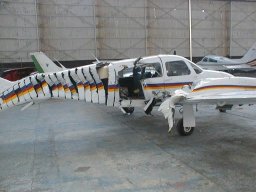
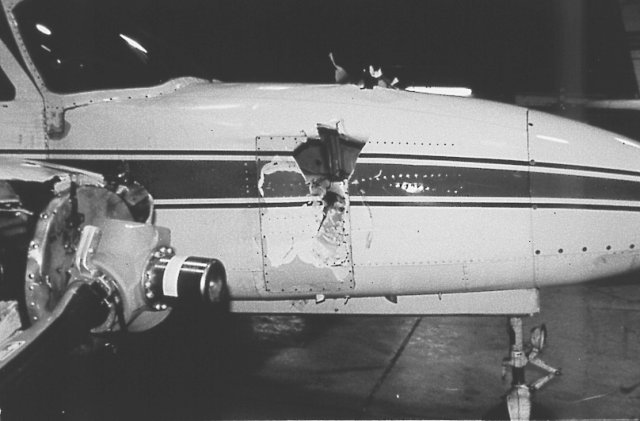
Broomstick wrote:Someone forgot to put the landing gear down. And it really is that simple - they forgot to put down the gear. This may seem to be a mind-boggling omission, but it's been an occassional problem since retractable gear airplanes were invented. It doesn't matter how many lights, buzzers, and alarms you stuf into these machines, a couple times a year someone gets so busy and distracted on landing they forget to pull the lever. That's one reason I liked flying the Piper Arrow - if you drop below a certain speed it puts the gear down for you. That mechanism isn't perfect, either, and people have managed to land them gear up despite that, but it's probably prevented a few accidents.
When I was going through my multi-engine training, we were on final for 31 at KSTC, a nice, big, long runway at 7,000 ft.
I was in the left seat of the BE-76 Duchess, my instructor in the right. The white landing gear knob was in the middle. Next to it were three green "Gear down and locked" lights in a triangular arrangement, with a red "in transit" light just above the lights.
Also, below the right-seat control yoke, was a panel of circuit breakers. Now, flight instructors tend to have a very irresistable urge to "play around" with these circuit breakers and look with amusement upon the student's reactions.
In my case, we were on final, with me having already pulled out and down on the landing gear handle. We got closer and closer to the runway, and all seemed fine. The airplane
appeared to be performing predictably, and it seemed the amount of power I had *should* equal to the airspeed and performance that I was seeing. Now, remember, at that point, having only 5 hours logged in a multi-engine aircraft, I was woefully inexperienced with the nuances and the "small things" about that type of aircraft, especially considering that I was only 1/3rd of the way through the multi-engine training.
So everything looked good, and we ended up about 200 ft above the runway, a thousand feet from the threshold, when my instructor asks me, "So, does everything look good for landing?"
I instantly knew that something wasn't right, something that's a critical component for landing, something that I missed, because an instructor wouldn't usually ask that question of a pilot unless something was up. In a split second I quickly checked a few major things.
-Twin blue levers (next to the throttle levers) all the way up, indicating the propeller pitch full forward...check.
-Flaps down to 40 degrees...check.
-Gear handle down...check.
I didn't see the source of the problem, and the runway was getting ever closer, and I knew that a go-around would be occuring within the next few seconds. So I answered, "I don't see anything wrong. What did I miss?"
"Go around. You put the landing gear handle down, which is good, but you didn't look at the indicator lights."
After applying throttle to go around, and putting up the flaps, I glance at the lights. They are distinctly
not shining green.
My instructor asked, "So what do you think is the problem? Burned out lights? Or is the gear really still up?"
I pressed on the top of of each light, which pushed it down a bit, and each light illuminated green. So the bulbs were good.
My instructor explained. "Your gear is still up, because I pulled the circuit breaker for it. The green lights are working, and they indicate that the gear is still up."
"How evil of you," I jokingly remarked. My instructor grinned, then explained, "Remember, a lot of gear-up landings are made because of inattentiveness. Always pay attention to all gauges, lights, and indicators. They're there for a reason."
"And as long as we're here, we can head out of the traffic pattern and practice some emergency gear extensions. And pretend there's nobody in the passenger seat to fly the plane while you do it." Yay. That meant me trying to keep the plane nice and steady (standard +/- 100ft. and +/- 10 kt. deviations maximum during this and other procedures, as perscribed in the Practical Test Standards booklets), while reaching in between my legs to try to twist the hydraulic release valve with a little tool on the floor between my legs, with my head at the level of my control yoke. Yes, we pilots ARE contortionists. Very precise contortionists, too.

But the lesson was well learned. The approach and landing phase has THE HIGHEST amount of workload for a flight crew. Exact attention, full awareness, workload control, and being able to fully implement the principles Crew Resource Management (CRM) are extremely crucial to sucessfully complete a flight day in and day out. And let it be known that this is not so easy to do every time. There are situations were the workload on a pilot approaches almost seemingly-ridiculous levels. The psychological stress at the highest workload points can be very burdensome, and has overwhelmed the occasional inexperienced pilot who was out of his/her element.



















 "
"