This one might prove a challenge, but I know how much you guys love to figure things out
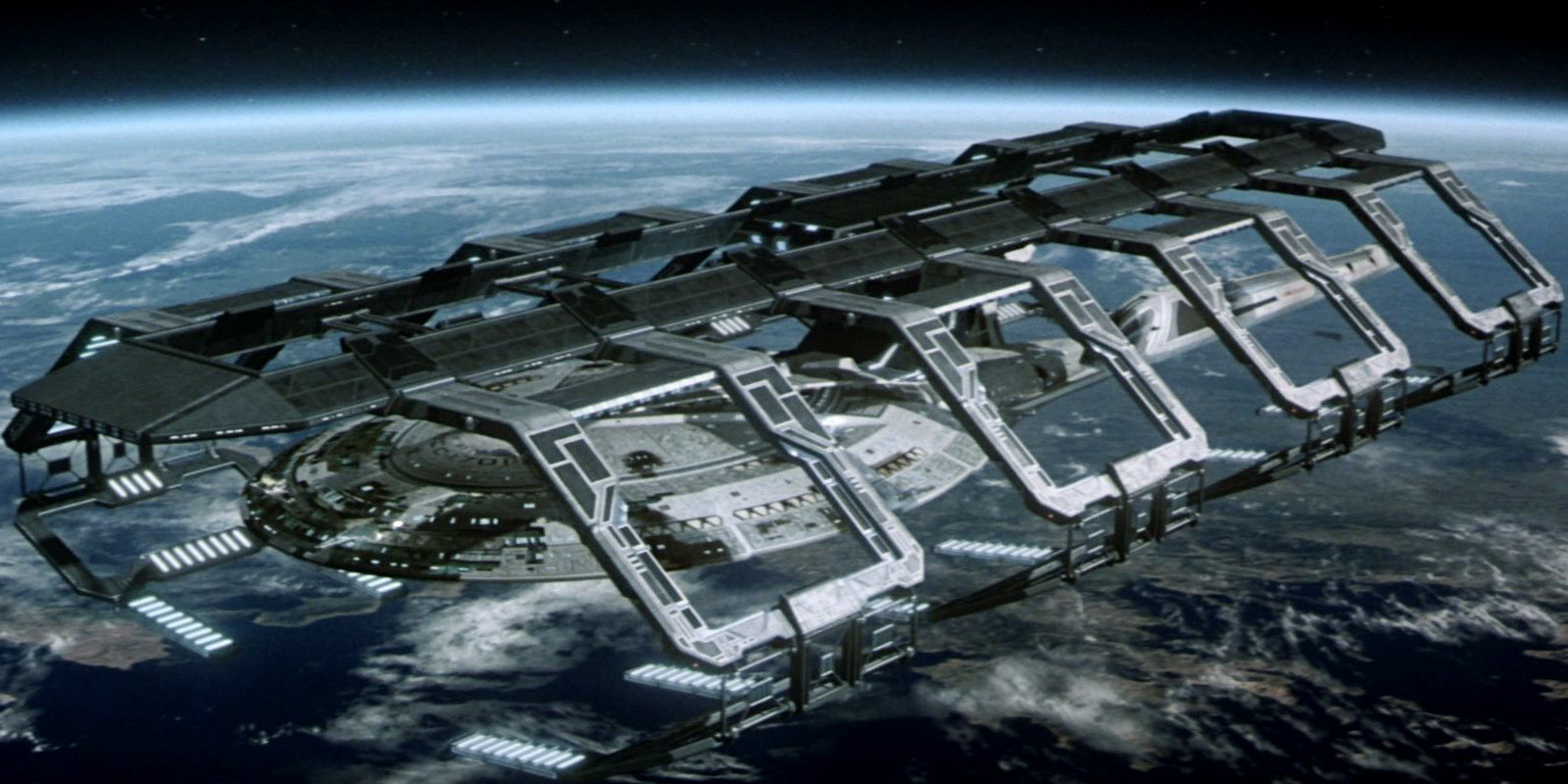
I was up at South Dakota this summer, and got an awesome view of the night sky. While watching some satellites cross the sky, I thought....What would the big shipyard that orbits earth in Star Trek look like from the ground? (sorry...I forgot the name of it )
Would it be as "big" as the moon in the night sky? Half the size of the moon? Twice the size? I'm sure that some of you engineering-types could figure out the distance it orbits away from earth, figure out how big it is...yadda yadda yadda.
Hope someone is up to this...cuz I think it would be interesting
Proud owner of a B.S. in Economics from Purdue University Class of 2007 w00t
"Sometimes, I just feel bad for the poor souls on this board"
Considering 1 km as its largest dimension (able to fit comfortably a Galaxy), and geoshycronous orbit being in the tens of thousands of kilometres of altitude, we would see it as a small luminous blob larger than Sirius (the brightest star in the sky).
[img=left]http://img.photobucket.com/albums/v206/ ... iggado.jpg[/img] "You know, it's odd; practically everything that's happened on any of the inhabited planets has happened on Terra before the first spaceship." -- Space Viking
You'd be able to make it out, sort of, with a telescope, much like Cochrane and gang were able to see Enterprise-E in the sky in First Contact. You can sort of see a blob with the warp nacelles sticking out; the shipyard would be much the same, except it'd be a bit of a larger, more rectangular, blob without the warp nacelles. Just depends on how powerful your telescope is, really.
Question: what about Earth Station McKinley (I think that's the name of the Starbase orbiting Earth)?
Dark Primus wrote:Or the space dock in the original movies?
I don't believe Spacedock orbited Earth-- it was at like Alpha Centauri or someplace else. 'Course, I've only seen a few of the original movies, so I'm not too certain... unless you refer to the one in The Search for Spock? Then, yeah, that one most certainly orbits Earth...
Y'know, I was probably thinking about one of the Starbases. Sorry...
Dark Primus wrote:Or the space dock in the original movies?
I don't believe Spacedock orbited Earth-- it was at like Alpha Centauri or someplace else. 'Course, I've only seen a few of the original movies, so I'm not too certain... unless you refer to the one in The Search for Spock? Then, yeah, that one most certainly orbits Earth...
Y'know, I was probably thinking about one of the Starbases. Sorry...
"Spacedock" is the large facility seen in ST III, IV, V and VI.
"Thousands of years ago cats were worshipped as gods. Cats have never forgotten this."
Dark Primus wrote:Or the space dock in the original movies?
I don't believe Spacedock orbited Earth-- it was at like Alpha Centauri or someplace else. 'Course, I've only seen a few of the original movies, so I'm not too certain... unless you refer to the one in The Search for Spock? Then, yeah, that one most certainly orbits Earth...
Y'know, I was probably thinking about one of the Starbases. Sorry...
The Space Dock is a large starbase orbiting Earth.
I have to tell you something everything I wrote above is a lie.
Warspite wrote:Considering 1 km as its largest dimension (able to fit comfortably a Galaxy), and geoshycronous orbit being in the tens of thousands of kilometres of altitude, we would see it as a small luminous blob larger than Sirius (the brightest star in the sky).
I thought spacedock was much bigger than 1 KM in diameter? Sure seemed bigger in III....
I'll have to go look it up in a manual somewhere....
Proud owner of a B.S. in Economics from Purdue University Class of 2007 w00t
"Sometimes, I just feel bad for the poor souls on this board"
Warspite wrote:Considering 1 km as its largest dimension (able to fit comfortably a Galaxy), and geoshycronous orbit being in the tens of thousands of kilometres of altitude, we would see it as a small luminous blob larger than Sirius (the brightest star in the sky).
I thought spacedock was much bigger than 1 KM in diameter? Sure seemed bigger in III....
I'll have to go look it up in a manual somewhere....
Spacedock http://www.ditl.org/gpns/GSBGenral1.jpg
According to DITL, its diameter is 3,810 meters. Bernd Schneider's Ex Astris Scientia confirms this figure.
Considering the ISS is the brightest object in the night sky at times, (Luna aside) I am certain an object 3km in diameter and 5km in length would reflect significant amounts of light- but no where near as much as the moon I'd figure. Same goes for the drydocks, there are also plenty of orbital office facilities I would assume, I also wonder would a colonised moon look significantly different to the naked eye than it does now (as per Riker's assesment, FC)


 )
)