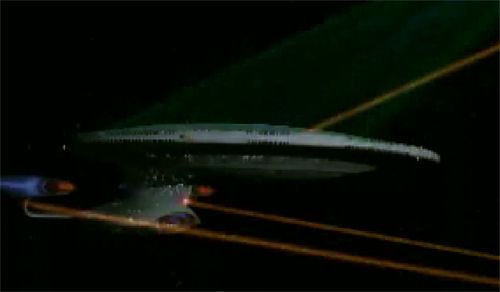
Not sure I understand you here. are the physical size of the phaser array emitter strips related to the power of the beam? If so, then you're correct. If, as I thought, the strip was only of that size to provide adequate arcs of fire, then, with a smaller saucer (shrinking the secondary hull while leaving the engineering hull unchanged is probably an oversimplification of what's involved), commensurably smaller emitter strips are required. After all, it's the arc length, in radians, that's important, not the surface area.Batman wrote:No argument. The question is could the equipmwnt that the Galaxy has on that saucer be fitted onto the smaller one? At least for the phaser arrays the answer is likely 'no, because there would quite simply be no room for them.andrewgpaul wrote: As for unnecessary space, if you leave out the non-crew living quarters and reduce the consumables in the cargo hold by an equivalent amount, you have a great deal of empty space. re-assign any still-used space to the centre of the saucer, and voila, the saucer is smaller.
As for beam generators, well, they'd fit into a smaller saucer, by the logic of my previous post.
As for tactical, strategic and operational concerns regarding ship size, you're probably right. However, combat was never the primary role of the Galaxy; it was mostly intended to be used, from what I remember , as an explorer
On that note, it's been a while (10 years, probably!) since I watched TOS or TNG, but the impression I got was that the E-D spent less time actually exploring outside the Federation (ie, Boldly Going) in its seven years (screen time; wasn't the mission profile for 12 years) then the original Enterprise. It always seemed to be ferrying diplomats, or sneacking back to Earth, or carrying out unsupervised and poorly thought out engineering experiments or something.