Page 2 of 2
Re: Constellation class
Posted: 2003-11-21 07:23pm
by Kitsune
MKSheppard wrote:Kitsune wrote:If they had built a large number of Kidds like was originally built.
No they didn't Only four Kidds were built, they were modified
Spruance Class, and they were packed chock full of weapons, a
lot more heavily armed than a Spruance was, and they were
built for the Navy of Iran. After the Iranian revolution, the USN
took over the ships.
I mean "Originally Planned" which the Spruance hull was originally meant for a guided missile destroyer class and my argunment is that if they had been built in large numbers, they would most likely have been retained longer than normal Spruance class. The Constellation class could have built in very small numbers and simply the support logistics for a small class was not worth it.
Re: Constellation class
Posted: 2003-11-21 07:24pm
by MKSheppard
Kitsune wrote:
I mean "Originally Planned" which the Spruance hull was originally meant for a guided missile destroyer class and my argunment is that if they had been built in large numbers
They built a Guided Missile Destroyer class on the SpruCan Hull.
It's called the Ticonderoga class

And 22 were built
(the very first Ticonderoga was a DDG, then it got reclassed as a guided
missile cruiser).
Re: Constellation class
Posted: 2003-11-21 07:39pm
by Kitsune
MKSheppard wrote:
They built a Guided Missile Destroyer class on the SpruCan Hull.
It's called the Ticonderoga class
And 22 were built
(the very first Ticonderoga was a DDG, then it got reclassed as a guided
missile cruiser).
In "The Ships and Aircraft of the US Fleet - Eleventh Edition"
Spruance Class:
Classification: During the proposal stage these shsips were assigned the project classification DX, pending completion of their design, a proposed SAM-armed variation (pre-Aegis) was designated DXG.
Norman Friedma'ns book on Destroyers is also suppose to cover it.
This gives a bit of information:
http://www.globalsecurity.org/military/ ... istory.htm
Posted: 2003-11-21 07:45pm
by Patrick Degan
Master of Ossus wrote:Patrick Degan wrote:Your assumption would be in error. The bulk of the ship's mass is already in the main hull, and the engines need only put out enough power to propel the ship at a given velocity. The total energy requirement would be the same in a two-nacelle arrangement, but two engines would be under greater stress to do the same amount of work.
So? Are you suggesting that the
Constellation class was purely a stop-gap measure designed in an effort to make up for exceptionally poor reliability in the warp nacelles? Moreover, even if the bulk of the mass is in the main hull, the engines still DO have mass. Thus, the overall efficiency of the system goes down.
Nothing of the sort. I'm saying that the configuration was evidently tailored toward the best propulsion solution for such a heavy design. And the mass of the engines is comparatively light —they'd have to be, elsewise it would not be feasible to mount them on cantilevered support pylons on any starship. The four nacelles combined would still be lower in displacement mass than two units of the size that would be required to do the same propulsion work as four standard linear warp units of the period. If you want an analogy, think of four standard engines on a B-29 as opposed to the sort of engine units which would be required to do the same work with only two units.
If we assume that the reason is purely due to maintenance (ie. the ship would constantly be heading back to starbases in order to be repaired, otherwise), then it suggests an even more serious problem with the design specifications. Consider: since the four-nacelled design was not adopted by later classes, such as the Galaxy and the Sovereign, then SF's engines must be considered reliable enough to keep the ship going (particularly since the GCS was designed as an explorer). Thus, the Constellation's additional engines serve no additional functional purpose for the ship, make it more expensive (probably by quite a lot, particularly since it gives little additional functionality), and while the single-hulled design is probably a considerable advantage, the Miranda class is basically a single-hull without all the drawbacks of a second set of warp engines.
That is specious reasoning. The four-nacelle configuration was what evidently was required for the design and mission profile of the
Constellation-class starship, and the comparison with the engines of later, heavier designs is like trying to make the same comparison between a B-29 and a B-2. Furthermore, you provide no support for your assertion that the four engines are "more expensive". How? On what terms?
Again, your assumption is in error. The Constellations were designed for long term deep space survey, on missions of decades duration.
Constitution class vessels were taking missions of 5 year durations a hundred years prior. It's difficult to imagine that the reliability of warp nacelles is THAT crappy, particularly since no similar problems have been observed due to stress in earlier or later ships. The warp core is the thing that's constantly breaking down, and that wouldn't be helped any by the additional engines.
So the endurance of the actual propulsion units is inconsequential? What sort of reasoning is THAT?!
With each engine unit taking only half the propulsion load that they might otherwise undergo in a standard two-nacelle configuration, the warp units of a Constellation would have a proportionately longer service endurance between refittings or wholesale replacement —a premium requirement for a starship which could spend years out in deep space before seeing the inside of a repair dock. Also, comparisons with the Miranda class are not valid, since the Constellation is clearly a larger, heavier design and consequently has different propulsion requirements.
The
Constellation's design was still a concession to poor warp-nacelle reliability even under the most generous examinations (ie. that the ship didn't completely suck, and just included the additional engines for the hell of it). Superior nacelle reliability would have rapidly made the entire class obsolete. Even if we assume that something in the
Constellation's mission had to make it much heavier than the
Miranda, we're still left with a design that is based around stop-gap principles, and one that would have become obsolete the instant reliable nacelles were developed.
You are missing the point. This discussion has
nothing to do with poor nacelle reliability (an unfounded assumption on your part) and everything to do with the engineering principle of the shared-load arrangement.
The more logical surmise is that the Ambassador, Galaxy, Nebula, and Soverign class starships —all considerably larger and heavier than a Constellation— were designs made possible by the development of a far more powerful warp reactor than what was available at the time the Constellations, Mirandas, and Excelsiors were being built, and therefore required no more than the standard two-nacelle configuration. The configuration for the Constellation was the best engineering solution for the mission requirements of that class of starship at that time and still represents a practical design.
You're using double-think. If the
Constellation's problem was that it couldn't use a more powerful reactor, then why were four nacelles used instead of a standard two? If anything, this indicates that the
Constellation had a larger warp-drive than the earlier ships, and if the larger ships could withstand the alleged strain with a two-engine design, I can give little benefit of the doubt to the
Constellation. It's design is clearly a stop-gap measure, and it should have been phased out as soon as more reliable warp-nacelles arrived, seeing as how the additional nacelles made the thing more expensive with HIGHLY minimal benefit.
That is
not doublethink, and you clearly do not understand the meaning of the term to even attempt to employ it here. You are also leaping wildly to a plethora of illogical conclusions based on unfounded assumptions, not the least of which being that it must somehow be more expensive to mount four standard engine units on a large starship (comparatively speaking) than two —and of a type which are already in mass-production to service already-existing starship classes. Your line of argument also ignores the evident fact that the more powerful engines developed later are being employed on vessels with considerably greater mass by volume than a
Constellation, (and all of which employ multiple hulls) which makes the comparison invalid.
Posted: 2003-11-22 07:24am
by Crazedwraith
Didn't picard say his ship was "Underpowered" once? Maybe the reason they were all mothballed prior to TNG was that they were crap, with not enough power to accomplish theor objectives and not enough room to re-fit so it could.
Posted: 2003-11-22 07:27am
by Patrick Degan
Crazedwraith wrote:Didn't picard say his ship was "Underpowered" once? Maybe the reason they were all mothballed prior to TNG was that they were crap, with not enough power to accomplish theor objectives and not enough room to re-fit so it could.
A subjective statement which could be nothing more than a comparison with the
Enterprise or referring to specific deficencies in the
Stargazer.
Posted: 2003-11-22 01:35pm
by Jason von Evil
The Constellation has a decendent ship class, the Cheyenne. It uses four nacelle and looks a bit like the Constellations.
Posted: 2003-11-22 02:01pm
by Einhander Sn0m4n
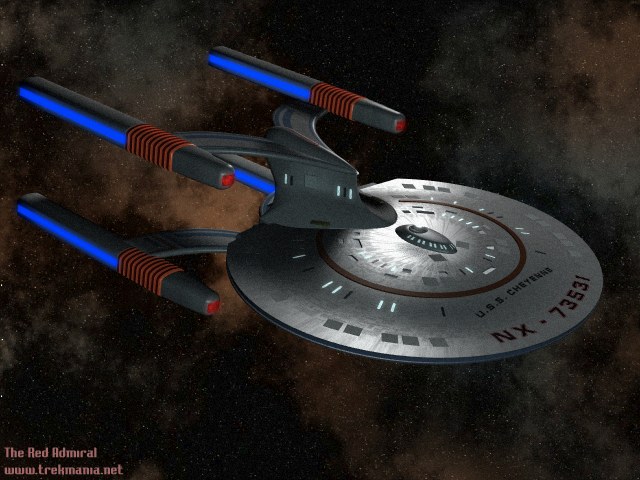
This one?
Posted: 2003-11-22 06:20pm
by Frank Hipper
Patrick Degan wrote:Crazedwraith wrote:Didn't picard say his ship was "Underpowered" once? Maybe the reason they were all mothballed prior to TNG was that they were crap, with not enough power to accomplish theor objectives and not enough room to re-fit so it could.
A subjective statement which could be nothing more than a comparison with the
Enterprise or referring to specific deficencies in the
Stargazer.
It could also be a valid criticism of a design, and a indicator of why they weren't seen much.
Posted: 2003-11-22 06:49pm
by Uraniun235
Picard: "It was an overworked, underpowered vessel, always on the verge of flying apart at the seams." (TNG Relics)
Posted: 2003-11-22 11:45pm
by Vertigo1
Einhander Sn0m4n wrote:*image removed*
This one?
Actually, I recall it to have a Galaxy-class hull with the same type (Galaxy) of warp nacelles. There was a 3D Model of it on the old Scifi-Art website, but since archive.org doesn't archive images, I can't show it to you.
Posted: 2003-11-23 12:50am
by Rogue 9
So what's that one?