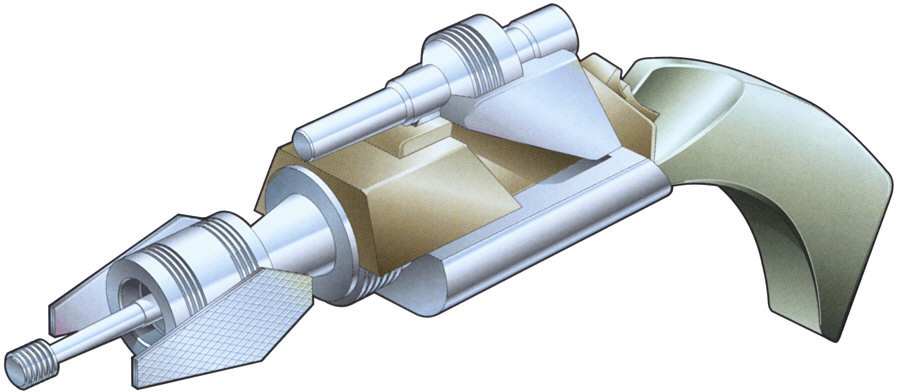
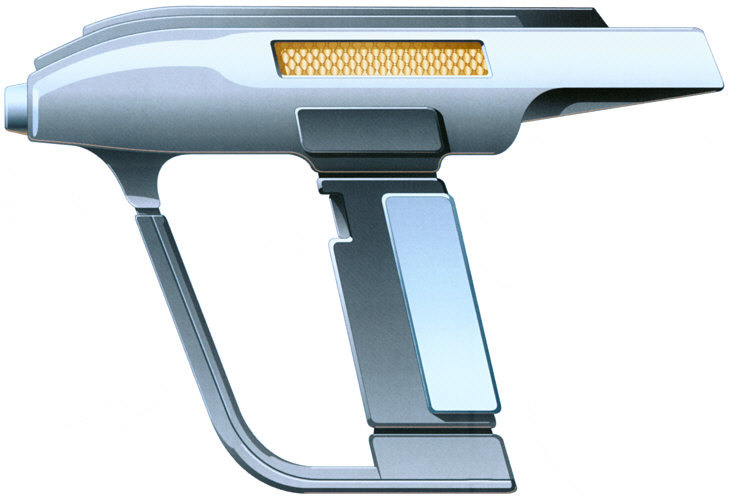
My theory goes like this. Over time, the phasers became less and less militarized from the TOS phaser pistol shape, to the TNG cobra shape. The assisted aiming technology is part of this demilitarization, as the Feds became totally reliant on their aiming system and started ignoring the ergonomics of the phaser because of this assisted aiming technology. Note that I say assisted-aiming, not auto-aiming, as the aim still has to be in the general direction of the fire. For example, the beam will not go off-axis 80 degrees. Eventually, during the Dominion war, they realized their grunts were totally handicapped in hand-eye co-ordination, and they introduced pulse-firing rifles which forced their users to practise by aiming through a sight.
Stark wrote:Ugh, auto-aiming again.
Certainly, phasers demonstrate off-axis firing. This in no way correlates to any actual aim-modification being performed with an eye to increasing accuracy.
You would be correct. Off-axis would not correlate to aim-modification. However, off-axis with accuracy would correlate to aim-modification. Sure you can throw in examples of a phaser missing. However for each example, I can find two with a beam phaser hitting. Think about it. If Federation phasers were so poorly designed that they had manufacturing defects of this scale, phasers would be totally useless because the user would miss every single time. Every single time, hand-eye co-ordination would be reset, because the user would have to learn to aim on a different axis. The miss-to-hit ratio would be immense. Try fucking with the sight on a gun with an olympic sharpshooter. Fuck with the sight every single time and see how well they do. This would be the equivalent of a beam firing randomly off axis. The olympic sharpshooter would miss almost all the time, at least the first few shots until he adjusted. By which time you would fuck with the sight again, because we have seen the same phaser fire off-axis in the same episode, and change axis! And despite this they still manage to hit! We do not see inaccuracy to this scale with phasers.
Given the appalling ergonomics of many phasers, it seems likely that stripping it down and modifying the hardware (as we see dudes do all the time) would allow a user to set their emitter geometry to however they like, to suit their firing style.
This theory would work. If it were not for the following.

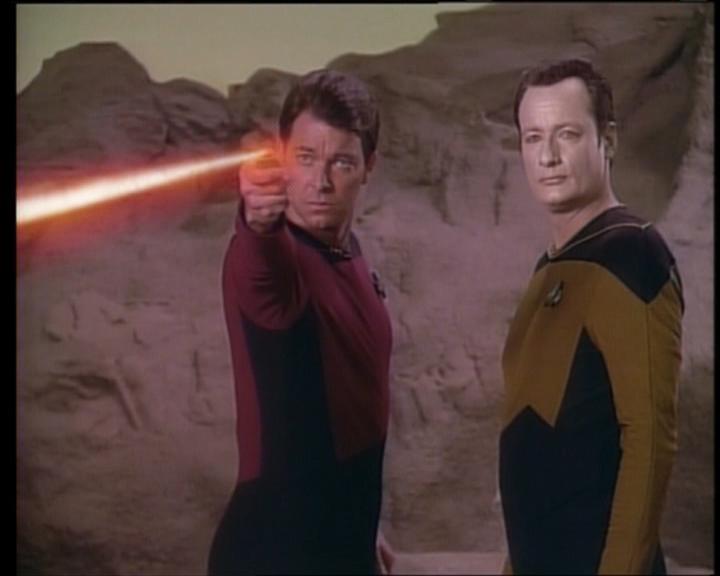
(Riker using a Type-I, Phasers.net, hosted on my own webspace)


(Riker using a Type-II, Phasers.net, hosted on my webspace)
If Riker was adjusting his phaser to fire on a certain axis to suit his firing style, why does his firing style change so often? We also see a phaser fire off-axis, and during the same episode, fire off-axis on a different axis! And the shot still hits! What you are saying is that Riker deliberately handicaps himself by throwing away all his previous experience with a certain axis, resetting his phaser to fire on a different axis between episodes -- actually, during the same episode and during the same scene, and still manages to hit. That is the same as saying Riker is stupid, and somehow he is so lucky that everytime someone fucks with his sight, he can still hit. If Riker was purposefully adjusting his geometry to match his style, he would keep a consistent axis.
Alternately it could simply be poor manufacturing quality control.
Phasers then, would demonstrate a far higher miss-to-hit ratio than we have seen. Phasers would miss almost all the time, since the axis of fire is never consistent. But Riker keeps getting those lucky shots. Unless you say that in between episodes, Riker retrains himself to fire on a different axis. But this is absurd, given that Riker could just keep the same hand phaser and practise with its axis of fire. Or, as you say, alter the geometry of the phaser always to fire on the same axis. But this doesn't happen. And, there are examples of phaser fire in the same scene with the same phaser changing axis, with no time for Riker to adjust to the new firing axis.
There are three buttons on early TNG phasers, IIRC, and that ain't enough to use any complex system, since those buttons are 'power up', 'power down' and 'shoot'.
Early TNG phasers have just as many buttons as late TNG phasers -- three. Even the First Contact Type-II's have the same number of buttons -- three, with a small bar.

(Early Type-I phaser, Phasers.net, hosted on my own webspace)
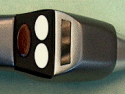
(TNG Type-II phaser, Phasers.net, hosted on my own webspace)

(ST:FC Type-II phaser, Phasers.net, hosted on my own webspace)
By your explaination, phasers should be able to do nothing but power up, power down, and shoot. However, we know this isn't true.
TNG Script, "The Game"
Wesley moving cautiously along. He stops at an
intersection between two corridors and kneels down.
He reaches into his pocket and reveals a TYPE-ONE
PHASER (a smaller version of the regular phasers) and
presses a command into it. He lays the phaser on the
arm rail, aiming it at the intersection.... then
activates it. The phaser sends out a series of weak,
sporadic BURSTS -- the tiny beams absorbed harmlessly
into the wall.
So Wesley manages to use a Type-I to fire with sporadic bursts repeatedly. If you say this could be one of the power settings, then we have a contradiction as a power setting has nothing to do with continuous fire. Three buttons means nothing -- depending on the software, the phaser could manage to do a lot of shit with three buttons. One could surmise that three buttons would be the absolute minimum necessary -- a fire button, and two function buttons.
They also continue to miss; indeed an argument could be made that some of these weapons are simply laughably inaccurate.
"Laughably inaccurate"? For every example you show me of a hand phaser missing, I can explain why the phaser misses, and introduce two other examples of the hand phaser hitting. Missing would be one of the limitations of the assisted aiming technology -- anyone agile enough, who realized how much the Feds relied on this technology, could duck around corners, run around, and defeat the assisted aiming. But if you were too slow, the tracking would work and you would be vaporized.
And to my knowledge 'wide beam' is never used for anything useful. Noone uses it to sweep corridors, noone uses it to shoot into or around corners, except to stun. Given the much higher power demands for such a wider beam, it seems likely that widebeam is simply militarily useless and wide-kill beams use too much power, perhaps more power than the emitters can handle.
Wide-beam stun is what has been observed, so lets say wide-beam stun is all there is. It would still be useful. We have not seen anybody using wide-beam stun to shoot around corners or sweep corridors either, and nobody in Trek wears body armor (other than I remember Borg, Hirogen and Klingons), so it would be useful to sweep with widebeam stun. They do not though -- this could be explained by bad training, rather than saying that widebeam is not useful, because it obviously is for the reasons you pointed out.
So to summarize my theory,
1. Original TOS phasers did not have assisted aiming and thus were shaped roughly like a gun allowing the user to aim.
2. Assisted aiming came in. Over time, the designers started relying on the assisted aiming and started making the phaser less and less ergonomical -- they even went as far as minaturizing the phaser to be smaller than a cell phone, making aiming by hand-eye co-ordination impossible if not extremely difficult.
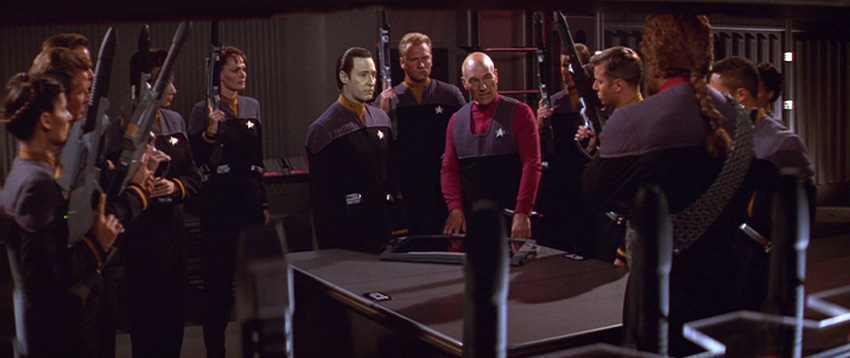
3. As a result, people stopped target shooting and had bad aim. Only the Guinan and Picard types maintained their hand-eye co-ordination abilities. The assisted aiming technology was not perfect, as someone agile enough could dodge phaser fire. This was demonstrated with the war with the Dominion, and Starfleet introduced pulse-firing phasers to conserve ammunition and to force users to start using an aiming receptacle.
The above is better than,
1. There is no assisted aiming, and thus all phaser hits are flukes, as axis has been observed to change on the same phaser in the same episode in the same scene.
My theory explains why the Federation would have made their phasers less and less ergonomical, still maintained a reasonable level of accuracy, and then later created a weapon with a sight. It is better than "LOLOloloslool1shift!!!!!shift1 the Federation is stoooooooopid", because it explains the erognomical change, explains why Type-I's were able to maintain a reasonable level of accuracy, and explains the later switch to pulse-firing sighted phaser rifles.
Brian