So, Steve got me interested in contributing to the story, but only if it was set in a slightly different reality than our own. Since my prior Kaetjhasti stories didn't go anywhere, I decided to set one in the MechWarrior: Scorched Earth universe... And this is the (very much only beginning) result of that effort to date. For the most part the stories do not overlap but it can be considered to be part of the official version.
http://i284.photobucket.com/albums/ll32 ... Cities.jpg
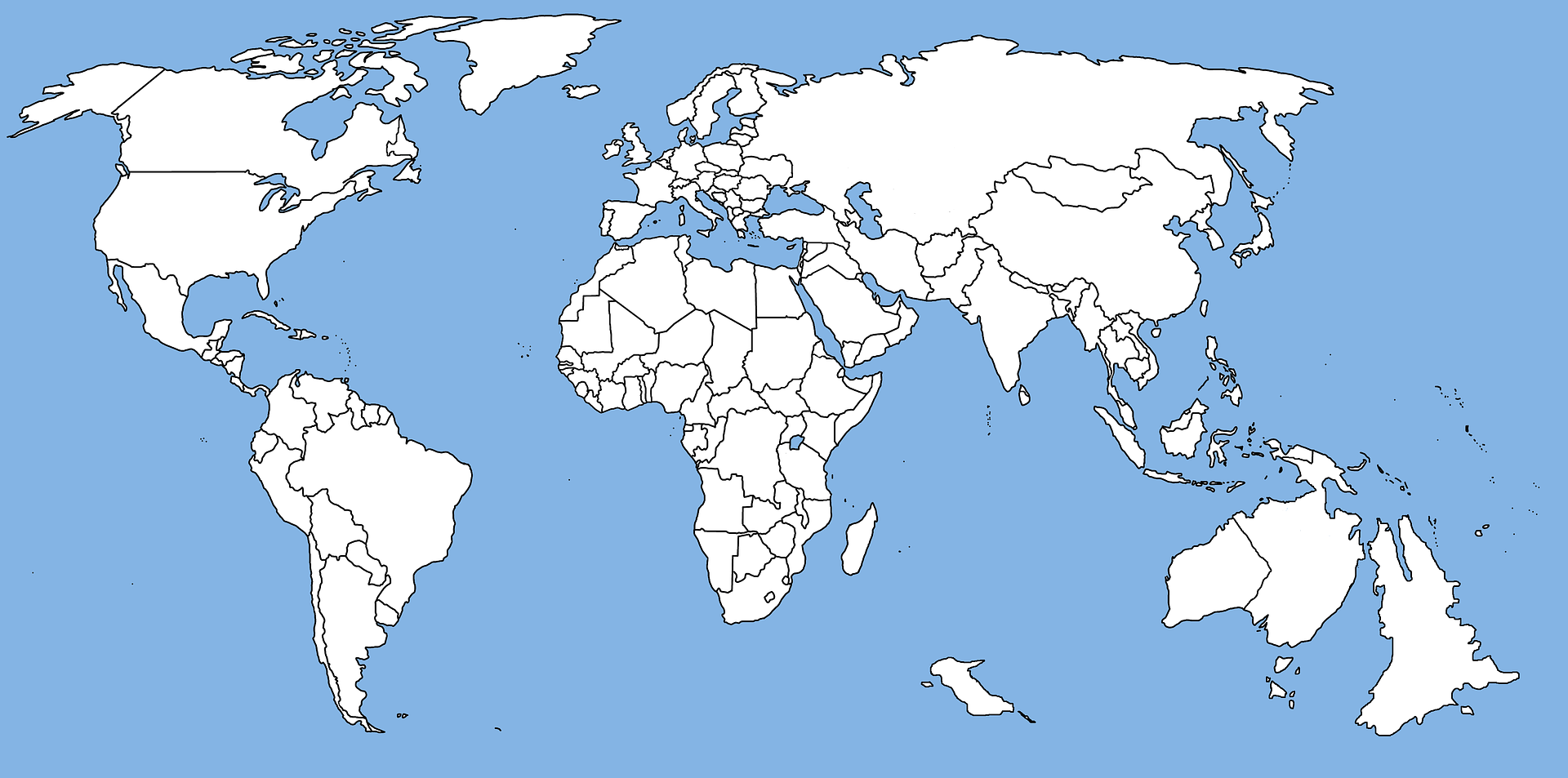
Here's a map of the continents of the action;
http://i284.photobucket.com/albums/ll32 ... olWoul.png
And one of the nations of the globe.
Prior story efforts:
Where there ain't no Ten Commandments
The Action of 5 Jyaistha
A Colonial Anabasis
And some information stuffs.
nMWSE: Panzerkampf.
Moderator: LadyTevar
-
The Duchess of Zeon

- Gözde
- Posts: 14566
- Joined: 2002-09-18 01:06am
- Location: Exiled in the Pale of Settlement.
nMWSE: Panzerkampf.

Last edited by The Duchess of Zeon on 2012-06-15 12:42am, edited 1 time in total.
The threshold for inclusion in Wikipedia is verifiability, not truth. -- Wikipedia's No Original Research policy page.
In 1966 the Soviets find something on the dark side of the Moon. In 2104 they come back. -- Red Banner / White Star, a nBSG continuation story. Updated to Chapter 4.0 -- 14 January 2013.
In 1966 the Soviets find something on the dark side of the Moon. In 2104 they come back. -- Red Banner / White Star, a nBSG continuation story. Updated to Chapter 4.0 -- 14 January 2013.
-
The Duchess of Zeon
- Gözde
- Posts: 14566
- Joined: 2002-09-18 01:06am
- Location: Exiled in the Pale of Settlement.
Re: nMWSE: Panzerkampf.
Imperial Kaenura, 23 May, 2039.
“I’m afraid you don’t understand that I make the decisions of administrative law and justice in this realm and that Her Gracious Majesty the Empress makes the decisions of War and Peace in this Realm, and collectively neither of us is you. The cosmos is not overwhelmingly on the side of the lunatics you have sold your souls to, and honestly, for the fundamental sake of the national ideal, I would have fought you alone.”
“Then you truly are mad, Keroljhis,” the emissary across the table sneered at the old, white-haired woman. “Just one more lunatic opposing the future of humanity, when you always claimed you were like us. We have compromised too much with your paranoid nationalism already. We were willing to accept the return of your government despite your previous hostility toward us and modify our arrangements, but it remains that we are at war with Australia and you must be also. Consider this to be a threat now, either you will cooperate in the invasion of Australia or you will be targeted yourselves. Do you want to be seen as a human or not?”
“I want to be seen as a Kaetjhasti. But we bleed, too. And strangely enough, when secular UE representatives are thrown out of windows, they die just as easily as Catholics in Prague!” The woman’s shrill final shout sent the table flying off as several of the young officers present took the signal and overturned it, heavy teak falling to the floor as they bodily seized the emissary and hurtled her, a screaming diplomat and not a soldier, through the windows of the Reichschancellery’s meeting room with a great cracking and crashing of glass.
Noises of shock echoed in the street… And then they changed to something else as the old white-haired woman walked with an arm, eighty-four years old and a contemporary of the Cold War and a girl-child mentressed by women who had fought in the last great Earth conflict; walking to the window where the glass was dispatched by quick strokes of a pistol’s barrel, to look down on the gathering scene.
“The Hour of Defiance is upon us! No foreign imposition shall stain these halls and banners, sisters. To arms for your Empress! Give me the foreigners!” The Reichskanzler stood on her balcony and called for violence, and Kaenura smoked. Paramilitary brownskirts rushed from building to building, and stormed the high-rise headquarters of the UE delegation with little hesitation, firing pistols and using improvised grenades to take out their security detachments, seizing documents relating to industrial supplies given to the UE and shooting the civilian personnel out of hand, as Gendarmes in their light blue uniforms and kappes stood guard outside and ignored it when the bodies started flying down to the pavement fronting the windows. Kaetjhasti was a polite society: By and large they had already been shot by the time they were defenestrated.
Keroljhis was watching the windows get boarded up with a very dead expression as a slightly younger woman, still quite elderly, chuckled dreadfully behind her. “You always did have a flair for the dramatic.”
“Your Gracious Majesty.” She turned and bowed her head slightly. “I wanted to make sure that there was no going back. Not ever. That we could not compromise on our independence. That we would never be tempted into it. The UE itself, by abandoning diplomatic protocols because the entire world was one government, opened themselves to this action as lawful; they were no emissaries of a foreign regime, because they refused to recognize that they were foreign. So I showed them the grave of traitors and the clarion call of defiance. The military’s already on full alert, though they won’t do anything for a while.”
“So it is, so it is. I’ve ruled this country for forty-one years, and I don’t doubt our readiness, not anymore. One out of ten is in uniform. What would you have me do?”
“Your Gracious Majesty, I beg you only to send an Imperial Rescript to the UE informing them it will be war if West Australia is invaded, or reinforcing troops sent to Bali, Ceylon, or Northwest Papua, and that a particularly forceful national response will be provided should any of these Clans land within the soil of the motherlands or the West Australian territory. I desire nothing else than to see them fully and very carefully understand that we are prepared to make war as nobody else has on the history of this planet. I will leave diplomatic arrangements to you. Your Gracious Majesty, we are both old women and this will the war of our daughters and granddaughters, of whom we are going to kill many. I pray I never know a minute of peace again; I have neither the will, nor do I believe I deserve, to outlive the victory parade. But with luck I will live to see that, and Your Gracious Majesty, I will pray that you be well enough to ride a white horse.”
“If not, perhaps we’ll craft an Imperial chariot,” she laughed mildly, and then nodded. “You think it inevitable?”
“Inevitable enough that we’re having this conversation, Your Gracious Majesty. The State is very strong, and must now be tested by war. That is all we can know, and say.” She drew the folds of her cloak closer and walked to the righted table, pulling out a chair for the Empress herself. “Your Gracious Majesty.”
Sita sat with a little sigh, taking tea with the Reichskanzler. “My mother thought you a little mad, but when they write the history books they will remember nothing of that. One way or another, it was your tireless positions that kept us apart from the rest of the world, Reichskanzler, and thereby gave us this moment. We are different, and the sacred contract of the nation will not fail. You have my assurance of it.”
“As Your Gracious Majesty says,” Keroljhis replied softly. “As Your Gracious Majesty says. But I will let history judge me when the war is over. Now I must work my life away to put the nation in final readiness. It is time to summon all the troops up and institute full war rationing.” The fact they had just killed a fair number of people slipped unspoken. The state had constricted, and stood ready against the world. As it was in days of old…
KRN Lahnajha, Central India Ocean.
The message flashed by blinker-light from the old nuclear cruiser out to the rest of the fleet, of ships built in the past 30 years and ships built in the 30 years before that, all kept in service by the pressing needs of the buildup required to meet the world-spanning forces of the UE. Government’s Out and Kerjhi’s Back. It said all it needed to, and the expression of exuberent pleasure on the Kaetjhasti ships was overwhelming, hats thrown into the air and cheerings ringing the decks as additional battle ensigns were spontaneously raised.
She had been a naval officer once before herself, and her endless advocacy for a larger fleet had been appreciated. She had negotiated the country through the dark days of the Second Great Depression, and her return to the Reichskanzlerei would surely mean great things. News of the incident of the Defenestration would flutter back shortly after that, and the messes of the taskgroup rang with rice wine toasts while women leaning on each other started using palm-tablets to prepare messages of farewell to their motherlines; an affectation of cheery pleasure and suicidal resignation juxtaposed in a way that the Occident always found impossibly disturbing from the Orient.
And the orders steaming into the towed ULF antennae of the command ships brought a second round of signal lights. Very purposeful weapons officers going to their posts soon followed, as keys were turned and control cabinets unlocked and settings changed. Nuclear anti-ballistic missile interceptors were readied for a task they had not exactly envisioned when they had been invented; but it would have to be good enough for the task at hand.
Far below the surface, the submarines dispersed first, heading away from the Taskgroup to covering positions in deeper water as the “War Warning” was processed, numb Kapitan-zur-See’s on the big cruise missile subs and boomers distributing keys and giving orders to commence regular silent running. Dispersal baffles were set to quick drop, and the submarines prepared to disappear from their UE pursuers.
Above water, the formation widened so that laser pointers and occasionally secure comms would be required for communication. The navigation department of the flagship was thoroughly distracted assisting in guiding a reentry vehicle with Gestirnonauts being repatriated home due to the exquisite vulnerability of their stations, a move some thought should have happened months ago; regardless, they were coming home safe, now. The Sailing Mistresses on their bridges, though, had more urgent concerns, as they guided the fleet into a cold war relic on the orders of that woman in the Reichskanzlerei who was, it was argued, also one; the nuclear blast dispersal formation around the light carrier they were escorting was shortly completed, so that an event could only take out one ship. Heavy missiles were brought to hair trigger as the news reverberated around the world and the consequences bore in. Across the combat zones they were prepared to support, from Flores and Sumba to Sri Lanka, guns were being loaded, troops being deployed to dispersed anti-blast revets, and contacts made with local paramilitaries. The Imperial Combined War Council did not intend to be caught in its knickers; if they dared come, this would be combat for the survival of the State from the first blow.
“I’m afraid you don’t understand that I make the decisions of administrative law and justice in this realm and that Her Gracious Majesty the Empress makes the decisions of War and Peace in this Realm, and collectively neither of us is you. The cosmos is not overwhelmingly on the side of the lunatics you have sold your souls to, and honestly, for the fundamental sake of the national ideal, I would have fought you alone.”
“Then you truly are mad, Keroljhis,” the emissary across the table sneered at the old, white-haired woman. “Just one more lunatic opposing the future of humanity, when you always claimed you were like us. We have compromised too much with your paranoid nationalism already. We were willing to accept the return of your government despite your previous hostility toward us and modify our arrangements, but it remains that we are at war with Australia and you must be also. Consider this to be a threat now, either you will cooperate in the invasion of Australia or you will be targeted yourselves. Do you want to be seen as a human or not?”
“I want to be seen as a Kaetjhasti. But we bleed, too. And strangely enough, when secular UE representatives are thrown out of windows, they die just as easily as Catholics in Prague!” The woman’s shrill final shout sent the table flying off as several of the young officers present took the signal and overturned it, heavy teak falling to the floor as they bodily seized the emissary and hurtled her, a screaming diplomat and not a soldier, through the windows of the Reichschancellery’s meeting room with a great cracking and crashing of glass.
Noises of shock echoed in the street… And then they changed to something else as the old white-haired woman walked with an arm, eighty-four years old and a contemporary of the Cold War and a girl-child mentressed by women who had fought in the last great Earth conflict; walking to the window where the glass was dispatched by quick strokes of a pistol’s barrel, to look down on the gathering scene.
“The Hour of Defiance is upon us! No foreign imposition shall stain these halls and banners, sisters. To arms for your Empress! Give me the foreigners!” The Reichskanzler stood on her balcony and called for violence, and Kaenura smoked. Paramilitary brownskirts rushed from building to building, and stormed the high-rise headquarters of the UE delegation with little hesitation, firing pistols and using improvised grenades to take out their security detachments, seizing documents relating to industrial supplies given to the UE and shooting the civilian personnel out of hand, as Gendarmes in their light blue uniforms and kappes stood guard outside and ignored it when the bodies started flying down to the pavement fronting the windows. Kaetjhasti was a polite society: By and large they had already been shot by the time they were defenestrated.
Keroljhis was watching the windows get boarded up with a very dead expression as a slightly younger woman, still quite elderly, chuckled dreadfully behind her. “You always did have a flair for the dramatic.”
“Your Gracious Majesty.” She turned and bowed her head slightly. “I wanted to make sure that there was no going back. Not ever. That we could not compromise on our independence. That we would never be tempted into it. The UE itself, by abandoning diplomatic protocols because the entire world was one government, opened themselves to this action as lawful; they were no emissaries of a foreign regime, because they refused to recognize that they were foreign. So I showed them the grave of traitors and the clarion call of defiance. The military’s already on full alert, though they won’t do anything for a while.”
“So it is, so it is. I’ve ruled this country for forty-one years, and I don’t doubt our readiness, not anymore. One out of ten is in uniform. What would you have me do?”
“Your Gracious Majesty, I beg you only to send an Imperial Rescript to the UE informing them it will be war if West Australia is invaded, or reinforcing troops sent to Bali, Ceylon, or Northwest Papua, and that a particularly forceful national response will be provided should any of these Clans land within the soil of the motherlands or the West Australian territory. I desire nothing else than to see them fully and very carefully understand that we are prepared to make war as nobody else has on the history of this planet. I will leave diplomatic arrangements to you. Your Gracious Majesty, we are both old women and this will the war of our daughters and granddaughters, of whom we are going to kill many. I pray I never know a minute of peace again; I have neither the will, nor do I believe I deserve, to outlive the victory parade. But with luck I will live to see that, and Your Gracious Majesty, I will pray that you be well enough to ride a white horse.”
“If not, perhaps we’ll craft an Imperial chariot,” she laughed mildly, and then nodded. “You think it inevitable?”
“Inevitable enough that we’re having this conversation, Your Gracious Majesty. The State is very strong, and must now be tested by war. That is all we can know, and say.” She drew the folds of her cloak closer and walked to the righted table, pulling out a chair for the Empress herself. “Your Gracious Majesty.”
Sita sat with a little sigh, taking tea with the Reichskanzler. “My mother thought you a little mad, but when they write the history books they will remember nothing of that. One way or another, it was your tireless positions that kept us apart from the rest of the world, Reichskanzler, and thereby gave us this moment. We are different, and the sacred contract of the nation will not fail. You have my assurance of it.”
“As Your Gracious Majesty says,” Keroljhis replied softly. “As Your Gracious Majesty says. But I will let history judge me when the war is over. Now I must work my life away to put the nation in final readiness. It is time to summon all the troops up and institute full war rationing.” The fact they had just killed a fair number of people slipped unspoken. The state had constricted, and stood ready against the world. As it was in days of old…
KRN Lahnajha, Central India Ocean.
The message flashed by blinker-light from the old nuclear cruiser out to the rest of the fleet, of ships built in the past 30 years and ships built in the 30 years before that, all kept in service by the pressing needs of the buildup required to meet the world-spanning forces of the UE. Government’s Out and Kerjhi’s Back. It said all it needed to, and the expression of exuberent pleasure on the Kaetjhasti ships was overwhelming, hats thrown into the air and cheerings ringing the decks as additional battle ensigns were spontaneously raised.
She had been a naval officer once before herself, and her endless advocacy for a larger fleet had been appreciated. She had negotiated the country through the dark days of the Second Great Depression, and her return to the Reichskanzlerei would surely mean great things. News of the incident of the Defenestration would flutter back shortly after that, and the messes of the taskgroup rang with rice wine toasts while women leaning on each other started using palm-tablets to prepare messages of farewell to their motherlines; an affectation of cheery pleasure and suicidal resignation juxtaposed in a way that the Occident always found impossibly disturbing from the Orient.
And the orders steaming into the towed ULF antennae of the command ships brought a second round of signal lights. Very purposeful weapons officers going to their posts soon followed, as keys were turned and control cabinets unlocked and settings changed. Nuclear anti-ballistic missile interceptors were readied for a task they had not exactly envisioned when they had been invented; but it would have to be good enough for the task at hand.
Far below the surface, the submarines dispersed first, heading away from the Taskgroup to covering positions in deeper water as the “War Warning” was processed, numb Kapitan-zur-See’s on the big cruise missile subs and boomers distributing keys and giving orders to commence regular silent running. Dispersal baffles were set to quick drop, and the submarines prepared to disappear from their UE pursuers.
Above water, the formation widened so that laser pointers and occasionally secure comms would be required for communication. The navigation department of the flagship was thoroughly distracted assisting in guiding a reentry vehicle with Gestirnonauts being repatriated home due to the exquisite vulnerability of their stations, a move some thought should have happened months ago; regardless, they were coming home safe, now. The Sailing Mistresses on their bridges, though, had more urgent concerns, as they guided the fleet into a cold war relic on the orders of that woman in the Reichskanzlerei who was, it was argued, also one; the nuclear blast dispersal formation around the light carrier they were escorting was shortly completed, so that an event could only take out one ship. Heavy missiles were brought to hair trigger as the news reverberated around the world and the consequences bore in. Across the combat zones they were prepared to support, from Flores and Sumba to Sri Lanka, guns were being loaded, troops being deployed to dispersed anti-blast revets, and contacts made with local paramilitaries. The Imperial Combined War Council did not intend to be caught in its knickers; if they dared come, this would be combat for the survival of the State from the first blow.
The threshold for inclusion in Wikipedia is verifiability, not truth. -- Wikipedia's No Original Research policy page.
In 1966 the Soviets find something on the dark side of the Moon. In 2104 they come back. -- Red Banner / White Star, a nBSG continuation story. Updated to Chapter 4.0 -- 14 January 2013.
In 1966 the Soviets find something on the dark side of the Moon. In 2104 they come back. -- Red Banner / White Star, a nBSG continuation story. Updated to Chapter 4.0 -- 14 January 2013.
-
The Duchess of Zeon
- Gözde
- Posts: 14566
- Joined: 2002-09-18 01:06am
- Location: Exiled in the Pale of Settlement.
Re: nMWSE: Panzerkampf.
Reichskanzlerei, Kaenura; November 10th 2039.
“Well, it’s finally come.” She distractedly pulled on a long lock of white hair and frowned down at the printout of the radio message. “I can speak English, give me the original,” Kerjhi sniffed in some irritation. “These kind of things are not suited for mistranslation in any circumstance.”
“Yes, herrin Reichskanzler.” One of the young staff officers in her crisp feldgrau handed the original text printout to her, and Keroljhis put on her reading glasses, feeling more dapper than she should be as she read it, savoured the words a bit, and read it again. Then compared it with the German for good measure. Then read it again. “It’s a declaration of war.”
“Ma’am! NESIKUA?” [1]
The old woman frowned and tapped at the computer laid out on the desk for a moment, asking her personal authorizations as Reichskanzler. “Get the Empress someplace safe to avoid a decapitation strike as the opening stage of the conflict. Give the dispersal orders to the Air Chief Marshal, I’m entering the authorization keys now. Nuclear alert to klasse-rotte, get the command assets moving. But we’re not going further than that. We understood this from the State Intelligence spies in the midst of the clans; this isn’t merely a declaration of war. It’s an invitation to negotiate the terms of a declaration of war. Where the goal is the extinguishment of the State. They want us to negotiate on what forces we will commit.”
“For the survival of the state? Tell them mayati!” One of the colonels exclaimed, flush with the adrenaline of the situation.
“Dead bodies, Kanakha? That is indeed very brave in spirit. I don’t think it’s suitable, though,” she concluded a bit tartly, and put the woman in her place. They were all boiling with the blood of kshatra and Keroljhis herself wanted to tell them to go to hell, too, that they’d all die in caves before surrendering. “General sri Varukha, please, is it merely my supposition that this works somewhat to our advantage, that we should not ignore these entreaties on their part to fight according to their old and hoary customs?”
“If we can force them to attack,” the Reichskanzler’s military chief of staff began, “from a predictable direction with, for instance, border minefields, then we will have functionally won a great victory. Their space superiourity and ability to land at any point on the globe is the real threat. If they are coming in from West Australia, for instance, we can fall back across many minefields, berms, and desert phase lines in an unpopulated area, attriting their forces the entire time they advance. Nuclear weapons could be offered up as a sacrifice in return, to avoid the risk of escalation against the population. We have considered this before.”
“Yes, yes, it’s been considered.” She sucked in her breath. “They’ve committed atrocities in the United States, but the Amis are not playing by the Clans’ rules, either. Well, we can fight a cabinet war. Isn’t that what we’ve wanted, a return to the old days? Honourable Ladies, find me an emissary. We will accept their request for negotiation. Let’s see if we can’t make them play to our strengths for the opening round. We’ll always have our atomics in reserve.”
“Jawohl, Herrin Reichskanler.”
“Get me an update on the force dispersal, and send a second order to the fleet to sortie and prepare for FALL MAJAPAHIT.” That got some looks for the old woman from around the table. She was her own Defense Minister, and this was strictly a military affair now. The rest of the government could be relied upon to mobilization for total war and that was the part which mattered.
“Herrin Reichskanzler.” A young staff lieutenant stepped in and saluted. “The Imperial Palace is forwarding two more messages. One is from the Clan Ice Hellion demanding a Trial of Possession for Garudaasti and one is from the West Australian autonomous government saying they have received their own notification from the Fire Mandrill Clan and wish to work on a joint defence of the continent.”
“Hrmmm.” Keroljhis picked up the phone that went on a sealed landline to the Foreign Ministry.
“ ‘Allo, Gariti?”
“Herrin Reichskanzler.”
“Ja, did you receive the message from Premier Caervon to the palace also?”
“Ja, Herrin Reichskanzler.”
“Sehr gut. Tell Premier Caervon that he should negotiate his own terms for the Fire Mandrill invasion at the moment, though we will coordinate if ENU troops get involved; but that he can find brave terms for the Diggers to stand on that will considerably aid him if he is willing to play their games. Then make plans for dispersing the government’s sections of foreign relations.”
“Understood, Herrin Reichskanzler. Should we expect an attack on the capitol imminently?”
“I cannot possibly speculate. We are negotiating, but the Clans will only accept kshatra negotiators, due to their clan based society, and war is inevitable. Nonetheless, certain details are subject to negotiation which we will be using to delay the start of operations for a short while.”
“Understood. Good luck, Herrin Reichskanzler.”
Keroljhis hung the phone up. “Have we confirmed Her Gracious Majesty leaving the Imperial Palace?”
“Ja, Herrin Reichskanzler.”
“Then prepare my private train. We will disperse to Point Delta to await the outcomes of the negotiations with the Clan personnel. General sri Varukha, select a woman for both sets of negotiations carefully, and from a very respectable lineage. We must impress them, that we are ‘respectable’ by their own terms, to make sure this is actually advantageous.”
“Well, if we’re talking about a respectable lineage, how about Generalfeldmarschall Tjandra sri Eriput’s eldest daughter? She did win the Blue Max just like her mother in the ‘Rift valley.”
“She rather does have a Motherline to match any bloodline, now, doesn’t she? Yes, have a Sri Eriput do it. They’re calm in foreign situations and can stand on their own among warriors.” Keroljhis rose impulsively. “Durga bless you, General, now let’s go. We’re negotiating with the clans, but I’ll take care of the other matter next: We’ll be drafting the declaration of War against the ENU on the train for immediate dispatch, and then preparing for Fall Indraasti.”
The officers in their feldgrau and the naval officers in their dress dark blues glanced around with a shifting and thrill of anticipation, and the Schoutbynacht assigned as the advisor to the Reichskanzler stepped forward crisply to her side. “Herrin Reichskanzler, I believe one of your proteges commands the Third Fleet u-kreuzer fleet?”
“Exactly.”
“What of the Indian government? We don’t want to further alienate them from this, and indeed encouraging them to turn against the ENU would be most preferable,” General sri Varukha raised as they walked purposefully toward the waiting line of limousines, into the world where the media had been taken over with warnings for people to send their children to the countryside and to prepare their survival shelters and review their blast shelter and evacuation preparations, to where jets were screaming overhead with sonic booms.
“I think the Special Directorate of the Gendarmerie can deal with that. Get me a line to their mobile headquarters when we’re on the train.”
“Jawohl, Herrin Reichskanzler!”
As she stepped outside, Keroljhis flashed the universal victory sign to the crowds milling, and was met with cheers as she walked to the waiting cars, her officers bundling the old woman into a navy greatcoat, a gesture to long ago when she had been a naval officer herself, even if she had never ranked higher on the active list than Korvettenkapitan. She flung out toward them, and started to speak.
“There is nothing ahead but pain and bloodshed, my sisters, for war has come to us. But let us all say Rayati! and know that if nation stands together as one, it may never be beaten! Remember Chennupur Pass and remember that we, too, have stood victorious in Vienna, in Berlin, in Tokyo. Your daughters and the tombs of your mothers are justification enough. Fight, fight with me and never look back! We are a nation, and the name Kaetjhasti shall not perish so ever long as we know that our unity is our strength. My daughters, my granddaughters and my pupils alike are on the front-lines with your daughters, your wives and granddaughters and pupils; and they will together buy us another hundred years peace with their bayonets. Rayati, Rayati, and forever Rayati Rauhiranya!”
Flashing another victory sign she swung into the limousine by the running board, supple enough with the limits of their medical technology, and rolled to the station down the great hills of Kaenura in some haste. The harbour was obscured by the haze from a hundred ships, some that hadn’t moved in years, bringing their engines up. When those at the navy docks, from the active modern nuclear ships to the elderly museum ships that could still make way, had brought their engines up, the civilian ships had followed suit. Even the old Prithvirani made way out of harbour, the steel in her bones a hundred and thirty years old. Nobody knew what the response was going to be yet, and dispersal to survive was the watchword of the day for the moment.
All across the country, the same process was repeating itself. The fleets were sortieing as sailors reported to their reserve assembly stations and went to the ships. At the Air Fields of the country, the Super Sarangas, the old Mach 3 interceptors of the 2010s, were brought out and fueled with benzene which had been adopted to improve their performance.
As each flight was armed with its heavy ramjet missiles, continuously evolved descendants of American AIM-47s, now flying well in excess of Mach 5; they were then checked, cleared by the ground crews, and swung out onto the broad cold war quick-reaction runways. Arrayed en echelon, a flight of four fighters would take off simultaneously, screaming down the runway and pulling skyward with their wings fully forward, retracting as they gained altitude and speed to rocket far, far into the sky. Then the next flight would follow, and the next, and then a whole squadron of sixteen would be skyborne and the barked orders in code would ring out across the base in battle German for that squadron’s support personnel to report to their trains.
As they went to the base sidings, a train with an old reserve steam locomotive or diesels would be waiting, power up to full, with lines of containerised weapons, fuel, fueling gear, repair equipment, and machine shops spread out behind the locomotives. The flight personnel would rush into their crew cars and immediately readiness would be reported. Gendarmerie officers at the gates of the base would open them, the track signals would show danger to regular traffic, and the train, wheels slipping and striking, would build up speed down a 6-foot gauge mainline toward its dispersal point where it would meet the squadron. The number of targets to take out the RKAF’s interceptors on the ground was accordingly quadrupled, and as the war progressed the shell game could be multipled over many remote locations.
The bombers shortly followed, while from the cover of their defensively reinforced hangars, the Skylon interceptors would be rolled out and fueled with liquid hydrogen at their bases. Barely more than a hundred and twenty in service now, they were the closest thing to space reach available, and the copious room for stores was now being aggressively utilized as they, too, were loaded up. They would operate from the bases that the Sarangas had vacated to disperse, ready to scream for the sky to challenge the enemy’s rule of the atmosphere of their homeworld.
Methodically, the preparations rolled outward, with the war warnings coming in so steadily. At sea, the submarines dropped their noise baffles, and dove deep to disappear from ENU tails. Special plates attached to the submarines to create noise and false signature profiles now sank to the bottom, and in wartime condition the submarines would leave behind no standardized noise recordings, as if they were new classes, for the ENU to tease out. There was one foe that there would certainly be no negotiation at all with.
Former Republic of India, Primary ENU Member Nation. 2300 Local, November 10th, 2039.
Maharashtra State, Mumbai.
“Miss Chamagupti? Madame Tata will see you now.”
“Thank you.” The Indian woman addressed her sari slightly and rose as the turbaned servant bowed deeply and led her into the halls of one of the richest women in India. As a major heir to the Tata fortune and industrialist in the country, Lakshmi Tata was one of the natural go-tos for establishing a Mech factory within the country as part of the ENU.
As it happened, she had kept her options opened and maintained contacts with the Special Overseas Directorate of the Kaetjhasti State Gendarmerie. That meant that Indira Chamagupti, herself once a woman of Shudra origins in Maharashtra state, was now her contact for such matters, one of the tens of millions of Indian origin women now living as immigrants in Kaetjhasti after almost a century of open immigration for the desperate, and those who could simply not fit in, to journey across the seas by ship and plane to the sororal Hindi Amazons of the southern oceans.
She was seated and given chai at once, with a flourish and a smile. “Lady Chamagupti, I take it that it was something very urgent that brought you here?”
“Yes. I want you to go ahead and send the message to the union representatives at the Pune Factory. It’s happening. The government is being notified by another source. I’m afraid after this, of course, that I will have to leave, though the Union Leaders are certainly going to be blamed for collaboration and not you. So we will be getting them out of the country with my departure, through channels.”
“Your friendship will be sorely missed. Well. We didn’t own the factory, anyway, we were just operating it,” Lakshmi Tata smiled very thinly. “I’ll let them know immediately that they should….”
“Go on strike, immediately. I believe sufficient background for the conditions of that strike has already been established.”
“Yes. They’ll get their raises when they’re back to work at our automobile factories. Thank you for doing this. The friendship of Kaetjhasti with the Indian people will not be forgotten, despite the regrettable circumstances. I assume you’ll be leaving almost immediately?”
“Unquestionably. I’ll need to make the arrangements for our extrication. Good night, Lady Tata, and thank you so very much. We desire very much to avoid any pointless effusion of Indian blood. With fortune our nations will soon again be on the same side of this war.”
“There are many here who feel the same way, steadily in the BJP as well as Azad Hind. The ENU is at the end of its rope, and the memory of Netajhi is strong. The Indian people are at the end of their patience, and were always meant to be free.”
Chamagupti smiled, finished her tea, and rose to bow. “I can only hope that to soon indeed be met with acton as well. Thank you kindly.” I know as like you are humouring me… But I know, too, that tomorrow the workers will be out of the plant. And with that, she left to make the final preparations.
Western Indian Ocean, 2000 Zulu, November 11th, 2039.
SAMUEL SAMUEL GUSTAV ZACHARIAS BRUNO DORA THEODOR THEODOR THEODOR ÜBERMUT.
“We’ve got a code.” Kapitan-zur-See Alexandria Reilly swung around from the comms station with a slightly stricken look as she cross-checked the print card with Fregattenkapitan Srimarta Gokaputra, the vastly shortly woman in her skirted service uniform—a luxury of officers aboard the larger submarines—ran through the analysis herself.
“Confirm non-nuclear attack authorization, Herrin Kapitan.”
“Confirm,” Kapitan Reilly repeated. Well, something’s good out of that missile changeout. Back in the old days we only had a nuclear option for a strike.
“ULF transmission tailing that authorization. Your Eyes Only, Herrin Kapitan,” Leutnant Amara Maacha stepped aside from the entrace to the claustrophobic Kapitan’s office off the CIC of the KRN Wellenläufer, named after some long-ago Privateer’s sailing ship, and a couple of destroyers subsequently.
The very tall white immigrant woman with flecked brown-to-gray hair who was their Kapitan slipped past her and settled into it with the door closed, as Gokaputra brought the submarine down on a routine course change, the ULF antennae trailing out as they skulked, having shaken their pursuers once the baffles were slipped from her hull.
She read the message, the blood draining from her face. A target in India? We are truly holding nothing back, then, Goddess have mercy. They had tried so hard to break the Indians from their course and had followed close by it for far too long out of the sororal friendship of the nations. But with Keroljhis in charge, the War Warning sent out the day before; baffles slipped and orders to free fire in defence of their subs already dispatched, it did indeed seem inevitable. Still, India seemed a strange place to open the conflict.
And me a Schoutbynacht? My broad pennant in such circustamces… She kissed three fingers in blessing, and brought up a computer map of India to home in on the location in question. Thanks to the Kaetjhasti satellite grid the location was well plotted, and she understood the importance of risking offending their friends in the Indian government immediately: It was one of two Mech factories of the ENU.
She stepped back out of her office immediately; resolved, even as she thought of her wife and daughters, the legacy and memory of thirty years of life in Kaetjhasti from a birth as a Cleveland girl so out of sorts with the conservative America of the 2000s. A life that had brought her to a mentress in Keroljhis and, now, to a war in which only by the favour of Ganesh was she actually on the same side as her birthland. But of that she had long since stopped caring, and her concern was more of the women of India, for her own family—and most of all for the ships under her command in this first of combat responsibilities.
“Ladies, we have the honour of commencing the first strike against the ENU. The target is a mech factory inside of Maharashtra State within the Republic of India, unfortunately, but these the duties of war demands. We can only pray that merciful Ganesh give us the favour of living to see the Ganga liberated from foreign oppressors once more and that Durga will grant our arms victory in Combat. I have been promoted to Schoutbynacht and given provisional command of the Third Fleet at sea standing cruise-missile attack submarine force.
“We will accordingly have the risky job of sending the attack coordination orders to the other three submarines which will be involved in this assault, and launching the guiding strike of missiles. We must at that point immediately take action to evade, as we can expect that our tailing submarine is still in the general vicinity and will commence war operations against us immediately. At the same time this message was sent, the declaration of war was dispatched to the ENU and therefore they will now be hunting for us to kill us. Ladies, we are now formally at war, and we’re going to do our jobs for the Goddess and the Rauhiranya. Rayati!”
“Rayati!” The shout echoed through the submarine, and Alexandria smiled thinly. The girls won’t be getting to shout again for quite some time.
“Stand by for ULF transmissions; code line ROTTE BLAU BRUNO BRUNO CAESAR.”
“ROTTE BLAU BRUNO BRUNO CAESAR, Aye, Herrin Schoutbynacht.”
“That’s still Kapitan, thank you very much, Leutnenat.”
A little smile from the beautifully dusky-skinned Ethiopian immigrant girl. “Aye, Kapitan”
“Come on, Marti.” She stepped back into her claustrophobic—and oh-so-homey—office, doffing her cap and reaching for gum, and the boiling vessel for Navy Tea, infused with coca leaf and who knews what else for stimulants by this point, chewing the gum as it boiled, and the two went over the attack plot, their position fixed inertially from the last KRNK [2] reference frame, the secret transmission including the operating positions of the rest of the squadron within attack boxes so that they could plan out their roles and missile approaches. They wouldn’t have KRNK rather quickly the way this game was being played out, but they had their last fix and by now the inertial navigation system was probably capable of providing reliable plots based on that last fix for years with the computing power aboard the submarine.
After that, they had to translate the attack orders into a standardized set of code that was low bandwidth enough to be effectively transmitted by the ULF trailing antenna of the submarine. The work took about ten minutes, and when it was done Alexandria got up with cups of tea for herself and her XO at once. She didn’t want her antennae out any longer than she could possibly need for them to be, considering the vulnerabilities involved in trailing an object through the water like that.
“Dari?” She went toward the forward sonar receiving room first. “What’s the position of that freighter we have on hydrophone?”
“Bearing one-two-six true, course south southeast at fifteen knots. Range to contact estimated to be forty three klicks, Herrin Kapitan.”
“One moment.” She frowned, her lips pursed sharply in thought for all that she felt strangely pleased with herself that she would be tested after so many years. That it overwhelmed the fear, quite comfortably. “Weapons, prepare for engagement with forward seventy centimeter torpedoes. They’re going to see the missiles launching and radio in our position otherwise. Hold supercavitating rounds, and I mean it. We’ll be dead if we use them right now.”
“Jawohl, Herrin Kapitan!”
I bet they were really not expecting us to be able to lose our tails that easily. Those baffles were easily the most useful investment the navy ever had. By fundamentally altering the noise signature of the submarines, their enemies had no reliable patterns to use their computers to look for, which meant the ENU submarines’ sonarmen had to guess about what the Kaetjhasti submarines actually sounded like instead of using decades of built-up tracking data from the usual games of cat and mouse… Because the moment they dropped the baffles, the sound profile of the submarine was completely altered.
“Periscope depth!” She took her watch out of her breast pocket and looked at it.
“Periscope depth, aye!”
“Marti?”
“Kapitan?”
“Have Leutnant Maacha begin the ULF transmission. I’m getting out bearings on that merchie.”
“Jawohl.”
The huge, 30,000-ton submerged SSGN levelled off below the surface and raised her sensor masts into the sky, giving no transmission. Only the slow, uneven pulse of the bursts from the ULF antenna trailed aft were sending anything of the sort, and it would take quite a lot of effort to localize that kind of transmission. There were sounds in the deep which could cover an entire ocean, located around areas the size of a country, and which nobody knew the origin or cause of. An entire minute of longitude and latitude in plus minus error; no way to pinpoint them: The Bloop, Julia, Train, Slow Down, Whistle, Upsweep. They were sea stories, legends to terrify and mystify kadets with. And they were one of the reasons that the transmission from the antenna would be very, very hard for the trailing attack boat to home in on.
She easily picked up the standard Galileo pattern transmit/receive of the set on the freighter, the Americans having only been able to knock out coverage over North America, and this ship well outside of the combat threat zones, so running unescorted with a cargo of containers filled with the materiale which kept the ENU humming. Unrestricted submarine warfare was certainly going to be a part of their operations in the future, of that she was sure, and they had the full authority to shoot as it was. The transmit/receive correlated with the hydrophone trace and gave her the final bearing on the freighter.
“Correlate these bearings into the torpedo data computer and load it into the torpedo computers. Mündungsklappen öffnen eins und zwei, Aki.”
The Malayo-Aborigine woman flashed a brilliant grin of white teeth and turned back to her post with cheerful aplomb. “Eins und zwei, jawohl Herrin Kapitan.”
Srimarta stepped back up to Alexandria’s side four minutes later. “Kapitan, the message is sent. We got the receipt ‘BLAUGAS’ code though we can’t identify numbers or source, as should be expected. I already ordered the ULF antennae drawn in.”
“Alright, Marti. Then we’re doing it.” She kissed three fingers and called quietly on the threeform High Deva, Shakti mother of All; and hoped that something had been done in India to spare the people from an excession of sororal casualties. “Achtung! Aktion Stationen!”
The submarine flipped to red light as the watertight doors closed and final preparations were made. “Lower the sensor mast!”
“Sensor mast down, aye.”
“Fächer in den Rohren eins und zwei, Aki.”
“Fächer in den Rohren eins und zwei!”
“Rohr eins – los!” her nails bit into her hands. I’m actually firing the first shot of the war. It was heady, and scary, all at once. Better not screw up. This target is important.
“Rohr eins, los!” The submarine shivered.
“Rohr zwei - los!”
“Rohr zwei, los!” And again she shivered.
“Mündungsklappen öffnen Raketerohr eins bis zwölf.”
“Jawohl, herrin Kapitan.”
The cruise missile submarine had twenty-four tubes, originally designed for the super-heavy FLIH-160 nuclear tipped cruise missile, with a range of thirty-five hundred kilometres and a speed in excess of Mach 3.5 bearing a 150kT warhead for dual-purpose anti-carrier group and anti-land installation employment. These had been lately replaced with initial rocket boosted ramjet missiles operating at in excess of Mach 5 with a low altitude hypersonic approach which could be quadpacked into the tubes, though the range was reduced to twenty-two hundred kilometres. It had been considered acceptable in the context; now half the tubes carried forty-eight of them with conventional warheads, the ones she was about to fire; the other forty-eight still had one hundred and fifty kilo nukes, and those would mercifully not be loosed today.
“Herrin Kapitan, Torpedo laueft eins! Torpedo laueft zwei!”
“Sehr sehr gut, Dari,” she thanked the sonar leutnant and turned her attention back to the main tactical plot which now showed the missile launch preparations as the minutes counted away toward the expected torpedo explosions. The crew was breathless. They, too, understood that they had just launched the first attack in their Empire’s participation in a global spanning war that had brought hell and fire everywhere, threatened their sovereignty, and involved humans from other dimensions in a descent into insanity to exceed anything imaginable before.
“Eine minute,” Aki reported. “Die Raketerohren eins bis zwölf werden geflutet.”
“Dreißig…”
“Zwanzig...”
“Zehn…”
The explosion was audible in the hull. The headphones of the sonar operators automatically damped it out these days, of course. Now they could just wait and see what was left… The second explosion hit fifteen seconds later, and as the sound cleared away and they started to get a clear picture of what had happened, Dari stepped into view with a very cheerful and urgent look. What followed… They sort of instinctually knew it, and the crew began to thrill. Dari confirmed it.
“Breaking up noises, Herrin Kapitan!”
There was no time to celebrate. They had prevented the enemy from exactly pinpointing their location, but they’d soon know that they were in the general vicinity, and they had to attack now and begin to evade.
“Aki! Fire missile tubes one through twelve.” Here we go. Whatever else happens, the first mission will be a success. A bitter bit of worry: If they don’t shoot them all down.
“Firing missile tubes one through twelve.” She flicked switch after switch, computers set to cluster salvo the four missiles in each tube, as the compressed air blew the missiles clear and rushing toward the surface; then their rocket boosters ignited and in a roar of power and energy they ripped out of the Indian ocean and took off skyward as bright pillars of light through the evening, again and again and again. Forty-eight missiles salvoed in the space of eight minutes as sonar confirmed the breaking up and sinking of the targeted freighter.
The lingering shock and roar of the sound in their ears from the concussion in the water of the rocket motors igniting overhead was still fading as Dari ducked back out of Sonar. “Herrin Kapitan, high speed screws bearing one-eight-seven True. Estimated speed thirty-three knots at ten dekametres, range forty-five hundred dekameters. It’s the Frog, Kapitan. They were close enough to pick up our trail!”
“Aki! Flood aft tubes one through four and stand by to fire!”
“Flooding aft tubes one through four, Yes, Lady Kapitan!” She turned without another thought, though Srimarta looked more dubious.
“Going to fight, Kapitan?”
“They’re doing a high speed run to get in range of us. We can fire our long-range torpedoes while their sonar is still blind, then go deep and silent. Stand by for counter-torpedoes! Get to it.”
“Jawohl, Herrin Kapitan.”
“Aft tubes one through four ready, Kapitan.”
“Fire tubes one through four.”
“Firing tubes one through four.”
“Take us down! Rig for silent running!” Durga, grant us our lives and our victory…
Pune, India, 2130 Zulu, November 11th, 2039.
It was 0300 in the morning in Pune and the night shift was refusing to work at the factory, instead at the gates almost a kilometre away from it and blocking all access. They were chanting slogans like “Gandhi’s Way is the Way of Peace” and carrying placards and banners and keeping anyone from getting access. VdO operatives were already present and conferring with the local security personnel to try and find ways to get the strikers back to work without immediately resorting to violence in one of the founding nations of the ENU.
The alarm had already been sounded, and even the VdO operatives were astonished as the wail of air raid sirens went off in the city of Pune in the distance, and then, automatically, inside the vast halls of one of the largest building complexes in the world—the Clantech mech factory of Pune that was half of the modern war machine building capacity of the ENU. As the air raid sirens began to wail, the marchers were at least dispersed. They got up and started to flee away from the gates of the factory. It would, after all, take a blind and drooling idiot to mistake what the target was going to be.
Not having anti-air weaponry, the VdO personnel decided it was a bloody good idea and also left in a great hurry. They were unfortunately well away, then, when the first of the hypersonic ramjet missiles went screaming into the defensive cordon. Orbital fire had already engaged the missiles off the coast, but they were shooting down into the ocean as the missiles skimmed across the top of the sea, and it had been hard to nail all of them in time.
The defences the Clans had provided for the factory were also very good, and the lasers burned streaks of energy into eyes across the sky while the autocannon sent out tracers in great long streams across the sky. It was the image of the nighttime air attack that had existed in the popular imagination of the world since the Persian Gulf War, blurry green lines and red tracers across the sky as the echo of the guns roared across the city, and the missiles raced far ahead of their sonic booms toward their targets.
Many started to explode in the air, raining debris down into the forest and starting forest fires, starting fires in some of the poorer areas of the city, too. That couldn’t be helped, and in fact the anti-aircraft autocannon would cause more than a few casualties from shells falling into the city as well. But the sheer storm of one hundred and ninety-two missiles sent toward the factory from four of the world’s largest cruise missile submarines had been too much to deal with. One hundred and sixty-two of them had been shot down. Thirty bored straight in.
Fourteen of them had ground-penetrating warheads, turning downwards and under full thrust plunging deep into the earth before detonating. They deranged the foundations and toppled expensive Clantech machine tools from their mountings, ripping chunks out of the tarmac around the buildings and sending walls toppling and swaying as the city shook with the equivalent of a cluster of small earthquakes, even far away from the factory complex itself.
Sixteen of them were thermobaric. They tore through the thin sheet metal walls of the main assembly buildings and detonated inerring, again and again, and detonated outside of the buildings too. They exploded and as they did, the thermobaric pulse of heat set the components alight, set electronics and painted surfaces and even metal on fire, the internal fittings of the factory and everything else. By the time that they were finished detonating, a huge roaring inferno of a firestorm was sweeping through the factory complex as the derangement from the ground-penetrating detonations brought buildings easily into collapse mode.
Outside, the VdO personnel were too stunned at the loss of half their mech manufacturing capability to immediately grasp the connection with the strike. But it would come; just not in time to keep their rivals in the Gendarmerie overseas directorate from having taken the leaders and spirited them away. One thing was very, very clear. The Kaetjhasti had decided not to wait for the clans to act. They struck first.
Glossary:
[1] = TACAMO - > TAke Charge And Move Out.
[2] = Kontinuierliche Referenz Navigation Konstellation. - > Continuous reference navigation constellation.
“Well, it’s finally come.” She distractedly pulled on a long lock of white hair and frowned down at the printout of the radio message. “I can speak English, give me the original,” Kerjhi sniffed in some irritation. “These kind of things are not suited for mistranslation in any circumstance.”
“Yes, herrin Reichskanzler.” One of the young staff officers in her crisp feldgrau handed the original text printout to her, and Keroljhis put on her reading glasses, feeling more dapper than she should be as she read it, savoured the words a bit, and read it again. Then compared it with the German for good measure. Then read it again. “It’s a declaration of war.”
“Ma’am! NESIKUA?” [1]
The old woman frowned and tapped at the computer laid out on the desk for a moment, asking her personal authorizations as Reichskanzler. “Get the Empress someplace safe to avoid a decapitation strike as the opening stage of the conflict. Give the dispersal orders to the Air Chief Marshal, I’m entering the authorization keys now. Nuclear alert to klasse-rotte, get the command assets moving. But we’re not going further than that. We understood this from the State Intelligence spies in the midst of the clans; this isn’t merely a declaration of war. It’s an invitation to negotiate the terms of a declaration of war. Where the goal is the extinguishment of the State. They want us to negotiate on what forces we will commit.”
“For the survival of the state? Tell them mayati!” One of the colonels exclaimed, flush with the adrenaline of the situation.
“Dead bodies, Kanakha? That is indeed very brave in spirit. I don’t think it’s suitable, though,” she concluded a bit tartly, and put the woman in her place. They were all boiling with the blood of kshatra and Keroljhis herself wanted to tell them to go to hell, too, that they’d all die in caves before surrendering. “General sri Varukha, please, is it merely my supposition that this works somewhat to our advantage, that we should not ignore these entreaties on their part to fight according to their old and hoary customs?”
“If we can force them to attack,” the Reichskanzler’s military chief of staff began, “from a predictable direction with, for instance, border minefields, then we will have functionally won a great victory. Their space superiourity and ability to land at any point on the globe is the real threat. If they are coming in from West Australia, for instance, we can fall back across many minefields, berms, and desert phase lines in an unpopulated area, attriting their forces the entire time they advance. Nuclear weapons could be offered up as a sacrifice in return, to avoid the risk of escalation against the population. We have considered this before.”
“Yes, yes, it’s been considered.” She sucked in her breath. “They’ve committed atrocities in the United States, but the Amis are not playing by the Clans’ rules, either. Well, we can fight a cabinet war. Isn’t that what we’ve wanted, a return to the old days? Honourable Ladies, find me an emissary. We will accept their request for negotiation. Let’s see if we can’t make them play to our strengths for the opening round. We’ll always have our atomics in reserve.”
“Jawohl, Herrin Reichskanler.”
“Get me an update on the force dispersal, and send a second order to the fleet to sortie and prepare for FALL MAJAPAHIT.” That got some looks for the old woman from around the table. She was her own Defense Minister, and this was strictly a military affair now. The rest of the government could be relied upon to mobilization for total war and that was the part which mattered.
“Herrin Reichskanzler.” A young staff lieutenant stepped in and saluted. “The Imperial Palace is forwarding two more messages. One is from the Clan Ice Hellion demanding a Trial of Possession for Garudaasti and one is from the West Australian autonomous government saying they have received their own notification from the Fire Mandrill Clan and wish to work on a joint defence of the continent.”
“Hrmmm.” Keroljhis picked up the phone that went on a sealed landline to the Foreign Ministry.
“ ‘Allo, Gariti?”
“Herrin Reichskanzler.”
“Ja, did you receive the message from Premier Caervon to the palace also?”
“Ja, Herrin Reichskanzler.”
“Sehr gut. Tell Premier Caervon that he should negotiate his own terms for the Fire Mandrill invasion at the moment, though we will coordinate if ENU troops get involved; but that he can find brave terms for the Diggers to stand on that will considerably aid him if he is willing to play their games. Then make plans for dispersing the government’s sections of foreign relations.”
“Understood, Herrin Reichskanzler. Should we expect an attack on the capitol imminently?”
“I cannot possibly speculate. We are negotiating, but the Clans will only accept kshatra negotiators, due to their clan based society, and war is inevitable. Nonetheless, certain details are subject to negotiation which we will be using to delay the start of operations for a short while.”
“Understood. Good luck, Herrin Reichskanzler.”
Keroljhis hung the phone up. “Have we confirmed Her Gracious Majesty leaving the Imperial Palace?”
“Ja, Herrin Reichskanzler.”
“Then prepare my private train. We will disperse to Point Delta to await the outcomes of the negotiations with the Clan personnel. General sri Varukha, select a woman for both sets of negotiations carefully, and from a very respectable lineage. We must impress them, that we are ‘respectable’ by their own terms, to make sure this is actually advantageous.”
“Well, if we’re talking about a respectable lineage, how about Generalfeldmarschall Tjandra sri Eriput’s eldest daughter? She did win the Blue Max just like her mother in the ‘Rift valley.”
“She rather does have a Motherline to match any bloodline, now, doesn’t she? Yes, have a Sri Eriput do it. They’re calm in foreign situations and can stand on their own among warriors.” Keroljhis rose impulsively. “Durga bless you, General, now let’s go. We’re negotiating with the clans, but I’ll take care of the other matter next: We’ll be drafting the declaration of War against the ENU on the train for immediate dispatch, and then preparing for Fall Indraasti.”
The officers in their feldgrau and the naval officers in their dress dark blues glanced around with a shifting and thrill of anticipation, and the Schoutbynacht assigned as the advisor to the Reichskanzler stepped forward crisply to her side. “Herrin Reichskanzler, I believe one of your proteges commands the Third Fleet u-kreuzer fleet?”
“Exactly.”
“What of the Indian government? We don’t want to further alienate them from this, and indeed encouraging them to turn against the ENU would be most preferable,” General sri Varukha raised as they walked purposefully toward the waiting line of limousines, into the world where the media had been taken over with warnings for people to send their children to the countryside and to prepare their survival shelters and review their blast shelter and evacuation preparations, to where jets were screaming overhead with sonic booms.
“I think the Special Directorate of the Gendarmerie can deal with that. Get me a line to their mobile headquarters when we’re on the train.”
“Jawohl, Herrin Reichskanzler!”
As she stepped outside, Keroljhis flashed the universal victory sign to the crowds milling, and was met with cheers as she walked to the waiting cars, her officers bundling the old woman into a navy greatcoat, a gesture to long ago when she had been a naval officer herself, even if she had never ranked higher on the active list than Korvettenkapitan. She flung out toward them, and started to speak.
“There is nothing ahead but pain and bloodshed, my sisters, for war has come to us. But let us all say Rayati! and know that if nation stands together as one, it may never be beaten! Remember Chennupur Pass and remember that we, too, have stood victorious in Vienna, in Berlin, in Tokyo. Your daughters and the tombs of your mothers are justification enough. Fight, fight with me and never look back! We are a nation, and the name Kaetjhasti shall not perish so ever long as we know that our unity is our strength. My daughters, my granddaughters and my pupils alike are on the front-lines with your daughters, your wives and granddaughters and pupils; and they will together buy us another hundred years peace with their bayonets. Rayati, Rayati, and forever Rayati Rauhiranya!”
Flashing another victory sign she swung into the limousine by the running board, supple enough with the limits of their medical technology, and rolled to the station down the great hills of Kaenura in some haste. The harbour was obscured by the haze from a hundred ships, some that hadn’t moved in years, bringing their engines up. When those at the navy docks, from the active modern nuclear ships to the elderly museum ships that could still make way, had brought their engines up, the civilian ships had followed suit. Even the old Prithvirani made way out of harbour, the steel in her bones a hundred and thirty years old. Nobody knew what the response was going to be yet, and dispersal to survive was the watchword of the day for the moment.
All across the country, the same process was repeating itself. The fleets were sortieing as sailors reported to their reserve assembly stations and went to the ships. At the Air Fields of the country, the Super Sarangas, the old Mach 3 interceptors of the 2010s, were brought out and fueled with benzene which had been adopted to improve their performance.
As each flight was armed with its heavy ramjet missiles, continuously evolved descendants of American AIM-47s, now flying well in excess of Mach 5; they were then checked, cleared by the ground crews, and swung out onto the broad cold war quick-reaction runways. Arrayed en echelon, a flight of four fighters would take off simultaneously, screaming down the runway and pulling skyward with their wings fully forward, retracting as they gained altitude and speed to rocket far, far into the sky. Then the next flight would follow, and the next, and then a whole squadron of sixteen would be skyborne and the barked orders in code would ring out across the base in battle German for that squadron’s support personnel to report to their trains.
As they went to the base sidings, a train with an old reserve steam locomotive or diesels would be waiting, power up to full, with lines of containerised weapons, fuel, fueling gear, repair equipment, and machine shops spread out behind the locomotives. The flight personnel would rush into their crew cars and immediately readiness would be reported. Gendarmerie officers at the gates of the base would open them, the track signals would show danger to regular traffic, and the train, wheels slipping and striking, would build up speed down a 6-foot gauge mainline toward its dispersal point where it would meet the squadron. The number of targets to take out the RKAF’s interceptors on the ground was accordingly quadrupled, and as the war progressed the shell game could be multipled over many remote locations.
The bombers shortly followed, while from the cover of their defensively reinforced hangars, the Skylon interceptors would be rolled out and fueled with liquid hydrogen at their bases. Barely more than a hundred and twenty in service now, they were the closest thing to space reach available, and the copious room for stores was now being aggressively utilized as they, too, were loaded up. They would operate from the bases that the Sarangas had vacated to disperse, ready to scream for the sky to challenge the enemy’s rule of the atmosphere of their homeworld.
Methodically, the preparations rolled outward, with the war warnings coming in so steadily. At sea, the submarines dropped their noise baffles, and dove deep to disappear from ENU tails. Special plates attached to the submarines to create noise and false signature profiles now sank to the bottom, and in wartime condition the submarines would leave behind no standardized noise recordings, as if they were new classes, for the ENU to tease out. There was one foe that there would certainly be no negotiation at all with.
Former Republic of India, Primary ENU Member Nation. 2300 Local, November 10th, 2039.
Maharashtra State, Mumbai.
“Miss Chamagupti? Madame Tata will see you now.”
“Thank you.” The Indian woman addressed her sari slightly and rose as the turbaned servant bowed deeply and led her into the halls of one of the richest women in India. As a major heir to the Tata fortune and industrialist in the country, Lakshmi Tata was one of the natural go-tos for establishing a Mech factory within the country as part of the ENU.
As it happened, she had kept her options opened and maintained contacts with the Special Overseas Directorate of the Kaetjhasti State Gendarmerie. That meant that Indira Chamagupti, herself once a woman of Shudra origins in Maharashtra state, was now her contact for such matters, one of the tens of millions of Indian origin women now living as immigrants in Kaetjhasti after almost a century of open immigration for the desperate, and those who could simply not fit in, to journey across the seas by ship and plane to the sororal Hindi Amazons of the southern oceans.
She was seated and given chai at once, with a flourish and a smile. “Lady Chamagupti, I take it that it was something very urgent that brought you here?”
“Yes. I want you to go ahead and send the message to the union representatives at the Pune Factory. It’s happening. The government is being notified by another source. I’m afraid after this, of course, that I will have to leave, though the Union Leaders are certainly going to be blamed for collaboration and not you. So we will be getting them out of the country with my departure, through channels.”
“Your friendship will be sorely missed. Well. We didn’t own the factory, anyway, we were just operating it,” Lakshmi Tata smiled very thinly. “I’ll let them know immediately that they should….”
“Go on strike, immediately. I believe sufficient background for the conditions of that strike has already been established.”
“Yes. They’ll get their raises when they’re back to work at our automobile factories. Thank you for doing this. The friendship of Kaetjhasti with the Indian people will not be forgotten, despite the regrettable circumstances. I assume you’ll be leaving almost immediately?”
“Unquestionably. I’ll need to make the arrangements for our extrication. Good night, Lady Tata, and thank you so very much. We desire very much to avoid any pointless effusion of Indian blood. With fortune our nations will soon again be on the same side of this war.”
“There are many here who feel the same way, steadily in the BJP as well as Azad Hind. The ENU is at the end of its rope, and the memory of Netajhi is strong. The Indian people are at the end of their patience, and were always meant to be free.”
Chamagupti smiled, finished her tea, and rose to bow. “I can only hope that to soon indeed be met with acton as well. Thank you kindly.” I know as like you are humouring me… But I know, too, that tomorrow the workers will be out of the plant. And with that, she left to make the final preparations.
Western Indian Ocean, 2000 Zulu, November 11th, 2039.
SAMUEL SAMUEL GUSTAV ZACHARIAS BRUNO DORA THEODOR THEODOR THEODOR ÜBERMUT.
“We’ve got a code.” Kapitan-zur-See Alexandria Reilly swung around from the comms station with a slightly stricken look as she cross-checked the print card with Fregattenkapitan Srimarta Gokaputra, the vastly shortly woman in her skirted service uniform—a luxury of officers aboard the larger submarines—ran through the analysis herself.
“Confirm non-nuclear attack authorization, Herrin Kapitan.”
“Confirm,” Kapitan Reilly repeated. Well, something’s good out of that missile changeout. Back in the old days we only had a nuclear option for a strike.
“ULF transmission tailing that authorization. Your Eyes Only, Herrin Kapitan,” Leutnant Amara Maacha stepped aside from the entrace to the claustrophobic Kapitan’s office off the CIC of the KRN Wellenläufer, named after some long-ago Privateer’s sailing ship, and a couple of destroyers subsequently.
The very tall white immigrant woman with flecked brown-to-gray hair who was their Kapitan slipped past her and settled into it with the door closed, as Gokaputra brought the submarine down on a routine course change, the ULF antennae trailing out as they skulked, having shaken their pursuers once the baffles were slipped from her hull.
She read the message, the blood draining from her face. A target in India? We are truly holding nothing back, then, Goddess have mercy. They had tried so hard to break the Indians from their course and had followed close by it for far too long out of the sororal friendship of the nations. But with Keroljhis in charge, the War Warning sent out the day before; baffles slipped and orders to free fire in defence of their subs already dispatched, it did indeed seem inevitable. Still, India seemed a strange place to open the conflict.
And me a Schoutbynacht? My broad pennant in such circustamces… She kissed three fingers in blessing, and brought up a computer map of India to home in on the location in question. Thanks to the Kaetjhasti satellite grid the location was well plotted, and she understood the importance of risking offending their friends in the Indian government immediately: It was one of two Mech factories of the ENU.
She stepped back out of her office immediately; resolved, even as she thought of her wife and daughters, the legacy and memory of thirty years of life in Kaetjhasti from a birth as a Cleveland girl so out of sorts with the conservative America of the 2000s. A life that had brought her to a mentress in Keroljhis and, now, to a war in which only by the favour of Ganesh was she actually on the same side as her birthland. But of that she had long since stopped caring, and her concern was more of the women of India, for her own family—and most of all for the ships under her command in this first of combat responsibilities.
“Ladies, we have the honour of commencing the first strike against the ENU. The target is a mech factory inside of Maharashtra State within the Republic of India, unfortunately, but these the duties of war demands. We can only pray that merciful Ganesh give us the favour of living to see the Ganga liberated from foreign oppressors once more and that Durga will grant our arms victory in Combat. I have been promoted to Schoutbynacht and given provisional command of the Third Fleet at sea standing cruise-missile attack submarine force.
“We will accordingly have the risky job of sending the attack coordination orders to the other three submarines which will be involved in this assault, and launching the guiding strike of missiles. We must at that point immediately take action to evade, as we can expect that our tailing submarine is still in the general vicinity and will commence war operations against us immediately. At the same time this message was sent, the declaration of war was dispatched to the ENU and therefore they will now be hunting for us to kill us. Ladies, we are now formally at war, and we’re going to do our jobs for the Goddess and the Rauhiranya. Rayati!”
“Rayati!” The shout echoed through the submarine, and Alexandria smiled thinly. The girls won’t be getting to shout again for quite some time.
“Stand by for ULF transmissions; code line ROTTE BLAU BRUNO BRUNO CAESAR.”
“ROTTE BLAU BRUNO BRUNO CAESAR, Aye, Herrin Schoutbynacht.”
“That’s still Kapitan, thank you very much, Leutnenat.”
A little smile from the beautifully dusky-skinned Ethiopian immigrant girl. “Aye, Kapitan”
“Come on, Marti.” She stepped back into her claustrophobic—and oh-so-homey—office, doffing her cap and reaching for gum, and the boiling vessel for Navy Tea, infused with coca leaf and who knews what else for stimulants by this point, chewing the gum as it boiled, and the two went over the attack plot, their position fixed inertially from the last KRNK [2] reference frame, the secret transmission including the operating positions of the rest of the squadron within attack boxes so that they could plan out their roles and missile approaches. They wouldn’t have KRNK rather quickly the way this game was being played out, but they had their last fix and by now the inertial navigation system was probably capable of providing reliable plots based on that last fix for years with the computing power aboard the submarine.
After that, they had to translate the attack orders into a standardized set of code that was low bandwidth enough to be effectively transmitted by the ULF trailing antenna of the submarine. The work took about ten minutes, and when it was done Alexandria got up with cups of tea for herself and her XO at once. She didn’t want her antennae out any longer than she could possibly need for them to be, considering the vulnerabilities involved in trailing an object through the water like that.
“Dari?” She went toward the forward sonar receiving room first. “What’s the position of that freighter we have on hydrophone?”
“Bearing one-two-six true, course south southeast at fifteen knots. Range to contact estimated to be forty three klicks, Herrin Kapitan.”
“One moment.” She frowned, her lips pursed sharply in thought for all that she felt strangely pleased with herself that she would be tested after so many years. That it overwhelmed the fear, quite comfortably. “Weapons, prepare for engagement with forward seventy centimeter torpedoes. They’re going to see the missiles launching and radio in our position otherwise. Hold supercavitating rounds, and I mean it. We’ll be dead if we use them right now.”
“Jawohl, Herrin Kapitan!”
I bet they were really not expecting us to be able to lose our tails that easily. Those baffles were easily the most useful investment the navy ever had. By fundamentally altering the noise signature of the submarines, their enemies had no reliable patterns to use their computers to look for, which meant the ENU submarines’ sonarmen had to guess about what the Kaetjhasti submarines actually sounded like instead of using decades of built-up tracking data from the usual games of cat and mouse… Because the moment they dropped the baffles, the sound profile of the submarine was completely altered.
“Periscope depth!” She took her watch out of her breast pocket and looked at it.
“Periscope depth, aye!”
“Marti?”
“Kapitan?”
“Have Leutnant Maacha begin the ULF transmission. I’m getting out bearings on that merchie.”
“Jawohl.”
The huge, 30,000-ton submerged SSGN levelled off below the surface and raised her sensor masts into the sky, giving no transmission. Only the slow, uneven pulse of the bursts from the ULF antenna trailed aft were sending anything of the sort, and it would take quite a lot of effort to localize that kind of transmission. There were sounds in the deep which could cover an entire ocean, located around areas the size of a country, and which nobody knew the origin or cause of. An entire minute of longitude and latitude in plus minus error; no way to pinpoint them: The Bloop, Julia, Train, Slow Down, Whistle, Upsweep. They were sea stories, legends to terrify and mystify kadets with. And they were one of the reasons that the transmission from the antenna would be very, very hard for the trailing attack boat to home in on.
She easily picked up the standard Galileo pattern transmit/receive of the set on the freighter, the Americans having only been able to knock out coverage over North America, and this ship well outside of the combat threat zones, so running unescorted with a cargo of containers filled with the materiale which kept the ENU humming. Unrestricted submarine warfare was certainly going to be a part of their operations in the future, of that she was sure, and they had the full authority to shoot as it was. The transmit/receive correlated with the hydrophone trace and gave her the final bearing on the freighter.
“Correlate these bearings into the torpedo data computer and load it into the torpedo computers. Mündungsklappen öffnen eins und zwei, Aki.”
The Malayo-Aborigine woman flashed a brilliant grin of white teeth and turned back to her post with cheerful aplomb. “Eins und zwei, jawohl Herrin Kapitan.”
Srimarta stepped back up to Alexandria’s side four minutes later. “Kapitan, the message is sent. We got the receipt ‘BLAUGAS’ code though we can’t identify numbers or source, as should be expected. I already ordered the ULF antennae drawn in.”
“Alright, Marti. Then we’re doing it.” She kissed three fingers and called quietly on the threeform High Deva, Shakti mother of All; and hoped that something had been done in India to spare the people from an excession of sororal casualties. “Achtung! Aktion Stationen!”
The submarine flipped to red light as the watertight doors closed and final preparations were made. “Lower the sensor mast!”
“Sensor mast down, aye.”
“Fächer in den Rohren eins und zwei, Aki.”
“Fächer in den Rohren eins und zwei!”
“Rohr eins – los!” her nails bit into her hands. I’m actually firing the first shot of the war. It was heady, and scary, all at once. Better not screw up. This target is important.
“Rohr eins, los!” The submarine shivered.
“Rohr zwei - los!”
“Rohr zwei, los!” And again she shivered.
“Mündungsklappen öffnen Raketerohr eins bis zwölf.”
“Jawohl, herrin Kapitan.”
The cruise missile submarine had twenty-four tubes, originally designed for the super-heavy FLIH-160 nuclear tipped cruise missile, with a range of thirty-five hundred kilometres and a speed in excess of Mach 3.5 bearing a 150kT warhead for dual-purpose anti-carrier group and anti-land installation employment. These had been lately replaced with initial rocket boosted ramjet missiles operating at in excess of Mach 5 with a low altitude hypersonic approach which could be quadpacked into the tubes, though the range was reduced to twenty-two hundred kilometres. It had been considered acceptable in the context; now half the tubes carried forty-eight of them with conventional warheads, the ones she was about to fire; the other forty-eight still had one hundred and fifty kilo nukes, and those would mercifully not be loosed today.
“Herrin Kapitan, Torpedo laueft eins! Torpedo laueft zwei!”
“Sehr sehr gut, Dari,” she thanked the sonar leutnant and turned her attention back to the main tactical plot which now showed the missile launch preparations as the minutes counted away toward the expected torpedo explosions. The crew was breathless. They, too, understood that they had just launched the first attack in their Empire’s participation in a global spanning war that had brought hell and fire everywhere, threatened their sovereignty, and involved humans from other dimensions in a descent into insanity to exceed anything imaginable before.
“Eine minute,” Aki reported. “Die Raketerohren eins bis zwölf werden geflutet.”
“Dreißig…”
“Zwanzig...”
“Zehn…”
The explosion was audible in the hull. The headphones of the sonar operators automatically damped it out these days, of course. Now they could just wait and see what was left… The second explosion hit fifteen seconds later, and as the sound cleared away and they started to get a clear picture of what had happened, Dari stepped into view with a very cheerful and urgent look. What followed… They sort of instinctually knew it, and the crew began to thrill. Dari confirmed it.
“Breaking up noises, Herrin Kapitan!”
There was no time to celebrate. They had prevented the enemy from exactly pinpointing their location, but they’d soon know that they were in the general vicinity, and they had to attack now and begin to evade.
“Aki! Fire missile tubes one through twelve.” Here we go. Whatever else happens, the first mission will be a success. A bitter bit of worry: If they don’t shoot them all down.
“Firing missile tubes one through twelve.” She flicked switch after switch, computers set to cluster salvo the four missiles in each tube, as the compressed air blew the missiles clear and rushing toward the surface; then their rocket boosters ignited and in a roar of power and energy they ripped out of the Indian ocean and took off skyward as bright pillars of light through the evening, again and again and again. Forty-eight missiles salvoed in the space of eight minutes as sonar confirmed the breaking up and sinking of the targeted freighter.
The lingering shock and roar of the sound in their ears from the concussion in the water of the rocket motors igniting overhead was still fading as Dari ducked back out of Sonar. “Herrin Kapitan, high speed screws bearing one-eight-seven True. Estimated speed thirty-three knots at ten dekametres, range forty-five hundred dekameters. It’s the Frog, Kapitan. They were close enough to pick up our trail!”
“Aki! Flood aft tubes one through four and stand by to fire!”
“Flooding aft tubes one through four, Yes, Lady Kapitan!” She turned without another thought, though Srimarta looked more dubious.
“Going to fight, Kapitan?”
“They’re doing a high speed run to get in range of us. We can fire our long-range torpedoes while their sonar is still blind, then go deep and silent. Stand by for counter-torpedoes! Get to it.”
“Jawohl, Herrin Kapitan.”
“Aft tubes one through four ready, Kapitan.”
“Fire tubes one through four.”
“Firing tubes one through four.”
“Take us down! Rig for silent running!” Durga, grant us our lives and our victory…
Pune, India, 2130 Zulu, November 11th, 2039.
It was 0300 in the morning in Pune and the night shift was refusing to work at the factory, instead at the gates almost a kilometre away from it and blocking all access. They were chanting slogans like “Gandhi’s Way is the Way of Peace” and carrying placards and banners and keeping anyone from getting access. VdO operatives were already present and conferring with the local security personnel to try and find ways to get the strikers back to work without immediately resorting to violence in one of the founding nations of the ENU.
The alarm had already been sounded, and even the VdO operatives were astonished as the wail of air raid sirens went off in the city of Pune in the distance, and then, automatically, inside the vast halls of one of the largest building complexes in the world—the Clantech mech factory of Pune that was half of the modern war machine building capacity of the ENU. As the air raid sirens began to wail, the marchers were at least dispersed. They got up and started to flee away from the gates of the factory. It would, after all, take a blind and drooling idiot to mistake what the target was going to be.
Not having anti-air weaponry, the VdO personnel decided it was a bloody good idea and also left in a great hurry. They were unfortunately well away, then, when the first of the hypersonic ramjet missiles went screaming into the defensive cordon. Orbital fire had already engaged the missiles off the coast, but they were shooting down into the ocean as the missiles skimmed across the top of the sea, and it had been hard to nail all of them in time.
The defences the Clans had provided for the factory were also very good, and the lasers burned streaks of energy into eyes across the sky while the autocannon sent out tracers in great long streams across the sky. It was the image of the nighttime air attack that had existed in the popular imagination of the world since the Persian Gulf War, blurry green lines and red tracers across the sky as the echo of the guns roared across the city, and the missiles raced far ahead of their sonic booms toward their targets.
Many started to explode in the air, raining debris down into the forest and starting forest fires, starting fires in some of the poorer areas of the city, too. That couldn’t be helped, and in fact the anti-aircraft autocannon would cause more than a few casualties from shells falling into the city as well. But the sheer storm of one hundred and ninety-two missiles sent toward the factory from four of the world’s largest cruise missile submarines had been too much to deal with. One hundred and sixty-two of them had been shot down. Thirty bored straight in.
Fourteen of them had ground-penetrating warheads, turning downwards and under full thrust plunging deep into the earth before detonating. They deranged the foundations and toppled expensive Clantech machine tools from their mountings, ripping chunks out of the tarmac around the buildings and sending walls toppling and swaying as the city shook with the equivalent of a cluster of small earthquakes, even far away from the factory complex itself.
Sixteen of them were thermobaric. They tore through the thin sheet metal walls of the main assembly buildings and detonated inerring, again and again, and detonated outside of the buildings too. They exploded and as they did, the thermobaric pulse of heat set the components alight, set electronics and painted surfaces and even metal on fire, the internal fittings of the factory and everything else. By the time that they were finished detonating, a huge roaring inferno of a firestorm was sweeping through the factory complex as the derangement from the ground-penetrating detonations brought buildings easily into collapse mode.
Outside, the VdO personnel were too stunned at the loss of half their mech manufacturing capability to immediately grasp the connection with the strike. But it would come; just not in time to keep their rivals in the Gendarmerie overseas directorate from having taken the leaders and spirited them away. One thing was very, very clear. The Kaetjhasti had decided not to wait for the clans to act. They struck first.
Glossary:
[1] = TACAMO - > TAke Charge And Move Out.
[2] = Kontinuierliche Referenz Navigation Konstellation. - > Continuous reference navigation constellation.
Last edited by The Duchess of Zeon on 2013-01-14 02:06am, edited 1 time in total.
The threshold for inclusion in Wikipedia is verifiability, not truth. -- Wikipedia's No Original Research policy page.
In 1966 the Soviets find something on the dark side of the Moon. In 2104 they come back. -- Red Banner / White Star, a nBSG continuation story. Updated to Chapter 4.0 -- 14 January 2013.
In 1966 the Soviets find something on the dark side of the Moon. In 2104 they come back. -- Red Banner / White Star, a nBSG continuation story. Updated to Chapter 4.0 -- 14 January 2013.
-
The Duchess of Zeon
- Gözde
- Posts: 14566
- Joined: 2002-09-18 01:06am
- Location: Exiled in the Pale of Settlement.
Re: nMWSE: Panzerkampf.
Western Indian Ocean, 2130 Zulu, November 11th, 2039.
“Half starboard rudder. Bring us about to 97 True.”
“Half starboard rudder, aye.”
“Ahead six knots.”
“Six knots, aye.”
The submarine was deathly quiet. Every surface was foam padded these days, formulations that would not burn or absorb radiation but which could dampen noises. Even so, speaking was strictly in whispers and the galley was shut down after making a last hot meal even as the attack progressed to distribute in preparation of this eventuality.
Alexandria and Srimarta stepped over to the plot where the last bearing on the enemy SSN had been taken. She had shut her engines down and pinged hard with sonar, then detected the torpedoes, released decoys and gone deep. There had not been an attack on their position and Alexandria was not sure if they had actually been detected by the enemy’s active sonar burst. Unfortunately getting out of the situation required closing with the attack boat, though at the greatest distance they should come only within twenty-five klicks of her. The long range shot of the aft torpedoes hadn’t had much time to maneouvre with their sonar active at the extreme distance she’d fired at, so they had almost certainly missed—no breaking up noises detected—and that was to be expected considering the distance had been forty-five klicks.
“We’re going to be coming into the range of our supercavitating torps, Kapitan,” Srimarta offered quietly as they lined off the ranges to circle of probability to the enemy submarine.
“Yeah. Load them in the aft tubes and forward one and two, Marti.”
“Certainly, Kapitan.” Srimarta stepped aside to quietly issue the orders as one of the enlisted women brought up a boxed meal for her—sitting in her command chair in CIC to eat—of comfortably hot lamb kebabs wrapped in naan. Navy Curry was still usually the order of the day, but the kettles for that would stay hot for many hours and make them a second meal before it was ration bars, fruit and nuts until they could risk cooking again. All things said, it was quite comfortable, and Alexandria could only think of just how much the creature comforts had come in the past years. Why, our boats are almost as comfortable as the USN’s in the 80’s these days. It was more than a bit sarcastic and almost made her snicker to herself. Though, they did have self-heating tea packs for these moments, and that was a genuine improvement.
Now just as long as nobody realizes I’m scared stiff for all of these girls. Short of using a recoilless rifle in the UAV mast to deter pirates, she’d never actually fought in active combat before. Launched a few cruise missiles, but in circumstances where the boat would have been safe on the surface; being hunted by close to a technological peer competitor with what was now plenty of reason to kill them very dead was another matter entirely.
It was her responsibility to see to the safety of something of one hundred and sixty women aboard the massive sub, and the thought weighed as much as the other contemplations to go with it: Am I alone, worrying over this, when the other skippers just accept that human life will be lost, their own and that under their command? It was always that alien thing that sometimes troubled her, if she’d truly integrated in heart and soul or if there were still differences in how she approached war from her sisters. And if she was really going to prove herself in this war that had been better if it had not come at all. They had wanted peace; but in the end the ENU had not given them the option, and the war had sucked in the whole world.
It was several hours of creeping silence, about five, in fact, before anything changed at all. The silent, nervously quiet routine of the ship; fed, caffeinated, with plentiful coca leaf and chemically heated tea, alert, active. Waiting. There were meditative chants to Durga and calming ones to the divine aspects of the Shakti; but both done only in total silence, in the mind’s eye; stretches and breaths, and waiting.
Dari stepped out of the sonar room and went forward with swift silence in her working slippers. “Herrin Kapitan, there’s something I want you to hear for yourself. Channel fourteen.”
It broke Alexandria out of the reverie at once, and she picked up a headset, pulling it on and flicking to the appropriate channel. A steady, thrushing noise, different from their own twin impellers aft. Older, and definitely what their enemy had: Still screws, however well designed. A breath.
“Can you localize it?”
“Not yet, Herrin Kapitan. But it’s getting louder.”
“He knew the direction we had to escape across.” She bit her lip. “Take your time firming that up, Dari. We’re going to need the most perfect firing solution we can get if we have to fight it out.” And I really don’t want to.
“Aye, Herrin Kapitan. We’ll get them locked down. Speed change?”
“Yes, get ready to recalibrate for three knots.” Alexandria pushed herself up, headphones set aside, and stepped over to the helm. “Reduce speed to three knots. All slow.”
“All slow, aye.” The order was repeated as the massive submarine slowed steadily in the water, and the news of the contact passed through their hearts and whispers faster than it seemed speech should, scuttlebutt leading to an extra level of attention as they all realized their paramount danger.
Then… One of the sonar operators almost yelped. “Splashes on the surface, Leutnant.” Even a slight increase in volume conveyed urgency, and Dari ducked back out.
“Herrin Kapitan—splashes on the surface.”
“Stand by counter-torpedoes and flood aft tubes one through four.” Sonobuoys. But—why? When they already have a submarine this close? It works both ways…
The rapid buzz-saw of pings in the hull echoed through their padding and damping and hurt the ears. It was so loud compared to the hours of silence, like stepping from a temple into midday traffic. “Launch AD!”
“Activ Decoy, Aye!” MOSS were jettisoned aft…
“Torpedoes ready. We’ve got them Kapitan! The sonobuoys are illuminating them too!”
“Aki! Fire aft tubes one through four. Marti, stand by for counter-torpedo engagement.”
“Standing by for counter-torpedo engagement, Kapitan…” She swung across at her own station as the submarine shuddered with the success series of launches.
“Helm! Tiefenruder to full! Ahead full! Take us down!” The deck heeled under a full power, thrashing dive, stretching the submarine down and forward with all of her rudders and both impellers.
“Supercavitating launch, enemy position!”
“Full counterbattery torpedo engagement…”
“On it, Herrin Kapitan.” She held the light tubes in reserve, Srimarta did, instead firing the two amidships tubes which had cluster-packed counter-torpedoes in them. The tiny 180mm diameter supercavitating torpedoes were deployed from a bus that stabilized them separate of the submarine while making noise and then spasmed 9 counter-torpedoes in the path of the enemy; eighteen in all, and for four incoming, now with two active decoys pulsing in the water behind them, diving on their own and simulating a submarine at speed.
The supercavitating torpedoes were traveling at speeds in excess of 250 kts, and this meant that the combat was over in a terrifying speed; barely two and a half minutes for the traverse to take place, waiting, hoping, knowing that the enemy was salvoing their own counter-torpedoes. And then the roar, echoing through the water, of breaking-up noises. Of knowing you had won and the enemy had lost—but that it might not matter in just another minute as his own torpedoes were racing in within their deadly cushion of bubbled air.
“Engines all stop! All quiet!” The purposeful chaos of CIC disappeared into silence once more, as the impellers ceased their thrum and the distant sound of rockets in the deep could be made out, all praying that they would come home from the experience as their enemies had not.
Then—one terrible, gut-wrenching explosion off and above. A MOSS! Their computers had taken the bait; they weren’t programmed for the sound signature that the ‘boat was presently displaying, making the decoys more effective. What followed was two more wrench explosions in the right track as the swarm of countertorpedoes did their work, killing the supercavitating torps in short succession.
But there was one left, and the crew could only look in horror and tension…. As it rushed past and then began to turn back, shorn from its path by the explosion of its cousins in the spread and now seeking for its target with the speed of an aircraft. The remaining MOSS drone wouldn’t last for much longer and Marti was dead quiet now as another salvo of counter-torpedoes would give them away.
Circling, it seemed to steady on its course, and Alexandria kissed three fingers nervously. Locking, tracking, roaring through the deep—and it detonated across the second MOSS drone just after it had gone silent, too late to retrack once again. It seemed, as they sagged in relief, that the end of an utter torment; but Alexandria knew better.
Dari back in. “Herrin Kapitan. There’s still screws in the water. Aerial torpedoes from the patrol bird.”
The officers exchanged a hesitant look. “Bearing?”
“…They’re just circling, Herrin Kapitan. They don’t have us. The sonobuoys have already gone silent and they haven’t dropped more. They must have caught the breaking-up noises on their hydrophones.”
“Then we stay very quiet, Leutnant. We stay very quiet.”
“Aye, Herrin Kapitan.”
Alexandria kissed her fingers again. That was so uncoordinated. It helped us more than it helped their own sub; like they weren’t even trying, just dumping torpedoes and sonobuoys into the water to prove they’d ‘done something’. And maybe that’s exactly what happened. Praise be, Lady Durga…
In the end, they didn’t get to go home, though; due to the threat of attack, they took on supplies and weapons from a submarine tender in Antarctic waters rather than stop in Trincomalee where the fighting was still going on between the Marines struggling to seize Colombo and the defending ENU troops, with constant air attacks from Indian bases making the harbour unsafe for the fleet as their ground-pounding sisters tried to gain control of the whole of Lanka to conclude their Blitzkrieg, and resumed their patrol. It was going to be a very, very long war. But the cracks had been showing in the ENU even before they had joined it. As for the clans, they had their own vulnerabilities.
“Half starboard rudder. Bring us about to 97 True.”
“Half starboard rudder, aye.”
“Ahead six knots.”
“Six knots, aye.”
The submarine was deathly quiet. Every surface was foam padded these days, formulations that would not burn or absorb radiation but which could dampen noises. Even so, speaking was strictly in whispers and the galley was shut down after making a last hot meal even as the attack progressed to distribute in preparation of this eventuality.
Alexandria and Srimarta stepped over to the plot where the last bearing on the enemy SSN had been taken. She had shut her engines down and pinged hard with sonar, then detected the torpedoes, released decoys and gone deep. There had not been an attack on their position and Alexandria was not sure if they had actually been detected by the enemy’s active sonar burst. Unfortunately getting out of the situation required closing with the attack boat, though at the greatest distance they should come only within twenty-five klicks of her. The long range shot of the aft torpedoes hadn’t had much time to maneouvre with their sonar active at the extreme distance she’d fired at, so they had almost certainly missed—no breaking up noises detected—and that was to be expected considering the distance had been forty-five klicks.
“We’re going to be coming into the range of our supercavitating torps, Kapitan,” Srimarta offered quietly as they lined off the ranges to circle of probability to the enemy submarine.
“Yeah. Load them in the aft tubes and forward one and two, Marti.”
“Certainly, Kapitan.” Srimarta stepped aside to quietly issue the orders as one of the enlisted women brought up a boxed meal for her—sitting in her command chair in CIC to eat—of comfortably hot lamb kebabs wrapped in naan. Navy Curry was still usually the order of the day, but the kettles for that would stay hot for many hours and make them a second meal before it was ration bars, fruit and nuts until they could risk cooking again. All things said, it was quite comfortable, and Alexandria could only think of just how much the creature comforts had come in the past years. Why, our boats are almost as comfortable as the USN’s in the 80’s these days. It was more than a bit sarcastic and almost made her snicker to herself. Though, they did have self-heating tea packs for these moments, and that was a genuine improvement.
Now just as long as nobody realizes I’m scared stiff for all of these girls. Short of using a recoilless rifle in the UAV mast to deter pirates, she’d never actually fought in active combat before. Launched a few cruise missiles, but in circumstances where the boat would have been safe on the surface; being hunted by close to a technological peer competitor with what was now plenty of reason to kill them very dead was another matter entirely.
It was her responsibility to see to the safety of something of one hundred and sixty women aboard the massive sub, and the thought weighed as much as the other contemplations to go with it: Am I alone, worrying over this, when the other skippers just accept that human life will be lost, their own and that under their command? It was always that alien thing that sometimes troubled her, if she’d truly integrated in heart and soul or if there were still differences in how she approached war from her sisters. And if she was really going to prove herself in this war that had been better if it had not come at all. They had wanted peace; but in the end the ENU had not given them the option, and the war had sucked in the whole world.
It was several hours of creeping silence, about five, in fact, before anything changed at all. The silent, nervously quiet routine of the ship; fed, caffeinated, with plentiful coca leaf and chemically heated tea, alert, active. Waiting. There were meditative chants to Durga and calming ones to the divine aspects of the Shakti; but both done only in total silence, in the mind’s eye; stretches and breaths, and waiting.
Dari stepped out of the sonar room and went forward with swift silence in her working slippers. “Herrin Kapitan, there’s something I want you to hear for yourself. Channel fourteen.”
It broke Alexandria out of the reverie at once, and she picked up a headset, pulling it on and flicking to the appropriate channel. A steady, thrushing noise, different from their own twin impellers aft. Older, and definitely what their enemy had: Still screws, however well designed. A breath.
“Can you localize it?”
“Not yet, Herrin Kapitan. But it’s getting louder.”
“He knew the direction we had to escape across.” She bit her lip. “Take your time firming that up, Dari. We’re going to need the most perfect firing solution we can get if we have to fight it out.” And I really don’t want to.
“Aye, Herrin Kapitan. We’ll get them locked down. Speed change?”
“Yes, get ready to recalibrate for three knots.” Alexandria pushed herself up, headphones set aside, and stepped over to the helm. “Reduce speed to three knots. All slow.”
“All slow, aye.” The order was repeated as the massive submarine slowed steadily in the water, and the news of the contact passed through their hearts and whispers faster than it seemed speech should, scuttlebutt leading to an extra level of attention as they all realized their paramount danger.
Then… One of the sonar operators almost yelped. “Splashes on the surface, Leutnant.” Even a slight increase in volume conveyed urgency, and Dari ducked back out.
“Herrin Kapitan—splashes on the surface.”
“Stand by counter-torpedoes and flood aft tubes one through four.” Sonobuoys. But—why? When they already have a submarine this close? It works both ways…
The rapid buzz-saw of pings in the hull echoed through their padding and damping and hurt the ears. It was so loud compared to the hours of silence, like stepping from a temple into midday traffic. “Launch AD!”
“Activ Decoy, Aye!” MOSS were jettisoned aft…
“Torpedoes ready. We’ve got them Kapitan! The sonobuoys are illuminating them too!”
“Aki! Fire aft tubes one through four. Marti, stand by for counter-torpedo engagement.”
“Standing by for counter-torpedo engagement, Kapitan…” She swung across at her own station as the submarine shuddered with the success series of launches.
“Helm! Tiefenruder to full! Ahead full! Take us down!” The deck heeled under a full power, thrashing dive, stretching the submarine down and forward with all of her rudders and both impellers.
“Supercavitating launch, enemy position!”
“Full counterbattery torpedo engagement…”
“On it, Herrin Kapitan.” She held the light tubes in reserve, Srimarta did, instead firing the two amidships tubes which had cluster-packed counter-torpedoes in them. The tiny 180mm diameter supercavitating torpedoes were deployed from a bus that stabilized them separate of the submarine while making noise and then spasmed 9 counter-torpedoes in the path of the enemy; eighteen in all, and for four incoming, now with two active decoys pulsing in the water behind them, diving on their own and simulating a submarine at speed.
The supercavitating torpedoes were traveling at speeds in excess of 250 kts, and this meant that the combat was over in a terrifying speed; barely two and a half minutes for the traverse to take place, waiting, hoping, knowing that the enemy was salvoing their own counter-torpedoes. And then the roar, echoing through the water, of breaking-up noises. Of knowing you had won and the enemy had lost—but that it might not matter in just another minute as his own torpedoes were racing in within their deadly cushion of bubbled air.
“Engines all stop! All quiet!” The purposeful chaos of CIC disappeared into silence once more, as the impellers ceased their thrum and the distant sound of rockets in the deep could be made out, all praying that they would come home from the experience as their enemies had not.
Then—one terrible, gut-wrenching explosion off and above. A MOSS! Their computers had taken the bait; they weren’t programmed for the sound signature that the ‘boat was presently displaying, making the decoys more effective. What followed was two more wrench explosions in the right track as the swarm of countertorpedoes did their work, killing the supercavitating torps in short succession.
But there was one left, and the crew could only look in horror and tension…. As it rushed past and then began to turn back, shorn from its path by the explosion of its cousins in the spread and now seeking for its target with the speed of an aircraft. The remaining MOSS drone wouldn’t last for much longer and Marti was dead quiet now as another salvo of counter-torpedoes would give them away.
Circling, it seemed to steady on its course, and Alexandria kissed three fingers nervously. Locking, tracking, roaring through the deep—and it detonated across the second MOSS drone just after it had gone silent, too late to retrack once again. It seemed, as they sagged in relief, that the end of an utter torment; but Alexandria knew better.
Dari back in. “Herrin Kapitan. There’s still screws in the water. Aerial torpedoes from the patrol bird.”
The officers exchanged a hesitant look. “Bearing?”
“…They’re just circling, Herrin Kapitan. They don’t have us. The sonobuoys have already gone silent and they haven’t dropped more. They must have caught the breaking-up noises on their hydrophones.”
“Then we stay very quiet, Leutnant. We stay very quiet.”
“Aye, Herrin Kapitan.”
Alexandria kissed her fingers again. That was so uncoordinated. It helped us more than it helped their own sub; like they weren’t even trying, just dumping torpedoes and sonobuoys into the water to prove they’d ‘done something’. And maybe that’s exactly what happened. Praise be, Lady Durga…
In the end, they didn’t get to go home, though; due to the threat of attack, they took on supplies and weapons from a submarine tender in Antarctic waters rather than stop in Trincomalee where the fighting was still going on between the Marines struggling to seize Colombo and the defending ENU troops, with constant air attacks from Indian bases making the harbour unsafe for the fleet as their ground-pounding sisters tried to gain control of the whole of Lanka to conclude their Blitzkrieg, and resumed their patrol. It was going to be a very, very long war. But the cracks had been showing in the ENU even before they had joined it. As for the clans, they had their own vulnerabilities.
The threshold for inclusion in Wikipedia is verifiability, not truth. -- Wikipedia's No Original Research policy page.
In 1966 the Soviets find something on the dark side of the Moon. In 2104 they come back. -- Red Banner / White Star, a nBSG continuation story. Updated to Chapter 4.0 -- 14 January 2013.
In 1966 the Soviets find something on the dark side of the Moon. In 2104 they come back. -- Red Banner / White Star, a nBSG continuation story. Updated to Chapter 4.0 -- 14 January 2013.
-
The Duchess of Zeon
- Gözde
- Posts: 14566
- Joined: 2002-09-18 01:06am
- Location: Exiled in the Pale of Settlement.
Re: nMWSE: Panzerkampf.
Tylura State, Empire of Kaetjhasti. November 14th, 2039.
“Rotation.”
“Roger that.” Lakshmi Tikani pulled back steadily on the old-style control yoke as four rocket engines roared doqn into the tarmac of the dispersal field upon the word of her copilot. Vr being exceeded, the huge landing gear of the massive and bulky spaceplane swung her upwards and her nose wheel left the ground. Yet one more moment passed, and screaming skyward as precoolers sucked in atmospheric air and delivered LOX to her engines, she angled upwards to shove the entirety of passengers and crew alike deep into their seats, and Lakshmi rode hard on the yoke to keep them rising. “Gear up.”
“Gear up.”
“Bypass ratios good, engines good,” the Flight Engineer echoed out across the checklist as the engines operated in conventional turbofan mode… Other than, of course, the injection of liquid oxygen into the plenum chamber of the jets. That would change, but not until they were at considerably greater altitude.
The radio crackled. “Skylon Ten, this is Army Central Ground Control Ulantra ADB.”
“Roger, Ulantra ADB, go ahead, over.”
“Skylon Ten, we have your orbital insertion track cleared of military and civil traffic on three-zero-niner to forty thousand meters. Proceed to forty thousand meters at your discretion and standby for final orbital clearance. You have total priority for your track, over.”
She was the newest of the Skylons, named in honour of the original proposed concept of Reaction Engines Ltd. that Tikani Sisters had bought out in the 2000s when their ideas seemed promising. The ten Skylons augmented vertical landing rocket-back passenger and cargo crewed and uncrewed variants all of which were boosted to orbit by parachute recovery heavy lift boosters. Over the past two and a half years since contact with the Clans, they had been hastily developing a new heavy lift booster which could be launched from a self-buoyant floating position as it was expected fixed infrastructure would easily be knocked out. Lakshmi Tikani had been kept very busy with these projects.
And now worried it was the last time she would go to space, perhaps permanently, she had volunteered immediately for this mission, to do the work of carrying their emissary to the Star Adders and Ice Hellions into orbit for a mission that, without the classical legacy of the Kurukshetra battle, seem ludicrous. As it was, one could only imagine what the negotiations would portend; victory surely depended on the favour of Lord Krishna and benevolence of Mother Durga.
Regardless of that, a decorated war heroine with the Blue Max was going up to negotiate with them, and it was just her job to be the ferry pilot. Extra tanks in the cargo areas to reach geostationary orbit, a crew of six and three passengers. With the moon base and orbital stations evacuated, space seemed lonely. There were just the ships of their enemies and co-belligerents up here; and one of the former in particular that they were heading relentlessly toward as merely their first destination. At 40,000 meters, the throttles were slid steadily forward, the external air fraction dropping away to nothing, and Skylon 10 accelerated toward the stars at more than Mach 5 on pure hydrogen-LOX fuel.
In the cabin behind her, a woman in the tight skin-fitting spacesuits of the Kaetjhasti (copied from a 2000s era MIT design rejected by NASA because it could only work with female astronauts; for the Kaetjhasti Gestirnonauts it was perfect, of course) was intently reviewing through the notes from her discussion with the ComStar representative who had been rushed to meet with her two days ago. They had spent the better part of an intense forty-eight hours conversing and reviewing material on the Clan social structure and negotiation expectations, and even then she did not expect to get everything right. She just had to do as good of a job as possible…
And her family well understood that life was sometimes merely the art of the possible. The notes scrolled past on her display goggles, jacked into the computer system on the Skylon, tapping from time to time on a handrest despite the extreme pressure driving her body back into the seat. It was an act of Will, and Will was rather a good thing right now. Honestly, she was most concerned about actually being able to put on her regular army uniform before docking…
WarShip Constantineau, Far Orbit
Earth Space
14 November 2039
The senior commanders of two Star Adder Galaxies were gathered alongside saKhan Tabitha Paik and her personal staff in the command chamber of the Constantineau. Elemental Marines stood in combat armor at the doors and other entry points, but none were near Paik. She had no need of armored infantry giants to be fearsome, not with the power she conveyed with her own body and posture.
Already the holotank was set to display the continent of Sahul, the strange alteration to the Terra the Clans had longed to take. Here there was no Torres Strait, but rather an isthmus, and the metropolitan layout was completely different. Most prominent of all was the city of Kaenura. A city that Paik looked forward to claiming for her Clan, regardless of how today's bidding was to turn out. She kept her eyes focused on the doors leading out as they slid open to admit her adversaries.
Of adversaries she had only one. A woman of about five and a half feet tall; thin, whipcord muscles, a case slung over one shoulder filled with documents; long gray greatcoat over gray uniform with red rank tabs on the collar and a crushed down peaked hat, unusual sword at her side with a crank-crescent curve to the scabbard. Asiatic, dark eyes that marked a killer and a single award of a jagged star around the neck. Hair done in a pony tail and worn long; boots, baggy pants to the uniform, a certain look of smooth, serpentine lethality, sizing up the Elemental Marines for weak points in their armour as a matter of habit. "Oberst Renata sri Eriput, daughter of Tjandra, heir of Bhanupriya." She clicked her heels and bowed. "saKhan Paik, I stand as the representative of Her Gracious Majesty to discuss the terms of your assault, per the custom of the challenge rendered."
"Very well then," Paik answered succinctly. "Our opening Bid consists of Delta and Zeta Galaxies" - her hand indicated markers for them on the holotank - "with my Quasar Keshik and the Constantineau with its three Stars of aerospace fighters."
Renata sri Eriput glanced across them and mentally translated the rank and list indicators. Their brief contacts with ComStar would have to be sufficient, and she replied by slipping out a series of sheets of paper which were set down in front of the woman. "Orders of battle for First and Third Area Armies." Then a third, then a fourth, and so on, very deliberately. "Imperial Corps of Marines; State Air Force Fallschirmjaegers; the Empress' War Fleet. Since this affair does not appertain to the continent of Garudaasti we do not bother to include the Second Area Army command which has responsibility for that sector. Nonetheless the final matter is that of the Imperial Defense Ministry integrated air defence command, here. At present; these are the assets you may expect to face when attacking. They include approximately twenty thousand tactical nuclear weapons."
There was a powerful silence in the room. Tabitha Paik crossed her arms and looked at the Oberst with steely eyes. "To unleash a nuclear weapon upon the Clans is to invite your annihilation. Do you understand this? Even if we did not, the other Clans would be stricken with horror..."
"We don't find the idea of a nuclear warfighting environment to be concerning," the woman answered with a laconic shrug that seemed totally unfazed by the saKhan's expression. "I will lead an attack through atomic clouds without protection if I must; many victories would be accounted to the name of my Motherline before I perished of radiation sickness. They are part of our arsenal. Is not the point here to negotiate what shall be employed and what shall not?"
There were murmurs from some of the assembled. There was a general revulsion towards nuclear weapons in the Clans, but here the Adders, always a practical-minded Clan, could respect the Oberst's argument. Paik gave a nod in her direction. "Very well then, if that is your choice." It would do us no good to take their country if it is a blasted ruin, Tabitha considered in her thoughts. "Very well, I shall remove the Constantineau from my bid, reducing your need for atomic weapons."
"All ground-based nuclear weapons will be removed, then." She stretched lithely. "We are prepared to grant you Safcon along the West Australian frontier in the Yulara district and remove aerial and sea launched nuclear weapons from contention in exchange for a restriction to landing DropShips only behind the territorial lines obtained by your ground troops in honourable combat advancing out of the Safcon area, by which I mean to say that you would only use your DropShips for resupply and not for Vertical Envelopment for the duration of the combat. Our nuclear weapons are to us our surety against your ability to choose points of the landings of your troops with impunity. If you must advance overland, saKhan, they will be withdrawn."
Tabitha avoided the looks of her staff and those of the two Galaxy Commanders present. She focused her eyes on that small but powerful woman, contemplating the intelligence the Adders had acquired on the women of Kaetjhasti. They are a nation of clones, with all the genetic stagnation that implies, but stagnation does not always mean inferiority. They clearly have warriors of some ability in their motherlines. "You seek to force us to fight through your border defenses, I see," she said simply.
"No. We have none, as in a war against the British and their Australian colony, we would have only attacked. We however do not have Mech's, and must necessarily fight with tanks and infantry. Therefore we must be able to deploy and concentrate, since technological inferiority prevents us from meeting Mech with Mech. Though we could, of course, send nuclear armed tanks into such contests if you would prefer, but I think not." Renata's voice grew cold as she added, "Because that is exactly how we will fight if you land deep behind our lines, saKhan."
"Indeed not." Paik allowed herself a smile with the thought of how improved her Clan would be by incorporating these hard women. "You have your offspring among your warriors, Oberst?" It was more statement than question.
"There are Brahmin who pray, Kshatra who fight, Vaishya who trade, and Shudra who farm and work. The officers of the State are Kshatra," she didn't bother to explain courtesy promotion; there would be no point and it would just weaken their hand. "And in the past five generations of my family four have won our highest award for valour, the Order For Merit. My DNA is the same as that of five generations ago; judge yourself the record. That which made us who we are took the best; killed the rest, and we are confident that we are a snapshot of perfection. The Motherlines of lesser blood perished with the Dark Ages. The ones that survived, expanded to take their place. There is the story of Kaetjhasti." One need not lie to create a fantasy.
The gathered Clansmen and Clanswomen looked at each other with feelings of interest and even approval. Clones they might be, without the benefit of the scientist caste's genetic engineering and not a jot of refinement or improvement, but a clone of Aleksandr Kerensky would still be a clone of the Great Father himself, with all of his talent and potential. "Then I hope your daughters survive the battle to come, Oberst. They will be our bondswomen and from there warriors of the Star Adders, and we will be the stronger for it." She reached into the holotank and homed in on the region Renata had indicated. "We will agree to land in this region, then, and advance our warriors only by land, if you will grant us safcon and remove your atomics and paratroopers from the bidding."
"That is agreeable, then." The comment about bondswomen simply bore no response. She did not deign to speak about how the affair would go. There were many things that they did not understand about each other; though the prospect of the Clans treating them honourably enough to take prisoners was, quite frankly, very appreciated. "Our Marine troops number slightly less than a quarter of a million and include heavy armour assets. We will remove them in exchange for our naval ships and bases being off-limits to attack."
Paik smiled, if of bemusement. "It is not our way to attack forces that are not bid, so long as they are not thrown in against us." She looked at the indicators for their naval forces. The Kaeties had a great strength for a terrestrial navy and would undoubtedly be throwing those forces somewhere. She suspected they would attack the ENU, but after the disreputable conduct of the Giuseppians in North America Tabitha had little regard for them. "Bargained well and done, Oberst. We shall see you on the field of battle in a week's time."
The Colonel clicked her heels and bowed with a sharp grin. "It was quite the pleasure, saKhan. We'll see you at the point of pike in a week's time, then. As it was at Kurukshetra shall now be our war to-day—Hare Krishna!" She bowed again. "Forgive me for not tarrying, saKhan, but I have to go now and see if Asa Taney is as charming as you are. We shall be rather busy shortly."
"Indeed you will." Paik and her fellow Adders watched the woman walk off. "This war might have some glory after all," Paik noted to the others. "I can only imagine how that hotheaded surat Taney will bid with them..." …Though as a point of fact, Taney himself was not even bothering with the bid.
Earth Geosynchronous Orbit, Beta Galaxy WarShip of Clan Ice Hellion;
14 November 3059.
Having already dealt with the clans, it was a straightforward orbital transfer to the flagship of the second attack force, and if mildly daunting for the crew, at least they could present themselves in their own right. And Renata sri Eriput was completely disinterested in her attitude. It was after all sufficient that they work to achieve their aims, and all she had heard about the Ice Hellions had already informed her that it would be less pleasant and at the same time perhaps easier to accomplish here. Her goals would be substantially different, anyway. Once the universal docking combination was obtained, dressed as she had been to face the Star Adders though less in the way of paper for these new enemies of the state, the woman nimbly swung herself through onto their deck, and announced herself with directness. "I am the emissary of the Imperial Government of Kaetjhasti to the Clan Ice Hellion for the negotiations of the invasion."
There was the expected guard of Elementals, but only a single man stood by to greet the Kaetjhasti envoy. He was well-built and showed off the Hellion uniform with panache, but the darkly skinned man was not of the armored infantry phenotype and definitely not an aerospace pilot. That he was a MechWarrior would have been obvious even if the stars on his collar did not register him such.
"I am Star Captain Connor Rood, commander of Beta Trinary of the 121st Hellion Lancers," he announced by way of introduction. "I have been assigned the... privilege of bidding terms for a Trial of Possession for the continent you have named Garudaland."
"As is suitable. I am Oberst or if you prefer Colonel Renata sri Eriput, of the Third Brigade, Second Armoured Division. You are aware of the legend of Garuda, perchance?" She stripped her gloves quite casually, sizing up his mettle for the affair.
"Most Warriors do not concern themselves with ancient superstitions," Rood replied, tone a bit more neutral than his words. "I investigated the origin of the continent's name as a matter of curiosity. The Hellion is a creature of speed and ferocity, not a beast that slithers on the ground."
"What is the Warrior without custom?" It was equally neutral in tone. "If you prefer to just bid the terms here... I have no real objection." An airlock was sufficient for the tenor of the moment.
He shrugged. "If that is as you wish. It will suffice for batchall, in any case. Clan Ice Hellion brings Beta Galaxy and Zeta Prime Galaxy for the conquest of Garudaland. With what forces will you defend yourselves?"
"The usual command for Garudaland is Second Area Army. I've brought the Order of Battle, here." She flipped open the side pocket of the attache case and proferred one stack of paper, quite preemptorily and knowing that excessive posturing or chatting would be exactly the wrong approach to take. "The integrated air defence network secondarily with associated aersopace interceptors, in the Northeast and Southeast Area Intercept Commands. It should be important to you to note that this includes only Army, Air Force, and Gendarmerie assets and associated units under their command, and not Naval Units. It also therefore includes approximately eight thousand tactical nuclear weapons."
"You are lucky SaKhan Cage is not here," Rood commented warily as he took the offered reports. "The Clans will not tolerate the use of nuclear weapons in battle. They are wasteful, chalcas. The Not-Named Clan were destroyed in a Trial of Annihilation in part over their use of them. If your people use them it will void the Trial and you will be considered dezgra, subject to defeat by all means at our disposal. Such as the ship we meet on today."
"We will remove them from the bid in exchange for the acceptance of a fixed area of combat in the central part of Garudaland. I have terrain maps which accurately show the size of the region; it is plenty large enough for the traditional and customary tactics of the Clan of Ice Hellions and not filled with unusual obstacles; very flat, in fact, with rolling, sculpted hills at most." These maps she reached to produce as well and provide for him to review. "We will evacuate the civilian population so that the atrocities of the American theatre are not an issue among honourable people, and you will hold your warships out of the action. Considering that our strategic and tactical doctrine, especially for air defence, has long revolved around the use of nuclear weapons and we made not inextensive preparations for their use, the size of the concession cannot be emphasized enough. Particularly since we are a people not unwilling to die, as you surely know." And you are here as an insult to me and my people. Then again she was only a Colonel; even if her mother was a Feldmarschalleutnant, so the insult had somewhat worked both ways and ironically the Ice Hellions had been more apt to catch it.
"For a warrior to die in honorable combat for their Clan is the greatest of ends," Rood responded gravely. "But we seek to limit the destructiveness of war to the Warrior Caste alone. It separates us from the Inner Sphere barbarians, who have nearly extinguished civilization itself as they did the Star League. And from the brutality of our ancestors, who would use such weapons and annihilate the civilian castes without mercy or reason."
He paused to look over the pictures after the somewhat pointed explanation, and frowned. "I have been ordered by the SaKhan to accept terms similar to what you have offered. You will forswear the use of your nuclear weapons and accept the outcome of the Trial?"
"If 2nd Area Army is functionally destroyed in the area of combat as well as the air defence forces stationed within it, we will withdraw all military presence from Garudaland proper that was not destroyed in the Trial. By proper I wish to emphasize that islands and naval operations in coastal waters are not included."
Cage looked at her dubiously, but nodded. "How long will you require to prepare the battlefield?"
"We have already begun evacuations. Six days will be quite sufficient to finish them," she answered simply.
"One week is an acceptable delay to complete this evacuation. Bargained well and done," he said, and held out his hand. "It is my hope your people will continue to walk the path of honor. The Clans respect martial honor from all enemies, even outmatched barbarians, and will meet it with honor. Your people will be given the security of Clan rule and those of your warriors we take as bondsmen may even test into our Warrior Caste. But if provoked, the Clans are ruthless in their righteous mandate. Thus shall it be until the stars shall fall."
She took his hand in the Clan fashion and met his eyes levelly. "My motherline has known the business of war for a very long time. I do not think my daughters will want for blood on the keris in their turn. Wait to judge us until you have faced us in battle. You will not get any other answer to such talk out of me, as you must quite understand."
The Star Captain's eyes narrowed, as if he was trying to see beyond her. "In battle is truth. We shall see." He broke the handshake and slid the various papers under his arm. "Bidding has been concluded. Do you require time to recover before you leave orbit?"
"No, though you have my thanks for the offer. We have a reentry window coming up which will minimize the chance of the ENU stabbing us in the back with an ASAT," she explained rather dryly. "The other clans have very dishonourable allies."
"They would not dare to dishonor the word of the Clans," Rood answered with some anger. "We have guaranteed your safety and that will be done. You may leave later if you see fit."
"I will then trust your hospitality, Star Captain, as I meant no offence, and shall tarry to recover before we return to Earth. But in defence of my speech--they did use a nuclear weapon at Fort Bliss in America despite your abhorrence for them. We appreciate your not allowing them to participate in these invasions, and that gesture is why we came to you in good faith."
"The ENU and Americans are both barbarians and so have been accustomed to fighting in barbaric ways. They will not make that mistake again," the Ice Hellion said, in the tone used for a vow. "I will see to the arrangements for departure with the bridge and our allies once you are ready."
"Thank you, Star Captain."
When she had rested, and prepared to return to the surface, Renata only had to quietly reflect on the situation. They had a huge prepoderence of strength, but there was a total absence of technological sophistication. As it had been for their longtime allies in Imperial Ethiopia—who she could only pray would soon be loosed of the ENU shackles—so it would be for them, as in the colonial era.
There were two ways that the fighting could go, the analysis had roughly indicated from the Army General Staff analysis, based on the comparison in historical premises and analysis of arrayed forces. They could fall like Haile Selassie’s armies before the Italians, in grueling and long-contested but ultimately futile warfare. Or they could triumph, like the armies of the Emperor Menelik those decades prior. It had been her duty to lay the framework for the latter, by forcing the star enemies to fight on the ground of their choosing, and then on her return she would have the chance to play her own part. Are you ready for your Adowa, Star Captain?
“Rotation.”
“Roger that.” Lakshmi Tikani pulled back steadily on the old-style control yoke as four rocket engines roared doqn into the tarmac of the dispersal field upon the word of her copilot. Vr being exceeded, the huge landing gear of the massive and bulky spaceplane swung her upwards and her nose wheel left the ground. Yet one more moment passed, and screaming skyward as precoolers sucked in atmospheric air and delivered LOX to her engines, she angled upwards to shove the entirety of passengers and crew alike deep into their seats, and Lakshmi rode hard on the yoke to keep them rising. “Gear up.”
“Gear up.”
“Bypass ratios good, engines good,” the Flight Engineer echoed out across the checklist as the engines operated in conventional turbofan mode… Other than, of course, the injection of liquid oxygen into the plenum chamber of the jets. That would change, but not until they were at considerably greater altitude.
The radio crackled. “Skylon Ten, this is Army Central Ground Control Ulantra ADB.”
“Roger, Ulantra ADB, go ahead, over.”
“Skylon Ten, we have your orbital insertion track cleared of military and civil traffic on three-zero-niner to forty thousand meters. Proceed to forty thousand meters at your discretion and standby for final orbital clearance. You have total priority for your track, over.”
She was the newest of the Skylons, named in honour of the original proposed concept of Reaction Engines Ltd. that Tikani Sisters had bought out in the 2000s when their ideas seemed promising. The ten Skylons augmented vertical landing rocket-back passenger and cargo crewed and uncrewed variants all of which were boosted to orbit by parachute recovery heavy lift boosters. Over the past two and a half years since contact with the Clans, they had been hastily developing a new heavy lift booster which could be launched from a self-buoyant floating position as it was expected fixed infrastructure would easily be knocked out. Lakshmi Tikani had been kept very busy with these projects.
And now worried it was the last time she would go to space, perhaps permanently, she had volunteered immediately for this mission, to do the work of carrying their emissary to the Star Adders and Ice Hellions into orbit for a mission that, without the classical legacy of the Kurukshetra battle, seem ludicrous. As it was, one could only imagine what the negotiations would portend; victory surely depended on the favour of Lord Krishna and benevolence of Mother Durga.
Regardless of that, a decorated war heroine with the Blue Max was going up to negotiate with them, and it was just her job to be the ferry pilot. Extra tanks in the cargo areas to reach geostationary orbit, a crew of six and three passengers. With the moon base and orbital stations evacuated, space seemed lonely. There were just the ships of their enemies and co-belligerents up here; and one of the former in particular that they were heading relentlessly toward as merely their first destination. At 40,000 meters, the throttles were slid steadily forward, the external air fraction dropping away to nothing, and Skylon 10 accelerated toward the stars at more than Mach 5 on pure hydrogen-LOX fuel.
In the cabin behind her, a woman in the tight skin-fitting spacesuits of the Kaetjhasti (copied from a 2000s era MIT design rejected by NASA because it could only work with female astronauts; for the Kaetjhasti Gestirnonauts it was perfect, of course) was intently reviewing through the notes from her discussion with the ComStar representative who had been rushed to meet with her two days ago. They had spent the better part of an intense forty-eight hours conversing and reviewing material on the Clan social structure and negotiation expectations, and even then she did not expect to get everything right. She just had to do as good of a job as possible…
And her family well understood that life was sometimes merely the art of the possible. The notes scrolled past on her display goggles, jacked into the computer system on the Skylon, tapping from time to time on a handrest despite the extreme pressure driving her body back into the seat. It was an act of Will, and Will was rather a good thing right now. Honestly, she was most concerned about actually being able to put on her regular army uniform before docking…
WarShip Constantineau, Far Orbit
Earth Space
14 November 2039
The senior commanders of two Star Adder Galaxies were gathered alongside saKhan Tabitha Paik and her personal staff in the command chamber of the Constantineau. Elemental Marines stood in combat armor at the doors and other entry points, but none were near Paik. She had no need of armored infantry giants to be fearsome, not with the power she conveyed with her own body and posture.
Already the holotank was set to display the continent of Sahul, the strange alteration to the Terra the Clans had longed to take. Here there was no Torres Strait, but rather an isthmus, and the metropolitan layout was completely different. Most prominent of all was the city of Kaenura. A city that Paik looked forward to claiming for her Clan, regardless of how today's bidding was to turn out. She kept her eyes focused on the doors leading out as they slid open to admit her adversaries.
Of adversaries she had only one. A woman of about five and a half feet tall; thin, whipcord muscles, a case slung over one shoulder filled with documents; long gray greatcoat over gray uniform with red rank tabs on the collar and a crushed down peaked hat, unusual sword at her side with a crank-crescent curve to the scabbard. Asiatic, dark eyes that marked a killer and a single award of a jagged star around the neck. Hair done in a pony tail and worn long; boots, baggy pants to the uniform, a certain look of smooth, serpentine lethality, sizing up the Elemental Marines for weak points in their armour as a matter of habit. "Oberst Renata sri Eriput, daughter of Tjandra, heir of Bhanupriya." She clicked her heels and bowed. "saKhan Paik, I stand as the representative of Her Gracious Majesty to discuss the terms of your assault, per the custom of the challenge rendered."
"Very well then," Paik answered succinctly. "Our opening Bid consists of Delta and Zeta Galaxies" - her hand indicated markers for them on the holotank - "with my Quasar Keshik and the Constantineau with its three Stars of aerospace fighters."
Renata sri Eriput glanced across them and mentally translated the rank and list indicators. Their brief contacts with ComStar would have to be sufficient, and she replied by slipping out a series of sheets of paper which were set down in front of the woman. "Orders of battle for First and Third Area Armies." Then a third, then a fourth, and so on, very deliberately. "Imperial Corps of Marines; State Air Force Fallschirmjaegers; the Empress' War Fleet. Since this affair does not appertain to the continent of Garudaasti we do not bother to include the Second Area Army command which has responsibility for that sector. Nonetheless the final matter is that of the Imperial Defense Ministry integrated air defence command, here. At present; these are the assets you may expect to face when attacking. They include approximately twenty thousand tactical nuclear weapons."
There was a powerful silence in the room. Tabitha Paik crossed her arms and looked at the Oberst with steely eyes. "To unleash a nuclear weapon upon the Clans is to invite your annihilation. Do you understand this? Even if we did not, the other Clans would be stricken with horror..."
"We don't find the idea of a nuclear warfighting environment to be concerning," the woman answered with a laconic shrug that seemed totally unfazed by the saKhan's expression. "I will lead an attack through atomic clouds without protection if I must; many victories would be accounted to the name of my Motherline before I perished of radiation sickness. They are part of our arsenal. Is not the point here to negotiate what shall be employed and what shall not?"
There were murmurs from some of the assembled. There was a general revulsion towards nuclear weapons in the Clans, but here the Adders, always a practical-minded Clan, could respect the Oberst's argument. Paik gave a nod in her direction. "Very well then, if that is your choice." It would do us no good to take their country if it is a blasted ruin, Tabitha considered in her thoughts. "Very well, I shall remove the Constantineau from my bid, reducing your need for atomic weapons."
"All ground-based nuclear weapons will be removed, then." She stretched lithely. "We are prepared to grant you Safcon along the West Australian frontier in the Yulara district and remove aerial and sea launched nuclear weapons from contention in exchange for a restriction to landing DropShips only behind the territorial lines obtained by your ground troops in honourable combat advancing out of the Safcon area, by which I mean to say that you would only use your DropShips for resupply and not for Vertical Envelopment for the duration of the combat. Our nuclear weapons are to us our surety against your ability to choose points of the landings of your troops with impunity. If you must advance overland, saKhan, they will be withdrawn."
Tabitha avoided the looks of her staff and those of the two Galaxy Commanders present. She focused her eyes on that small but powerful woman, contemplating the intelligence the Adders had acquired on the women of Kaetjhasti. They are a nation of clones, with all the genetic stagnation that implies, but stagnation does not always mean inferiority. They clearly have warriors of some ability in their motherlines. "You seek to force us to fight through your border defenses, I see," she said simply.
"No. We have none, as in a war against the British and their Australian colony, we would have only attacked. We however do not have Mech's, and must necessarily fight with tanks and infantry. Therefore we must be able to deploy and concentrate, since technological inferiority prevents us from meeting Mech with Mech. Though we could, of course, send nuclear armed tanks into such contests if you would prefer, but I think not." Renata's voice grew cold as she added, "Because that is exactly how we will fight if you land deep behind our lines, saKhan."
"Indeed not." Paik allowed herself a smile with the thought of how improved her Clan would be by incorporating these hard women. "You have your offspring among your warriors, Oberst?" It was more statement than question.
"There are Brahmin who pray, Kshatra who fight, Vaishya who trade, and Shudra who farm and work. The officers of the State are Kshatra," she didn't bother to explain courtesy promotion; there would be no point and it would just weaken their hand. "And in the past five generations of my family four have won our highest award for valour, the Order For Merit. My DNA is the same as that of five generations ago; judge yourself the record. That which made us who we are took the best; killed the rest, and we are confident that we are a snapshot of perfection. The Motherlines of lesser blood perished with the Dark Ages. The ones that survived, expanded to take their place. There is the story of Kaetjhasti." One need not lie to create a fantasy.
The gathered Clansmen and Clanswomen looked at each other with feelings of interest and even approval. Clones they might be, without the benefit of the scientist caste's genetic engineering and not a jot of refinement or improvement, but a clone of Aleksandr Kerensky would still be a clone of the Great Father himself, with all of his talent and potential. "Then I hope your daughters survive the battle to come, Oberst. They will be our bondswomen and from there warriors of the Star Adders, and we will be the stronger for it." She reached into the holotank and homed in on the region Renata had indicated. "We will agree to land in this region, then, and advance our warriors only by land, if you will grant us safcon and remove your atomics and paratroopers from the bidding."
"That is agreeable, then." The comment about bondswomen simply bore no response. She did not deign to speak about how the affair would go. There were many things that they did not understand about each other; though the prospect of the Clans treating them honourably enough to take prisoners was, quite frankly, very appreciated. "Our Marine troops number slightly less than a quarter of a million and include heavy armour assets. We will remove them in exchange for our naval ships and bases being off-limits to attack."
Paik smiled, if of bemusement. "It is not our way to attack forces that are not bid, so long as they are not thrown in against us." She looked at the indicators for their naval forces. The Kaeties had a great strength for a terrestrial navy and would undoubtedly be throwing those forces somewhere. She suspected they would attack the ENU, but after the disreputable conduct of the Giuseppians in North America Tabitha had little regard for them. "Bargained well and done, Oberst. We shall see you on the field of battle in a week's time."
The Colonel clicked her heels and bowed with a sharp grin. "It was quite the pleasure, saKhan. We'll see you at the point of pike in a week's time, then. As it was at Kurukshetra shall now be our war to-day—Hare Krishna!" She bowed again. "Forgive me for not tarrying, saKhan, but I have to go now and see if Asa Taney is as charming as you are. We shall be rather busy shortly."
"Indeed you will." Paik and her fellow Adders watched the woman walk off. "This war might have some glory after all," Paik noted to the others. "I can only imagine how that hotheaded surat Taney will bid with them..." …Though as a point of fact, Taney himself was not even bothering with the bid.
Earth Geosynchronous Orbit, Beta Galaxy WarShip of Clan Ice Hellion;
14 November 3059.
Having already dealt with the clans, it was a straightforward orbital transfer to the flagship of the second attack force, and if mildly daunting for the crew, at least they could present themselves in their own right. And Renata sri Eriput was completely disinterested in her attitude. It was after all sufficient that they work to achieve their aims, and all she had heard about the Ice Hellions had already informed her that it would be less pleasant and at the same time perhaps easier to accomplish here. Her goals would be substantially different, anyway. Once the universal docking combination was obtained, dressed as she had been to face the Star Adders though less in the way of paper for these new enemies of the state, the woman nimbly swung herself through onto their deck, and announced herself with directness. "I am the emissary of the Imperial Government of Kaetjhasti to the Clan Ice Hellion for the negotiations of the invasion."
There was the expected guard of Elementals, but only a single man stood by to greet the Kaetjhasti envoy. He was well-built and showed off the Hellion uniform with panache, but the darkly skinned man was not of the armored infantry phenotype and definitely not an aerospace pilot. That he was a MechWarrior would have been obvious even if the stars on his collar did not register him such.
"I am Star Captain Connor Rood, commander of Beta Trinary of the 121st Hellion Lancers," he announced by way of introduction. "I have been assigned the... privilege of bidding terms for a Trial of Possession for the continent you have named Garudaland."
"As is suitable. I am Oberst or if you prefer Colonel Renata sri Eriput, of the Third Brigade, Second Armoured Division. You are aware of the legend of Garuda, perchance?" She stripped her gloves quite casually, sizing up his mettle for the affair.
"Most Warriors do not concern themselves with ancient superstitions," Rood replied, tone a bit more neutral than his words. "I investigated the origin of the continent's name as a matter of curiosity. The Hellion is a creature of speed and ferocity, not a beast that slithers on the ground."
"What is the Warrior without custom?" It was equally neutral in tone. "If you prefer to just bid the terms here... I have no real objection." An airlock was sufficient for the tenor of the moment.
He shrugged. "If that is as you wish. It will suffice for batchall, in any case. Clan Ice Hellion brings Beta Galaxy and Zeta Prime Galaxy for the conquest of Garudaland. With what forces will you defend yourselves?"
"The usual command for Garudaland is Second Area Army. I've brought the Order of Battle, here." She flipped open the side pocket of the attache case and proferred one stack of paper, quite preemptorily and knowing that excessive posturing or chatting would be exactly the wrong approach to take. "The integrated air defence network secondarily with associated aersopace interceptors, in the Northeast and Southeast Area Intercept Commands. It should be important to you to note that this includes only Army, Air Force, and Gendarmerie assets and associated units under their command, and not Naval Units. It also therefore includes approximately eight thousand tactical nuclear weapons."
"You are lucky SaKhan Cage is not here," Rood commented warily as he took the offered reports. "The Clans will not tolerate the use of nuclear weapons in battle. They are wasteful, chalcas. The Not-Named Clan were destroyed in a Trial of Annihilation in part over their use of them. If your people use them it will void the Trial and you will be considered dezgra, subject to defeat by all means at our disposal. Such as the ship we meet on today."
"We will remove them from the bid in exchange for the acceptance of a fixed area of combat in the central part of Garudaland. I have terrain maps which accurately show the size of the region; it is plenty large enough for the traditional and customary tactics of the Clan of Ice Hellions and not filled with unusual obstacles; very flat, in fact, with rolling, sculpted hills at most." These maps she reached to produce as well and provide for him to review. "We will evacuate the civilian population so that the atrocities of the American theatre are not an issue among honourable people, and you will hold your warships out of the action. Considering that our strategic and tactical doctrine, especially for air defence, has long revolved around the use of nuclear weapons and we made not inextensive preparations for their use, the size of the concession cannot be emphasized enough. Particularly since we are a people not unwilling to die, as you surely know." And you are here as an insult to me and my people. Then again she was only a Colonel; even if her mother was a Feldmarschalleutnant, so the insult had somewhat worked both ways and ironically the Ice Hellions had been more apt to catch it.
"For a warrior to die in honorable combat for their Clan is the greatest of ends," Rood responded gravely. "But we seek to limit the destructiveness of war to the Warrior Caste alone. It separates us from the Inner Sphere barbarians, who have nearly extinguished civilization itself as they did the Star League. And from the brutality of our ancestors, who would use such weapons and annihilate the civilian castes without mercy or reason."
He paused to look over the pictures after the somewhat pointed explanation, and frowned. "I have been ordered by the SaKhan to accept terms similar to what you have offered. You will forswear the use of your nuclear weapons and accept the outcome of the Trial?"
"If 2nd Area Army is functionally destroyed in the area of combat as well as the air defence forces stationed within it, we will withdraw all military presence from Garudaland proper that was not destroyed in the Trial. By proper I wish to emphasize that islands and naval operations in coastal waters are not included."
Cage looked at her dubiously, but nodded. "How long will you require to prepare the battlefield?"
"We have already begun evacuations. Six days will be quite sufficient to finish them," she answered simply.
"One week is an acceptable delay to complete this evacuation. Bargained well and done," he said, and held out his hand. "It is my hope your people will continue to walk the path of honor. The Clans respect martial honor from all enemies, even outmatched barbarians, and will meet it with honor. Your people will be given the security of Clan rule and those of your warriors we take as bondsmen may even test into our Warrior Caste. But if provoked, the Clans are ruthless in their righteous mandate. Thus shall it be until the stars shall fall."
She took his hand in the Clan fashion and met his eyes levelly. "My motherline has known the business of war for a very long time. I do not think my daughters will want for blood on the keris in their turn. Wait to judge us until you have faced us in battle. You will not get any other answer to such talk out of me, as you must quite understand."
The Star Captain's eyes narrowed, as if he was trying to see beyond her. "In battle is truth. We shall see." He broke the handshake and slid the various papers under his arm. "Bidding has been concluded. Do you require time to recover before you leave orbit?"
"No, though you have my thanks for the offer. We have a reentry window coming up which will minimize the chance of the ENU stabbing us in the back with an ASAT," she explained rather dryly. "The other clans have very dishonourable allies."
"They would not dare to dishonor the word of the Clans," Rood answered with some anger. "We have guaranteed your safety and that will be done. You may leave later if you see fit."
"I will then trust your hospitality, Star Captain, as I meant no offence, and shall tarry to recover before we return to Earth. But in defence of my speech--they did use a nuclear weapon at Fort Bliss in America despite your abhorrence for them. We appreciate your not allowing them to participate in these invasions, and that gesture is why we came to you in good faith."
"The ENU and Americans are both barbarians and so have been accustomed to fighting in barbaric ways. They will not make that mistake again," the Ice Hellion said, in the tone used for a vow. "I will see to the arrangements for departure with the bridge and our allies once you are ready."
"Thank you, Star Captain."
When she had rested, and prepared to return to the surface, Renata only had to quietly reflect on the situation. They had a huge prepoderence of strength, but there was a total absence of technological sophistication. As it had been for their longtime allies in Imperial Ethiopia—who she could only pray would soon be loosed of the ENU shackles—so it would be for them, as in the colonial era.
There were two ways that the fighting could go, the analysis had roughly indicated from the Army General Staff analysis, based on the comparison in historical premises and analysis of arrayed forces. They could fall like Haile Selassie’s armies before the Italians, in grueling and long-contested but ultimately futile warfare. Or they could triumph, like the armies of the Emperor Menelik those decades prior. It had been her duty to lay the framework for the latter, by forcing the star enemies to fight on the ground of their choosing, and then on her return she would have the chance to play her own part. Are you ready for your Adowa, Star Captain?
The threshold for inclusion in Wikipedia is verifiability, not truth. -- Wikipedia's No Original Research policy page.
In 1966 the Soviets find something on the dark side of the Moon. In 2104 they come back. -- Red Banner / White Star, a nBSG continuation story. Updated to Chapter 4.0 -- 14 January 2013.
In 1966 the Soviets find something on the dark side of the Moon. In 2104 they come back. -- Red Banner / White Star, a nBSG continuation story. Updated to Chapter 4.0 -- 14 January 2013.
-
The Duchess of Zeon
- Gözde
- Posts: 14566
- Joined: 2002-09-18 01:06am
- Location: Exiled in the Pale of Settlement.
Re: nMWSE: Panzerkampf.
Paraojhasti AFB, Merauke State, Empire of Kaetjhasti.
15 November 2039.
Major Kalimatra sri Batrika was a meteorologist. Her job was weather forecasting. She was not usually the final word on ordering a major attack. Particularly an attack on absolutely nothing at all, by every bomber and most fighter-bombers that could fly in the Air Force, since such an attack would not normally make the slightest bit of sense. That it was also being hidden as a maneouvre and exercise in preparation for the invasion was but sauce for the goose. It was a sort of exercise, to be sure, and there would be actual fighter combat with practice missiles for what it was worth.
The bombers and fighter-bombers however were not using practice bombs. They were using live bombs. Lots of them. All that they could carry, in fact. The mission was very short ranged and was over what was an official bombing range: Most of northeastern Papua and the offshore islands of the Bismarck Archipelago. The next day, an actual combat mission against the hard-pressed Indonesian—ENU positions in northwest Papua would follow, and strangely enough her job was also to coordinate that one.
She compared the weather reports carefully, and signed off on the final time of 2000 hours local where the winds would be blowing most optimally. The trades were still coming, blowing from northwest to southeast, and it would be another month and a half until the wind direction shifted as the monsoon started to move further north.
For the moment, the monsoon was parked over Garudaasti, dumping huge quantities of rain on it as it had since September, and did every year. The cloud cover was omnipresent. Feeding into it were the southeasterly trades, and they would keep blowing… Six long weeks, until the monsoon traveled further north and the trades died away until April.
It really was the perfect storm. She smiled one last time and marveled at the amount of environmental destruction she was about to commit, something that would have shocked her even two years before, especially how nonchalant she felt about it now. Two thousand aircraft were about to take off, the very next day, as well as some airships; and the collective bomb load they were carrying was about equivalent to the load that could have been put over Berlin by three thousand B-17s during the Second Great War.
They would be unopposed, for the war hadn’t started against the Clans, and ENU air power in New Guinea had been pretty well thoroughly knocked out in the opening hours, so even the latter strikes would not have a major effect. The “drills” and strikes would continue for four days, then stop so the pilots could rest and regroup and prepare for the impending invasion. But actually those drills and strikes were going to help them win the real war.
Their practice bombs were napalm and their target was the dry jungles of Northern Papua which had not yet experienced the annual monsoon. The wind was blowing in such a direction as to drive the particulate matter from thousands of tons of napalm igniting forest fires—and there would be plenty of ground personnel joining in, with flamethrowers and gasoline trucks and anything else that could be scrounged up—down and into the endless monsoon clouds creating an omnipresent and total barrier over the Ice Hellion LZ.
They used lasers to defend their DropShips against missiles, after all.
15 November 2039.
Major Kalimatra sri Batrika was a meteorologist. Her job was weather forecasting. She was not usually the final word on ordering a major attack. Particularly an attack on absolutely nothing at all, by every bomber and most fighter-bombers that could fly in the Air Force, since such an attack would not normally make the slightest bit of sense. That it was also being hidden as a maneouvre and exercise in preparation for the invasion was but sauce for the goose. It was a sort of exercise, to be sure, and there would be actual fighter combat with practice missiles for what it was worth.
The bombers and fighter-bombers however were not using practice bombs. They were using live bombs. Lots of them. All that they could carry, in fact. The mission was very short ranged and was over what was an official bombing range: Most of northeastern Papua and the offshore islands of the Bismarck Archipelago. The next day, an actual combat mission against the hard-pressed Indonesian—ENU positions in northwest Papua would follow, and strangely enough her job was also to coordinate that one.
She compared the weather reports carefully, and signed off on the final time of 2000 hours local where the winds would be blowing most optimally. The trades were still coming, blowing from northwest to southeast, and it would be another month and a half until the wind direction shifted as the monsoon started to move further north.
For the moment, the monsoon was parked over Garudaasti, dumping huge quantities of rain on it as it had since September, and did every year. The cloud cover was omnipresent. Feeding into it were the southeasterly trades, and they would keep blowing… Six long weeks, until the monsoon traveled further north and the trades died away until April.
It really was the perfect storm. She smiled one last time and marveled at the amount of environmental destruction she was about to commit, something that would have shocked her even two years before, especially how nonchalant she felt about it now. Two thousand aircraft were about to take off, the very next day, as well as some airships; and the collective bomb load they were carrying was about equivalent to the load that could have been put over Berlin by three thousand B-17s during the Second Great War.
They would be unopposed, for the war hadn’t started against the Clans, and ENU air power in New Guinea had been pretty well thoroughly knocked out in the opening hours, so even the latter strikes would not have a major effect. The “drills” and strikes would continue for four days, then stop so the pilots could rest and regroup and prepare for the impending invasion. But actually those drills and strikes were going to help them win the real war.
Their practice bombs were napalm and their target was the dry jungles of Northern Papua which had not yet experienced the annual monsoon. The wind was blowing in such a direction as to drive the particulate matter from thousands of tons of napalm igniting forest fires—and there would be plenty of ground personnel joining in, with flamethrowers and gasoline trucks and anything else that could be scrounged up—down and into the endless monsoon clouds creating an omnipresent and total barrier over the Ice Hellion LZ.
They used lasers to defend their DropShips against missiles, after all.
The threshold for inclusion in Wikipedia is verifiability, not truth. -- Wikipedia's No Original Research policy page.
In 1966 the Soviets find something on the dark side of the Moon. In 2104 they come back. -- Red Banner / White Star, a nBSG continuation story. Updated to Chapter 4.0 -- 14 January 2013.
In 1966 the Soviets find something on the dark side of the Moon. In 2104 they come back. -- Red Banner / White Star, a nBSG continuation story. Updated to Chapter 4.0 -- 14 January 2013.
-
The Duchess of Zeon
- Gözde
- Posts: 14566
- Joined: 2002-09-18 01:06am
- Location: Exiled in the Pale of Settlement.
Re: nMWSE: Panzerkampf.
Queen Sita IX-class CVN KRN Tuivatikui,
250km off Cape Purwo, East Java.
21 November 2039/3059.
The attacks had started on the 14th. Following up on the blitzkrieg through the island of Flores with combined Kaetjhasti and Timorese forces, Army LCUs and Naval Militia and Gendarmerie LSLs and LCUs escorted by Timor Force 2nd Fleet elements had landed a Light Motor-Rifle Division and a brigade of Gendarmes on the beaches 6 kilometres south of Jompong. With plentiful air support blasting their way through the ENU defenders overstretched by constant drafts of more personnel and aircraft to go assist the battles in the United States, the two defending divisions, worn down by constant fighting with Balinese Hindi partisans in the west of the island in the Autonomous Kingdom, had found themselves bereft of air cover.
Under hostile skies and a rolling barrage from naval artillery ranging deep onto the island, the landings had been pulled off without a hitch and older Varuna IV tanks and modern 10x10 Cerpelai II wheeled tank destroyers had proved quite able in smashing resistance, cutting off one division between the guerrillas in the west and the landing beaches and driving the other one back in disarray toward Bima in five days of hard fighting. The operation had been carefully planned and prepared for over the past six days, and the shootdown of the reconaissance satellite networks of the ENU by Comstar forces had made it impossible for them to have adequate warning before the demarche that the hostilities were already being exhaustively planned and troops concentrated in Timor.
At the same time, and with no small additional risk, General-Admiral Lin Na Hue had parked her three 115,000 ton super-carriers, two 30,000 ton light carriers and three seaplane tenders in operational orbit tracks off of Bali and Lombok. Super Saranga TVI-260Hs, TVI-442s, TVF-438s and GA-80neo fighters—all upgraded to palm derived bio-benzene fueled engines for improved performance and range—with plentiful support from helicopters and amphibious scout planes and gunships had gone through the defences of East Java, and with loss, blasted Eurofighters and PAK-FAs and sundry second-line ENU aircraft from the sky with long range missile fire and altitude dictated energy attacks in a rolling barrage of air combat which had ripped a gaping hole into the defences of the islands.
Amphibious ASW aircraft and helicopters with forward deployed lines of picket frigates had taken the fight to the ENU submarines enforcing the blockade on Singapore in the Straits, and destroyer and frigate gunfire and missilery had swatted their missile boats aside with the loss of only one schnellboot on forward reconaissance. It was occurring exactly the way that a surprise attack should, precisely taking advantage of the fact that nobody in the ENU had taken seriously the possibility that the Kaetjhasti would decide when threatened with outside invasion from two of the Clans of Kerensky that the best possible course of action would be to launch a massive invasion of Indonesia. But nobody had expected them to actually negotiate the batchall, and now that they had, they had essentially freed for themselves the resources for this offensive while setting the stage for the actions of the RKAD in the defence of their homeland. And the RKB was not about to simply lay back and do nothing in the Third Great War.
With the air defences cleared from over Bali and Lombok and rolling airstrikes ripping through integrated air defence assets in the eastern half of Java with vicious tempo, the Air Force had joined in. Even as napalm operations were conducted over northern Papua there were still plenty of third-line attack aircraft in the skies. Diving and striking with rocket, autocannon, and laser-guided bombs, they had pounded the anti-insurgency divisions on the two islands.
Then the Schützetruppen of the combined forces, the Kaetjhasti equivalent of special forces units, had landed to cut communications lines, sabotage airports, and drop marking beacons for the Fallschirmjaegers. The population of Bali rose up in hope at the arrival of their coreligionists, groaning under the VdO yoke, and the four combat brigades of the 1st Fallschirmjaeger Division met their hopes from the skies above as ships of the 3rd Fleet dashed in from offshore to pound ENU positions with 155mm and 210mm cannon fire and ground attack cruise missiles.
Not even with ten years of massive military buildup was Kaetjhasti capable of deploying its two Fallschirmjaeger divisions simultaneously; it was not, however, necessary. After the landings in the predawn of November 16th the 1st Fallschirmjaegers had seized Denpasar airport to allow aerial assets to start flying in the 2nd Light Motor-Rifle Division with regular transports, minus the heavy Varuna tanks which could only be delivered by airship or the water navy, but more than potent enough when supported by the Cerpelai II against the third-rate armour of ENU garrison divisions.
The brutal fighting over the airport had claimed several transports to MANPADs, but the tide had steadily turned and the Fallschirmjaegers had pushed forward and further out. The Balinese guerrillas fought relentlessly, refusing to surrender and always fighting to the death in their custom of puputan, slaying the VdO where they found them. The past five days had seen the Kaetjhasti liberate as far as Baturiti and Abang, the 1st Fallschirmjaegers locked in fierce combat as they tried to break through to Pekutatan in the hardest fighting the unit had seen since the Fiume Paradrop in April of 1945.
The fleet had already moved on. Lin Na Hue, whose great-grandmother had commanded the RKB’s High Seas Fleet in 1942 – 1944, had more pressing tasks to deal with. Steadfastly she was biting, and holding, driving her carrier battlegroups closer to shore for more loiter time and bringing her strikefighters within range of airfields on Sumatra and Borneo with major bomb loads. She had good reason for it. Four Amphibious Assault Groups were coming up under escort bearing eight brigades of the Imperial Marines, with the rest of a force of three divisions coming up behind them and the Army of the Republic of Timor preparing to send a division and an independent brigade within a month.
So far the ENU had not been able to muster any kind of sizable naval or aerial opposition to the operations. With their major reverses in the United States, continuing problems in China, and grumbling from India and other former allies over having to fight Kaetjhasti, it would be very hard for them to change that, even though they surely eventually would. For the moment, the situation had to be capitalized upon. In three more days, the Kaetjhasti would storm ashore on the beaches northwest of Purwo and open the East Java front for the liberation of Banyuwangi. Six days later the regenerated air drop units dispersed away from their vulnerable bases at home to airfields carved out of the jungle on the Timorese islands, would complete the offensive’s landings with the thrust toward already-isolated Lombok.
For all the intensity and the pride of their operations, however, the fleet’s thoughts were somewhat distracted. They were professional soldiers, heirs of a tradition dating back to the 1640s. They had hoisted the banners of the Empress Yasovati the Great and they had fought with cannon in replicas of Dutch Indiamen and Great Ships, in copies of captured French and Spanish Liners; in purchased ironclads, and then the pride of their own motherland’s iron foundries. But they had fought to defend their homes.
And their job was explicitly not to do that, not here. Oh, certainly, they would make sure that the ENU did not interfere. And if the Clans broke their terms, they would have the brutal job of turning nuclear weapons on them to make sure that they paid for the destruction of the Imperial State by treachery. But for the moment their job was to effect the liberation of Great Majapahit while they had been rendered hors d’combat by the terms of the batchall from defending their own homelands. It was a gut-wrenching feeling because, starting that very day, the Clans had the right to land. Little surprise that the swarms of missiles and airstrikes rippled with such tempo as UAVs fed back coordinates for targets and strike cruisers raced toward the land to bring their rocket-assisted 210mm projectiles within range of the defending ENU troops. It was the only way to vent their rage over the fact that, in four hundred years of the RKB’s history, for the first time, they were going to let some of their enemies land on their motherland without a fight.
Though they’d certainly toast to the girls of the RKAD Air Defence Army who were going to try their best to see it through that the Ice Hellions would not have the same privilege.
Phase Line Anton, near Anatye,
Central Territory, Yulara District.
IV Panzerkorps frontage, 6 Armee.
21 November 2039.
“I really think that we must have the worst job in the world,” Jhulae Haputara grumbled from her position sitting on the turret, chewing coca leaf to numb the hangover of the last bottle of schnapps last night. “Are we even going to get to fight back effectively, my Stabsfeldwebel? Probably not. We’ll be accounted lucky if we manage to survive escaping to report their line of advance.”
“We joined the army to die, and someone has to shoot at them while they go over the Phase Line. We’ve got plentiful artillery support, too, so don’t think your death is going to be any time soon. Clear of their actual landing zone, there isn’t much that they can do to us with the ships, and they’ll be walking in.” Stabsfeldwebel Bailuikha Varaitai was the tall Lapita commander of the Cerpelai II, one of many supporting the reconaissance elements of the IV Panzerkorps. With its recoil pulsed 105 it stood some chance of doing real hurt to a ‘Mech and was a very, very fast armoured car.
More importantly over the past ten days the military had been relentlessly bulldozing the area. Hundreds of thousands of civilian dozers and backhoes had been concentrated and massive, multi-hundred kilometre berms dug in the earth with trenches behind them. Aircraft flew overhead dropping mines to create defences. After all, they had not asked for the time to evacuate civilians; they had been granted a week by the saKhan, and intended to use it to place a cordon around the agreed upon Safcon LZ.
None of the tankists really understood it, nor the scout girls here, sunbeaten and wiry soldiery of a half-dozen ethnicities of the Empire. Sometimes looking through binoculars, mostly munching on food and sucking on coca leaf, drinking plenty of water. The scrubland of the Great Sahul Savannah had given way to battle lines, and as the Mechs tried to climb up the sandy, poor soil churned up into the berms, they’d hopefully be left slowed and sluggish. The ones that could jet, silhouetted against the sky for their guns, while they landed amidst mines after taking off amidst then. Then, having established the strength of the enemy, they would retreat as promptly as possible to let the armour face them, leaving behind a Parthian Shot of anti-tank missiles.
They were still expecting to take the first invasion under the late spring sun of western Sahul. Nervous, anticipating; wondering how long the Star Adders as they were called would delay from this game of negotiating they had played, so as to gain some measure of tactical surprise. Only the high elements of command understood this was truly ritual warfare; the girls below had their marching orders, and they knew how to march and die.
Then their driver poked her head up with a pallid look for such brown skin. “Stabsfeldwebel! The State radio is reporting that their ships are coming down… Over Garudaasti!”
The NCO bit back a virulent curse; her family was from the northeast of the continent, and she hated vigorously being reminded of the other invasion. Grabbing her binoculars, she lofted them skyward and scanned once more, before dropping down to check her sensors, too. But it was no good. The Star Adders were coming; that was sure. But when? It scarcely seemed to matter, now that the attack was beginning: But now she badly wanted them in front of her, to vent rage upon them at the fact she was several thousand klicks from her motherline and her daughters. There were no good answers for that.
250km off Cape Purwo, East Java.
21 November 2039/3059.
The attacks had started on the 14th. Following up on the blitzkrieg through the island of Flores with combined Kaetjhasti and Timorese forces, Army LCUs and Naval Militia and Gendarmerie LSLs and LCUs escorted by Timor Force 2nd Fleet elements had landed a Light Motor-Rifle Division and a brigade of Gendarmes on the beaches 6 kilometres south of Jompong. With plentiful air support blasting their way through the ENU defenders overstretched by constant drafts of more personnel and aircraft to go assist the battles in the United States, the two defending divisions, worn down by constant fighting with Balinese Hindi partisans in the west of the island in the Autonomous Kingdom, had found themselves bereft of air cover.
Under hostile skies and a rolling barrage from naval artillery ranging deep onto the island, the landings had been pulled off without a hitch and older Varuna IV tanks and modern 10x10 Cerpelai II wheeled tank destroyers had proved quite able in smashing resistance, cutting off one division between the guerrillas in the west and the landing beaches and driving the other one back in disarray toward Bima in five days of hard fighting. The operation had been carefully planned and prepared for over the past six days, and the shootdown of the reconaissance satellite networks of the ENU by Comstar forces had made it impossible for them to have adequate warning before the demarche that the hostilities were already being exhaustively planned and troops concentrated in Timor.
At the same time, and with no small additional risk, General-Admiral Lin Na Hue had parked her three 115,000 ton super-carriers, two 30,000 ton light carriers and three seaplane tenders in operational orbit tracks off of Bali and Lombok. Super Saranga TVI-260Hs, TVI-442s, TVF-438s and GA-80neo fighters—all upgraded to palm derived bio-benzene fueled engines for improved performance and range—with plentiful support from helicopters and amphibious scout planes and gunships had gone through the defences of East Java, and with loss, blasted Eurofighters and PAK-FAs and sundry second-line ENU aircraft from the sky with long range missile fire and altitude dictated energy attacks in a rolling barrage of air combat which had ripped a gaping hole into the defences of the islands.
Amphibious ASW aircraft and helicopters with forward deployed lines of picket frigates had taken the fight to the ENU submarines enforcing the blockade on Singapore in the Straits, and destroyer and frigate gunfire and missilery had swatted their missile boats aside with the loss of only one schnellboot on forward reconaissance. It was occurring exactly the way that a surprise attack should, precisely taking advantage of the fact that nobody in the ENU had taken seriously the possibility that the Kaetjhasti would decide when threatened with outside invasion from two of the Clans of Kerensky that the best possible course of action would be to launch a massive invasion of Indonesia. But nobody had expected them to actually negotiate the batchall, and now that they had, they had essentially freed for themselves the resources for this offensive while setting the stage for the actions of the RKAD in the defence of their homeland. And the RKB was not about to simply lay back and do nothing in the Third Great War.
With the air defences cleared from over Bali and Lombok and rolling airstrikes ripping through integrated air defence assets in the eastern half of Java with vicious tempo, the Air Force had joined in. Even as napalm operations were conducted over northern Papua there were still plenty of third-line attack aircraft in the skies. Diving and striking with rocket, autocannon, and laser-guided bombs, they had pounded the anti-insurgency divisions on the two islands.
Then the Schützetruppen of the combined forces, the Kaetjhasti equivalent of special forces units, had landed to cut communications lines, sabotage airports, and drop marking beacons for the Fallschirmjaegers. The population of Bali rose up in hope at the arrival of their coreligionists, groaning under the VdO yoke, and the four combat brigades of the 1st Fallschirmjaeger Division met their hopes from the skies above as ships of the 3rd Fleet dashed in from offshore to pound ENU positions with 155mm and 210mm cannon fire and ground attack cruise missiles.
Not even with ten years of massive military buildup was Kaetjhasti capable of deploying its two Fallschirmjaeger divisions simultaneously; it was not, however, necessary. After the landings in the predawn of November 16th the 1st Fallschirmjaegers had seized Denpasar airport to allow aerial assets to start flying in the 2nd Light Motor-Rifle Division with regular transports, minus the heavy Varuna tanks which could only be delivered by airship or the water navy, but more than potent enough when supported by the Cerpelai II against the third-rate armour of ENU garrison divisions.
The brutal fighting over the airport had claimed several transports to MANPADs, but the tide had steadily turned and the Fallschirmjaegers had pushed forward and further out. The Balinese guerrillas fought relentlessly, refusing to surrender and always fighting to the death in their custom of puputan, slaying the VdO where they found them. The past five days had seen the Kaetjhasti liberate as far as Baturiti and Abang, the 1st Fallschirmjaegers locked in fierce combat as they tried to break through to Pekutatan in the hardest fighting the unit had seen since the Fiume Paradrop in April of 1945.
The fleet had already moved on. Lin Na Hue, whose great-grandmother had commanded the RKB’s High Seas Fleet in 1942 – 1944, had more pressing tasks to deal with. Steadfastly she was biting, and holding, driving her carrier battlegroups closer to shore for more loiter time and bringing her strikefighters within range of airfields on Sumatra and Borneo with major bomb loads. She had good reason for it. Four Amphibious Assault Groups were coming up under escort bearing eight brigades of the Imperial Marines, with the rest of a force of three divisions coming up behind them and the Army of the Republic of Timor preparing to send a division and an independent brigade within a month.
So far the ENU had not been able to muster any kind of sizable naval or aerial opposition to the operations. With their major reverses in the United States, continuing problems in China, and grumbling from India and other former allies over having to fight Kaetjhasti, it would be very hard for them to change that, even though they surely eventually would. For the moment, the situation had to be capitalized upon. In three more days, the Kaetjhasti would storm ashore on the beaches northwest of Purwo and open the East Java front for the liberation of Banyuwangi. Six days later the regenerated air drop units dispersed away from their vulnerable bases at home to airfields carved out of the jungle on the Timorese islands, would complete the offensive’s landings with the thrust toward already-isolated Lombok.
For all the intensity and the pride of their operations, however, the fleet’s thoughts were somewhat distracted. They were professional soldiers, heirs of a tradition dating back to the 1640s. They had hoisted the banners of the Empress Yasovati the Great and they had fought with cannon in replicas of Dutch Indiamen and Great Ships, in copies of captured French and Spanish Liners; in purchased ironclads, and then the pride of their own motherland’s iron foundries. But they had fought to defend their homes.
And their job was explicitly not to do that, not here. Oh, certainly, they would make sure that the ENU did not interfere. And if the Clans broke their terms, they would have the brutal job of turning nuclear weapons on them to make sure that they paid for the destruction of the Imperial State by treachery. But for the moment their job was to effect the liberation of Great Majapahit while they had been rendered hors d’combat by the terms of the batchall from defending their own homelands. It was a gut-wrenching feeling because, starting that very day, the Clans had the right to land. Little surprise that the swarms of missiles and airstrikes rippled with such tempo as UAVs fed back coordinates for targets and strike cruisers raced toward the land to bring their rocket-assisted 210mm projectiles within range of the defending ENU troops. It was the only way to vent their rage over the fact that, in four hundred years of the RKB’s history, for the first time, they were going to let some of their enemies land on their motherland without a fight.
Though they’d certainly toast to the girls of the RKAD Air Defence Army who were going to try their best to see it through that the Ice Hellions would not have the same privilege.
Phase Line Anton, near Anatye,
Central Territory, Yulara District.
IV Panzerkorps frontage, 6 Armee.
21 November 2039.
“I really think that we must have the worst job in the world,” Jhulae Haputara grumbled from her position sitting on the turret, chewing coca leaf to numb the hangover of the last bottle of schnapps last night. “Are we even going to get to fight back effectively, my Stabsfeldwebel? Probably not. We’ll be accounted lucky if we manage to survive escaping to report their line of advance.”
“We joined the army to die, and someone has to shoot at them while they go over the Phase Line. We’ve got plentiful artillery support, too, so don’t think your death is going to be any time soon. Clear of their actual landing zone, there isn’t much that they can do to us with the ships, and they’ll be walking in.” Stabsfeldwebel Bailuikha Varaitai was the tall Lapita commander of the Cerpelai II, one of many supporting the reconaissance elements of the IV Panzerkorps. With its recoil pulsed 105 it stood some chance of doing real hurt to a ‘Mech and was a very, very fast armoured car.
More importantly over the past ten days the military had been relentlessly bulldozing the area. Hundreds of thousands of civilian dozers and backhoes had been concentrated and massive, multi-hundred kilometre berms dug in the earth with trenches behind them. Aircraft flew overhead dropping mines to create defences. After all, they had not asked for the time to evacuate civilians; they had been granted a week by the saKhan, and intended to use it to place a cordon around the agreed upon Safcon LZ.
None of the tankists really understood it, nor the scout girls here, sunbeaten and wiry soldiery of a half-dozen ethnicities of the Empire. Sometimes looking through binoculars, mostly munching on food and sucking on coca leaf, drinking plenty of water. The scrubland of the Great Sahul Savannah had given way to battle lines, and as the Mechs tried to climb up the sandy, poor soil churned up into the berms, they’d hopefully be left slowed and sluggish. The ones that could jet, silhouetted against the sky for their guns, while they landed amidst mines after taking off amidst then. Then, having established the strength of the enemy, they would retreat as promptly as possible to let the armour face them, leaving behind a Parthian Shot of anti-tank missiles.
They were still expecting to take the first invasion under the late spring sun of western Sahul. Nervous, anticipating; wondering how long the Star Adders as they were called would delay from this game of negotiating they had played, so as to gain some measure of tactical surprise. Only the high elements of command understood this was truly ritual warfare; the girls below had their marching orders, and they knew how to march and die.
Then their driver poked her head up with a pallid look for such brown skin. “Stabsfeldwebel! The State radio is reporting that their ships are coming down… Over Garudaasti!”
The NCO bit back a virulent curse; her family was from the northeast of the continent, and she hated vigorously being reminded of the other invasion. Grabbing her binoculars, she lofted them skyward and scanned once more, before dropping down to check her sensors, too. But it was no good. The Star Adders were coming; that was sure. But when? It scarcely seemed to matter, now that the attack was beginning: But now she badly wanted them in front of her, to vent rage upon them at the fact she was several thousand klicks from her motherline and her daughters. There were no good answers for that.
The threshold for inclusion in Wikipedia is verifiability, not truth. -- Wikipedia's No Original Research policy page.
In 1966 the Soviets find something on the dark side of the Moon. In 2104 they come back. -- Red Banner / White Star, a nBSG continuation story. Updated to Chapter 4.0 -- 14 January 2013.
In 1966 the Soviets find something on the dark side of the Moon. In 2104 they come back. -- Red Banner / White Star, a nBSG continuation story. Updated to Chapter 4.0 -- 14 January 2013.
-
The Duchess of Zeon
- Gözde
- Posts: 14566
- Joined: 2002-09-18 01:06am
- Location: Exiled in the Pale of Settlement.
Re: nMWSE: Panzerkampf.
Kaenura, Navy Yacht Club, Inner Harbour.
21 November 2039/3059.
The Yacht Club had been an Institution in the Inner Harbour since the 1860s. It still was, and in fact had a relatively more important role now. With the lack of interest in a major attack on the capitol now clearly established—though multiple command aircraft and ships would be permanently orbiting and the Imperial Family had been dispersed throughout zones of the country far from combat—the Empress and the Reichskanzler had agreed that it was most appropriate for both of them, old women, to remain in the capitol.
The Crimson Guard and other protective services had protested against the Imperial Palace, however, as it was an obvious target for a surprise decapitation strike; so was the Reichskanzlerei. Therefore it had been decided that it was most appropriate for them to both be in residence in the Navy Yacht Club; and then shift to other locations in the city, mostly private luxury clubs, from whence the internal communications grid of Kaenura could easily allow secured communications with the various government ministries responsible for the war effort. In a few weeks they’d shift to the Jewish Benevolent Club of Little Germany, for instance.
The two women were sitting with some of their officers where the windows of the grand neo-Baroque structure showed the continuous rain of the Monsoon outside, the empty inner harbour where the museum ships of the Empire had been. Even the old screw SOL had been towed away to some quiet fishing cove. Prithvirani was swinging at anchor in a fishing harbour of the Kali Archipelago; Keroljhis could not quite remember where. Settsu was at yet another.
“What do you think the world you will create will be like afterwards, Reichskanzler?” The Empress sipped from a glass of madeira—damnit all, of course, but there wouldn’t be any more for quite some time, yet the cellars were at least quite large—and looked across with still lively eyes. “I am very confident of our victory, though I am, personally, not sure of the world that my daughters shall be leading us into.”
“It is one much more hostile to democracy, for starters, Your Gracious Majesty,” Keroljhis answered promptly. She was sharp about such matters, and not afraid to talk at length. “The Inner Sphere proves that. It is the fad of the ages, and though the Phrygian Cap may yet be donned and the call to form the popular battalions echo across squares and city blocks, I do not think its predominance will survive without some check in the face of such a great mass of people. It is truth be told that mass of people that concerns me; we have been reduced from a minority to an oddity by this other dimension that we shall be permanently in contact with.”
“It is worrying. You would have us expand.”
“There may be peoples who are receptive to our way of life out among the Stars, and the Clans are an obvious target for conquest. More trivially I will raise the flag over Bali and Lombok for good before I die, and perhaps Borneo as well, to the succor of the non-Muslim peoples of that island, Your Gracious Majesty.”
A little smile. “It’s so quaint. They haven’t even landed yet and we’re already preparing for the world after we’ve shown them off. Thank you, Keroljhis. It is the kind of confidence that we very much need to show to the people, and I thank you for that. You’ve been a dynamo here, and staying behind was the right thing for both of us.”
“Thank you, Your Gracious Majesty. I am just pleased to have the chance to lead the nation in War. It is an opportunity to serve with the duties I had always wished, since I was a young girl listening to those danger and horror fraught stories of the Second Great War. We will prevail, and we must prevail. It is a matter of spirit.”
“And spirit we may blessedly account for ourselves a surfeit, whilst our enemies have so little. It will have to matter a great deal against their war-machines, though….”
An aide quietly approached from their command information centre, and saluted. “Your Gracious Majesty, Reichskanzler. With Generalfeldmarschall sri Bulanti’s compliments, thirty space-atmospheric craft of varying tonnage have been detected descending from the atmosphere. Radar tracks confirm they are headed for Garudaasti and are Ice Hellion signatures. She invites your presence to receive reports as they take place from Integrated Air Defence Command.”
The two women exchanged a look, and Keroljhis smiled politely and spoke for her by the unspoken signal. “Just a moment, Hauptmann. Our presence won’t make a whit of difference, and it’s a crime to waste madeira these days. I trust Feldmarschalleutnant Tykatiui to have the situation well in hand.”
“As you wish.” She saluted again, and stepped back, the Empress with a twinkle in her eyes as she looked to Kerjhi.
“And here I thought you were going to suggest it would leave us with time for a rubber of whist…”
“Pfft. Far too Britisch. Might be time for Schnapps, though. I imagine the missiles were already flying by the time she got here, though, Your Gracious Majesty. Some will only work in the upper atmosphere. I would not worry; micromanagement in warfare is an American addiction. We have professionals.”
Central Integrated Air Defence Command, ADB Jhakamapur.
21 November 2039/3059.
Feldmarschalleutnant Ngaio Tykatiui was on the dapper side for Kaetjhasti Maori, dark hair and proudly dusky Polynesian skin inset with innumerable tattoos, folded up in a chair in the enormously shock-reinforced Air Defence Base which had been designed to withstand 25 MT nuclear warheads detonating in the ground above. Personally, despite the weapons of the enemy, she was not incredibly concerned for her own life.
To rigidly keep things fair for the sake of the batchall, the command facility was located within the territory to be defended; otherwise there would have been multiple backups. So were all the engaging batteries. This limited them to about one-third of the firepower they could notionally produce, more like half in practice as they did not have non-nuclear warheads sufficient for all missiles. There were three ABM facilities defining the outer points of the triangle, all on mountains above the low farming valleys. Those were now evacuated from their usual grain-growing activities, the towns abandoned, the houses and farms abandoned, the canals laying empty and forgotten with the gates open, untended, patrolled only by heavily armed river monitors. That was part of the plan, too.
Ngaio’s part of the plan was a different one entirely. The first part. Under her control was anything the Kaetjhasti Empire had been able to position in time to meet the threat--two weeks of desperate effort had to serve there--as well as pre-existing assets. The huge network of ground-based ABM radars and orbiting AWACS aircraft were already giving good data. Thirty very large spacecraft entering the atmosphere covered by approximately two hundred fighters.
In comparison she was able to defend with eight squadrons of TVI-500s and thirty-two squadrons of TVI-260Hs. More uniquely the strategic bombers had been provided to her as backup. She had 144 TKhB-300s going airborne even as the situation defined itself, though they were not under her direct control. The TVI-500s, fueled with hydrogen, were burning their way into intercept positions and building speed to in excess of Mach 5 from disparate bases; the TVI-260Hs would be the reliable second tier. Air Force ground attack aircraft would not be under her control, either, which included not just the big TKhB-300s but also a large number of other ground attack aircraft.
Her position as supreme commander of the air defences meant that her personal part of the war was refined and clinical. A cold room, filled with electronics; hot coffee, tea, and snacks. Computer displays and controllers looking intently. It was far removed from the suffering of the soldiers in the islands and shortly enough, on the fields of their homeland. One of staff aides, Major Kalimdha, interrupted the tense reverie as she stepped up with a salute. It was time to begin.
“Your Honour,” she offered. “Particle batteries are requesting permission to open fire. The enemy ASFs will be within their tracking ability for a relatively short period of time.”
“Inform them that the engagement may commence, then.” She finished her coffee and rose to the plotting table.
“PAR tracking good. Incoming enemy force is currently over Fiji in Air Defence Grid A-2080 at an altitude of one hundred and fifty kilometres. Particle batteries receiving good tracking data and preparing to engage. Electrical grid power transfer backup is good.”
Ngaio sucked in her breath at that. Each of the three particle beam accelerators drew 12 GW of power while firing. That was developed by six nuclear reactors in a bank of eight, and the Ice Hellions taking those out would give the country three Fukushimas in a night. They were fortunately located far enough from the nuclear plants that their inevitable likelihood of being knocked out of action was not going to cause such damage. Nonetheless, a small risk had to be taken.
“Engagement commencing. Firing protocols resolved; tracking good; High-Alt intercept runs clear of firing tracks.”
“First ASF targets have disappeared from radar. Good hits.” This dry language reported that the massive particle beams, intended for large-sky arc tracking of incoming ballistic missiles to render the technology useless to the modern era—there were seven installations in Kaetjhasti, five of which were finished, at a cost of five billion rupiyah each—were slicing their way through Ice Hellion ASFs like they didn’t exist with raw power to make up for their relative primitiveness.
“Major jamming is now distorting our radar picture. Last pictures indicated the ASFs breaking across into evasive patterns in their descent approaches,” the next report came in.
“Switch to IR detection and direct grid power into the primary PARs to overcome jamming,” Ngaio ordered as Major Kalimdha sucked in her breath. Just like that, the electrical grid across the whole continent of Garudaasti would be going down as dozens and dozens of nuclear powerplants had their power sucked away down greedy high-tension lines toward massive phased array radar installations which were hardened against EMP and intended to track the kind of attack which had killed hundreds of millions of people in China and Russia eight years before--hundreds of ICBMs--and wipe it from the sky before it come down amongst the hearths of their Motherlines.
“We’re now collating and correlating data across the computer systems,” one of the Watch Warrants reported from her interfaces with the huge supercomputers of the base. “Computer prediction is giving us reasonably good targeting data from the raw reports. Even the PARs are fuzzy here but with computer discernment we are separating targets from bad ECM derived radar ghosts, Your Honour. Those engines show up to both IR and UV scanners despite the cloud layer, and we can still track our own aircraft.”
“Can we get paints on the ASFs anymore?”
“No, Your Honour. But the DropShips show up clearly enough for the particle batteries to resume firing. With your permission?” She got a sharp nod in return and transmitted the directive by computer.
“Particle batteries painting heavy targets… Good engagement, we have constant contacts... Heat blooms visible to tracking stations…”
It was a job they had all prepared for, over the course of years or decades. Yet it seemed to lack some of the urgency of an actual nuclear war. The Ice Hellions were explicitly not coming with nukes against them, and as the particle beams bore into their targets, causing damage and eating through armour and simply staying on track with continuous beams as dozens of gigawatts of power disappeared from the grid, and families all across the continent went deep into their fallout shelters with stockpiled food and masks, there still seemed to be just a fundamental lack of urgency because of that which nagged a bit, for the stakes were still deadly serious.
“We’re approaching minimum effective altitude for LARI-78H and LARI-100 batteries, Feldmarschalleutnant. They’ll need to launch now to participate in the battle.”
“Give permission to the fourth, fifth, and ninth ABM brigades to commence firing.”
“High-Alt intercept squadrons now preparing approach runs.”
“Tell them to stand off while the missiles go in and then follow the initial missile strikes, Major.”
“Yes, Your Honour.”
Explosive packs blew off the covers to missile silos at the northern and southern ends of the combat zone. Massive three-stage missiles erupted out of the heavily fortified siloes with compressed gas charges and then their rocket motors ignited and blew them toward the sky, steadily accelerating under the massive cloud and ash layer of the monsoon and the huge trade-wind driven forest fires in Papua to the Northwest.
The LARI-78H missiles were uprated versions of 1990s replacements for Cold War ABM systems. Improved versions of the Kaetjhasti competitor to Spartan II, they were designed for nuclear warheads, but had always been intended to be used with non-nuclear warheads too for intercepting space debris, and these were essentially short range “Hohe Reaktionsgeschwindigkeit” missiles that replaced the normal 5 MT neutron warhead payload. Under the cover of the cloud layer the missiles steadily accelerated to speeds of up to Mach 7 into the stratosphere. A total of one hundred and sixty LARI-78H missiles had been launched. Of course, they had removed the warheads from the kinetic-kill vehicles guarding Nagaasti to make this possible, leaving only nuclear missiles there; but the agreements of war would in principle leave the only threats to cities by the Star Adders as Aerospace fighters, and they had SAMs against those.
Their onboard tracking immediately began as they searched into the sky above for the blazon IR signatures of the descending DropShips. Ships they could have easily killed with 5 MT neutron warheads, or at least rendered hors d’combat. Now they had to survive to do some relatively uncertain damage. The Ice Hellions saw them after they cleared the cloud layer, and climbing they had their own brilliant plumes across their sensors.
The ABM missiles were not particularly maneouvrable and were instead designed to obtain orbit as fast as possible. They were coming on strong toward the Hellions and it was nonetheless enough of a threat that they opened up with everything they had. Lasers tore through the missiles. The missiles had been reflectively coated against laser fire, to be sure, and so they initially survived being painted. They were not however designed to dodge, and though it would trouble the Hellion defences they kept on coming despite the lasers being targeted on them, burn-throughs with incredible propellant explosions started to quickly follow.
Before the missiles were within the 30km needed to launch their payloads, one hundred and fifty had been engaged by the Ice Hellions’ defences and one hundred and thirty-five had been shot down or decoyed away by the ECM to positions from which they could not successfully attack the DropShips. Then there was the nasty surprise. Erupting from the missiles, which were themselves at full thrust still as they were well below maximum altitude, were six and a half tonne seeker-interceptors with jet-head nozzles on their steering fins. Arcing through the sky they were accelerating at 400g’s with their solid-fueled nitroglycerine rocket motors, steering at up to 60g’s lateral acceleration.
Acceleration lasted for two seconds before first stage burnout. The second stage achieved the same acceleration axially with 300g acceleration laterally, providing final targeting. The technology had been developed in the 1960s; the lack of the sustained nuclear threat in the universe that the Clans had come from meant it hadn’t been aggressively pursued.
Their lasers tried to track, and missed, as the IR tracking on the second stage warheads lined them up with their targets in a mere one second of continuing burn before they fell silent, too. At that point the kill vehicles were less than four kilometers from their targets at a closing speed of 14,000m/s. They were now going straight in, but the defensive lasers had milliseconds in which to respond, and it was insufficient. The 400kg impactors delivered a prodiguous amount of energy, on the order of one hundred 16in naval rounds colliding with the target simultaneously. Twenty-five of them hit across sixteen of the DropShips and genuinely shuddered them, punching through armour and damaging internal systems.
On one of the spheroid dropships, the penetrator had buried itself in the primary thrust engine. The IceHellions could only watch as the engines went dead and the DropShip started to fall out of the sky. It was a sickening, rather incredible feeling that these barbaric primitives had just put one-thirtieth of the invasion force out of commission. The DropShips were now maneouvring as hard as they were able, trying to keep the particle beams off them as they sought to add more damage to the hits from the interceptor missiles.
They already had missiles and bombs going in against the particle batteries, and shortly enough they ceased firing on the DropShips to fire on their incoming attackers, defending themselves to survive and being taken out of the equation for the moment in so doing. Their firing had nonetheless left long, blackened and melted scars across the armour and hulls of the landers. And now the second wave of missiles, the LARI-100s, were coming up hard. They had been designed to use kinetic kill warheads from the start, and had some limited maneouvring ability.
There were only 96 LARI-100s coming up from three anti-ballistic missile batteries, but they were maneouvring and able to reflect the lasers to a limited extent. Each one also had two of the space-capable terminal interceptors for cluster intercept of pre-MIRV ICBMs. The ships were maneouvring very radically, and 50 of the kinetic-kill interceptors were successfully launched from the missiles, the others duped or shot down, their penaids of minimal use against Clan technology. The Clan DropShips were ready for them this time, but the performance against the kinetic-kill interceptors was still brutal. Only fourteen were shot down in the three seconds of useful intercept time even with full preparation for the threat.
Thirty-six hit their targets and two DropShips were knocked from the sky with hits driving through their main thrust motors during the critical loss final braking phase in the upper atmosphere. Systems damage was starting to pile up on the other DropShips, too, as the attack masked the approach of the TVI-500s coming in hard and doing final IR tracking of the huge heat paints at altitude of the DropShips. Each one was ready to salvo ten ARI-96H missiles, and there were ninety-six of them coming in from four compas points at forty degrees separation. The Aerospace fighters were game, but most of them could not actually accelerate to the speeds required to intercept TVI-500s while still committed to an orbital descent.
They also started tracking with their missiles from extreme ranges of 200km. The non-Spheroid dropships were now maneouvring as hard as they could, but the Ice Hellions had long favoured large spheroid DropShip types and most of them were not so luxurious, or lucky. Return fire was nonetheless prodiguous from the Aerospace fighters while the TVI-500s salvoed off their missiles, rocket motors bringing them toward Mach 7 in the upper atmosphere, the Skylon derived interceptors being above their descending enemies at this point, but the Monsoon clouds backlighting and reflecting the energy of the heat from the JumpShips, so that the missiles diving on them wouldn’t miss even if they were spoofed.
The Aerospace fighters could and did intercept, however, and missile volleys were traded as the TVI-500s tried to make it back to base after their assault, ARI-96H’s coming in and hitting multiple aerospace fighters with the force designed to swat a Tu-160 out of the sky with a single hit. Most of them were decoyed by the quick maneouvres of the Aerospace fighters and aggressive countermeasures. The ones going in for the DropShips didn’t have the power to inflict crippling or knockout damage; instead, they added damage, taking out weapons systems and sensors and contributing to the level of damage inflicted by particle battery paints and kinetic-kill interceptors. Nine more Aerospace fighters were shot down, bringing the number to 17 in total; 19 TVI-500s were lost in the attack alone to the Aerospace fighters attacking them, and 77 returned safely to their dispersal bases. With losses double what the Aerospace fighters had taken despite their speed advantage, it was not the best showing.
“We’re losing even the PARs, Your Honour.” Major Kalimdha looked a bit worried now, as the battle wore on and the entirety of the control staff was sucking on coca leaf to stay fully alert between stern draughts of nicotine infused tea. “As they go below thirty thousand meters and come across the coast the clutter is helping their ECM and complicating our IR reception picture, and with the longer we’re painting them with the PARs the better they’re getting at jamming them. We can still get targets, but only because of the IR stations in Vanautu and the Kermadecs providing triangulation for the computers now that they’ve passed them.”
“What’s the good news?” Ngaio was chewing coca leaf just like everyone else, and watching as the invaders transited across the coast, now less than a thousand kilometres of ground traverse from their primary landing zones. The fact that there were only twenty-seven DropShips instead of thirty was certainly comforting, but she had been hoping that they would have done better.
“By drawing the Aerospace fighters into pursuit dogfights at thirty-five to forty thousand meters they’re now above the DropShips they were supposed to be defending, and no attack which point-defence interceptors has been unable to deal with has developed around the primary Air Defence Brigade bases. The Particle batteries are still intact, and we’ve been salvoing point-defence ABM missiles to deal with most of the incoming from the DropShips themselves. Siloes have held up well to the impacts that have taken place.”
“Have the Particle batteries resume targeting the DropShips until the Arjuna Ghats mask them. Make sure that the Sarangas understand they’re not to attempt further missile engagements of the DropShips; it’s clearly worthless with 96’s. Let’s focus on knocking down those Aerospace fighters for the next round instead.”
“Understood, Your Honour.” She stepped aside to transit the latest set of general engagement instructions as the particle batteries would once again start painting their targets at full power. Holding onto three DropShips for as many seconds as they possible could, trying to reacquire the same targets if contact was lost. Finally, one of the targets, already hit by three non-critical impacts from the kinetic-kill vehicles, a half a dozen ARI-96H’s and having been painted by one of the particle batteries twice before, was struck with enough damage to kill its engines and dropped into the foothills of the Arjuna Ghats from an altitude of 20,000 meters, leaving a massive crater and tremedous explosion, unlike the last three which had gone into deep ocean.
Then the lasers lost their fix again. “Launch Midcourse interceptors,” Ngaio ordered, in congruence with a plan developed long before. Arcing high up through the protective monsoon cloud layers, the two hundred and forty midcourse interceptors would loft above the DropShips as they came in over the Arjuna Ghats and then drop their kinetic kill interceptors onto them from the top.
It was a new attack pattern, but the Clans still adapted to it admirably. They scythed their way through the interceptors relentlessly, and at the end only another forty of the kinetic kill vehicles found their targets. It was a miserable intercept rate for the Kaetjhasti, though it proved able enough to overcome one more DropShip with damage enough to blast it out of the sky. In every case of engagement for the Ice Hellions so far the same problem at been present: The Monsoon clouds were preventing the lasers on the DropShips from effectively targeting the missiles until they were too close to kill them all before they launched their terminal kinetic-kill interceptors, and the brute force power of those designs was not something they had been fully prepared for.
Now they had exhausted their supply of kinetic kill interceptors. The normally nuclear-tipped short-range interceptors guarding the bases were simply colliding their standard missile bodies into the incoming with an empty warhead slot replaced with a slug of steel. It mattered less as the DropShips crossed over the Arjuna Ghats. They would be descending into the clouds, and finally cleared themselves to fire at the defensive batteries, but also brought them within range of SAMs.
Likewise the Aerospace fighters were coming back, and they were now definitely tasked to suppress the defences, dropping as hard as they could toward low altitude. That, however, would be bringing them within range of the Sarangas. As fast as any Aerospace fighter while fighting “down and dirty” in the lower atmosphere, with their wings at full sweep, the big, lean interceptors of Tikani Sisters Aviation Ltd. charged in their squadrons, following last fixes of AWACS craft now killing their radars and going for the deck as the Aerospace fighters tried to take them out enpassant, and then switching to infrared passive scanning to try and get through the massive haze of jamming that was degrading their datalinked radars.
Over the skies of Gylakha State,
84th Interceptor Regiment.
Oberst Bilima sri Kondraka was a Congolese girl adopted in the early 2000s by a noble family during the Great African War. Now; over the skies of her home, there was war again. War as it had stamped out the Ostafrika Bloc, coming ever closer; the aliens, the war in America, their allies arriving at the last moment; it was all a tumult; blow after blow to the peace of the world, recalling the lyrics of an old English song that summed up the path from the Great War to the Second in a single verse of dread portent:
A decision that was now being duly tested. The fighting had started easily. The attacks on Papua in the greatest secrecy. Now, the warnings, the orbiting of their homeland with refueling just like as they had drilled to receive a nuclear bomber attack. And then the word that came to her as the active flying commander of the 84th that it was time to go in against the enemy. Straight into a fog, literal and of war alike, worse than could have been expected. With their up-tuned benzene fueled engines they were comfortably on reheat at Mach 3.0 and holding it. No radars active; in the current environment she’d squawked to her formation to just turn them off.
It was hard to maintain visibility as they flew through the clouds of the monsoon, and the ash in the air might give them serious trouble with the engines, but it was worth it. Their radar detectors were on instead, and those were going off constantly as the Ice Hellion Aerospace fighters bore in on them with combined very high closing speeds. Letting the HARI-96H missiles refine their tracks even as they were still on the launch rails, with their IR seeking heads chilled and ready to go in backup, the Kaetjhasti pilots tensely waited for their moment.
With the active radar variant having been launched by the TVI-500s at high altitude to minimal effect--almost a thousand salvoed in a perfect four-point attack with less than ten enemy fighters knocked out of the sky and more than twice that lost in return--it was the return of the older and more versatile Sarangas… With missiles that would go in after the radar signatures of the enemy at range and then switch to IR for final approach.
“Aaloka?”
“Target at forty klicks, descending toward our altitude – call it twenty-one thousand meters. Missiles are resolving on their radar… Yes, lock good.”
She unflicked the firing switch and salvoed two missiles into the target as it passed their altitude, and then turned into a sharp dive, expecting an attack herself and her Indian born backseater punching decoys out as they dove. “Asp Lead, Fox Five, Fox Five.” They set the example for most of the regiment, and with good reason as enemy missiles had been coming in. High-powered dives mostly did to shake them as the dual HARM/IR missiles went after their targets as fast as they could, diving on them as the Ice Hellions tried to regain altitude from their original ground attack roles and back up toward the missiles to outmaneouvre them and then gain the advantage on the Sarangas as they went low to dodge the missiles sent against them in turn.
The missiles were miserable in a dogfight, but they had been salvoed from range and it wasn’t quite the same thing, some of them got through, even as many did not. The Ice Hellions took losses; but she heard her own people punching out as missiles struck home and she finally snapped out of a last roll as missiles went groundward to claw back up, having lost ten of her regiment and only shot down four Aerospace fighters in return.
And then five. One of the Aerospace fighters that had gone back down as a second salvo of missiles went for it had managed to come close enough to one of the Sarangas and the savage glee of Rittmeister Aamrapali Chandrasekharan. “Asp Twelve, Fox two, Fox two, Guns!” as two wingtip mounted ARI-9Ls went straight into the tailpipe of an ASF and twin thirty revolver cannon tore into the massive armoured beast all at once, peppering it with three hundred DU 30x184mm slugs as Aamrapali defiantly emptied her magazines. The ASF turned away, losing altitude rapidly and making for an emergency landing, engines unable to keep the massive beast skyborne. As it turned out, the need to catapult off a carrier gave the Saranga a hell of a lot more alpha than an aerospace fighter, and the Kaetjhasti pilots seized on it at once.
The raw power of the aerospace fighters wasn’t something they could fight, then, but meant to go supersonic at low altitude even as a high-altitude interceptor , the Saranga had enough power to stay and play down low, and the huge and heavy aerospace fighters of up to 100 tonnes were proving themselves not nearly as invincible as they’d like to think with heavy missiles salvoed at close range and twin 30mm cannon able to do real damage—albeit only if their entire magazine capacity was exhausted in a single burst--despite the enormous armour of their enemies. Instead of being a fight to the death, it at least allowed the better part of the 84th to go home on Winchester having done some real hurt to their enemies. And they were only one of eight Interceptor regiments engaged against the Ice Hellions—whose aerospace fighters had gone into the battle outnumbered some three-to-one.
Central Integrated Air Defence Command, ADB Jhakamapur.
21 November 2039/3059.
Ngaio was feeling better now, despite the damage that was piling up to her command. Staying as alert as drugs could provide—public health corps doctors were outright cutting amphetamines for the duty personnel at this point to keep them fully alert where caffeine, nicotine, and coca leaf could not suffice—she was doing her job, and doing it better than anyone from the Inner Sphere likely would have expected in attriting the landing force.
The ABM complexes were under heavy attack by the Aerospace fighters and the particle batteries had been knocked out in a vicious exchange of fire with the DropShips as they finally entered range, even if they had caused yet more damage to the DropShips for as long as they could track them. Nonetheless they were doing their jobs very well: the DropShips still had no direct Aerospace fighter support as they were all off tearing through the area defences--which mostly didn’t have anything to attack the enemy with now, anyway, making it a useless indulgence for the Ice Hellions--as the SAMs had always been an outer crust defence while the ABM missiles were concentrated in the interior of the country to give them more coverage with their much greater altitudes of interception. Instead nine four-vehicle transporter-erector batteries of Besipana LRFI-250 heavy SAMs had been concentrated inside the final combat zone to provide the anti-air missiles as the final layer of defence before the enemy could land.
These were still under Ngaio’s direct control, and she unleashed them simultaneously even as she detailed some of her staff to oversee the evacuation of all personnel from the ABM sites who couldn’t contribute to the defence against the Aerospace fighters. They had thrown their bolt, and there was no need for excessive casualties. As for herself, her last direct orders given, she could only watch the badly clouded tactical picture. With the AWACS planes out of the picture, most of the long range radars and IR scanners destroyed or knocked out of the picture, they were relying on fuzzy reports from mobile units.
Nonetheless, they had that one last trick. Thirty-six launchers with four missiles each caught the DropShips in a heavy SAM crossfire as they entered the clouds… And the Ice Hellions found their lasers severely degraded by the particulate matter of the immense forest fires laced into them. IR targets showing up good and clear in the cool Monsoon clouds of the summer, lances of high velocity missiles leapt up and pummeled the DropShips again and again with explosives. Every single one of them had taken damage now, and one last Overlord slipped from the sky as the virtually unimpeded missiles ripped into the formation. Another was left to make an emergency landing far from the LZs of the two groups of DropShips representing the two Galaxies of invading Ice Hellions.
For Ngaio, then, the battle was essentially over. They had destroyed 20% of the incoming enemy force before it had reached the ground, and marked the position and reported to the All-Imperial Bomber Army and Frontal Aviation on the one crash-landed DropShip, which could be aggressively attacked in its damaged condition by light strike fighters to make sure it would never take off again and its cargo was destroyed. The data was filtered through to the people who would need it for the next part of the attack on the landing sites, though, because that was the most important thing left. Ngaio accordingly turned her attention to making sure all possible resources were given to the Air Defence Interceptor Army Super Sarangas still dueling their counterparts in the skies over Garudaasti, and left the DropShips to someone else.
The All-Imperial Bomber Army was going into action.
Sammiti District, Gylakha State
2100 Hours Local, November 21st 2039.
Before the insanity of the war had descended upon her, Lykhara sri Vuilati had been a Gendarmerie officer on road patrol. Her Ilahjhi polizeikreuzer was hidden in an abandoned farmhouse about fifteen klicks away, and with luck they’d make it back. Her motherline had long lived in this area, respectable gentry of the lowest order of kshatra, and fifteen years as a Gendarme had not really prepared her for what she was about to do.
In front of her was a group of dropships of the enemy, and with her enlisted patrol assistant Variti Ghulamai they had, before pushing forward to this, one of many potential LZs in the gentle terrain of the combat zone, opened the boot for a recent addition to their arsenal. It was a laser targeting pointer, and presently deactivated and positioned with plentiful camo netting, the two military policewomen were refining their trace on the landed DropShips. For whatever reason, they had been the unlucky ones whose coverage zone actually included the LZ.
The rain pounded against them, wet and miserable despite the attempts to waterproof and wear as many layers of waterproof clothing as they could. The sweat from the exertions of carrying the targeter added to the general shared misery, though neither complained. Monsoon rain was a fact of life, and one they had grown up playing in, even if no warm motherline house to return to was in the offing for them in this hour.
Now, with the data being piped back into data centres at several Air Bases around the country, they were linked into an underground fibre-optic line which ran nearby and then into data computation centres and assets throughout the country. Some of which was being broadcast to the squadrons of the All-Imperial Bomber Army’s strategic bomb corps that were coming north at speed from their orbits over the Highlands.
On those bombers, only dimly understood by Lykhara and Variti as they watched the tremendous landing equipment deploy and preparations for immediate deployment of ‘Mechs to begin, the inertial guidance systems of extremely heavy missiles normally used as carrier-killers in the anti-ship role was being refined. On land, too, batteries of Medium-Range Ballistic Missiles were being prepared from their transporter-erectors for firing on the position, as well as ground-launched cruise missiles.
The final go-ahead was given. Going to full power and pushing Mach 2.8, the huge TKhB-300s roared up from the south to reach their missile firing points of 700km distant from the launch points. Each one was carrying two of the heavy missiles, which with the laser pointer-transceivers in place would be able to overcome terrain clutter on land here where the ground was so flat and featureless. And then, coming out of the clouds that severely degraded the effectiveness of the laser-based Ice Hellion defences, the missiles would turn on them at supersonic speed and go into powered dives directly into their cruiser-sized targets in the form of the landed DropShips.
Minutes ticked by as the Mechs were progressively unloaded and began to swing out into positions to immediately take in the ground, form up, and move out with the typical rapidity of the Ice Hellions. They were unloading fast, and how much good could be done by the missiles was falling away with each second in which more were unloaded… A warning through the tapped line brought Variti’s head up sharp and quick.
“Your Honour. Activate.”
The Gendarme shrugged her shoulders, bit her lip, and flicked the switch within a heartbeat. “Let’s go!” The two leapt up with their guns and tumbling and running down the low and rolling hill on the other side, raced deep into the undergrowth of a swampy creekbed.
The active homing of the huge missiles as they came in warned the Ice Hellions, firing their lasers which could bear and which were operational up through the cloud cover and the particulate ash in the sky to watch them reflected and refracted, though other weapons were much more able. There were almost a hundred and fifty supersonic missiles racing in against them, though, and then the homing tracker on the 25kg targeting unit went live.
Combined with their inertial guidance to the exact point, the missiles dived, picking up the signals and plunging down into the ground at supersonic speeds as more of the missiles exploded in the sky above from fire, or being spoofed into turns beyond the ability of their frames to handle. Mechs already deploying were ripped to pieces as missiles exploded nearby to them, boring into the ground and detonating to rip their limbs off in erupting craters of earth and rock as missiles intended to sink aircraft carriers easily overwhelmed them. And then two dropships were hit, hit particularly bad, their loading ramps down and Mechs in the process of deploying, and blew up. Others took the missiles bodily on their armour and survived, though several were knocked loose from their mooring legs and extensively damaged.
The Ballistic missiles plunged out of the cloud cover even as the secondary explosions from the anti-ship missiles were still taking place. The two women hid deep, burowing down into the creek valley, and started to move their way out of it, while in the rolling fields beyond they could hear the explosions echoing through the land. The Ballistic missiles didn’t have to hit their targets. They were fitted with huge 4,000kg thermobaric warheads, turning the air around the opened up and unloading DropShips into a living firestorm inferno. Only eight of the 32 missiles launched at the LZ had actually gotten through despite all the advantages the Kaetjhasti had crafted into the assault, but it was enough to still wreak hell with the DropShips in the middle of unloading.
Then the inertially guided truck-launched stealth cruise missiles came in, also detonating with thermobaric munitions in the midst of the LZ. Their effect was considerably lessened as most of the DropShip commanders had managed to button up by that point, and even when severely damaged, worked aggressively to contain damage and bring internal fires started under control, and of course the stealth was less than fully effective against the defensive fires, but it was still sufficient to cause more damage.
Finally, desperately, the GA-80neo’s went in, toss-bombing in regimental sized attack groups on each of the enemy LZ’s. They tore through the sky at barely subsonic speeds and little more than twenty metres above the terrain, to launch their payloads in tight, arcing flips that sent bombs on ballistic trajectories toward the enemy LZs, and paid for it, many being shot down by the defenders’ weaponry as they tried to arc back into low altitude cover. But they had come in fast and hard and incredibly close to the ground, and many of the two 1,000kg bombs each was carrying plunged down into the LZ even if the fighter itself was lost, high explosives cratering the ground as the speed of the attack brought it from fruition to ending within bare minutes. Several succeeded in striking the DropShips and yet more damage accumulated; some more unlucky Mechs were destroyed while they rushed to form anti-air perimeters.
The sole crash-landed DropShip by itself was not so lucky. Able to line up on it and overwhelm it with mass, the third of the GA-80 regiments tore it shreds with a series of bomb hits that finished off the Mechs and Mech pilots inside, lobbing more than a hundred and twenty bombs at it for the loss of only six aircraft, while eight MRBMs finished the site with their thermobaric warheads. By the end of the fighting another seven DropShips at the two LZs were hors d’combat.
And the two Gendarme officers--in their pattern camoflauge instead of peacetime baby blue uniforms with Sam Brown belt and kappe--were moving faster now, through the endless driving rain, through the high fields of farmers who would not have the chance to reap their crops, toward the shelter of friendly formations moving in to give battle. They knew that to be on low ground would be very bad indeed. Much of this land was reclaimed swamp, and it was only going to remain reclaimed for a very short time longer.
For that matter, they were also the only targeting team to survive intact. A small consolation to the Ice Hellions; almost 45% of their invasion force had been rendered hors d’combat before it had entered battle. But likewise, the Kaetjhasti had exhausted a single thrown bolt, designed to be used in the excruciatingly quick tempo of Nuclear War, which had taken ten years to build up to this strength, and which had been carefully concentrated on a small part of the country over a fortnight’s desperate effort to make the strike count.
****************
By the end of the day 19 TVI-500s, 171 TVI-260Hs, 56 GA-80neo, 4 AWACS aircraft, and 7 TKhB-300 bombers had been shot down and 25 billion rupiyah worth of military hardware had been destroyed, beyond the billions more of munitions exhausted in the fighting. But the Besipana Transporter-Erectors had mostly escaped intact, so the Army would still have its heavy air-defence SAMs as it moved in to open the land battle. There was no reason to give the Ice Hellions a chance to spread out; if they loved speed, they would get it. The Panzerkorps formations concentrated to attack the next day.
21 November 2039/3059.
The Yacht Club had been an Institution in the Inner Harbour since the 1860s. It still was, and in fact had a relatively more important role now. With the lack of interest in a major attack on the capitol now clearly established—though multiple command aircraft and ships would be permanently orbiting and the Imperial Family had been dispersed throughout zones of the country far from combat—the Empress and the Reichskanzler had agreed that it was most appropriate for both of them, old women, to remain in the capitol.
The Crimson Guard and other protective services had protested against the Imperial Palace, however, as it was an obvious target for a surprise decapitation strike; so was the Reichskanzlerei. Therefore it had been decided that it was most appropriate for them to both be in residence in the Navy Yacht Club; and then shift to other locations in the city, mostly private luxury clubs, from whence the internal communications grid of Kaenura could easily allow secured communications with the various government ministries responsible for the war effort. In a few weeks they’d shift to the Jewish Benevolent Club of Little Germany, for instance.
The two women were sitting with some of their officers where the windows of the grand neo-Baroque structure showed the continuous rain of the Monsoon outside, the empty inner harbour where the museum ships of the Empire had been. Even the old screw SOL had been towed away to some quiet fishing cove. Prithvirani was swinging at anchor in a fishing harbour of the Kali Archipelago; Keroljhis could not quite remember where. Settsu was at yet another.
“What do you think the world you will create will be like afterwards, Reichskanzler?” The Empress sipped from a glass of madeira—damnit all, of course, but there wouldn’t be any more for quite some time, yet the cellars were at least quite large—and looked across with still lively eyes. “I am very confident of our victory, though I am, personally, not sure of the world that my daughters shall be leading us into.”
“It is one much more hostile to democracy, for starters, Your Gracious Majesty,” Keroljhis answered promptly. She was sharp about such matters, and not afraid to talk at length. “The Inner Sphere proves that. It is the fad of the ages, and though the Phrygian Cap may yet be donned and the call to form the popular battalions echo across squares and city blocks, I do not think its predominance will survive without some check in the face of such a great mass of people. It is truth be told that mass of people that concerns me; we have been reduced from a minority to an oddity by this other dimension that we shall be permanently in contact with.”
“It is worrying. You would have us expand.”
“There may be peoples who are receptive to our way of life out among the Stars, and the Clans are an obvious target for conquest. More trivially I will raise the flag over Bali and Lombok for good before I die, and perhaps Borneo as well, to the succor of the non-Muslim peoples of that island, Your Gracious Majesty.”
A little smile. “It’s so quaint. They haven’t even landed yet and we’re already preparing for the world after we’ve shown them off. Thank you, Keroljhis. It is the kind of confidence that we very much need to show to the people, and I thank you for that. You’ve been a dynamo here, and staying behind was the right thing for both of us.”
“Thank you, Your Gracious Majesty. I am just pleased to have the chance to lead the nation in War. It is an opportunity to serve with the duties I had always wished, since I was a young girl listening to those danger and horror fraught stories of the Second Great War. We will prevail, and we must prevail. It is a matter of spirit.”
“And spirit we may blessedly account for ourselves a surfeit, whilst our enemies have so little. It will have to matter a great deal against their war-machines, though….”
An aide quietly approached from their command information centre, and saluted. “Your Gracious Majesty, Reichskanzler. With Generalfeldmarschall sri Bulanti’s compliments, thirty space-atmospheric craft of varying tonnage have been detected descending from the atmosphere. Radar tracks confirm they are headed for Garudaasti and are Ice Hellion signatures. She invites your presence to receive reports as they take place from Integrated Air Defence Command.”
The two women exchanged a look, and Keroljhis smiled politely and spoke for her by the unspoken signal. “Just a moment, Hauptmann. Our presence won’t make a whit of difference, and it’s a crime to waste madeira these days. I trust Feldmarschalleutnant Tykatiui to have the situation well in hand.”
“As you wish.” She saluted again, and stepped back, the Empress with a twinkle in her eyes as she looked to Kerjhi.
“And here I thought you were going to suggest it would leave us with time for a rubber of whist…”
“Pfft. Far too Britisch. Might be time for Schnapps, though. I imagine the missiles were already flying by the time she got here, though, Your Gracious Majesty. Some will only work in the upper atmosphere. I would not worry; micromanagement in warfare is an American addiction. We have professionals.”
Central Integrated Air Defence Command, ADB Jhakamapur.
21 November 2039/3059.
Feldmarschalleutnant Ngaio Tykatiui was on the dapper side for Kaetjhasti Maori, dark hair and proudly dusky Polynesian skin inset with innumerable tattoos, folded up in a chair in the enormously shock-reinforced Air Defence Base which had been designed to withstand 25 MT nuclear warheads detonating in the ground above. Personally, despite the weapons of the enemy, she was not incredibly concerned for her own life.
To rigidly keep things fair for the sake of the batchall, the command facility was located within the territory to be defended; otherwise there would have been multiple backups. So were all the engaging batteries. This limited them to about one-third of the firepower they could notionally produce, more like half in practice as they did not have non-nuclear warheads sufficient for all missiles. There were three ABM facilities defining the outer points of the triangle, all on mountains above the low farming valleys. Those were now evacuated from their usual grain-growing activities, the towns abandoned, the houses and farms abandoned, the canals laying empty and forgotten with the gates open, untended, patrolled only by heavily armed river monitors. That was part of the plan, too.
Ngaio’s part of the plan was a different one entirely. The first part. Under her control was anything the Kaetjhasti Empire had been able to position in time to meet the threat--two weeks of desperate effort had to serve there--as well as pre-existing assets. The huge network of ground-based ABM radars and orbiting AWACS aircraft were already giving good data. Thirty very large spacecraft entering the atmosphere covered by approximately two hundred fighters.
In comparison she was able to defend with eight squadrons of TVI-500s and thirty-two squadrons of TVI-260Hs. More uniquely the strategic bombers had been provided to her as backup. She had 144 TKhB-300s going airborne even as the situation defined itself, though they were not under her direct control. The TVI-500s, fueled with hydrogen, were burning their way into intercept positions and building speed to in excess of Mach 5 from disparate bases; the TVI-260Hs would be the reliable second tier. Air Force ground attack aircraft would not be under her control, either, which included not just the big TKhB-300s but also a large number of other ground attack aircraft.
Her position as supreme commander of the air defences meant that her personal part of the war was refined and clinical. A cold room, filled with electronics; hot coffee, tea, and snacks. Computer displays and controllers looking intently. It was far removed from the suffering of the soldiers in the islands and shortly enough, on the fields of their homeland. One of staff aides, Major Kalimdha, interrupted the tense reverie as she stepped up with a salute. It was time to begin.
“Your Honour,” she offered. “Particle batteries are requesting permission to open fire. The enemy ASFs will be within their tracking ability for a relatively short period of time.”
“Inform them that the engagement may commence, then.” She finished her coffee and rose to the plotting table.
“PAR tracking good. Incoming enemy force is currently over Fiji in Air Defence Grid A-2080 at an altitude of one hundred and fifty kilometres. Particle batteries receiving good tracking data and preparing to engage. Electrical grid power transfer backup is good.”
Ngaio sucked in her breath at that. Each of the three particle beam accelerators drew 12 GW of power while firing. That was developed by six nuclear reactors in a bank of eight, and the Ice Hellions taking those out would give the country three Fukushimas in a night. They were fortunately located far enough from the nuclear plants that their inevitable likelihood of being knocked out of action was not going to cause such damage. Nonetheless, a small risk had to be taken.
“Engagement commencing. Firing protocols resolved; tracking good; High-Alt intercept runs clear of firing tracks.”
“First ASF targets have disappeared from radar. Good hits.” This dry language reported that the massive particle beams, intended for large-sky arc tracking of incoming ballistic missiles to render the technology useless to the modern era—there were seven installations in Kaetjhasti, five of which were finished, at a cost of five billion rupiyah each—were slicing their way through Ice Hellion ASFs like they didn’t exist with raw power to make up for their relative primitiveness.
“Major jamming is now distorting our radar picture. Last pictures indicated the ASFs breaking across into evasive patterns in their descent approaches,” the next report came in.
“Switch to IR detection and direct grid power into the primary PARs to overcome jamming,” Ngaio ordered as Major Kalimdha sucked in her breath. Just like that, the electrical grid across the whole continent of Garudaasti would be going down as dozens and dozens of nuclear powerplants had their power sucked away down greedy high-tension lines toward massive phased array radar installations which were hardened against EMP and intended to track the kind of attack which had killed hundreds of millions of people in China and Russia eight years before--hundreds of ICBMs--and wipe it from the sky before it come down amongst the hearths of their Motherlines.
“We’re now collating and correlating data across the computer systems,” one of the Watch Warrants reported from her interfaces with the huge supercomputers of the base. “Computer prediction is giving us reasonably good targeting data from the raw reports. Even the PARs are fuzzy here but with computer discernment we are separating targets from bad ECM derived radar ghosts, Your Honour. Those engines show up to both IR and UV scanners despite the cloud layer, and we can still track our own aircraft.”
“Can we get paints on the ASFs anymore?”
“No, Your Honour. But the DropShips show up clearly enough for the particle batteries to resume firing. With your permission?” She got a sharp nod in return and transmitted the directive by computer.
“Particle batteries painting heavy targets… Good engagement, we have constant contacts... Heat blooms visible to tracking stations…”
It was a job they had all prepared for, over the course of years or decades. Yet it seemed to lack some of the urgency of an actual nuclear war. The Ice Hellions were explicitly not coming with nukes against them, and as the particle beams bore into their targets, causing damage and eating through armour and simply staying on track with continuous beams as dozens of gigawatts of power disappeared from the grid, and families all across the continent went deep into their fallout shelters with stockpiled food and masks, there still seemed to be just a fundamental lack of urgency because of that which nagged a bit, for the stakes were still deadly serious.
“We’re approaching minimum effective altitude for LARI-78H and LARI-100 batteries, Feldmarschalleutnant. They’ll need to launch now to participate in the battle.”
“Give permission to the fourth, fifth, and ninth ABM brigades to commence firing.”
“High-Alt intercept squadrons now preparing approach runs.”
“Tell them to stand off while the missiles go in and then follow the initial missile strikes, Major.”
“Yes, Your Honour.”
Explosive packs blew off the covers to missile silos at the northern and southern ends of the combat zone. Massive three-stage missiles erupted out of the heavily fortified siloes with compressed gas charges and then their rocket motors ignited and blew them toward the sky, steadily accelerating under the massive cloud and ash layer of the monsoon and the huge trade-wind driven forest fires in Papua to the Northwest.
The LARI-78H missiles were uprated versions of 1990s replacements for Cold War ABM systems. Improved versions of the Kaetjhasti competitor to Spartan II, they were designed for nuclear warheads, but had always been intended to be used with non-nuclear warheads too for intercepting space debris, and these were essentially short range “Hohe Reaktionsgeschwindigkeit” missiles that replaced the normal 5 MT neutron warhead payload. Under the cover of the cloud layer the missiles steadily accelerated to speeds of up to Mach 7 into the stratosphere. A total of one hundred and sixty LARI-78H missiles had been launched. Of course, they had removed the warheads from the kinetic-kill vehicles guarding Nagaasti to make this possible, leaving only nuclear missiles there; but the agreements of war would in principle leave the only threats to cities by the Star Adders as Aerospace fighters, and they had SAMs against those.
Their onboard tracking immediately began as they searched into the sky above for the blazon IR signatures of the descending DropShips. Ships they could have easily killed with 5 MT neutron warheads, or at least rendered hors d’combat. Now they had to survive to do some relatively uncertain damage. The Ice Hellions saw them after they cleared the cloud layer, and climbing they had their own brilliant plumes across their sensors.
The ABM missiles were not particularly maneouvrable and were instead designed to obtain orbit as fast as possible. They were coming on strong toward the Hellions and it was nonetheless enough of a threat that they opened up with everything they had. Lasers tore through the missiles. The missiles had been reflectively coated against laser fire, to be sure, and so they initially survived being painted. They were not however designed to dodge, and though it would trouble the Hellion defences they kept on coming despite the lasers being targeted on them, burn-throughs with incredible propellant explosions started to quickly follow.
Before the missiles were within the 30km needed to launch their payloads, one hundred and fifty had been engaged by the Ice Hellions’ defences and one hundred and thirty-five had been shot down or decoyed away by the ECM to positions from which they could not successfully attack the DropShips. Then there was the nasty surprise. Erupting from the missiles, which were themselves at full thrust still as they were well below maximum altitude, were six and a half tonne seeker-interceptors with jet-head nozzles on their steering fins. Arcing through the sky they were accelerating at 400g’s with their solid-fueled nitroglycerine rocket motors, steering at up to 60g’s lateral acceleration.
Acceleration lasted for two seconds before first stage burnout. The second stage achieved the same acceleration axially with 300g acceleration laterally, providing final targeting. The technology had been developed in the 1960s; the lack of the sustained nuclear threat in the universe that the Clans had come from meant it hadn’t been aggressively pursued.
Their lasers tried to track, and missed, as the IR tracking on the second stage warheads lined them up with their targets in a mere one second of continuing burn before they fell silent, too. At that point the kill vehicles were less than four kilometers from their targets at a closing speed of 14,000m/s. They were now going straight in, but the defensive lasers had milliseconds in which to respond, and it was insufficient. The 400kg impactors delivered a prodiguous amount of energy, on the order of one hundred 16in naval rounds colliding with the target simultaneously. Twenty-five of them hit across sixteen of the DropShips and genuinely shuddered them, punching through armour and damaging internal systems.
On one of the spheroid dropships, the penetrator had buried itself in the primary thrust engine. The IceHellions could only watch as the engines went dead and the DropShip started to fall out of the sky. It was a sickening, rather incredible feeling that these barbaric primitives had just put one-thirtieth of the invasion force out of commission. The DropShips were now maneouvring as hard as they were able, trying to keep the particle beams off them as they sought to add more damage to the hits from the interceptor missiles.
They already had missiles and bombs going in against the particle batteries, and shortly enough they ceased firing on the DropShips to fire on their incoming attackers, defending themselves to survive and being taken out of the equation for the moment in so doing. Their firing had nonetheless left long, blackened and melted scars across the armour and hulls of the landers. And now the second wave of missiles, the LARI-100s, were coming up hard. They had been designed to use kinetic kill warheads from the start, and had some limited maneouvring ability.
There were only 96 LARI-100s coming up from three anti-ballistic missile batteries, but they were maneouvring and able to reflect the lasers to a limited extent. Each one also had two of the space-capable terminal interceptors for cluster intercept of pre-MIRV ICBMs. The ships were maneouvring very radically, and 50 of the kinetic-kill interceptors were successfully launched from the missiles, the others duped or shot down, their penaids of minimal use against Clan technology. The Clan DropShips were ready for them this time, but the performance against the kinetic-kill interceptors was still brutal. Only fourteen were shot down in the three seconds of useful intercept time even with full preparation for the threat.
Thirty-six hit their targets and two DropShips were knocked from the sky with hits driving through their main thrust motors during the critical loss final braking phase in the upper atmosphere. Systems damage was starting to pile up on the other DropShips, too, as the attack masked the approach of the TVI-500s coming in hard and doing final IR tracking of the huge heat paints at altitude of the DropShips. Each one was ready to salvo ten ARI-96H missiles, and there were ninety-six of them coming in from four compas points at forty degrees separation. The Aerospace fighters were game, but most of them could not actually accelerate to the speeds required to intercept TVI-500s while still committed to an orbital descent.
They also started tracking with their missiles from extreme ranges of 200km. The non-Spheroid dropships were now maneouvring as hard as they could, but the Ice Hellions had long favoured large spheroid DropShip types and most of them were not so luxurious, or lucky. Return fire was nonetheless prodiguous from the Aerospace fighters while the TVI-500s salvoed off their missiles, rocket motors bringing them toward Mach 7 in the upper atmosphere, the Skylon derived interceptors being above their descending enemies at this point, but the Monsoon clouds backlighting and reflecting the energy of the heat from the JumpShips, so that the missiles diving on them wouldn’t miss even if they were spoofed.
The Aerospace fighters could and did intercept, however, and missile volleys were traded as the TVI-500s tried to make it back to base after their assault, ARI-96H’s coming in and hitting multiple aerospace fighters with the force designed to swat a Tu-160 out of the sky with a single hit. Most of them were decoyed by the quick maneouvres of the Aerospace fighters and aggressive countermeasures. The ones going in for the DropShips didn’t have the power to inflict crippling or knockout damage; instead, they added damage, taking out weapons systems and sensors and contributing to the level of damage inflicted by particle battery paints and kinetic-kill interceptors. Nine more Aerospace fighters were shot down, bringing the number to 17 in total; 19 TVI-500s were lost in the attack alone to the Aerospace fighters attacking them, and 77 returned safely to their dispersal bases. With losses double what the Aerospace fighters had taken despite their speed advantage, it was not the best showing.
“We’re losing even the PARs, Your Honour.” Major Kalimdha looked a bit worried now, as the battle wore on and the entirety of the control staff was sucking on coca leaf to stay fully alert between stern draughts of nicotine infused tea. “As they go below thirty thousand meters and come across the coast the clutter is helping their ECM and complicating our IR reception picture, and with the longer we’re painting them with the PARs the better they’re getting at jamming them. We can still get targets, but only because of the IR stations in Vanautu and the Kermadecs providing triangulation for the computers now that they’ve passed them.”
“What’s the good news?” Ngaio was chewing coca leaf just like everyone else, and watching as the invaders transited across the coast, now less than a thousand kilometres of ground traverse from their primary landing zones. The fact that there were only twenty-seven DropShips instead of thirty was certainly comforting, but she had been hoping that they would have done better.
“By drawing the Aerospace fighters into pursuit dogfights at thirty-five to forty thousand meters they’re now above the DropShips they were supposed to be defending, and no attack which point-defence interceptors has been unable to deal with has developed around the primary Air Defence Brigade bases. The Particle batteries are still intact, and we’ve been salvoing point-defence ABM missiles to deal with most of the incoming from the DropShips themselves. Siloes have held up well to the impacts that have taken place.”
“Have the Particle batteries resume targeting the DropShips until the Arjuna Ghats mask them. Make sure that the Sarangas understand they’re not to attempt further missile engagements of the DropShips; it’s clearly worthless with 96’s. Let’s focus on knocking down those Aerospace fighters for the next round instead.”
“Understood, Your Honour.” She stepped aside to transit the latest set of general engagement instructions as the particle batteries would once again start painting their targets at full power. Holding onto three DropShips for as many seconds as they possible could, trying to reacquire the same targets if contact was lost. Finally, one of the targets, already hit by three non-critical impacts from the kinetic-kill vehicles, a half a dozen ARI-96H’s and having been painted by one of the particle batteries twice before, was struck with enough damage to kill its engines and dropped into the foothills of the Arjuna Ghats from an altitude of 20,000 meters, leaving a massive crater and tremedous explosion, unlike the last three which had gone into deep ocean.
Then the lasers lost their fix again. “Launch Midcourse interceptors,” Ngaio ordered, in congruence with a plan developed long before. Arcing high up through the protective monsoon cloud layers, the two hundred and forty midcourse interceptors would loft above the DropShips as they came in over the Arjuna Ghats and then drop their kinetic kill interceptors onto them from the top.
It was a new attack pattern, but the Clans still adapted to it admirably. They scythed their way through the interceptors relentlessly, and at the end only another forty of the kinetic kill vehicles found their targets. It was a miserable intercept rate for the Kaetjhasti, though it proved able enough to overcome one more DropShip with damage enough to blast it out of the sky. In every case of engagement for the Ice Hellions so far the same problem at been present: The Monsoon clouds were preventing the lasers on the DropShips from effectively targeting the missiles until they were too close to kill them all before they launched their terminal kinetic-kill interceptors, and the brute force power of those designs was not something they had been fully prepared for.
Now they had exhausted their supply of kinetic kill interceptors. The normally nuclear-tipped short-range interceptors guarding the bases were simply colliding their standard missile bodies into the incoming with an empty warhead slot replaced with a slug of steel. It mattered less as the DropShips crossed over the Arjuna Ghats. They would be descending into the clouds, and finally cleared themselves to fire at the defensive batteries, but also brought them within range of SAMs.
Likewise the Aerospace fighters were coming back, and they were now definitely tasked to suppress the defences, dropping as hard as they could toward low altitude. That, however, would be bringing them within range of the Sarangas. As fast as any Aerospace fighter while fighting “down and dirty” in the lower atmosphere, with their wings at full sweep, the big, lean interceptors of Tikani Sisters Aviation Ltd. charged in their squadrons, following last fixes of AWACS craft now killing their radars and going for the deck as the Aerospace fighters tried to take them out enpassant, and then switching to infrared passive scanning to try and get through the massive haze of jamming that was degrading their datalinked radars.
Over the skies of Gylakha State,
84th Interceptor Regiment.
Oberst Bilima sri Kondraka was a Congolese girl adopted in the early 2000s by a noble family during the Great African War. Now; over the skies of her home, there was war again. War as it had stamped out the Ostafrika Bloc, coming ever closer; the aliens, the war in America, their allies arriving at the last moment; it was all a tumult; blow after blow to the peace of the world, recalling the lyrics of an old English song that summed up the path from the Great War to the Second in a single verse of dread portent:
It always stuck with her, the way the world could simply go mad. Long ago, it had explained why she had ended up the daughter of Malay nobility, out of some Congolese village, whose name she had been too young to remember. Now it was reassuring her that she had made the right decision in life to stand as a warrior and protectress. One brave metal steed riding a jet of benzene to stand against the madness touching all she knew.Then came surrender
Then came the peace
Then revolution out of the east
Then came the crash
Then came the tears
Then came the thirties
The nightmare years
Then came the same thing--
Over again
Mad as the moon
That watches over the plain
Driven insane
A decision that was now being duly tested. The fighting had started easily. The attacks on Papua in the greatest secrecy. Now, the warnings, the orbiting of their homeland with refueling just like as they had drilled to receive a nuclear bomber attack. And then the word that came to her as the active flying commander of the 84th that it was time to go in against the enemy. Straight into a fog, literal and of war alike, worse than could have been expected. With their up-tuned benzene fueled engines they were comfortably on reheat at Mach 3.0 and holding it. No radars active; in the current environment she’d squawked to her formation to just turn them off.
It was hard to maintain visibility as they flew through the clouds of the monsoon, and the ash in the air might give them serious trouble with the engines, but it was worth it. Their radar detectors were on instead, and those were going off constantly as the Ice Hellion Aerospace fighters bore in on them with combined very high closing speeds. Letting the HARI-96H missiles refine their tracks even as they were still on the launch rails, with their IR seeking heads chilled and ready to go in backup, the Kaetjhasti pilots tensely waited for their moment.
With the active radar variant having been launched by the TVI-500s at high altitude to minimal effect--almost a thousand salvoed in a perfect four-point attack with less than ten enemy fighters knocked out of the sky and more than twice that lost in return--it was the return of the older and more versatile Sarangas… With missiles that would go in after the radar signatures of the enemy at range and then switch to IR for final approach.
“Aaloka?”
“Target at forty klicks, descending toward our altitude – call it twenty-one thousand meters. Missiles are resolving on their radar… Yes, lock good.”
She unflicked the firing switch and salvoed two missiles into the target as it passed their altitude, and then turned into a sharp dive, expecting an attack herself and her Indian born backseater punching decoys out as they dove. “Asp Lead, Fox Five, Fox Five.” They set the example for most of the regiment, and with good reason as enemy missiles had been coming in. High-powered dives mostly did to shake them as the dual HARM/IR missiles went after their targets as fast as they could, diving on them as the Ice Hellions tried to regain altitude from their original ground attack roles and back up toward the missiles to outmaneouvre them and then gain the advantage on the Sarangas as they went low to dodge the missiles sent against them in turn.
The missiles were miserable in a dogfight, but they had been salvoed from range and it wasn’t quite the same thing, some of them got through, even as many did not. The Ice Hellions took losses; but she heard her own people punching out as missiles struck home and she finally snapped out of a last roll as missiles went groundward to claw back up, having lost ten of her regiment and only shot down four Aerospace fighters in return.
And then five. One of the Aerospace fighters that had gone back down as a second salvo of missiles went for it had managed to come close enough to one of the Sarangas and the savage glee of Rittmeister Aamrapali Chandrasekharan. “Asp Twelve, Fox two, Fox two, Guns!” as two wingtip mounted ARI-9Ls went straight into the tailpipe of an ASF and twin thirty revolver cannon tore into the massive armoured beast all at once, peppering it with three hundred DU 30x184mm slugs as Aamrapali defiantly emptied her magazines. The ASF turned away, losing altitude rapidly and making for an emergency landing, engines unable to keep the massive beast skyborne. As it turned out, the need to catapult off a carrier gave the Saranga a hell of a lot more alpha than an aerospace fighter, and the Kaetjhasti pilots seized on it at once.
The raw power of the aerospace fighters wasn’t something they could fight, then, but meant to go supersonic at low altitude even as a high-altitude interceptor , the Saranga had enough power to stay and play down low, and the huge and heavy aerospace fighters of up to 100 tonnes were proving themselves not nearly as invincible as they’d like to think with heavy missiles salvoed at close range and twin 30mm cannon able to do real damage—albeit only if their entire magazine capacity was exhausted in a single burst--despite the enormous armour of their enemies. Instead of being a fight to the death, it at least allowed the better part of the 84th to go home on Winchester having done some real hurt to their enemies. And they were only one of eight Interceptor regiments engaged against the Ice Hellions—whose aerospace fighters had gone into the battle outnumbered some three-to-one.
Central Integrated Air Defence Command, ADB Jhakamapur.
21 November 2039/3059.
Ngaio was feeling better now, despite the damage that was piling up to her command. Staying as alert as drugs could provide—public health corps doctors were outright cutting amphetamines for the duty personnel at this point to keep them fully alert where caffeine, nicotine, and coca leaf could not suffice—she was doing her job, and doing it better than anyone from the Inner Sphere likely would have expected in attriting the landing force.
The ABM complexes were under heavy attack by the Aerospace fighters and the particle batteries had been knocked out in a vicious exchange of fire with the DropShips as they finally entered range, even if they had caused yet more damage to the DropShips for as long as they could track them. Nonetheless they were doing their jobs very well: the DropShips still had no direct Aerospace fighter support as they were all off tearing through the area defences--which mostly didn’t have anything to attack the enemy with now, anyway, making it a useless indulgence for the Ice Hellions--as the SAMs had always been an outer crust defence while the ABM missiles were concentrated in the interior of the country to give them more coverage with their much greater altitudes of interception. Instead nine four-vehicle transporter-erector batteries of Besipana LRFI-250 heavy SAMs had been concentrated inside the final combat zone to provide the anti-air missiles as the final layer of defence before the enemy could land.
These were still under Ngaio’s direct control, and she unleashed them simultaneously even as she detailed some of her staff to oversee the evacuation of all personnel from the ABM sites who couldn’t contribute to the defence against the Aerospace fighters. They had thrown their bolt, and there was no need for excessive casualties. As for herself, her last direct orders given, she could only watch the badly clouded tactical picture. With the AWACS planes out of the picture, most of the long range radars and IR scanners destroyed or knocked out of the picture, they were relying on fuzzy reports from mobile units.
Nonetheless, they had that one last trick. Thirty-six launchers with four missiles each caught the DropShips in a heavy SAM crossfire as they entered the clouds… And the Ice Hellions found their lasers severely degraded by the particulate matter of the immense forest fires laced into them. IR targets showing up good and clear in the cool Monsoon clouds of the summer, lances of high velocity missiles leapt up and pummeled the DropShips again and again with explosives. Every single one of them had taken damage now, and one last Overlord slipped from the sky as the virtually unimpeded missiles ripped into the formation. Another was left to make an emergency landing far from the LZs of the two groups of DropShips representing the two Galaxies of invading Ice Hellions.
For Ngaio, then, the battle was essentially over. They had destroyed 20% of the incoming enemy force before it had reached the ground, and marked the position and reported to the All-Imperial Bomber Army and Frontal Aviation on the one crash-landed DropShip, which could be aggressively attacked in its damaged condition by light strike fighters to make sure it would never take off again and its cargo was destroyed. The data was filtered through to the people who would need it for the next part of the attack on the landing sites, though, because that was the most important thing left. Ngaio accordingly turned her attention to making sure all possible resources were given to the Air Defence Interceptor Army Super Sarangas still dueling their counterparts in the skies over Garudaasti, and left the DropShips to someone else.
The All-Imperial Bomber Army was going into action.
Sammiti District, Gylakha State
2100 Hours Local, November 21st 2039.
Before the insanity of the war had descended upon her, Lykhara sri Vuilati had been a Gendarmerie officer on road patrol. Her Ilahjhi polizeikreuzer was hidden in an abandoned farmhouse about fifteen klicks away, and with luck they’d make it back. Her motherline had long lived in this area, respectable gentry of the lowest order of kshatra, and fifteen years as a Gendarme had not really prepared her for what she was about to do.
In front of her was a group of dropships of the enemy, and with her enlisted patrol assistant Variti Ghulamai they had, before pushing forward to this, one of many potential LZs in the gentle terrain of the combat zone, opened the boot for a recent addition to their arsenal. It was a laser targeting pointer, and presently deactivated and positioned with plentiful camo netting, the two military policewomen were refining their trace on the landed DropShips. For whatever reason, they had been the unlucky ones whose coverage zone actually included the LZ.
The rain pounded against them, wet and miserable despite the attempts to waterproof and wear as many layers of waterproof clothing as they could. The sweat from the exertions of carrying the targeter added to the general shared misery, though neither complained. Monsoon rain was a fact of life, and one they had grown up playing in, even if no warm motherline house to return to was in the offing for them in this hour.
Now, with the data being piped back into data centres at several Air Bases around the country, they were linked into an underground fibre-optic line which ran nearby and then into data computation centres and assets throughout the country. Some of which was being broadcast to the squadrons of the All-Imperial Bomber Army’s strategic bomb corps that were coming north at speed from their orbits over the Highlands.
On those bombers, only dimly understood by Lykhara and Variti as they watched the tremendous landing equipment deploy and preparations for immediate deployment of ‘Mechs to begin, the inertial guidance systems of extremely heavy missiles normally used as carrier-killers in the anti-ship role was being refined. On land, too, batteries of Medium-Range Ballistic Missiles were being prepared from their transporter-erectors for firing on the position, as well as ground-launched cruise missiles.
The final go-ahead was given. Going to full power and pushing Mach 2.8, the huge TKhB-300s roared up from the south to reach their missile firing points of 700km distant from the launch points. Each one was carrying two of the heavy missiles, which with the laser pointer-transceivers in place would be able to overcome terrain clutter on land here where the ground was so flat and featureless. And then, coming out of the clouds that severely degraded the effectiveness of the laser-based Ice Hellion defences, the missiles would turn on them at supersonic speed and go into powered dives directly into their cruiser-sized targets in the form of the landed DropShips.
Minutes ticked by as the Mechs were progressively unloaded and began to swing out into positions to immediately take in the ground, form up, and move out with the typical rapidity of the Ice Hellions. They were unloading fast, and how much good could be done by the missiles was falling away with each second in which more were unloaded… A warning through the tapped line brought Variti’s head up sharp and quick.
“Your Honour. Activate.”
The Gendarme shrugged her shoulders, bit her lip, and flicked the switch within a heartbeat. “Let’s go!” The two leapt up with their guns and tumbling and running down the low and rolling hill on the other side, raced deep into the undergrowth of a swampy creekbed.
The active homing of the huge missiles as they came in warned the Ice Hellions, firing their lasers which could bear and which were operational up through the cloud cover and the particulate ash in the sky to watch them reflected and refracted, though other weapons were much more able. There were almost a hundred and fifty supersonic missiles racing in against them, though, and then the homing tracker on the 25kg targeting unit went live.
Combined with their inertial guidance to the exact point, the missiles dived, picking up the signals and plunging down into the ground at supersonic speeds as more of the missiles exploded in the sky above from fire, or being spoofed into turns beyond the ability of their frames to handle. Mechs already deploying were ripped to pieces as missiles exploded nearby to them, boring into the ground and detonating to rip their limbs off in erupting craters of earth and rock as missiles intended to sink aircraft carriers easily overwhelmed them. And then two dropships were hit, hit particularly bad, their loading ramps down and Mechs in the process of deploying, and blew up. Others took the missiles bodily on their armour and survived, though several were knocked loose from their mooring legs and extensively damaged.
The Ballistic missiles plunged out of the cloud cover even as the secondary explosions from the anti-ship missiles were still taking place. The two women hid deep, burowing down into the creek valley, and started to move their way out of it, while in the rolling fields beyond they could hear the explosions echoing through the land. The Ballistic missiles didn’t have to hit their targets. They were fitted with huge 4,000kg thermobaric warheads, turning the air around the opened up and unloading DropShips into a living firestorm inferno. Only eight of the 32 missiles launched at the LZ had actually gotten through despite all the advantages the Kaetjhasti had crafted into the assault, but it was enough to still wreak hell with the DropShips in the middle of unloading.
Then the inertially guided truck-launched stealth cruise missiles came in, also detonating with thermobaric munitions in the midst of the LZ. Their effect was considerably lessened as most of the DropShip commanders had managed to button up by that point, and even when severely damaged, worked aggressively to contain damage and bring internal fires started under control, and of course the stealth was less than fully effective against the defensive fires, but it was still sufficient to cause more damage.
Finally, desperately, the GA-80neo’s went in, toss-bombing in regimental sized attack groups on each of the enemy LZ’s. They tore through the sky at barely subsonic speeds and little more than twenty metres above the terrain, to launch their payloads in tight, arcing flips that sent bombs on ballistic trajectories toward the enemy LZs, and paid for it, many being shot down by the defenders’ weaponry as they tried to arc back into low altitude cover. But they had come in fast and hard and incredibly close to the ground, and many of the two 1,000kg bombs each was carrying plunged down into the LZ even if the fighter itself was lost, high explosives cratering the ground as the speed of the attack brought it from fruition to ending within bare minutes. Several succeeded in striking the DropShips and yet more damage accumulated; some more unlucky Mechs were destroyed while they rushed to form anti-air perimeters.
The sole crash-landed DropShip by itself was not so lucky. Able to line up on it and overwhelm it with mass, the third of the GA-80 regiments tore it shreds with a series of bomb hits that finished off the Mechs and Mech pilots inside, lobbing more than a hundred and twenty bombs at it for the loss of only six aircraft, while eight MRBMs finished the site with their thermobaric warheads. By the end of the fighting another seven DropShips at the two LZs were hors d’combat.
And the two Gendarme officers--in their pattern camoflauge instead of peacetime baby blue uniforms with Sam Brown belt and kappe--were moving faster now, through the endless driving rain, through the high fields of farmers who would not have the chance to reap their crops, toward the shelter of friendly formations moving in to give battle. They knew that to be on low ground would be very bad indeed. Much of this land was reclaimed swamp, and it was only going to remain reclaimed for a very short time longer.
For that matter, they were also the only targeting team to survive intact. A small consolation to the Ice Hellions; almost 45% of their invasion force had been rendered hors d’combat before it had entered battle. But likewise, the Kaetjhasti had exhausted a single thrown bolt, designed to be used in the excruciatingly quick tempo of Nuclear War, which had taken ten years to build up to this strength, and which had been carefully concentrated on a small part of the country over a fortnight’s desperate effort to make the strike count.
****************
By the end of the day 19 TVI-500s, 171 TVI-260Hs, 56 GA-80neo, 4 AWACS aircraft, and 7 TKhB-300 bombers had been shot down and 25 billion rupiyah worth of military hardware had been destroyed, beyond the billions more of munitions exhausted in the fighting. But the Besipana Transporter-Erectors had mostly escaped intact, so the Army would still have its heavy air-defence SAMs as it moved in to open the land battle. There was no reason to give the Ice Hellions a chance to spread out; if they loved speed, they would get it. The Panzerkorps formations concentrated to attack the next day.
The threshold for inclusion in Wikipedia is verifiability, not truth. -- Wikipedia's No Original Research policy page.
In 1966 the Soviets find something on the dark side of the Moon. In 2104 they come back. -- Red Banner / White Star, a nBSG continuation story. Updated to Chapter 4.0 -- 14 January 2013.
In 1966 the Soviets find something on the dark side of the Moon. In 2104 they come back. -- Red Banner / White Star, a nBSG continuation story. Updated to Chapter 4.0 -- 14 January 2013.
-
The Duchess of Zeon
- Gözde
- Posts: 14566
- Joined: 2002-09-18 01:06am
- Location: Exiled in the Pale of Settlement.
Re: nMWSE: Panzerkampf.
Kaenura, Imperial Yacht Club.
22 November 2039/3059.
“So, what’s the latest situation report?” Keroljhis looked remarkably chipper for an elderly woman that morning, stepping lightly into the control room set up in one of the meeting halls of the Yacht club, surrounded by officers of the combined forces.
“Herrin Reichskanzler, we’ve confirmed the landings of the Star Adders in the designated Safcon zone. After the attacks on the Ice Hellions it appears they are taking their time and being much more deliberate in preparing for their offensive into the Empire, and haven’t made any moves beyond setting up a perimeter. We’ve confirmed this with UAV surveillance and preparing logistical support for their advance.”
“Thank you, Oberst,” she answered to the woman, while a civilian in a sari stepped forward with an ident badge for the Foreign Ministry and bowed.
“Herrin Reichskanzler, we received a report from Premier Caervon saying that the Fire Mandrills have completed their own landing in the western desert. They are preparing to meet them with armoured units and Mechs. He’s again repeating his request for a full allied liason staff.”
“Yes, I imagine he would, but he’s in something of a better position than we are. Doesn’t he have plenty of his own Mechs?”
“Regimental-strength First and Second Battalions, Royal Australian Light Horse, Royal Newfoundland Regiment ‘the Blue Puttees’, and the Anglo-Indian Poona Light Horse Regiment of the Andaman and Nicobars,” one of her attendant Majors supplied. “Makes up for the fact that they have less than five hundred Chally Threes, primarily, and older Twos in the territorial reserves.”
“Yes, the Empire has come together to defend its last and most major territorial holding outside of the scattered islands… Hrrmm. Well, I suppose Canada is closer to Britain than Britain to Europe, now, and the people have turned against MacPhearson firmly at home.” Her attention returned to the civilian. “Go ahead and tell the Foreign Minister to draft a message to Premier Caervon agreeing to an allied planning staff, only.”
She then adjusted her glasses and looked mildly over the plot. “Keep Her Gracious Majesty up to date on the regular theatre level developments. We’re going into battle very soon,” she continued, metaphorically since she herself was not, of course, “against the remaining Ice Hellion forces, yes?”
“I believe our reconaissance troops may have already made ground contact with their Mechs. They’ve shaken off a great deal of the disorder from yesterday’s victories already.”
“No surprise there. Do we have a final count on the number of Aerospace fighters shot down?”
“One hundred and six, Herrin Reichskanzler.”
“Thank you.”
“Our stocks of HARI-96 missiles were severely depleted in the action, unfortunately. Factory production is at full strength, but it was never anticipated that we would fire four thousand anti-radiation missiles in a single day’s fighting and only about fifteen hundred regular active-homing missiles.”
The old woman sighed. Well, outside of a nuclear war. “Thank you, Major… Lakhila, yes?”
“Yes, Herrin Reichskanzler.”
“Our main task for the Air Force now is to just keep their Aerospace fighters from dominating the sky in both continents, and without the need to attack DropShips I do so hope we will be using fewer missiles. Nonetheless, don’t worry about it; production, I am assured, has the situation well in hand.
“Understood. It’s just very much a concern of the front-line troops.”
“You were an Interceptor girl?”
“Yes, Herrin Reichskanzler.” A faint, wane smile. “I don’t know how many friends are dead, but we did good yesterday, I like to think, and just need the tools to keep fighting back.”
“I should like to think so too. We will be working on that. Thank you.” She stepped away for the car to her meeting, thinking on that. They needed lots of tools with which to fight back, foremost of which was something, probably a derivative of the Super Saranga, which could go directly toe-to-toe with Aerospace fighters. Tikani Sisters was redoubtably working on that already, and had been for the past year and a half. That, they could already build with their present technology.
Mechs, not so much. They needed at least the heavy type—those which she understood to be the Assault class—which could destroy the enemy Mech units or at least stalemate their superiour fighting ability so that, in combined arms operations with panzers, artillery, and panzergrenadiers, they could actually fight without severe disadvantages. And that was a matter for the Gendarmerie intelligence services heavily emplaced throughout India, which they should already be dealing with..
“Herrin Reichskanzler!” Another aide caught up to her as she was climbing into the back of the Ilahjhi limousine, an umbrella held firmly over her head by a Gendarme NCO to keep her out of the ominpresent and roaring Monsoon rains that they had just used to such great advantage against the Ice Hellions. “A message from Her Gracious Majesty.”
She nodded firmly, taking the envelope, and reading it over. “So Comstar and the representatives of this Prince Victor are trying to establish a closer relationship with us, eh? Well, no surprise; we did show our worth yesterday. Carry on, girl, I’ll be in touch with Her Gracious Majesty during the drive.”
“Jawohl, Herrin Reichskanzler!”
Pune, India, November 22nd, 2039.
The Tata family had been denied further contracts with the Clans and was under scrutiny, but that was survivable. The Union organisers had disappeared with their families, and the VdO had over the past eleven days accordingly waged a hugely unpopular war on organised labour in India in retaliation for it. In the meanwhile, broadcast in every single language of the Subcontinent, massive swarms of propaganda were coming through from Kaetjhasti held territory, mostly done by Indian immigrant women to that land from bases in Kaetjhasti-occupied Sri Lanka, where the fighting was now house-to-house in Colombo.
Patrols in India were up for the possibility of both Azad Hind and Naxalite Maoist Faction terrorist attacks. Amongst all of these developments there was one thing which was not really concerning. The clean-up of the old Mech factory in Pune was now underway. It had, after all, been burned into a twisted inferno by thermobaric explosives and the buildings toppled by ground-penetrating warheads, so it was a rather low priority.
Accordingly the Indian local government had through the usual process of political connections and notionally ‘competitive’ bidding ended up giving a Keralan recycling firm the contract for cleaning up the site for future war related construction and manufacturing. Bulldozers were happily knocking everything over and pushing the twisted rubble into massive articulated dumptrucks which would run down through the Western Ghats to load onto elderly bulker ships good for nothing else but garbage hauling these days, for processing, salvage, and recycling back in Kerala at the company’s main facilities.
Raakhi Hynala had just finished chatting through a walkie-talkie with one of her supervisors and stepped back to the constabularly officer providing security for the site. “We’ll probably have it cleaned up in another fortnight. There isn’t much left at all, of course.”
The man nodded and shrugged. He’d been paid the usual bribes by Hynala and her recycling corporation to keep things going smoothly. “Good, good. The VdO people, they’re uneasy, nasty about this. They want to make sure everything is taken care of quickly.”
“Yes, that’s quite understandable. We’re working as hard as we can on it, Captain. I don’t know if anything will go in here again, though. We’ve buried things to make way for the foundation being relaid, but you know,” she gestured upwards, even as she thought, how good at lying I’ve become…
“Yeah, yeah, the star people won’t trust the government with this kind of thing again,” he answered with a shrug. “Good, good, the war will go somewhere else, my sons won’t be drafted! Let the white men, let the Euros fight with the Malay Desis. They promised us a world like Gandhi’s vision of peace and all we get is this war!”
“Exactly my sentiments, Captain.” She bowed and stepped back to her staff; it was still rare enough for a woman-owned heavily machinery operation in India, though much more common in Kerala, which was both matrilineal and heavily Kaetjhasti influenced. But those days had been a long time past, right? Well; not really, and Raakhi at least knew that machine tools held up to thermobaric munitions surprisingly well. Why she was supposed to be carting them off as ‘recycled garbage’, well, that probably wasn’t something she needed to know.
22 November 2039/3059.
“So, what’s the latest situation report?” Keroljhis looked remarkably chipper for an elderly woman that morning, stepping lightly into the control room set up in one of the meeting halls of the Yacht club, surrounded by officers of the combined forces.
“Herrin Reichskanzler, we’ve confirmed the landings of the Star Adders in the designated Safcon zone. After the attacks on the Ice Hellions it appears they are taking their time and being much more deliberate in preparing for their offensive into the Empire, and haven’t made any moves beyond setting up a perimeter. We’ve confirmed this with UAV surveillance and preparing logistical support for their advance.”
“Thank you, Oberst,” she answered to the woman, while a civilian in a sari stepped forward with an ident badge for the Foreign Ministry and bowed.
“Herrin Reichskanzler, we received a report from Premier Caervon saying that the Fire Mandrills have completed their own landing in the western desert. They are preparing to meet them with armoured units and Mechs. He’s again repeating his request for a full allied liason staff.”
“Yes, I imagine he would, but he’s in something of a better position than we are. Doesn’t he have plenty of his own Mechs?”
“Regimental-strength First and Second Battalions, Royal Australian Light Horse, Royal Newfoundland Regiment ‘the Blue Puttees’, and the Anglo-Indian Poona Light Horse Regiment of the Andaman and Nicobars,” one of her attendant Majors supplied. “Makes up for the fact that they have less than five hundred Chally Threes, primarily, and older Twos in the territorial reserves.”
“Yes, the Empire has come together to defend its last and most major territorial holding outside of the scattered islands… Hrrmm. Well, I suppose Canada is closer to Britain than Britain to Europe, now, and the people have turned against MacPhearson firmly at home.” Her attention returned to the civilian. “Go ahead and tell the Foreign Minister to draft a message to Premier Caervon agreeing to an allied planning staff, only.”
She then adjusted her glasses and looked mildly over the plot. “Keep Her Gracious Majesty up to date on the regular theatre level developments. We’re going into battle very soon,” she continued, metaphorically since she herself was not, of course, “against the remaining Ice Hellion forces, yes?”
“I believe our reconaissance troops may have already made ground contact with their Mechs. They’ve shaken off a great deal of the disorder from yesterday’s victories already.”
“No surprise there. Do we have a final count on the number of Aerospace fighters shot down?”
“One hundred and six, Herrin Reichskanzler.”
“Thank you.”
“Our stocks of HARI-96 missiles were severely depleted in the action, unfortunately. Factory production is at full strength, but it was never anticipated that we would fire four thousand anti-radiation missiles in a single day’s fighting and only about fifteen hundred regular active-homing missiles.”
The old woman sighed. Well, outside of a nuclear war. “Thank you, Major… Lakhila, yes?”
“Yes, Herrin Reichskanzler.”
“Our main task for the Air Force now is to just keep their Aerospace fighters from dominating the sky in both continents, and without the need to attack DropShips I do so hope we will be using fewer missiles. Nonetheless, don’t worry about it; production, I am assured, has the situation well in hand.
“Understood. It’s just very much a concern of the front-line troops.”
“You were an Interceptor girl?”
“Yes, Herrin Reichskanzler.” A faint, wane smile. “I don’t know how many friends are dead, but we did good yesterday, I like to think, and just need the tools to keep fighting back.”
“I should like to think so too. We will be working on that. Thank you.” She stepped away for the car to her meeting, thinking on that. They needed lots of tools with which to fight back, foremost of which was something, probably a derivative of the Super Saranga, which could go directly toe-to-toe with Aerospace fighters. Tikani Sisters was redoubtably working on that already, and had been for the past year and a half. That, they could already build with their present technology.
Mechs, not so much. They needed at least the heavy type—those which she understood to be the Assault class—which could destroy the enemy Mech units or at least stalemate their superiour fighting ability so that, in combined arms operations with panzers, artillery, and panzergrenadiers, they could actually fight without severe disadvantages. And that was a matter for the Gendarmerie intelligence services heavily emplaced throughout India, which they should already be dealing with..
“Herrin Reichskanzler!” Another aide caught up to her as she was climbing into the back of the Ilahjhi limousine, an umbrella held firmly over her head by a Gendarme NCO to keep her out of the ominpresent and roaring Monsoon rains that they had just used to such great advantage against the Ice Hellions. “A message from Her Gracious Majesty.”
She nodded firmly, taking the envelope, and reading it over. “So Comstar and the representatives of this Prince Victor are trying to establish a closer relationship with us, eh? Well, no surprise; we did show our worth yesterday. Carry on, girl, I’ll be in touch with Her Gracious Majesty during the drive.”
“Jawohl, Herrin Reichskanzler!”
Pune, India, November 22nd, 2039.
The Tata family had been denied further contracts with the Clans and was under scrutiny, but that was survivable. The Union organisers had disappeared with their families, and the VdO had over the past eleven days accordingly waged a hugely unpopular war on organised labour in India in retaliation for it. In the meanwhile, broadcast in every single language of the Subcontinent, massive swarms of propaganda were coming through from Kaetjhasti held territory, mostly done by Indian immigrant women to that land from bases in Kaetjhasti-occupied Sri Lanka, where the fighting was now house-to-house in Colombo.
Patrols in India were up for the possibility of both Azad Hind and Naxalite Maoist Faction terrorist attacks. Amongst all of these developments there was one thing which was not really concerning. The clean-up of the old Mech factory in Pune was now underway. It had, after all, been burned into a twisted inferno by thermobaric explosives and the buildings toppled by ground-penetrating warheads, so it was a rather low priority.
Accordingly the Indian local government had through the usual process of political connections and notionally ‘competitive’ bidding ended up giving a Keralan recycling firm the contract for cleaning up the site for future war related construction and manufacturing. Bulldozers were happily knocking everything over and pushing the twisted rubble into massive articulated dumptrucks which would run down through the Western Ghats to load onto elderly bulker ships good for nothing else but garbage hauling these days, for processing, salvage, and recycling back in Kerala at the company’s main facilities.
Raakhi Hynala had just finished chatting through a walkie-talkie with one of her supervisors and stepped back to the constabularly officer providing security for the site. “We’ll probably have it cleaned up in another fortnight. There isn’t much left at all, of course.”
The man nodded and shrugged. He’d been paid the usual bribes by Hynala and her recycling corporation to keep things going smoothly. “Good, good. The VdO people, they’re uneasy, nasty about this. They want to make sure everything is taken care of quickly.”
“Yes, that’s quite understandable. We’re working as hard as we can on it, Captain. I don’t know if anything will go in here again, though. We’ve buried things to make way for the foundation being relaid, but you know,” she gestured upwards, even as she thought, how good at lying I’ve become…
“Yeah, yeah, the star people won’t trust the government with this kind of thing again,” he answered with a shrug. “Good, good, the war will go somewhere else, my sons won’t be drafted! Let the white men, let the Euros fight with the Malay Desis. They promised us a world like Gandhi’s vision of peace and all we get is this war!”
“Exactly my sentiments, Captain.” She bowed and stepped back to her staff; it was still rare enough for a woman-owned heavily machinery operation in India, though much more common in Kerala, which was both matrilineal and heavily Kaetjhasti influenced. But those days had been a long time past, right? Well; not really, and Raakhi at least knew that machine tools held up to thermobaric munitions surprisingly well. Why she was supposed to be carting them off as ‘recycled garbage’, well, that probably wasn’t something she needed to know.
The threshold for inclusion in Wikipedia is verifiability, not truth. -- Wikipedia's No Original Research policy page.
In 1966 the Soviets find something on the dark side of the Moon. In 2104 they come back. -- Red Banner / White Star, a nBSG continuation story. Updated to Chapter 4.0 -- 14 January 2013.
In 1966 the Soviets find something on the dark side of the Moon. In 2104 they come back. -- Red Banner / White Star, a nBSG continuation story. Updated to Chapter 4.0 -- 14 January 2013.
-
Sea Skimmer

- Yankee Capitalist Air Pirate
- Posts: 37390
- Joined: 2002-07-03 11:49pm
- Location: Passchendaele City, HAB
Re: nMWSE: Panzerkampf.
Needs more Landmines, that's what I thought all those thousands of early air sorties were going to be for.
"This cult of special forces is as sensible as to form a Royal Corps of Tree Climbers and say that no soldier who does not wear its green hat with a bunch of oak leaves stuck in it should be expected to climb a tree"
— Field Marshal William Slim 1956
— Field Marshal William Slim 1956
-
Simon_Jester
- Emperor's Hand
- Posts: 30165
- Joined: 2009-05-23 07:29pm
Re: nMWSE: Panzerkampf.
One thing about 'Mechs, their feet could pretty easily be (for all I know) little more than solid steel bricks; they'd be a bit less vulnerable to antitank mines designed to break tracks, or penetrate belly armor and blow ammo racks.
Stepping on a big antitank mine would undoubtedly cripple a 'Mech, but that kind of mine isn't normally airdroppable, and you couldn't deliver enough for satisfactory area coverage by dropping them out of thousand pound canisters.
Stepping on a big antitank mine would undoubtedly cripple a 'Mech, but that kind of mine isn't normally airdroppable, and you couldn't deliver enough for satisfactory area coverage by dropping them out of thousand pound canisters.
This space dedicated to Vasily Arkhipov
-
Voyager989

- Redshirt
- Posts: 40
- Joined: 2010-01-19 07:56am
Re: nMWSE: Panzerkampf.
One issue might have to do with the "terms". I think the Clans regard the use of landmines as one of those abhorrent things - the Kaetjhasti using them en mass might result in a disproportionate response.
-
Simon_Jester
- Emperor's Hand
- Posts: 30165
- Joined: 2009-05-23 07:29pm
Re: nMWSE: Panzerkampf.
Then the Kaetjhasti have a small problem on their hands...The Duchess of Zeon wrote:More importantly over the past ten days the military had been relentlessly bulldozing the area. Hundreds of thousands of civilian dozers and backhoes had been concentrated and massive, multi-hundred kilometre berms dug in the earth with trenches behind them. Aircraft flew overhead dropping mines to create defences. After all, they had not asked for the time to evacuate civilians; they had been granted a week by the saKhan, and intended to use it to place a cordon around the agreed upon Safcon LZ.
This space dedicated to Vasily Arkhipov
-
The Duchess of Zeon
- Gözde
- Posts: 14566
- Joined: 2002-09-18 01:06am
- Location: Exiled in the Pale of Settlement.
Re: nMWSE: Panzerkampf.
If the clans didn't want them used they should have been bid out. Mines weren't employed against the Ice Hellion LZ because of their right to redeploy with their DropShips in the batchall, making fixed defences useless. Mobile defences were accordingly concentrated there, such as canal monitors.
The threshold for inclusion in Wikipedia is verifiability, not truth. -- Wikipedia's No Original Research policy page.
In 1966 the Soviets find something on the dark side of the Moon. In 2104 they come back. -- Red Banner / White Star, a nBSG continuation story. Updated to Chapter 4.0 -- 14 January 2013.
In 1966 the Soviets find something on the dark side of the Moon. In 2104 they come back. -- Red Banner / White Star, a nBSG continuation story. Updated to Chapter 4.0 -- 14 January 2013.
-
KlavoHunter
- Jedi Master
- Posts: 1401
- Joined: 2007-08-26 10:53pm
Re: nMWSE: Panzerkampf.
The Clans have no problem with deploying mines from Thunder LRMs, I think they can hardly fault the Kaetjhasti for using everything at their disposal they did not bid away.
"The 4th Earl of Hereford led the fight on the bridge, but he and his men were caught in the arrow fire. Then one of de Harclay's pikemen, concealed beneath the bridge, thrust upwards between the planks and skewered the Earl of Hereford through the anus, twisting the head of the iron pike into his intestines. His dying screams turned the advance into a panic."'
SDNW4: The Sultanate of Klavostan
SDNW4: The Sultanate of Klavostan
-
The Duchess of Zeon
- Gözde
- Posts: 14566
- Joined: 2002-09-18 01:06am
- Location: Exiled in the Pale of Settlement.
Re: nMWSE: Panzerkampf.
Sammiti District, Gylakha State
1000 Hours Local, November 22nd 2039.
Lykhara and Variti had been stumbling through the morning, traversing across muddy ground with the endless rain pooling in the fields more than Lykhara had remembered, when they found their Ilahjhi police cruiser untouched where they had left it and started off down abandoned roads. Variti was sticking her head through the moonroof to keep an eye out for aircraft, seeing their lack of other options, and the trip was made with extreme tension down that empty and abandoned highway which was starting to flood in places. They nonetheless made it to the scout lines of Cerpelai armoured cars and scout vehicles of the 2nd Panzergrenadier Korps and were ushered back divisional headquarters of the 29th Panzergrenadier Divisione to give their report to the commanding general.
Said general took down the story of their having been responsible for the targeting at the Zeta Prime LZ, and correlated their position with the position of the LZ quickly on a map, confirming it with Lykhara and her staff. “Truly the best traditions of the Gendarmerie, and thank you for service, kameraden. As you might imagine we’re advancing with the 11th Panzergrenadier Divisione toward the LZ right now. We expect that we will make contact no matter what happens, though the enemy as a point of fact has not yet launched an attack. We’ll be sending you to the rear if you like, or you can fall in with our Provost detachment if you prefer.”
“We’ll take the Provost detachment. I heard that the Ice Hellions like attacking rear areas, anyway. We’ll be just as safe or safer riding in an APC close to the front line,” Lykhara answered crisply.
“Bylykha, get them a pass to the 18th Brigade and orders. We’ve got work to do to get the division moving.”
“Herrin General!” The chief of staff saluted crisply and then she turned away to make the arrangements as the General smiled generously to her subordinate guests. “We will, with luck, seize their damaged DropShips for the Empire and leave them with no escape to be had from this Earth, Durga grant us favour. Blessings to you, ladies.” And that was that, for shortly more important things were coming and she could not be further distracted.
As they were hustled out, they heard a shout of unbelieving urgency, and overhead a rippling line of sonic booms. Soon the rumbling of anti-aircraft artillery and whoosh of SAMs leaving their launching rails was erupting all around them, and with their passes in hand they rushed forward to the front, just to find the front moving.
“At least we’re on the attack!” Variti was exclaiming excitedly, as from behind they could hear the distant rumble of massive, massed heavy artillery and katyushas. “We’re advancing!”
“I’m not sure—Variti, I’m not sure, what’s going on, why all the firing is to the rear. But it’s true, that we’re not actually turning back to whatever those other sounds are, but pressing on more aggressively toward the LZ.” She drummed her fingers on the side of the transport APC as they raced forward to catch up to the unit and report in, noting along the way that, with the situation so hopeless when unarmoured against the enemy, most of the women were not bothering to dress in their camoflauge uniforms but bore the regular field dress of their regiments proudly. It was not a terrible thing, to be sure, considering the power arrayed against them, a spiritual gesture of defiance.
Behind them the detonations erupted from countless heavy artillery shells, even as they fell in with a Panzerbrigade pushing closer to cover the deployment of the artillery for the assault on the original landing zone. They had no idea what was going on around them, and with the extreme motivation of the troops there was really no-one to force back into the ranks—the usual duty of a Provost detachment of Gendarmes--and certainly, thankfully, no need for field executions for cowardice, which was still another very real job in principle, even though nobody had been executed for it since the Second Great War in reality. Kaetjhasti cultural traditions meant they tended to have unit discipline even from fresh conscripts to rival that of the most premier units of foreign states.
Immediately behind them the 155mm guns were opening up, firing ranging shots down onto the position of the DropShips that hadn’t gotten off the ground, DropShips that with their direct-fire weapons couldn’t easily reply. MLRS salvoes followed to distract and overwhelm the defences of the DropShips, and overhead the whistle of shell and rocket was omnipresent as two artillery brigades were firing as fast as they could with almost a hundred 155’s and half that number of katyushas. It was impressive, but the fire was yet immeasurably more intense to the rear, and the two Gendarmes could only wonder what that meant.
Sammiti Trunk Canal, 1115 local.
LM-106 was one of the larger monitors in the brownwater navy of the RKB. She was outfitted with two 210mm twin rapid-fire cannon and four twin turrets for 80mm autocannon, plus two evolved RAM missile launchers, a 280mm morser, and 30mm gatlings. Capable of drawing as little as 3 meters of water, though usually more, she glided through the canal which led by turns and locks down into the great artificial lake to their north, the last of the big hydro-generation projects below sea-level which had served to provide more clean power for the Empire, and to help enable the expansion of thousands of kilometres of large canals in the area.
Kapitanleutnant Amarita Gupta was leading her forward and into the battle as her captain, covered as she was in immensely thick steel armour, flat-bottomed and low-slung in silhouette. She had heard the report of the enemy attack not from radio or other communications, but had seen it herself on her open flying bridge strung across the conning tower of the LM-106. They were sitting on one of the large lakes of the canal, near the neck where it narrowed down to a raised berm canal that proceeded across lowland for fourteen kilometres before entering another raised lake and then descending by lock. Down that dangerously narrow route, only three hundred metres wide and entirely artificial with concrete-lined earthen berms to each side, the enemy was coming in, landing in their huge DropShips.
Amarita stood on her open bridge, blue officer’s greatcoat pulled tight against the rain, high-brimmed cap seated above her braided hair and the lighter skin of a Punjabi. It was otherwordly, watching the huge DropShips appearing down out of the clouds with the roar and thrust of their main engines straight into the heart of the Army, firing as they came. And it told her too, exactly what she would need to do, for in LM-106 was the closest thing in size and arms and staying power to the DropShips the Empire could offer. So it was that the Navy would join the battle. “All ahead full! Bring me a rangefinder.”
They set one of the heavy-duty rangefinders into place, hearkening back to the Second Great War with their radars jammed. Amarita leaned down to gaze into it. “Lestari, get below!” she ordered to her XO. “Only one of us up here.”
“Herrin Kaelun, you should be in the tower too!”
“Once we’re engaged—only once we’re engaged. Without radar I need to see.”
“Very well then, Herrin Kaelun.”
“Thank you, Lestari, now, clear the bridge!”
With a salute she led half the crew of the open bridge to go below, leaving Amarita standing with the coxswain and a few orderlies, the rain pouring down as they accelerated toward fifteen knots in the open waters of the lake, navigating toward the barge channel. Their huge Burmeister & Wain straight sixes thundered in a steady growl as brown water was churned aside.
And then as they reached the mouth of the raised canal, that most hideous sight of all. “Walkers!” One of her lookouts shouted, using the shorthand for ‘battlemech’ that the RKB had adopted, rather than the simple ‘Mech’ of the RKAD. “Walkers, two points to starboard! They’re in the water, Herrin Kaelun! Very close, less than two klicks!”
Amarita swung her rangefinder to starboard and dialed down the range until she focused on the huge Walkers, a trinary of big ‘assault’ types that were wading through the lake as part of their advance, trying to establish themselves on the far side of the canal. With a flick she opened her commo link to below. “Guns, action starboard! All weapons free!”
They were so close. And Amarita had very little time to react, but instantly seized upon an idea as she faced the hundred-tonne death dealing monsters that had dropped from above onto the army and onto her adoptive motherland. “Helm two points to starboard. All ahead emergency flank!” The engines hammered down and the screws bit harder into the water, spray churning across the bows as the strong Chomoi coxswain was grinning with her hands firmly on the old bronze and wooden wheel, standing with her legs firmly planted on the deck, while around her the deck officers stood, studying the markings and visage of the huge Mechs calmly through binoculars while fully exposed on the deck.
The thunder of the guns began. Hammering out fifteen rounds a minute from each barrel, the forward 210’s tore a sheet of shell splashes around the Mechs as they began to return fire. Energy weapons and shells struck at the ship… And did nothing. Their armour was so great as to take the concentrated fire of the trinary without damage, the heat flaring up across the open bridge as they charged closer. Their autocannon turrets along the starboard beam were pounding through burst after burst, not ceasing their fire as shot bounced off them. The energy weapons scoured the armour, melting the outer surface, but they could not punch through.
Here in the water the Mechs could not move nearly as fast, and the LM-106 was making almost 40km/h as she charged her enemies. Suddenly the Ice Hellion pilots realized what was happening, that she was not turning aside and certainly not getting sunk by the mere firepower of the Mechs. One of the Mechs faltered from damage, collapsing into the water—and then another! The crew on the open bridge raised a cheer. The huge crimson swastika of the naval ensign was flapping crisply in the wind from her mainmast yards and sternpost, and the guns of the enemy seemed for that moment as harmless as rocks against a tank. For the Clans who had found the militaries of Earth so easy to fight on land, to face the old strength of a naval state here in what should have been their element—it was so heartening to the crew to see, for that brief moment, the roles reversed.
And in the apotheosis of the monitor, she rammed her way through three of the Asssault Mechs, flashing red of energy weapons of the others standing around her striking into her plating. Steam rose from where the energy weapons turned her armour cherry red against the waterline, but she held her ground. The Mechs were knocked underwater before her with crash after sickening crash against her steaming and glowing prow, and one even overturned and slipped below the water from the wake of the massive monitor as she pivoted back toward the channel, hard to port, every cannon blazing now, her morser putting shells down into them at pointblank range. The trinary was falling back—retreating back toward the north shore!
But it was hardly the only enemy they were going to fight that day. Amarita looked ahead, and saw the huge ovoids of the DropShips coming into view as they charged out into the canal. Those DropShips knew what had happened, and spun their guns around from wrecking the rear areas of the korps around them to instead focus directly on her command. Five Dropships turned their fire toward the LM-106.
“All below!” She was the last to slide down the armoured stairs into the conning tower, slamming hatches behind her, as command shifted to the tiny and cramped but massively heavily armoured conning tower. Now there was no maneouvring, the canal too narrow for it. They just had to keep steady, where vision mattered little, and fight with all of their strength. The DropShips opened fire, piercing through the unprotected superstructure, explosions erupting, but LM-106 firing back, too! Every gun was now bearing on the main targets of the DropShips, and she had the firepower to hurt them! The army troops, in confused disorder at the attack directly into the korps command headquarters, and the Korps commander’s last order sending artillery onto her own position, were immensely heartened by the sight of eight thousand tonnes of armoured monitor.
An Aerospace fighter in the area put a salvo of rockets into her and knocked out a port autocannon turret, but the LM-106 shrugged off the damage and stood her ground. Orders were given to reduce speed to all-slow. She was committed to battle now, and not going to pass by the optimal range for engaging the hovering DropShips. Gouts of flame erupted from the DropShips as armour piercing shells punched through their hides and burst within machinery and crew spaces, and every explosion was a cry of the defiance of the motherland.
As the endless fire ripped up every unarmoured part of the ship, liferafts in flames and everything not steel seeming to burn beyond the protected RAM mounts, the flags were struck down one by one from their halyards and posts. One of the gun captains saw it and the word was sent back to the conning tower at once.
“See to the colours!” Amarita looked dreadful as she gave the order to one of the young enlisted women in the conning tower, and reaching for a spare ensign, she would, burning her hand despite a glove, swing open the hot door of the conning tower and dash out toward the stump of the mast. Something in the sight made the Ice Hellions, it almost seemed—perhaps it was just illusion, a trick of a lull in the battle, but who could know?—check their fire as the young girl climbed to the twisted stump of the mainmast and nailed the Standard into place.
As she fled back toward shelter, fire swept over them again. This time more assault mechs were joining in the fight, at least eight of them. The autocannon shifted fire from the DropShips to them, and the battle was again fairly met. The endless concussion of fire against the thick steel of the ship’s armoured carapace was unending, and the roar of the guns back in reply went on, matching shot for shot as she pinned in place the entire Ice Hellion attack and around them the Armee began to recover, and reinforcements were rushed forward to counterattack.
The conning tower was getting to be a very uncomfortable place, though. Direct fire with the 210’s and arcing morser shots, pounding the DropShips with everything that could bear upon them. The fire had been replied to with great vigour from the DropShips from the very first, RAM missiles firing for point-blank intercept against point-blank launches of missiles against them from only a few klicks off, the armour still taking much of the brunt of the fire.
The korps rear-areas had disintegrated around her as Kaelun Gupta fought her ship in hope of reinforcement, though the artillery brigade had opened up in support. Joining her 280mm morser, the morsers of the artillery brigade, of the same calibre and twelve in number, had started pounding on the dropships while light strike fighters with armour-piercing bombs were vectored in. Around them was an epic view of Hell dimly gazed through the periscope and narrow mirrored apertures in the conning tower. Seventy Mechs with support from infantry units and about forty aerospace fighrters had gone in for the attack against them, and a hundred shattered tanks were burning from their fire within her vantage alone.
Six Mechs were still firing on them at the moment, their missiles exhausted but with plenty of energy weapons to keep gouging into the LM-106’s thick armour with. Amarita herself was deaf, concussion shock from the missiles that got through blasting at the conning tower like hammers on a drum. Her guns were still firing, hitting, clawing at the target of the DropShips hovering so close, when the monitor lurched to the side and shuddered painfully aft, taking on a sharp list.
“CHECK THE ENGINE ROOM,” she shouted, not sure if she could be barely heard even barely, as the coxswain swung the helm until the rudder indicators showered hard to port, finding it hard to keep them steady in the canal. They were taking the concentrated fire of two DropShips and six Mechs and surviving, the monitor having up to four hundred and fifty millimetre plate in some locations, one of six in the Navy, and needing every millimetre of it to survive.
Around them, the sweep of the battle was overwhelming, the great gouts of flame from the DropShip before them as the shells penetrated, as morser bombs walked across her hull as she thrusted her engines at less than a thousand meters altitude to stay aloft and swept the field with incredible bolts of green and red energy and sundered ears with the endless crack of automatic cannon.
“WE’RE TAKING WATER, KAPITAN. STEERING IS ABANDONED FROM FLOODING, NO POWER.”
“ANY HELM AT ALL?”
The Coxswain just shook her head sharply, wiping blood from one of her ears. “THINK WE GROUNDED OUT.”
“GOOD!” Yes, they had only had about a half-meter of clearance from the bottom here anyway, though they were moving still, which was disconcerting at first. Amarita then realized it was a hole in the berm which held the canal slightly above the land until the next lock-step was reached. The ground was flooding, and her ship was wrenched into the gap, wedged firmly against the crumbled concrete and shattered earth of the long waterway, guns still firing.
Three of the autocannon turrets had been knocked out, but one was still firing, and they were savagely satisfied to see another Mech go down. The main guns kept firing at the DropShips even though the 280mm morser could no longer bear, the underwater loading compartments partially flooding as the angle of the monitor brought part of her deck below water; a wreck, time passing faster than Amarita could think. She was shipwrecked seven hundred kilometres from the sea, a daze of hell all around, but still fighting, the LM-106 standing firm even in her grave, with all 12,000-tonnes of light ship displacement, sixty-five percent of it armour, sunken into the canal but still keeping her hulk intact through the constant pounding.
A light strike fighter crashed directly into the DropShip in front of her, not trying to pull up, and the crew of the LM-106 cheered at the Puputan, for it brought down a second DropShip after what seemed like hours fighting outnumbered against so many of the enemy. Then there was another tremendous shudder and the Monitor shook and slumped lower into the water as the forward main gun turret was taken out in an explosion by almost pointblank Mech fire.
The aft gun abandoned firing at the DropShips and swung around, depressing to maximum to counteract the list of the wreck, and opened fire at point-blank into the offending Mech, with two rounds in five seconds and more following. The Mech crumpled before them with the firing of the ejection seat even as the other Mechs swarmed and started physically attacking the aft turret with their actuator fists, finally dismembering it even as the crew fired more rounds point-blank into another Mech wrestling with the barrels. The autocannon mount that remained fired one more burst—Amarita just kept sending out reports and instructions to try and counterattack the flooding and keep ammuntion available to her gunners—before finally falling silent, too, ammunition exhausted.
Disarmed, they were helpless. Personally helpless too and concussively shocked, Amarita dragged herself down into the hull. There was no order to abandon ship and no surrendering. Instead, screaming the orders again and again, they slipped down into the half-submerged ruin of what had four hours before been their proud brown water fighting ship. The Mechs did not bother to inflict further havoc upon her with her guns silenced, and moved on, obeying the dictum of blitzkireg and speed warfare that the Ice Hellions lived by, and that LM-106 had halted for more than an hour.
Slowly, the concussion shock of hearing loss faded. Chewing coca leaf helped. Amarita dragged herself up from the dazed and wounded, the big bore 10mm sidearm reassuring at her hip as she dragged herself to one of the hatches and quietly opened it up. They were about half submerged, the upperworks wrecked and burned through, jammed at a thirty degree angle list to port into the wall of the raised canal which had formed a natural defensive berm for the Armee, and the path for LM-106 to get to grips with her enemies.
Gurgling, bubbling, sucking water under them, the berm was spewing a great flood of brown water down into the low-lying terrain below, which meant that the wounded were in a fairly desperate struggle to escape drowning. The battle had seemed to already move far behind them, the wrecked DropShip sitting in mud and floodwaters while the burnt out hulks of two hundred or more tanks seemed to litter the ground, and countless more APCs and other light vehicles.
The Indian girl, who ten years before had been a penniless Dalit, and now could be accounted a kshatra and an officer, leapt from the flat-bottomed hull onto the intact portion of the berm through the driving monsoon rain. There were clearly many other holes in it from the fire of the enemy, and that had been part of the plan. They were going to turn the battlefield into their own Passchendaele.
Safety flipped off, she walked the berm, checking the wounded with quiet thanks to Ganesh or entreaties to mercy to the divine Shakti echoing off wounded lips. At once she headed back—resolving to send her medics out even if wounded remained in the half-flooded compartments of her ship among her own crew—but noticed as she did that one of the women in the line didn’t have the uniform of her Army kameraden.
She thrust the pistol down into the wounded woman’s face, and was met with an English phrase she could barely understand. But she thought…
“Yes, you may surrender—but aren’t we behind your lines?” She tried, in reply, in the lilting english of her own childhood.
“Ice Hellions have no lines; if I am left behind, I am your possession. Your Bondswoman, kshatra, officer. I see your rank, I surrender. Your ship fairly bested my Mech in the combat, and fighting outnumbered and already sunk, beside.”
Kapitanleutnant Gupta could only smile dryly at the recognition of status, and wish to fall over. She reached down and offered the woman her hand, remembering firmly what the reports had told her in advance for dealing with situations like this. The Clans took such things very seriously. “I am Kapitanleutnant Amarita Gupta, commander of the LM-106 and thus so it is that you are my bond. Come. We’re going to get her refloated as the wounded are tended to, and you can help.”
“Mara, once of the 52nd Hector Cavaliers, ovKhan.”
A line of earth-shattering explosions shook the horizon from the fire of yet more 280mm morsers. It was coming from the east, not from the south like the fire of the Armee’s own artillery had been before. It brought her head over, to attention, with a snap of alertness. “The Reserve Garde Korps is on the counterattack!” Someone used to a climate of total war might well have used that distraction to reverse their position and fight to escape; but the Clanswoman was totally pliant, as she dragged herself back onto the sunken monitor, gripping hard onto the shattered deck plates to lower herself down into the hatch at Amarita’s direction, leaving the Kapitanleutnant slightly guilty.
************************************
Star Colonel Rose of the 176th Attack Cluster had watched the battle fly by her, enduring continuous artillery barrage after barrage, one blending into the next. It was the fighting of dezgra, not real warriors, but the Kaetjhasti had no other way, less of a chance in proper fighting than the Inner Sphere. And they were better at organized fighting than the Spheroids, to be sure, which made them surprisingly bedeviling despite their lack of Mechs.
They had leapt, pounced with their intact DropShips, under the cover of about forty Aerospace fighters of the Galaxy and delivered seventy Mechs into combat deep into the enemy’s rear areas to disrupt their command and control and formations and put them into a disorganized rout. Instead of a quick lightning strike, though, she had fought her way through battalion after battalion launching separate attacks into their Mechs, while massed artillery rained down so fiercely that the ground had been churned into continuous holes of shells and mud, sucking infantry of both sides—the Zetas, being Freeborns, had few Elementals—down into their doom while the Mechs struggled through the mud to face tanks standing their ground, the huge Monitor of the enemy acting like a fortress of steel and arms to check their speed, engaging with one of their few trinaries of assault Mechs and knocking it back in disorder. That had been the first sign that things were gravely wrong, rather than the usual mere disorder and surprises of battle.
She had nonetheless thought they had wiped out at least five battalions of enemy armour but in the process they had lost twelve Mechs, many to the artillery, and more battalions were snorkeling their way through the canal to get to grips with them from a reinforcing unit. They had called down the DropShips to provide direct fire support under Galaxy Commander Eld’s orders—Rilla had been on one of the crippled DropShips of the prior day’s landings and the Galaxy Commander’s subordinate, a Star Captain, was controlling the 52nd—just to watch the heavy artillery start to damage the dropships with a barrage of heavy shells from out of sight which had pressed the DropShip commanders to the very limit to reply.
Aerospace fighters, diving down knock out the artillery, had been pulled away from the dogfights in the air above, thus giving the chance to the enemy to make up for the heavier losses they had taken on that day than the day before. And then—the monitor, looking like it filled half of the breadth of the canal—had appeared at range, firing her guns into the DropShips she was almost as big as and shrugging off their return fire.
Leading the remains of the three clusters—already at fifty percent strength after the massive barrage of missiles that had cut through the DropShips the day before—they had responded with aggression and vigour, hammering the counterattacking forces and shattering them, too. Another eight of their ‘Panzer battalions’ had fallen, driven back in general disorder as they attacked independently while their command and control was hammered to pieces.
But the ship in the canal had destroyed Mech after Mech, more than a dozen fell to its guns such that Rilla’s old Cluster, the 52nd, had been sent back exclusively to deal with it while the two remaining clusters pressed forward into the great mass of the enemy, shattering another korps. That had cost them an hour to deal with. And then, yet more bad news from what had supposed to have been a raid: Behind them, one of the DropShips fighting the Kaetjhasti water ship collapsed to the ground—another had already been lost--as one of the enemy warriors had sacrificed her life plunging a fighter into it, an act truly impressive even to her perspective, as no escape had been even attempted.
The monitor had been sunk, and… Five Mechs had returned from the 52nd. Rose counted at least five hundred enemy tanks shattered between the two fields of battle. They had lost thirty-five Mechs so far, exactly half of their strength, and they had been firing their weapons continuously for almost eight hours of the day. It would be time to retreat, lick their wounds, and get fresh ammunition, considering the length of time the fighting had continued without ceasing. But overhead the remaining DropShips were under very heavy attack, and massive salvoes of rockets had virtually overwhelmed their defensive lasers at times.
Direct fire support was no longer in the offing. So with few other options, Galaxy Commander Eld had led them forward into the enemy reserve, the enemy Panzerdivisione of the 6th Panzergrenadier Korps. They brought their Clusters close together and reaped of the enemy tanks like gods of War. Yet the enemy came on, firing their quick double-shots with disciplined ardour, many of the tanks, here on open terrain where they could not hide, flying flags to identify themselves rather than try to skulk, crews leaping down when they disabled, to mostly friendly land: The non-elemental infantry support of the Zetas had essentially been wiped out by that point in the battle. All that was left were the Mechs themselves.
They needed to drive the enemy off long enough that their artillery could be forced out of range, and the DropShips could come in to extricate them. Instead, the ground shook again as another salvo of huge artillery shells pounded down across one of the nearer DropShips. They were now under fire from the east, too.
“Rose! Wheel the 176th about and close with the new enemy immediately. Order of battle data indicates it is the Garde Reserve Korps, an elite unit. They must be driven back if we are to safely embark.”
“Aff, Galaxy Commander.” What do we have left?! It had crept up on them throughout the day, throughout the feelings of overwhelming power of commanding a ratio of fifteen-to-one between the premier enemy armour and their own Mechs. Now it was clear that the enemy had plenty more than fifteen to one, and the artillery firepower to seriously damage or even destroy DropShips on the ground!
She marked down the Trinaries. “We will charge them and then use jumpjets to clear the first line and engage in close-quarters battle,” she explained, still confident, to the Galaxy Commander. “When shall I extricate my command?”
“You will not have the opportunity to do so. If you drive them back in sufficient disorder, lead away what Mechs as remain.”
“…Aff, Galaxy Commander.” No questioning now, she pulled her fourteen Mechs off the line and turned toward the Imperial Garde. The Garde met them a half an hour later with SP guns firing their 155’s down open sights to reinforce the fire of the front-line tanks as the katyushas and morsers salvoed into their positions, shaking and hammering the Mechs. It was a death sentence, but a very honourable one, as the celerity of the defence promised that it was indeed a superb array of units they were fighting in a dense slaughterhouse of a battle across terrain more packed with enemy vehicles than could have ever before even been imagined.
Behind them, Eld led the remaining twenty-one Mechs of the Galaxy into close quarters battle of his own with the Panzerdivisione he was facing. The slaughter from their energy weapons alone was sufficient to finally force the divisione to fall back, knowing the incredible feeling of having known they were facing three hundred thousand enemy, and remained alive and defeating them all. With the intense tempo of the battle, it was at least true that they were fighting it like a proper Trial instead of a drawn out and dishonourable game. They had FORCED the enemy to do it, and the pride Rose felt at that, of taking forces intended to take these losses over weeks and inflicting them in hours, drove her forward with her Mechs to punish them once more. Freeborns they would be, but if they could drive back the Garde, then Bloodname Trials there would be for the survivors. We just need the open area to bring down our DropShips where they won’t have to deal with both artillery and those suicide planes while helpless on the ground…
Another tank appeared in her crosshairs, and lasers and PPCs burst through the ERA and then, more shells thudding helplessly off the armour of the Mech, brought a second round of fire onto them and slagged the tank. Pivoting quickly, there was another one, and she fired again, in the same relentless tempo. The fact that the fire to her rear and right was further away was telling her that the Galaxy Commander was winning! They were clearing open a fresh LZ! Through the smoke she could confirm it through sensors, and then another tank caught her eye, and the same brutally outnumbered duel was repeatedly.
And then the Garde Artillery put a 280mm morser shell into the ground astride the legs of her Mech, and the Garde counterattacked across a bridge of raw fire even as they fell through the desperate efforts of the remaining Mechs. Eight of them, now, taking fire from a hundred tanks, overwhelmed and finally starting to fall fast.
1000 Hours Local, November 22nd 2039.
Lykhara and Variti had been stumbling through the morning, traversing across muddy ground with the endless rain pooling in the fields more than Lykhara had remembered, when they found their Ilahjhi police cruiser untouched where they had left it and started off down abandoned roads. Variti was sticking her head through the moonroof to keep an eye out for aircraft, seeing their lack of other options, and the trip was made with extreme tension down that empty and abandoned highway which was starting to flood in places. They nonetheless made it to the scout lines of Cerpelai armoured cars and scout vehicles of the 2nd Panzergrenadier Korps and were ushered back divisional headquarters of the 29th Panzergrenadier Divisione to give their report to the commanding general.
Said general took down the story of their having been responsible for the targeting at the Zeta Prime LZ, and correlated their position with the position of the LZ quickly on a map, confirming it with Lykhara and her staff. “Truly the best traditions of the Gendarmerie, and thank you for service, kameraden. As you might imagine we’re advancing with the 11th Panzergrenadier Divisione toward the LZ right now. We expect that we will make contact no matter what happens, though the enemy as a point of fact has not yet launched an attack. We’ll be sending you to the rear if you like, or you can fall in with our Provost detachment if you prefer.”
“We’ll take the Provost detachment. I heard that the Ice Hellions like attacking rear areas, anyway. We’ll be just as safe or safer riding in an APC close to the front line,” Lykhara answered crisply.
“Bylykha, get them a pass to the 18th Brigade and orders. We’ve got work to do to get the division moving.”
“Herrin General!” The chief of staff saluted crisply and then she turned away to make the arrangements as the General smiled generously to her subordinate guests. “We will, with luck, seize their damaged DropShips for the Empire and leave them with no escape to be had from this Earth, Durga grant us favour. Blessings to you, ladies.” And that was that, for shortly more important things were coming and she could not be further distracted.
As they were hustled out, they heard a shout of unbelieving urgency, and overhead a rippling line of sonic booms. Soon the rumbling of anti-aircraft artillery and whoosh of SAMs leaving their launching rails was erupting all around them, and with their passes in hand they rushed forward to the front, just to find the front moving.
“At least we’re on the attack!” Variti was exclaiming excitedly, as from behind they could hear the distant rumble of massive, massed heavy artillery and katyushas. “We’re advancing!”
“I’m not sure—Variti, I’m not sure, what’s going on, why all the firing is to the rear. But it’s true, that we’re not actually turning back to whatever those other sounds are, but pressing on more aggressively toward the LZ.” She drummed her fingers on the side of the transport APC as they raced forward to catch up to the unit and report in, noting along the way that, with the situation so hopeless when unarmoured against the enemy, most of the women were not bothering to dress in their camoflauge uniforms but bore the regular field dress of their regiments proudly. It was not a terrible thing, to be sure, considering the power arrayed against them, a spiritual gesture of defiance.
Behind them the detonations erupted from countless heavy artillery shells, even as they fell in with a Panzerbrigade pushing closer to cover the deployment of the artillery for the assault on the original landing zone. They had no idea what was going on around them, and with the extreme motivation of the troops there was really no-one to force back into the ranks—the usual duty of a Provost detachment of Gendarmes--and certainly, thankfully, no need for field executions for cowardice, which was still another very real job in principle, even though nobody had been executed for it since the Second Great War in reality. Kaetjhasti cultural traditions meant they tended to have unit discipline even from fresh conscripts to rival that of the most premier units of foreign states.
Immediately behind them the 155mm guns were opening up, firing ranging shots down onto the position of the DropShips that hadn’t gotten off the ground, DropShips that with their direct-fire weapons couldn’t easily reply. MLRS salvoes followed to distract and overwhelm the defences of the DropShips, and overhead the whistle of shell and rocket was omnipresent as two artillery brigades were firing as fast as they could with almost a hundred 155’s and half that number of katyushas. It was impressive, but the fire was yet immeasurably more intense to the rear, and the two Gendarmes could only wonder what that meant.
Sammiti Trunk Canal, 1115 local.
LM-106 was one of the larger monitors in the brownwater navy of the RKB. She was outfitted with two 210mm twin rapid-fire cannon and four twin turrets for 80mm autocannon, plus two evolved RAM missile launchers, a 280mm morser, and 30mm gatlings. Capable of drawing as little as 3 meters of water, though usually more, she glided through the canal which led by turns and locks down into the great artificial lake to their north, the last of the big hydro-generation projects below sea-level which had served to provide more clean power for the Empire, and to help enable the expansion of thousands of kilometres of large canals in the area.
Kapitanleutnant Amarita Gupta was leading her forward and into the battle as her captain, covered as she was in immensely thick steel armour, flat-bottomed and low-slung in silhouette. She had heard the report of the enemy attack not from radio or other communications, but had seen it herself on her open flying bridge strung across the conning tower of the LM-106. They were sitting on one of the large lakes of the canal, near the neck where it narrowed down to a raised berm canal that proceeded across lowland for fourteen kilometres before entering another raised lake and then descending by lock. Down that dangerously narrow route, only three hundred metres wide and entirely artificial with concrete-lined earthen berms to each side, the enemy was coming in, landing in their huge DropShips.
Amarita stood on her open bridge, blue officer’s greatcoat pulled tight against the rain, high-brimmed cap seated above her braided hair and the lighter skin of a Punjabi. It was otherwordly, watching the huge DropShips appearing down out of the clouds with the roar and thrust of their main engines straight into the heart of the Army, firing as they came. And it told her too, exactly what she would need to do, for in LM-106 was the closest thing in size and arms and staying power to the DropShips the Empire could offer. So it was that the Navy would join the battle. “All ahead full! Bring me a rangefinder.”
They set one of the heavy-duty rangefinders into place, hearkening back to the Second Great War with their radars jammed. Amarita leaned down to gaze into it. “Lestari, get below!” she ordered to her XO. “Only one of us up here.”
“Herrin Kaelun, you should be in the tower too!”
“Once we’re engaged—only once we’re engaged. Without radar I need to see.”
“Very well then, Herrin Kaelun.”
“Thank you, Lestari, now, clear the bridge!”
With a salute she led half the crew of the open bridge to go below, leaving Amarita standing with the coxswain and a few orderlies, the rain pouring down as they accelerated toward fifteen knots in the open waters of the lake, navigating toward the barge channel. Their huge Burmeister & Wain straight sixes thundered in a steady growl as brown water was churned aside.
And then as they reached the mouth of the raised canal, that most hideous sight of all. “Walkers!” One of her lookouts shouted, using the shorthand for ‘battlemech’ that the RKB had adopted, rather than the simple ‘Mech’ of the RKAD. “Walkers, two points to starboard! They’re in the water, Herrin Kaelun! Very close, less than two klicks!”
Amarita swung her rangefinder to starboard and dialed down the range until she focused on the huge Walkers, a trinary of big ‘assault’ types that were wading through the lake as part of their advance, trying to establish themselves on the far side of the canal. With a flick she opened her commo link to below. “Guns, action starboard! All weapons free!”
They were so close. And Amarita had very little time to react, but instantly seized upon an idea as she faced the hundred-tonne death dealing monsters that had dropped from above onto the army and onto her adoptive motherland. “Helm two points to starboard. All ahead emergency flank!” The engines hammered down and the screws bit harder into the water, spray churning across the bows as the strong Chomoi coxswain was grinning with her hands firmly on the old bronze and wooden wheel, standing with her legs firmly planted on the deck, while around her the deck officers stood, studying the markings and visage of the huge Mechs calmly through binoculars while fully exposed on the deck.
The thunder of the guns began. Hammering out fifteen rounds a minute from each barrel, the forward 210’s tore a sheet of shell splashes around the Mechs as they began to return fire. Energy weapons and shells struck at the ship… And did nothing. Their armour was so great as to take the concentrated fire of the trinary without damage, the heat flaring up across the open bridge as they charged closer. Their autocannon turrets along the starboard beam were pounding through burst after burst, not ceasing their fire as shot bounced off them. The energy weapons scoured the armour, melting the outer surface, but they could not punch through.
Here in the water the Mechs could not move nearly as fast, and the LM-106 was making almost 40km/h as she charged her enemies. Suddenly the Ice Hellion pilots realized what was happening, that she was not turning aside and certainly not getting sunk by the mere firepower of the Mechs. One of the Mechs faltered from damage, collapsing into the water—and then another! The crew on the open bridge raised a cheer. The huge crimson swastika of the naval ensign was flapping crisply in the wind from her mainmast yards and sternpost, and the guns of the enemy seemed for that moment as harmless as rocks against a tank. For the Clans who had found the militaries of Earth so easy to fight on land, to face the old strength of a naval state here in what should have been their element—it was so heartening to the crew to see, for that brief moment, the roles reversed.
And in the apotheosis of the monitor, she rammed her way through three of the Asssault Mechs, flashing red of energy weapons of the others standing around her striking into her plating. Steam rose from where the energy weapons turned her armour cherry red against the waterline, but she held her ground. The Mechs were knocked underwater before her with crash after sickening crash against her steaming and glowing prow, and one even overturned and slipped below the water from the wake of the massive monitor as she pivoted back toward the channel, hard to port, every cannon blazing now, her morser putting shells down into them at pointblank range. The trinary was falling back—retreating back toward the north shore!
But it was hardly the only enemy they were going to fight that day. Amarita looked ahead, and saw the huge ovoids of the DropShips coming into view as they charged out into the canal. Those DropShips knew what had happened, and spun their guns around from wrecking the rear areas of the korps around them to instead focus directly on her command. Five Dropships turned their fire toward the LM-106.
“All below!” She was the last to slide down the armoured stairs into the conning tower, slamming hatches behind her, as command shifted to the tiny and cramped but massively heavily armoured conning tower. Now there was no maneouvring, the canal too narrow for it. They just had to keep steady, where vision mattered little, and fight with all of their strength. The DropShips opened fire, piercing through the unprotected superstructure, explosions erupting, but LM-106 firing back, too! Every gun was now bearing on the main targets of the DropShips, and she had the firepower to hurt them! The army troops, in confused disorder at the attack directly into the korps command headquarters, and the Korps commander’s last order sending artillery onto her own position, were immensely heartened by the sight of eight thousand tonnes of armoured monitor.
An Aerospace fighter in the area put a salvo of rockets into her and knocked out a port autocannon turret, but the LM-106 shrugged off the damage and stood her ground. Orders were given to reduce speed to all-slow. She was committed to battle now, and not going to pass by the optimal range for engaging the hovering DropShips. Gouts of flame erupted from the DropShips as armour piercing shells punched through their hides and burst within machinery and crew spaces, and every explosion was a cry of the defiance of the motherland.
As the endless fire ripped up every unarmoured part of the ship, liferafts in flames and everything not steel seeming to burn beyond the protected RAM mounts, the flags were struck down one by one from their halyards and posts. One of the gun captains saw it and the word was sent back to the conning tower at once.
“See to the colours!” Amarita looked dreadful as she gave the order to one of the young enlisted women in the conning tower, and reaching for a spare ensign, she would, burning her hand despite a glove, swing open the hot door of the conning tower and dash out toward the stump of the mast. Something in the sight made the Ice Hellions, it almost seemed—perhaps it was just illusion, a trick of a lull in the battle, but who could know?—check their fire as the young girl climbed to the twisted stump of the mainmast and nailed the Standard into place.
As she fled back toward shelter, fire swept over them again. This time more assault mechs were joining in the fight, at least eight of them. The autocannon shifted fire from the DropShips to them, and the battle was again fairly met. The endless concussion of fire against the thick steel of the ship’s armoured carapace was unending, and the roar of the guns back in reply went on, matching shot for shot as she pinned in place the entire Ice Hellion attack and around them the Armee began to recover, and reinforcements were rushed forward to counterattack.
The conning tower was getting to be a very uncomfortable place, though. Direct fire with the 210’s and arcing morser shots, pounding the DropShips with everything that could bear upon them. The fire had been replied to with great vigour from the DropShips from the very first, RAM missiles firing for point-blank intercept against point-blank launches of missiles against them from only a few klicks off, the armour still taking much of the brunt of the fire.
The korps rear-areas had disintegrated around her as Kaelun Gupta fought her ship in hope of reinforcement, though the artillery brigade had opened up in support. Joining her 280mm morser, the morsers of the artillery brigade, of the same calibre and twelve in number, had started pounding on the dropships while light strike fighters with armour-piercing bombs were vectored in. Around them was an epic view of Hell dimly gazed through the periscope and narrow mirrored apertures in the conning tower. Seventy Mechs with support from infantry units and about forty aerospace fighrters had gone in for the attack against them, and a hundred shattered tanks were burning from their fire within her vantage alone.
Six Mechs were still firing on them at the moment, their missiles exhausted but with plenty of energy weapons to keep gouging into the LM-106’s thick armour with. Amarita herself was deaf, concussion shock from the missiles that got through blasting at the conning tower like hammers on a drum. Her guns were still firing, hitting, clawing at the target of the DropShips hovering so close, when the monitor lurched to the side and shuddered painfully aft, taking on a sharp list.
“CHECK THE ENGINE ROOM,” she shouted, not sure if she could be barely heard even barely, as the coxswain swung the helm until the rudder indicators showered hard to port, finding it hard to keep them steady in the canal. They were taking the concentrated fire of two DropShips and six Mechs and surviving, the monitor having up to four hundred and fifty millimetre plate in some locations, one of six in the Navy, and needing every millimetre of it to survive.
Around them, the sweep of the battle was overwhelming, the great gouts of flame from the DropShip before them as the shells penetrated, as morser bombs walked across her hull as she thrusted her engines at less than a thousand meters altitude to stay aloft and swept the field with incredible bolts of green and red energy and sundered ears with the endless crack of automatic cannon.
“WE’RE TAKING WATER, KAPITAN. STEERING IS ABANDONED FROM FLOODING, NO POWER.”
“ANY HELM AT ALL?”
The Coxswain just shook her head sharply, wiping blood from one of her ears. “THINK WE GROUNDED OUT.”
“GOOD!” Yes, they had only had about a half-meter of clearance from the bottom here anyway, though they were moving still, which was disconcerting at first. Amarita then realized it was a hole in the berm which held the canal slightly above the land until the next lock-step was reached. The ground was flooding, and her ship was wrenched into the gap, wedged firmly against the crumbled concrete and shattered earth of the long waterway, guns still firing.
Three of the autocannon turrets had been knocked out, but one was still firing, and they were savagely satisfied to see another Mech go down. The main guns kept firing at the DropShips even though the 280mm morser could no longer bear, the underwater loading compartments partially flooding as the angle of the monitor brought part of her deck below water; a wreck, time passing faster than Amarita could think. She was shipwrecked seven hundred kilometres from the sea, a daze of hell all around, but still fighting, the LM-106 standing firm even in her grave, with all 12,000-tonnes of light ship displacement, sixty-five percent of it armour, sunken into the canal but still keeping her hulk intact through the constant pounding.
A light strike fighter crashed directly into the DropShip in front of her, not trying to pull up, and the crew of the LM-106 cheered at the Puputan, for it brought down a second DropShip after what seemed like hours fighting outnumbered against so many of the enemy. Then there was another tremendous shudder and the Monitor shook and slumped lower into the water as the forward main gun turret was taken out in an explosion by almost pointblank Mech fire.
The aft gun abandoned firing at the DropShips and swung around, depressing to maximum to counteract the list of the wreck, and opened fire at point-blank into the offending Mech, with two rounds in five seconds and more following. The Mech crumpled before them with the firing of the ejection seat even as the other Mechs swarmed and started physically attacking the aft turret with their actuator fists, finally dismembering it even as the crew fired more rounds point-blank into another Mech wrestling with the barrels. The autocannon mount that remained fired one more burst—Amarita just kept sending out reports and instructions to try and counterattack the flooding and keep ammuntion available to her gunners—before finally falling silent, too, ammunition exhausted.
Disarmed, they were helpless. Personally helpless too and concussively shocked, Amarita dragged herself down into the hull. There was no order to abandon ship and no surrendering. Instead, screaming the orders again and again, they slipped down into the half-submerged ruin of what had four hours before been their proud brown water fighting ship. The Mechs did not bother to inflict further havoc upon her with her guns silenced, and moved on, obeying the dictum of blitzkireg and speed warfare that the Ice Hellions lived by, and that LM-106 had halted for more than an hour.
Slowly, the concussion shock of hearing loss faded. Chewing coca leaf helped. Amarita dragged herself up from the dazed and wounded, the big bore 10mm sidearm reassuring at her hip as she dragged herself to one of the hatches and quietly opened it up. They were about half submerged, the upperworks wrecked and burned through, jammed at a thirty degree angle list to port into the wall of the raised canal which had formed a natural defensive berm for the Armee, and the path for LM-106 to get to grips with her enemies.
Gurgling, bubbling, sucking water under them, the berm was spewing a great flood of brown water down into the low-lying terrain below, which meant that the wounded were in a fairly desperate struggle to escape drowning. The battle had seemed to already move far behind them, the wrecked DropShip sitting in mud and floodwaters while the burnt out hulks of two hundred or more tanks seemed to litter the ground, and countless more APCs and other light vehicles.
The Indian girl, who ten years before had been a penniless Dalit, and now could be accounted a kshatra and an officer, leapt from the flat-bottomed hull onto the intact portion of the berm through the driving monsoon rain. There were clearly many other holes in it from the fire of the enemy, and that had been part of the plan. They were going to turn the battlefield into their own Passchendaele.
Safety flipped off, she walked the berm, checking the wounded with quiet thanks to Ganesh or entreaties to mercy to the divine Shakti echoing off wounded lips. At once she headed back—resolving to send her medics out even if wounded remained in the half-flooded compartments of her ship among her own crew—but noticed as she did that one of the women in the line didn’t have the uniform of her Army kameraden.
She thrust the pistol down into the wounded woman’s face, and was met with an English phrase she could barely understand. But she thought…
“Yes, you may surrender—but aren’t we behind your lines?” She tried, in reply, in the lilting english of her own childhood.
“Ice Hellions have no lines; if I am left behind, I am your possession. Your Bondswoman, kshatra, officer. I see your rank, I surrender. Your ship fairly bested my Mech in the combat, and fighting outnumbered and already sunk, beside.”
Kapitanleutnant Gupta could only smile dryly at the recognition of status, and wish to fall over. She reached down and offered the woman her hand, remembering firmly what the reports had told her in advance for dealing with situations like this. The Clans took such things very seriously. “I am Kapitanleutnant Amarita Gupta, commander of the LM-106 and thus so it is that you are my bond. Come. We’re going to get her refloated as the wounded are tended to, and you can help.”
“Mara, once of the 52nd Hector Cavaliers, ovKhan.”
A line of earth-shattering explosions shook the horizon from the fire of yet more 280mm morsers. It was coming from the east, not from the south like the fire of the Armee’s own artillery had been before. It brought her head over, to attention, with a snap of alertness. “The Reserve Garde Korps is on the counterattack!” Someone used to a climate of total war might well have used that distraction to reverse their position and fight to escape; but the Clanswoman was totally pliant, as she dragged herself back onto the sunken monitor, gripping hard onto the shattered deck plates to lower herself down into the hatch at Amarita’s direction, leaving the Kapitanleutnant slightly guilty.
************************************
Star Colonel Rose of the 176th Attack Cluster had watched the battle fly by her, enduring continuous artillery barrage after barrage, one blending into the next. It was the fighting of dezgra, not real warriors, but the Kaetjhasti had no other way, less of a chance in proper fighting than the Inner Sphere. And they were better at organized fighting than the Spheroids, to be sure, which made them surprisingly bedeviling despite their lack of Mechs.
They had leapt, pounced with their intact DropShips, under the cover of about forty Aerospace fighters of the Galaxy and delivered seventy Mechs into combat deep into the enemy’s rear areas to disrupt their command and control and formations and put them into a disorganized rout. Instead of a quick lightning strike, though, she had fought her way through battalion after battalion launching separate attacks into their Mechs, while massed artillery rained down so fiercely that the ground had been churned into continuous holes of shells and mud, sucking infantry of both sides—the Zetas, being Freeborns, had few Elementals—down into their doom while the Mechs struggled through the mud to face tanks standing their ground, the huge Monitor of the enemy acting like a fortress of steel and arms to check their speed, engaging with one of their few trinaries of assault Mechs and knocking it back in disorder. That had been the first sign that things were gravely wrong, rather than the usual mere disorder and surprises of battle.
She had nonetheless thought they had wiped out at least five battalions of enemy armour but in the process they had lost twelve Mechs, many to the artillery, and more battalions were snorkeling their way through the canal to get to grips with them from a reinforcing unit. They had called down the DropShips to provide direct fire support under Galaxy Commander Eld’s orders—Rilla had been on one of the crippled DropShips of the prior day’s landings and the Galaxy Commander’s subordinate, a Star Captain, was controlling the 52nd—just to watch the heavy artillery start to damage the dropships with a barrage of heavy shells from out of sight which had pressed the DropShip commanders to the very limit to reply.
Aerospace fighters, diving down knock out the artillery, had been pulled away from the dogfights in the air above, thus giving the chance to the enemy to make up for the heavier losses they had taken on that day than the day before. And then—the monitor, looking like it filled half of the breadth of the canal—had appeared at range, firing her guns into the DropShips she was almost as big as and shrugging off their return fire.
Leading the remains of the three clusters—already at fifty percent strength after the massive barrage of missiles that had cut through the DropShips the day before—they had responded with aggression and vigour, hammering the counterattacking forces and shattering them, too. Another eight of their ‘Panzer battalions’ had fallen, driven back in general disorder as they attacked independently while their command and control was hammered to pieces.
But the ship in the canal had destroyed Mech after Mech, more than a dozen fell to its guns such that Rilla’s old Cluster, the 52nd, had been sent back exclusively to deal with it while the two remaining clusters pressed forward into the great mass of the enemy, shattering another korps. That had cost them an hour to deal with. And then, yet more bad news from what had supposed to have been a raid: Behind them, one of the DropShips fighting the Kaetjhasti water ship collapsed to the ground—another had already been lost--as one of the enemy warriors had sacrificed her life plunging a fighter into it, an act truly impressive even to her perspective, as no escape had been even attempted.
The monitor had been sunk, and… Five Mechs had returned from the 52nd. Rose counted at least five hundred enemy tanks shattered between the two fields of battle. They had lost thirty-five Mechs so far, exactly half of their strength, and they had been firing their weapons continuously for almost eight hours of the day. It would be time to retreat, lick their wounds, and get fresh ammunition, considering the length of time the fighting had continued without ceasing. But overhead the remaining DropShips were under very heavy attack, and massive salvoes of rockets had virtually overwhelmed their defensive lasers at times.
Direct fire support was no longer in the offing. So with few other options, Galaxy Commander Eld had led them forward into the enemy reserve, the enemy Panzerdivisione of the 6th Panzergrenadier Korps. They brought their Clusters close together and reaped of the enemy tanks like gods of War. Yet the enemy came on, firing their quick double-shots with disciplined ardour, many of the tanks, here on open terrain where they could not hide, flying flags to identify themselves rather than try to skulk, crews leaping down when they disabled, to mostly friendly land: The non-elemental infantry support of the Zetas had essentially been wiped out by that point in the battle. All that was left were the Mechs themselves.
They needed to drive the enemy off long enough that their artillery could be forced out of range, and the DropShips could come in to extricate them. Instead, the ground shook again as another salvo of huge artillery shells pounded down across one of the nearer DropShips. They were now under fire from the east, too.
“Rose! Wheel the 176th about and close with the new enemy immediately. Order of battle data indicates it is the Garde Reserve Korps, an elite unit. They must be driven back if we are to safely embark.”
“Aff, Galaxy Commander.” What do we have left?! It had crept up on them throughout the day, throughout the feelings of overwhelming power of commanding a ratio of fifteen-to-one between the premier enemy armour and their own Mechs. Now it was clear that the enemy had plenty more than fifteen to one, and the artillery firepower to seriously damage or even destroy DropShips on the ground!
She marked down the Trinaries. “We will charge them and then use jumpjets to clear the first line and engage in close-quarters battle,” she explained, still confident, to the Galaxy Commander. “When shall I extricate my command?”
“You will not have the opportunity to do so. If you drive them back in sufficient disorder, lead away what Mechs as remain.”
“…Aff, Galaxy Commander.” No questioning now, she pulled her fourteen Mechs off the line and turned toward the Imperial Garde. The Garde met them a half an hour later with SP guns firing their 155’s down open sights to reinforce the fire of the front-line tanks as the katyushas and morsers salvoed into their positions, shaking and hammering the Mechs. It was a death sentence, but a very honourable one, as the celerity of the defence promised that it was indeed a superb array of units they were fighting in a dense slaughterhouse of a battle across terrain more packed with enemy vehicles than could have ever before even been imagined.
Behind them, Eld led the remaining twenty-one Mechs of the Galaxy into close quarters battle of his own with the Panzerdivisione he was facing. The slaughter from their energy weapons alone was sufficient to finally force the divisione to fall back, knowing the incredible feeling of having known they were facing three hundred thousand enemy, and remained alive and defeating them all. With the intense tempo of the battle, it was at least true that they were fighting it like a proper Trial instead of a drawn out and dishonourable game. They had FORCED the enemy to do it, and the pride Rose felt at that, of taking forces intended to take these losses over weeks and inflicting them in hours, drove her forward with her Mechs to punish them once more. Freeborns they would be, but if they could drive back the Garde, then Bloodname Trials there would be for the survivors. We just need the open area to bring down our DropShips where they won’t have to deal with both artillery and those suicide planes while helpless on the ground…
Another tank appeared in her crosshairs, and lasers and PPCs burst through the ERA and then, more shells thudding helplessly off the armour of the Mech, brought a second round of fire onto them and slagged the tank. Pivoting quickly, there was another one, and she fired again, in the same relentless tempo. The fact that the fire to her rear and right was further away was telling her that the Galaxy Commander was winning! They were clearing open a fresh LZ! Through the smoke she could confirm it through sensors, and then another tank caught her eye, and the same brutally outnumbered duel was repeatedly.
And then the Garde Artillery put a 280mm morser shell into the ground astride the legs of her Mech, and the Garde counterattacked across a bridge of raw fire even as they fell through the desperate efforts of the remaining Mechs. Eight of them, now, taking fire from a hundred tanks, overwhelmed and finally starting to fall fast.
The threshold for inclusion in Wikipedia is verifiability, not truth. -- Wikipedia's No Original Research policy page.
In 1966 the Soviets find something on the dark side of the Moon. In 2104 they come back. -- Red Banner / White Star, a nBSG continuation story. Updated to Chapter 4.0 -- 14 January 2013.
In 1966 the Soviets find something on the dark side of the Moon. In 2104 they come back. -- Red Banner / White Star, a nBSG continuation story. Updated to Chapter 4.0 -- 14 January 2013.
-
The Duchess of Zeon
- Gözde
- Posts: 14566
- Joined: 2002-09-18 01:06am
- Location: Exiled in the Pale of Settlement.
Re: nMWSE: Panzerkampf.
Reserve Horse Garde Division Hauptquartier,
Sammiti District, 1840 hours local.
The night before they had given toasts to each other and the Empress and the nation, and sent lockets of hair to lovers, and drunk heavily of rice wine and schnapps. “Black Guards, stand tall--All for one, and one for all!” They had thrust a circle of keris blades high and given the grand old cheer of their Guard division and its sister of foot. Now, they prepared to do battle.
Dressed in black riding jodhpurs and silver-buttoned tunic, bandolier-sash and belt, the left-side upturned brim slouch hats of the Imperial Garde, feathers flicking out, silver aiguillettes with braided cords, the officers showed their disdain for danger in the panoply of a Gardes officer of Horse. They had sworn their oath and then bowed and kissed three fingers, hats doffed to the side, before an Idol of Durga, and at the head of this group of young officers was their Colonel, the commander of the 14th Guards Battalion of Horse, in the elite Panzerdivisione of the Reserve Guards.
They were a little bit cavalier and a little dandy, silk cravats and ruffled undersleeves. They wore armour under their uniforms, giving them a very impressive looking build, and they were all at least five and a half Dutch feet high, the oldest requirement for the Black Guard and the Horse Guard, matching the height of their Colonel—the flashing, dashing Princess Sita Mandodari sri Prakriti en Kaniput, twenty-five years old and hair sharply braided like all the rest of the officers, going into battle by vote of the regiments (“Durch die Abstimmung der Regimenter”) in traditional uniforms because of the hopelessness of anyone outside of a vehicle against the Clans to begin with. It was a right of the Guards dating from the First World War to conduct attacks in the old uniform and to be granted it and to have voluntarily voted for it was a tremendous boost to morale.
Many were carrying lockets of the Rembrandt of Yasovati the Great with her Black Guards in exactly the same uniforms, from four hundred years before with pike and arquebus and keris so proudly displayed in black silk with hanging banners. Sitting in pockets alongside those of loved ones and deities, they could hope that the Incarnate of Surya would stand with them in spirit on this day of battle.
They had gleefully sworn the oath of the Guardswomen at the site of the downed DropShip that evening, the cripple that had been bombed into submission. They had confidently taken the survivors of the shattered crew prisoner, and captured Mechs still in their bays: many were at least partially intact, but trapped by twisted and damaged components of the wrecked DropShip. It was a considerable prize, perhaps even repairable, and the Mechs had been dragged off and out of the battle zone, though not before Sita Mandodari (“Taki” to her family) had sat in one of them and eyed the connections and equipment sharply. There was something of the endless curiousity of the family in that, and she’d felt herself called to return when she had the chance. Warfare was changing, and she was well aware that the nobles of the Inner Sphere led from the front, as was the whole family.
Then she had driven her battalion forward, for she would lead from the front on this day herself, to her position: stationed with the reserve that was the Horse Guard while the Motor-Rifle Divisions of the Black Guard and the Maori Guard had gone ahead to make initial contact with the enemy. They had heard of the major attack on the 11th Armee to their left flank shortly after 1000 local and pivoted hard on their heels, such that the Horse Guard was then the leading unit on the southern flank of the Korps while the Maori took the north and the Black Guards fell back into the reserve. They charged forward across the good rolling farmland with the canal on their right flank to the north and soon came across the main body of the enemy.
Transporter-erectors salvoed all the SAMs they had available, heavy, medium, and light, in great numbers against the constant harassing attacks of Aerospace fighters. Others took long-range potshots at the DropShips to little effect. They had accumulated almost ten percent casualties in their tank forces from air attack by the time they had brought their artillery into range to pound the low-lying DropShips, which were soon pulling back from their direct fire roles under the very heavy morser, howitzer, and cannon fire. This let them deal with the continued attacks by light strike fighters, who nonetheless pressed home despite the tremendous casualties they took.
Taki was following directives from divisional headquarters for her brigade, and leading a repositioning to the extreme southern flank of the army. The guard was laden with modern Indra Mk.II battletanks with twin autocannon, unlike the older Mk.I’s with pulse rifles. Her own command tank had just a single autocannon for the space for her and her radios and computers, and laser coms too; the last were most useful while there was such constant static, though they could tap into buried fibre-topic lines with trailing cables through ground radiation interface, it had a risk of being intercepted and required sophisticated codes and slow transmit times. It forced warface back to a more primitive conception, and their fight, like Blucher’s at Waterloo, would be one of following the sounds of the guns and Encounter Battle.
The Ice Hellions had paid attention to the command tanks with harrying strikes from Aerospace fighters, and they’d accordingly already shot off half their ammunition at those attackers by the time they’d arrived at the battlefield. It was a visage to give one pause: A downed DropShip, and another falling out of the sky under massed fighter and artillery attack.Hundreds or thousands of burning vehicles, the field churned into mud from tens of thousands of shell and bomb hits.
And the flickering green and red of energy weapons as a little knot of Mechs stood in the centre of the battlefield before them, on picked terrain which covered all of their forms except for the upper halves of their bodies with the weapons firing so fast. It covered them from everything except for the morsers, whose shells knocked one down just as Taki brought her unit into range. “Api, fire free!”
“Jawohl, Your Honour!” The autocannon tracked onto its target as the driver shoved them to the side hard with the right track flailing on mud, turret compensating as a burst ripped across open ground to connect with one of the Mechs. Then Api, the gunner, sighted in her missiles and salvoed all eight into one of the Mechs to get rid of them before they could be blown up, part of a massed battalion salvo Taki had ordered to do as much hurt as possible. She had maneouvred fifty-six combat tanks and six command tanks into range of the Clanners, exactly as ordered, and now they fired again and again, charging their enemy’s positions from enfilade.
Three other armoured battalions were now firing on and closing with the remaining Mechs, while IFVs salvoed off their missiles at range and then retired, producing volley after volley from each Panzergrenadier battalion in its turn as artillery hammered down on the enemy position. The radios crackled with reports now, able to overcome the jamming at close range as the number of jammers was reduced via physical removal from existence. Taki finally swept their jamming to the side and put through her own transmission.
“Fourteenth Horse, closing directly on the enemy position from the left flank! Cover us with all your remaining munitions. We are in close order!”
There were only four Mechs left in front of her, and their legs were now exposed to their fire as the tanks ploughed forward, driving hard, rushing brutally close-in. With their autocannon and missiles completely exhausted, the Mechs were firing energy weapons only back at them. These still quite sufficed to blow through the ERA on Taki’s tank, and her gunner yelped from the brightness of the eruptions through her sight… And then fired off the last burst from her autocannon, delivering concentrated fire with more than a dozen other tanks to hammer one of the Mechs into the ground, and then switching to 30mm and emptying the magazine as fast as the revolver cannon could fire as they pounded at 70kmh across the open farmland.
They were barely thirty meters from the Mechs when another shot tore through the side of the tank, spraying hydraulic fluid from the right tread tranmission which immediately burst into flames, trying to seize up as Felidha in the driver’s seat held them on course by sheer desperation… And then suddenly the remaining Mechs just weren’t. Her battalion charged straight through them at point-blank range and the last of them fell to their fire at point-blank range.
Her adjuntant Valmiki, functionally the tank’s operator, threw open the turret hatch with a fire extinguisher immediately as Felidha brought them to a stop. The incredible roar of heavy reaction engines and thunder of heavy fire rolled through the land several dozen klicks distant. Around them the crippled and knocked out Mechs, conquered by tanks, smoked from their damage, and the Princess, first daughter of the Second Daughter of the Empress and Duchess of Taramaki, pulled herself out of the tank and replaced a padded helmet with a slouch hat as she leapt down into the thick, churned mud. With a radio at her side, she was in a moment working to supervise as the Motor Rifle battalion of her command’s brigade arrived to sweep for wounded and potential prisoners and oversee the recovery of the Mechs.
It provided her with just the perfect chance to gaze on the most incredible of sights. The long-range artillery was pounding two DropShips for all they were worth as they came into the ground and landed, and then one of them crumpled into the mud as a salvo of shells burst around one of its landing legs. The other one applied all of the engine force it could, and ripped its way straight into the atmosphere, firing its guns viciously, still dozens of klicks distant, at some unit from another korps she could not even see at that distance.
“Your Honour, what’s happening?”
“They’re retreating, Val. We’ve defeated this division. Spread the word! The Guard conquers—one for all and all for one! Rayati!” The moment of their victory was incredible in its own right.
“Rayati!” The cheer followed, and seemed general, even through the mud and death, for the victory was decisive in a way they had not dreamed.
And yet… There was loss all around them. They’d had one hundred tanks knocked out of action on that day, from seven hundred. Such a bloody price to pay... …Of the three korps that the ‘Freeborn Fanaticism’ had faced, their losses were the lightest. She thought back to the Mechs they had pulled from the downed DropShip, and Taki decided that the sooner she was in one, the better. The blood of war had long flowed in the veins of the Imperial family, and instead of terror or hesitation, there was pleasure, euphoria, intensity of puissant emotion in her veins. She was the direct genetic legacy of a woman who had founded an Empire, and felt it most acutely now. I understand now Sita’s eightfold charges at Chennupur Pass, or the seven times Pappenheim’s sabre went forth at Breitenfeld. This ambrosia is dangerous—yet ambrosia it is nonetheless.
She yelped in surprise then as she was embraced by one of her sister-officers at the moment of victory, and laughing, worried no more at the ruthlessness of her own reaction. She was young, and far from the throne. If she wanted to fight, better her than another young conscript! And they had won, with no help from the Star League. That counted for something, something momentous for Kaetjhasti and Earth, for the first time an Earth power had won a great victory against the Clans without assistance!
And dressed as for the Thirty Years War, the officers of the Guard flicked swords toward the throats of their prisoners and prepared bondcords. If that was how the Clans wanted to fight, let them come on! Certainly, the customs of the Clans would yield much bounty toward their own ability to fight the war, with the loyalty of their prisoners now assured in their own service.
But the Zeta Prime Galaxy had been only second-line freeborn without bloodnames, and known for indiscipline. The victory was, at best, the end of the beginning, and as her eye caught the last flare of the DropShip's drive in the monsoon clouds that were once again splattering them with rain, she was struck with the realization. How many more times will they come forth from the stars on high? It was a good antidote to the heady brew of victory.
Sammiti District, 1840 hours local.
The night before they had given toasts to each other and the Empress and the nation, and sent lockets of hair to lovers, and drunk heavily of rice wine and schnapps. “Black Guards, stand tall--All for one, and one for all!” They had thrust a circle of keris blades high and given the grand old cheer of their Guard division and its sister of foot. Now, they prepared to do battle.
Dressed in black riding jodhpurs and silver-buttoned tunic, bandolier-sash and belt, the left-side upturned brim slouch hats of the Imperial Garde, feathers flicking out, silver aiguillettes with braided cords, the officers showed their disdain for danger in the panoply of a Gardes officer of Horse. They had sworn their oath and then bowed and kissed three fingers, hats doffed to the side, before an Idol of Durga, and at the head of this group of young officers was their Colonel, the commander of the 14th Guards Battalion of Horse, in the elite Panzerdivisione of the Reserve Guards.
They were a little bit cavalier and a little dandy, silk cravats and ruffled undersleeves. They wore armour under their uniforms, giving them a very impressive looking build, and they were all at least five and a half Dutch feet high, the oldest requirement for the Black Guard and the Horse Guard, matching the height of their Colonel—the flashing, dashing Princess Sita Mandodari sri Prakriti en Kaniput, twenty-five years old and hair sharply braided like all the rest of the officers, going into battle by vote of the regiments (“Durch die Abstimmung der Regimenter”) in traditional uniforms because of the hopelessness of anyone outside of a vehicle against the Clans to begin with. It was a right of the Guards dating from the First World War to conduct attacks in the old uniform and to be granted it and to have voluntarily voted for it was a tremendous boost to morale.
Many were carrying lockets of the Rembrandt of Yasovati the Great with her Black Guards in exactly the same uniforms, from four hundred years before with pike and arquebus and keris so proudly displayed in black silk with hanging banners. Sitting in pockets alongside those of loved ones and deities, they could hope that the Incarnate of Surya would stand with them in spirit on this day of battle.
They had gleefully sworn the oath of the Guardswomen at the site of the downed DropShip that evening, the cripple that had been bombed into submission. They had confidently taken the survivors of the shattered crew prisoner, and captured Mechs still in their bays: many were at least partially intact, but trapped by twisted and damaged components of the wrecked DropShip. It was a considerable prize, perhaps even repairable, and the Mechs had been dragged off and out of the battle zone, though not before Sita Mandodari (“Taki” to her family) had sat in one of them and eyed the connections and equipment sharply. There was something of the endless curiousity of the family in that, and she’d felt herself called to return when she had the chance. Warfare was changing, and she was well aware that the nobles of the Inner Sphere led from the front, as was the whole family.
Then she had driven her battalion forward, for she would lead from the front on this day herself, to her position: stationed with the reserve that was the Horse Guard while the Motor-Rifle Divisions of the Black Guard and the Maori Guard had gone ahead to make initial contact with the enemy. They had heard of the major attack on the 11th Armee to their left flank shortly after 1000 local and pivoted hard on their heels, such that the Horse Guard was then the leading unit on the southern flank of the Korps while the Maori took the north and the Black Guards fell back into the reserve. They charged forward across the good rolling farmland with the canal on their right flank to the north and soon came across the main body of the enemy.
Transporter-erectors salvoed all the SAMs they had available, heavy, medium, and light, in great numbers against the constant harassing attacks of Aerospace fighters. Others took long-range potshots at the DropShips to little effect. They had accumulated almost ten percent casualties in their tank forces from air attack by the time they had brought their artillery into range to pound the low-lying DropShips, which were soon pulling back from their direct fire roles under the very heavy morser, howitzer, and cannon fire. This let them deal with the continued attacks by light strike fighters, who nonetheless pressed home despite the tremendous casualties they took.
Taki was following directives from divisional headquarters for her brigade, and leading a repositioning to the extreme southern flank of the army. The guard was laden with modern Indra Mk.II battletanks with twin autocannon, unlike the older Mk.I’s with pulse rifles. Her own command tank had just a single autocannon for the space for her and her radios and computers, and laser coms too; the last were most useful while there was such constant static, though they could tap into buried fibre-topic lines with trailing cables through ground radiation interface, it had a risk of being intercepted and required sophisticated codes and slow transmit times. It forced warface back to a more primitive conception, and their fight, like Blucher’s at Waterloo, would be one of following the sounds of the guns and Encounter Battle.
The Ice Hellions had paid attention to the command tanks with harrying strikes from Aerospace fighters, and they’d accordingly already shot off half their ammunition at those attackers by the time they’d arrived at the battlefield. It was a visage to give one pause: A downed DropShip, and another falling out of the sky under massed fighter and artillery attack.Hundreds or thousands of burning vehicles, the field churned into mud from tens of thousands of shell and bomb hits.
And the flickering green and red of energy weapons as a little knot of Mechs stood in the centre of the battlefield before them, on picked terrain which covered all of their forms except for the upper halves of their bodies with the weapons firing so fast. It covered them from everything except for the morsers, whose shells knocked one down just as Taki brought her unit into range. “Api, fire free!”
“Jawohl, Your Honour!” The autocannon tracked onto its target as the driver shoved them to the side hard with the right track flailing on mud, turret compensating as a burst ripped across open ground to connect with one of the Mechs. Then Api, the gunner, sighted in her missiles and salvoed all eight into one of the Mechs to get rid of them before they could be blown up, part of a massed battalion salvo Taki had ordered to do as much hurt as possible. She had maneouvred fifty-six combat tanks and six command tanks into range of the Clanners, exactly as ordered, and now they fired again and again, charging their enemy’s positions from enfilade.
Three other armoured battalions were now firing on and closing with the remaining Mechs, while IFVs salvoed off their missiles at range and then retired, producing volley after volley from each Panzergrenadier battalion in its turn as artillery hammered down on the enemy position. The radios crackled with reports now, able to overcome the jamming at close range as the number of jammers was reduced via physical removal from existence. Taki finally swept their jamming to the side and put through her own transmission.
“Fourteenth Horse, closing directly on the enemy position from the left flank! Cover us with all your remaining munitions. We are in close order!”
There were only four Mechs left in front of her, and their legs were now exposed to their fire as the tanks ploughed forward, driving hard, rushing brutally close-in. With their autocannon and missiles completely exhausted, the Mechs were firing energy weapons only back at them. These still quite sufficed to blow through the ERA on Taki’s tank, and her gunner yelped from the brightness of the eruptions through her sight… And then fired off the last burst from her autocannon, delivering concentrated fire with more than a dozen other tanks to hammer one of the Mechs into the ground, and then switching to 30mm and emptying the magazine as fast as the revolver cannon could fire as they pounded at 70kmh across the open farmland.
They were barely thirty meters from the Mechs when another shot tore through the side of the tank, spraying hydraulic fluid from the right tread tranmission which immediately burst into flames, trying to seize up as Felidha in the driver’s seat held them on course by sheer desperation… And then suddenly the remaining Mechs just weren’t. Her battalion charged straight through them at point-blank range and the last of them fell to their fire at point-blank range.
Her adjuntant Valmiki, functionally the tank’s operator, threw open the turret hatch with a fire extinguisher immediately as Felidha brought them to a stop. The incredible roar of heavy reaction engines and thunder of heavy fire rolled through the land several dozen klicks distant. Around them the crippled and knocked out Mechs, conquered by tanks, smoked from their damage, and the Princess, first daughter of the Second Daughter of the Empress and Duchess of Taramaki, pulled herself out of the tank and replaced a padded helmet with a slouch hat as she leapt down into the thick, churned mud. With a radio at her side, she was in a moment working to supervise as the Motor Rifle battalion of her command’s brigade arrived to sweep for wounded and potential prisoners and oversee the recovery of the Mechs.
It provided her with just the perfect chance to gaze on the most incredible of sights. The long-range artillery was pounding two DropShips for all they were worth as they came into the ground and landed, and then one of them crumpled into the mud as a salvo of shells burst around one of its landing legs. The other one applied all of the engine force it could, and ripped its way straight into the atmosphere, firing its guns viciously, still dozens of klicks distant, at some unit from another korps she could not even see at that distance.
“Your Honour, what’s happening?”
“They’re retreating, Val. We’ve defeated this division. Spread the word! The Guard conquers—one for all and all for one! Rayati!” The moment of their victory was incredible in its own right.
“Rayati!” The cheer followed, and seemed general, even through the mud and death, for the victory was decisive in a way they had not dreamed.
And yet… There was loss all around them. They’d had one hundred tanks knocked out of action on that day, from seven hundred. Such a bloody price to pay... …Of the three korps that the ‘Freeborn Fanaticism’ had faced, their losses were the lightest. She thought back to the Mechs they had pulled from the downed DropShip, and Taki decided that the sooner she was in one, the better. The blood of war had long flowed in the veins of the Imperial family, and instead of terror or hesitation, there was pleasure, euphoria, intensity of puissant emotion in her veins. She was the direct genetic legacy of a woman who had founded an Empire, and felt it most acutely now. I understand now Sita’s eightfold charges at Chennupur Pass, or the seven times Pappenheim’s sabre went forth at Breitenfeld. This ambrosia is dangerous—yet ambrosia it is nonetheless.
She yelped in surprise then as she was embraced by one of her sister-officers at the moment of victory, and laughing, worried no more at the ruthlessness of her own reaction. She was young, and far from the throne. If she wanted to fight, better her than another young conscript! And they had won, with no help from the Star League. That counted for something, something momentous for Kaetjhasti and Earth, for the first time an Earth power had won a great victory against the Clans without assistance!
And dressed as for the Thirty Years War, the officers of the Guard flicked swords toward the throats of their prisoners and prepared bondcords. If that was how the Clans wanted to fight, let them come on! Certainly, the customs of the Clans would yield much bounty toward their own ability to fight the war, with the loyalty of their prisoners now assured in their own service.
But the Zeta Prime Galaxy had been only second-line freeborn without bloodnames, and known for indiscipline. The victory was, at best, the end of the beginning, and as her eye caught the last flare of the DropShip's drive in the monsoon clouds that were once again splattering them with rain, she was struck with the realization. How many more times will they come forth from the stars on high? It was a good antidote to the heady brew of victory.
The threshold for inclusion in Wikipedia is verifiability, not truth. -- Wikipedia's No Original Research policy page.
In 1966 the Soviets find something on the dark side of the Moon. In 2104 they come back. -- Red Banner / White Star, a nBSG continuation story. Updated to Chapter 4.0 -- 14 January 2013.
In 1966 the Soviets find something on the dark side of the Moon. In 2104 they come back. -- Red Banner / White Star, a nBSG continuation story. Updated to Chapter 4.0 -- 14 January 2013.
-
The Duchess of Zeon
- Gözde
- Posts: 14566
- Joined: 2002-09-18 01:06am
- Location: Exiled in the Pale of Settlement.
Re: nMWSE: Panzerkampf.
Sammiti District, Gylakha State
1900 Hours Local, November 22nd 2039.
Oberst Bylykha Oatoangoia was the half-Polynesian, half-Malay Chief of Staff of the 29th Panzergrenadier Division. It had been her duty to oversee the deployment of the division during their dash forward to the enemy LZ, the preplanned response to their redeployment of their main forces into the rear areas of the korps. She had worked overtime—quite figurative, for a military officer--since then as the divisione struggled to overcome the heavy resistance of the disabled DropShips. The Comstar information database suggested they were of the Sassanid, Overlord-C and Broadsword classes respectively, and they had all been damaged by the thermobaric bombardment of MRBMs and in the first two cases, direct hits by FLIH-160 class heavy anti-ship cruise missiles.
The rest of the DropShips had left to involve themselves in the desant operation against the main bulk of the Armee, which was now in heavy combat. Two of the DropShips before them were definitively not going anywhere: They had been knocked off their landing gear supports—the Overlord was leaning over like someone had dropped it—and the third had suffered main engine damage from a direct FLIH-160 strike. Thermobaric munitions had scorched many of the weapons on the outside of the DropShips, but designed to enter and reenter the atmosphere many times, they were mostly still fully operational.
Against this, the korps heavy artillery had been left behind to fight the enemy desant operation, leaving the two divisions with only their divisional artillery support. The fire from the MLRS launchers was mostly being checked by the lasers of the grounded DropShips, though a fair number of special (naval designed, and universally compatible) 155mm armour-piercing rounds were being fired directly by the massed SP guns to good effect against the ships. The artillerists shifted positions quickly, and sometimes Bylykha shifted tanks tanks within range of their long-range rocket assisted AP shells to join in. The tanks themselves were older, Indra Mk.I and Varuna V, as most of the tanks in Garudaasti were, rather than the modern tanks the Guard Reserve Corps had, but engaged in ‘shoot and scoot’ like the artillery suffered little.
The battle had turned into something of a siege over the past several hours. Bylykha had overseen positioning their assets in a continuous series of maneouvres, taking advantage of the flooded creek vales and small rolling hills, bringing the artillery from position to position to execute the directives of her commanding general, wearing down the defences with salvoes of anti-tank missiles. It was all done with plentiful time for the tanks, artillery, and IFVs to actually reload with missiles and shells to continue the attack, at least until the break in the supply line from their rear areas caught up with them. They’d have to attack before that, or succeed in getting supplies from another part of the very fluid battlefield of the 2nd Area Army’s combat zone.
The person responsible for all of this effort was a slight and self-effacing woman; a dusky and tattooed figure showing through her feldgrau, and thus seeming an unlikely soldier. She had nonetheless drawn herself by repositioning her command into visual distance from the DropShips, watching the flickering of artillery crashing down around them continuously, drawing deep craters in the rich earth, once silt at the bottom of the sea only twenty million years ago. In a moment’s clarity through the storm of steel it seemed to make the single volcanic hotspot said to separate her world geologically from the Earth of these clans more meaningful; in many way they might as well be aliens, aliens who had come to find their tombs in this rich land. The hint of triumphalism came with good reason. The last of the enemy Zeta Prime Galaxy had just been forced to evacuate by a grand armoured conterattack of the Guards.
But now they had to prepare for their own final assault. She set down her coffee, and grabbed a mouthpiece for the coms with the main command truck. The General and her Chief of Staff traditionally operated from two separate command vehicles directly linked by hardwire coms, so that a lucky enemy hit would not leave the division with central control. This was especially true now that they had been under constant air harassment for most of the day. “Your Honour, I already have the anti-air assets shifting from fighter support to preparing to target the operational DropShips if they return, but initial telemetry suggest they’re redeploying toward the Beta Galaxy LZ.”
“Any word on ammunition resupply status, Bylykha?” The relationship between the two was relatively cordial, which was as important as anything else for the health of the division.
“No, Your Honour. I suspect it will take at least a day’s effort to deal with the flooding situation around the canal and resume supply convoys. We are still facing substantial opposition from the DropShips, but with our ammunition running low, I do believe it’s time to lay down the Durchbruchmüller and send the IFVs forward. We wouldn’t want to hammer those DropShips until they explode or are unrepairable, anyway.”
“Should we offer them a chance to surrender?”
“No, Your Honour. They will refuse it.”
“Then go ahead with the final barrage, Bylykha. We’ll send forward the infantry as it continues. When we have those ships I want you to make sure they are secured against any further damage. Our nation needs the technology within.”
“Understood, Your Honour. We’ll leave appropriate security detachments depending on the level of functionality we can obtain from the defences ourselves. With your permission?”
“Command out.”
She hung the mouthpiece back up and turned to her subordinates the divisional staff. “Alright, artillery brigade stand by! Durchbruchmüller on the enemy ships with all available remaining ammunition until IFVs reach blue line—artillery to cease fire only on visual confirmation that the infantry is on the blue line! We need to take the risk to guarantee that they can break through.”
The term referred to an explicit kind of rapid suppression bombardment simultaneously covering the advance and hammering the enemy rear, in this case the DropShips, which told the artillerists most of what they needed to do to execute it. She subsequently read out the precise grid coordinates as they sent up micro-UAVs for the final precision targeting, though most had already been shot down. With a pair of tripod mounted binoculars she could obtain range precisely herself, though it was mostly to observe and double check as the artillery started to fall.
Under this cover, as the other guns shifted to very rapid fire with every shell they had onto the DropShips, and shrapnel sweeping across the LZ in case any of them had defences outside of the DropShips, the IFVs went forward. Puma derivatives, they were good enough for the circumstances, and most could survive two or three shots from the heavy guns of the DropShips, long enough for crews to bail out and try to start working their way forward, or with suicidal bravery leap onto the other IFVs to ride outside and keep advancing. Casualties in knocked out vehicles were heavy, but the DropShips were genuinely exhausted of munitions and fighting ability, and as the bombardment reached a crescendo the attacking Panzergrenadier brigades swung into position and aft hatches popped open to release troops.
In the boldest maneouvre one of the offloading ramps of the Sassanid was the objective for an enterprising kompanie commander. She sent a platoon of IFVs directly up the lowered ramp, depositing their women inside the great ship. The heavy FN-FAL derived .375 H&H magnum battle rifles would finally be having their moment, with flashbang grenades in accompaniment, as the body armoured Kaetjhasti troops with rifles meant to give them some chance against Elementals went after the DropShip crews in numbers. Counterfiring recoilless rifles for confined spaces complimented the rest of the concentrated firepower as hundreds of women stormed into the DropShips.
The artillery bombardment’s aftermath drifted away with the smoke, the shell-pocked ground, covered in deep craters from the several days of fighting at this spot, damaged vehicles struggling back as infantry continued to push into the DropShips. It was haunting in its own way, a testimony to the carnage necessary in the way they had counterattacked. One by one, the remaining external guns fell silent as the corridor-to-corridor fight carried Kaetjhasti troops past them and inexorably toward victory, the soldiers gradually discovering just how heavily they outnumbered the enemy as they dragged surrendering lower-caste personnel out of hiding places and overcame the warriors with energy and élan.
Bylykha trotted down from her position just outside the command trailer to a waiting ARV. The last time she’d seen a spaceship it had been a tiny little retired capsule from the 1980s. For the Ice Hellions it was a bad loss, but nothing life-altering; for the Empire, it might as well be the dawn of a new world upon that bloody plain of Mars.
Uloitata District, Gylakha State.
2100 Hours local.
Star Captain Connor Rood had found himself in command of the entirety of Beta Galaxy. The Galaxy commander and the Cluster commanders had all been killed as the DropShips went down or were heavily damaged immediately after the landing during the missile attacks on the Beta LZ which had mirrored those on the Zeta Prime LZ. That had left him in charge of conducting the offensive against the Kaetjhasti by Beta Galaxy with only eighty Mechs, plus aerospace, Elemental, and conventional assets. He had carefully established a perimeter with his grounded DropShips then used conventional ground manoeuvre tactics with all the typical celerity and élan of the best traditions of the Ice Hellions to at once drive back the Panzergrenadierkorps facing him, maintaining aggressive pressure on them throughout the day.
They had not recovered from these Ice Hellion blitzkrieg tactics and he had effectively opened a major gap in the enemy lines in a single day’s fighting with the loss of only five Mechs. Conversely the enemy had suffered the loss of more than three hundred of their MBTs in his estimates, though the exact numbers did not matter exactly in fighting absent of zellbrigen, rather it was the fact their momentum had been eliminated and they had been driven clear of defensive ground. It had been a good day of fighting, and promising for the loss ratio as many enemy artillery pieces and lighter vehicles had also been swept up in the intensity of the fighting.
Certainly for a Star Captain now in effective command of a Galaxy it had mattered a great deal to Connor that he had done so well. But of course the freeborn Eld of Zeta Prime Galaxy had been an utter idiot. Living up to their nickname, their ferocious attack had done much damage but also guaranteed they would be cut off from easy retreat to their DropShips and ultimately annihilated. Fortunately there would not be the distraction of a leadership dispute, as Eld had fallen before he could be extricated. But thirteen Mechs in one DropShip, with a second one providing top cover, and twenty Aerospace fighters were thus falling under his command by default as the only survivors of Zeta Prime Galaxy.
It was a paltry force: Eighty-eight Mechs with associated Elemental infantry and other combined arms units; and sixty-five Aerospace Fighters, as well as seven operational DropShips and two cripples. Generally it was about twenty-five percent of the original attacking force in the batchall, and even Connor at first thought it would be insufficient for him to do more than hold out for Hegira. But the longer he contemplated his position, the more he was starting to understand both the strengths and weaknesses of the Kaetjhasti way of war—it was all chalcas, but it could be effective—and would not make further errors in punishing them for their intransigence. He could yet bring honour and victory to the Clan Ice Hellion. They could still win, but only as long as they understood what speed, celerity, and maneouvre meant against such a large force as this, rather than the inappropriate ideas of deep strike and combat intensity which had led the Freeborns to overthink their strengths and destroy themselves.
Now the best warriors would show the enemy how to really fight, and it would be to their loss and his ultimate triumph, as long as they did not underestimate their position nor the resouces he was facing. First, he would get proper reconaissance on the true losses of the enemy; then, with the remnants of Zeta Prime integrated as a Cluster into Beta, he would disrupt the enemy formations and logistics, so that individual groups could then be dealt with where overwhelming firepower would, even while still outnumbered, guarantee victory. He had his regular Mech formations and the OmniMechs and Elementals of the support groups, and there was no dishonour to be had in such tactics when fighting outnumbered five hundred to one.
Sammiti Trunk Canal, 0900 local.
Sammiti District, November 23rd, 2039.
Amarita had worked through the night with her crew, lead them in diving into the canal again and again--with lines to prevent them from being sucked under by the violent undertow produced by the jet of water into the fields. Fortunately, the engineers of the Guard Corps had closed the maintenance lock upstream at the lake, which meant the water levels had started to rapidly drain as additional water was not being drawn out of the rest of the canal system into the damaged section.
This had allowed them to start working once the water was thigh-deep to keep the grand monitor from shifting more such that she broke her back as the water fled from the canal, and to make actual repairs. Using bags of underwater hardening cement and massive amounts of wood brought forward by engineering units, shoving extra dirt and debris off the top of the berm with the help of Army bulldozers, they had worked in the darkness to hammer up a line of continuous shoring beams for the hull and earthen and concrete reinforcement besides.
With dawn, LM-106 lived again in the sunlight, having been shored into place, her list improved and held fast as the canal drained out to drips and drabs of water at the muddy, concrete lined bottom of the elevated section. The concrete was then used, too, for starting to repair the major breach alongside the monitor’s hull as engineering units went to work elsewhere.
That left Amarita’s crew to start the repairs to the monitor herself. Once again, concrete was used to seal the breach with wooden retaining bulkheads on each side bolted into the twisted metal of the damaged hull plating. Jagged bits had been cut off and made smooth to the intact sections of the hull allowing for a final seal. The job was going on without ceasing, in hopes that the canal could soon be re-flooded and the LM-106 could get back into service to either rejoing the fighting or head out of the combat zone for repairs; her executive officer was off trying to locate a new barrel for the aft gun out of the Armee’s artillery division stocks, and RAM missiles were being loaded back into the defensive launchers. 30mm and 80mm ammunition, at least, were plentiful for the turrets and gatlings that could be repaired.
Some further wedging brought the list down to less than ten degrees, and mere hours later Amarita had slumped herself into a chair in her captain’s cabin. Mara had worked devilishly the entire time, too, winning the quick affection of the crew, asking for nothing despite her rather serious wounds, such that Amarita had not bothered to mention the woman to the engineering officers around them. They all sort of vaguely realized it, though the surgeon who arrived to care for her and bandage her wounds upon the slanted and battered deck had been especially kind despite it. Only now she could look up the Orders of the Day again to remember exactly what she was supposed to do with Clan prisoners.
…Generally, the Clans will respect us more if we follow their rules of order and honour. We will gain greater advantages from doing this than from treating prisoners in the customary fashion, as they will sincerely defect to our service if the rituals are scrupulously followed. Thus, commissioned officers should take responsibility for captured Clan warriors, assert their kshatra status as commissioned officers--regardless of birth caste--and provide a three-coloured bondcord reflecting the colours of the Empire to signify the individual has been captured… Generally they should be treated like batgirls or other enlisted servants of officers for a period of time. This period of time should be on the whim of the officer on question, but at least we believe several months is necessary, or the duration of this Trial and perhaps a little longer. In this period they are to be treated as their labourer or Shudra caste were in pre-modern times and may be ordered about…
The government in this case hesitates using the word slave to describe their position, but it is appropriate enough, with strict provisos against certain obviously inappropriate behaviours. Treat them curteously but maintain a stiff demand for service so that they do not think they are getting off likely, and have earned rehabilitation. Make inquiries into their tactics and make them available to intelligence personnel for debriefing, but at your discretion so that you appear totally in control. When freed, Imperial government agents will arrange their integration into the Imperial armed forces, where they can be expected to be totally loyal to their new ‘clan’.
The woman was still trying to work now that she had received medical treatment when Amarita came back to her, looking even more haggard than her … bondswoman. She came up from behind her. “Gently now, but the heat of battle prevented it before,” she remarked, in that English of the subcontinent, and affixed the bondcord as the directives had explained she ought. “We will see what your service makes you worthy of.”
“Ovkhan.” The woman turned around to face her in scrupulous subservience.
“Mara, we are a people of many lands and languages, so that you may be sure you will find your use here. You worked hard to help save my ship from a broken back. That is good enough for now. I command you to come with me and rest with me. I am not very familiar with your customs, but you will sleep at the foot of my bed for we both know the laws of this matter, at least, if I am ignorant of the other parts.”
“Aff, ovkhan.” She followed so meekly, pliant in a way that made her status as a Mechwarrior the day before almost absurd.
It left Amarita slightly guilty again, and she poured the woman tea as they arrived, the kettle quite able to work at only a ten degree list. Her cabin was trashed, but someone in the crew had lovingly put a canvas tarp over the shrapnel hole earlier, very useful as it started raining again in the monsoon and the brief minutes of sunshine were once again replaced with clouds and heavy rain.
An altar to Durga had been dusted and righted before the intact idol case, and she lit some incense before stripping off the outer layers of a sweat and water drenched uniform—a yeast infection seemed a surety among other irritations in the days to come, the water dirty and filled with corpses—and changed into fresh undergarments, offering the same to her bondswoman. The tea gave her the strength to slump into her bunk with stylus and pad, and start composing the after action report.
The silence seemed almost companionable, then. It was strange to imagine this woman had been fighting against her ship the day before, had been the target of LM-106’s guns, whose damaged Mech in Ice Hellion colours had been dragged off by an ARV to the nearest point it could be loaded on a tank transporter. That twenty-four housr before, they had been striving to kill each other. She tossed the instructions around in her head again, and felt surprisingly at ease with them. Honestly, this sort of war seems better than what we were trained to fight. It was an interesting thought, certainly more in line with Hindu teaching, and comforting all the more for it.
1900 Hours Local, November 22nd 2039.
Oberst Bylykha Oatoangoia was the half-Polynesian, half-Malay Chief of Staff of the 29th Panzergrenadier Division. It had been her duty to oversee the deployment of the division during their dash forward to the enemy LZ, the preplanned response to their redeployment of their main forces into the rear areas of the korps. She had worked overtime—quite figurative, for a military officer--since then as the divisione struggled to overcome the heavy resistance of the disabled DropShips. The Comstar information database suggested they were of the Sassanid, Overlord-C and Broadsword classes respectively, and they had all been damaged by the thermobaric bombardment of MRBMs and in the first two cases, direct hits by FLIH-160 class heavy anti-ship cruise missiles.
The rest of the DropShips had left to involve themselves in the desant operation against the main bulk of the Armee, which was now in heavy combat. Two of the DropShips before them were definitively not going anywhere: They had been knocked off their landing gear supports—the Overlord was leaning over like someone had dropped it—and the third had suffered main engine damage from a direct FLIH-160 strike. Thermobaric munitions had scorched many of the weapons on the outside of the DropShips, but designed to enter and reenter the atmosphere many times, they were mostly still fully operational.
Against this, the korps heavy artillery had been left behind to fight the enemy desant operation, leaving the two divisions with only their divisional artillery support. The fire from the MLRS launchers was mostly being checked by the lasers of the grounded DropShips, though a fair number of special (naval designed, and universally compatible) 155mm armour-piercing rounds were being fired directly by the massed SP guns to good effect against the ships. The artillerists shifted positions quickly, and sometimes Bylykha shifted tanks tanks within range of their long-range rocket assisted AP shells to join in. The tanks themselves were older, Indra Mk.I and Varuna V, as most of the tanks in Garudaasti were, rather than the modern tanks the Guard Reserve Corps had, but engaged in ‘shoot and scoot’ like the artillery suffered little.
The battle had turned into something of a siege over the past several hours. Bylykha had overseen positioning their assets in a continuous series of maneouvres, taking advantage of the flooded creek vales and small rolling hills, bringing the artillery from position to position to execute the directives of her commanding general, wearing down the defences with salvoes of anti-tank missiles. It was all done with plentiful time for the tanks, artillery, and IFVs to actually reload with missiles and shells to continue the attack, at least until the break in the supply line from their rear areas caught up with them. They’d have to attack before that, or succeed in getting supplies from another part of the very fluid battlefield of the 2nd Area Army’s combat zone.
The person responsible for all of this effort was a slight and self-effacing woman; a dusky and tattooed figure showing through her feldgrau, and thus seeming an unlikely soldier. She had nonetheless drawn herself by repositioning her command into visual distance from the DropShips, watching the flickering of artillery crashing down around them continuously, drawing deep craters in the rich earth, once silt at the bottom of the sea only twenty million years ago. In a moment’s clarity through the storm of steel it seemed to make the single volcanic hotspot said to separate her world geologically from the Earth of these clans more meaningful; in many way they might as well be aliens, aliens who had come to find their tombs in this rich land. The hint of triumphalism came with good reason. The last of the enemy Zeta Prime Galaxy had just been forced to evacuate by a grand armoured conterattack of the Guards.
But now they had to prepare for their own final assault. She set down her coffee, and grabbed a mouthpiece for the coms with the main command truck. The General and her Chief of Staff traditionally operated from two separate command vehicles directly linked by hardwire coms, so that a lucky enemy hit would not leave the division with central control. This was especially true now that they had been under constant air harassment for most of the day. “Your Honour, I already have the anti-air assets shifting from fighter support to preparing to target the operational DropShips if they return, but initial telemetry suggest they’re redeploying toward the Beta Galaxy LZ.”
“Any word on ammunition resupply status, Bylykha?” The relationship between the two was relatively cordial, which was as important as anything else for the health of the division.
“No, Your Honour. I suspect it will take at least a day’s effort to deal with the flooding situation around the canal and resume supply convoys. We are still facing substantial opposition from the DropShips, but with our ammunition running low, I do believe it’s time to lay down the Durchbruchmüller and send the IFVs forward. We wouldn’t want to hammer those DropShips until they explode or are unrepairable, anyway.”
“Should we offer them a chance to surrender?”
“No, Your Honour. They will refuse it.”
“Then go ahead with the final barrage, Bylykha. We’ll send forward the infantry as it continues. When we have those ships I want you to make sure they are secured against any further damage. Our nation needs the technology within.”
“Understood, Your Honour. We’ll leave appropriate security detachments depending on the level of functionality we can obtain from the defences ourselves. With your permission?”
“Command out.”
She hung the mouthpiece back up and turned to her subordinates the divisional staff. “Alright, artillery brigade stand by! Durchbruchmüller on the enemy ships with all available remaining ammunition until IFVs reach blue line—artillery to cease fire only on visual confirmation that the infantry is on the blue line! We need to take the risk to guarantee that they can break through.”
The term referred to an explicit kind of rapid suppression bombardment simultaneously covering the advance and hammering the enemy rear, in this case the DropShips, which told the artillerists most of what they needed to do to execute it. She subsequently read out the precise grid coordinates as they sent up micro-UAVs for the final precision targeting, though most had already been shot down. With a pair of tripod mounted binoculars she could obtain range precisely herself, though it was mostly to observe and double check as the artillery started to fall.
Under this cover, as the other guns shifted to very rapid fire with every shell they had onto the DropShips, and shrapnel sweeping across the LZ in case any of them had defences outside of the DropShips, the IFVs went forward. Puma derivatives, they were good enough for the circumstances, and most could survive two or three shots from the heavy guns of the DropShips, long enough for crews to bail out and try to start working their way forward, or with suicidal bravery leap onto the other IFVs to ride outside and keep advancing. Casualties in knocked out vehicles were heavy, but the DropShips were genuinely exhausted of munitions and fighting ability, and as the bombardment reached a crescendo the attacking Panzergrenadier brigades swung into position and aft hatches popped open to release troops.
In the boldest maneouvre one of the offloading ramps of the Sassanid was the objective for an enterprising kompanie commander. She sent a platoon of IFVs directly up the lowered ramp, depositing their women inside the great ship. The heavy FN-FAL derived .375 H&H magnum battle rifles would finally be having their moment, with flashbang grenades in accompaniment, as the body armoured Kaetjhasti troops with rifles meant to give them some chance against Elementals went after the DropShip crews in numbers. Counterfiring recoilless rifles for confined spaces complimented the rest of the concentrated firepower as hundreds of women stormed into the DropShips.
The artillery bombardment’s aftermath drifted away with the smoke, the shell-pocked ground, covered in deep craters from the several days of fighting at this spot, damaged vehicles struggling back as infantry continued to push into the DropShips. It was haunting in its own way, a testimony to the carnage necessary in the way they had counterattacked. One by one, the remaining external guns fell silent as the corridor-to-corridor fight carried Kaetjhasti troops past them and inexorably toward victory, the soldiers gradually discovering just how heavily they outnumbered the enemy as they dragged surrendering lower-caste personnel out of hiding places and overcame the warriors with energy and élan.
Bylykha trotted down from her position just outside the command trailer to a waiting ARV. The last time she’d seen a spaceship it had been a tiny little retired capsule from the 1980s. For the Ice Hellions it was a bad loss, but nothing life-altering; for the Empire, it might as well be the dawn of a new world upon that bloody plain of Mars.
Uloitata District, Gylakha State.
2100 Hours local.
Star Captain Connor Rood had found himself in command of the entirety of Beta Galaxy. The Galaxy commander and the Cluster commanders had all been killed as the DropShips went down or were heavily damaged immediately after the landing during the missile attacks on the Beta LZ which had mirrored those on the Zeta Prime LZ. That had left him in charge of conducting the offensive against the Kaetjhasti by Beta Galaxy with only eighty Mechs, plus aerospace, Elemental, and conventional assets. He had carefully established a perimeter with his grounded DropShips then used conventional ground manoeuvre tactics with all the typical celerity and élan of the best traditions of the Ice Hellions to at once drive back the Panzergrenadierkorps facing him, maintaining aggressive pressure on them throughout the day.
They had not recovered from these Ice Hellion blitzkrieg tactics and he had effectively opened a major gap in the enemy lines in a single day’s fighting with the loss of only five Mechs. Conversely the enemy had suffered the loss of more than three hundred of their MBTs in his estimates, though the exact numbers did not matter exactly in fighting absent of zellbrigen, rather it was the fact their momentum had been eliminated and they had been driven clear of defensive ground. It had been a good day of fighting, and promising for the loss ratio as many enemy artillery pieces and lighter vehicles had also been swept up in the intensity of the fighting.
Certainly for a Star Captain now in effective command of a Galaxy it had mattered a great deal to Connor that he had done so well. But of course the freeborn Eld of Zeta Prime Galaxy had been an utter idiot. Living up to their nickname, their ferocious attack had done much damage but also guaranteed they would be cut off from easy retreat to their DropShips and ultimately annihilated. Fortunately there would not be the distraction of a leadership dispute, as Eld had fallen before he could be extricated. But thirteen Mechs in one DropShip, with a second one providing top cover, and twenty Aerospace fighters were thus falling under his command by default as the only survivors of Zeta Prime Galaxy.
It was a paltry force: Eighty-eight Mechs with associated Elemental infantry and other combined arms units; and sixty-five Aerospace Fighters, as well as seven operational DropShips and two cripples. Generally it was about twenty-five percent of the original attacking force in the batchall, and even Connor at first thought it would be insufficient for him to do more than hold out for Hegira. But the longer he contemplated his position, the more he was starting to understand both the strengths and weaknesses of the Kaetjhasti way of war—it was all chalcas, but it could be effective—and would not make further errors in punishing them for their intransigence. He could yet bring honour and victory to the Clan Ice Hellion. They could still win, but only as long as they understood what speed, celerity, and maneouvre meant against such a large force as this, rather than the inappropriate ideas of deep strike and combat intensity which had led the Freeborns to overthink their strengths and destroy themselves.
Now the best warriors would show the enemy how to really fight, and it would be to their loss and his ultimate triumph, as long as they did not underestimate their position nor the resouces he was facing. First, he would get proper reconaissance on the true losses of the enemy; then, with the remnants of Zeta Prime integrated as a Cluster into Beta, he would disrupt the enemy formations and logistics, so that individual groups could then be dealt with where overwhelming firepower would, even while still outnumbered, guarantee victory. He had his regular Mech formations and the OmniMechs and Elementals of the support groups, and there was no dishonour to be had in such tactics when fighting outnumbered five hundred to one.
Sammiti Trunk Canal, 0900 local.
Sammiti District, November 23rd, 2039.
Amarita had worked through the night with her crew, lead them in diving into the canal again and again--with lines to prevent them from being sucked under by the violent undertow produced by the jet of water into the fields. Fortunately, the engineers of the Guard Corps had closed the maintenance lock upstream at the lake, which meant the water levels had started to rapidly drain as additional water was not being drawn out of the rest of the canal system into the damaged section.
This had allowed them to start working once the water was thigh-deep to keep the grand monitor from shifting more such that she broke her back as the water fled from the canal, and to make actual repairs. Using bags of underwater hardening cement and massive amounts of wood brought forward by engineering units, shoving extra dirt and debris off the top of the berm with the help of Army bulldozers, they had worked in the darkness to hammer up a line of continuous shoring beams for the hull and earthen and concrete reinforcement besides.
With dawn, LM-106 lived again in the sunlight, having been shored into place, her list improved and held fast as the canal drained out to drips and drabs of water at the muddy, concrete lined bottom of the elevated section. The concrete was then used, too, for starting to repair the major breach alongside the monitor’s hull as engineering units went to work elsewhere.
That left Amarita’s crew to start the repairs to the monitor herself. Once again, concrete was used to seal the breach with wooden retaining bulkheads on each side bolted into the twisted metal of the damaged hull plating. Jagged bits had been cut off and made smooth to the intact sections of the hull allowing for a final seal. The job was going on without ceasing, in hopes that the canal could soon be re-flooded and the LM-106 could get back into service to either rejoing the fighting or head out of the combat zone for repairs; her executive officer was off trying to locate a new barrel for the aft gun out of the Armee’s artillery division stocks, and RAM missiles were being loaded back into the defensive launchers. 30mm and 80mm ammunition, at least, were plentiful for the turrets and gatlings that could be repaired.
Some further wedging brought the list down to less than ten degrees, and mere hours later Amarita had slumped herself into a chair in her captain’s cabin. Mara had worked devilishly the entire time, too, winning the quick affection of the crew, asking for nothing despite her rather serious wounds, such that Amarita had not bothered to mention the woman to the engineering officers around them. They all sort of vaguely realized it, though the surgeon who arrived to care for her and bandage her wounds upon the slanted and battered deck had been especially kind despite it. Only now she could look up the Orders of the Day again to remember exactly what she was supposed to do with Clan prisoners.
…Generally, the Clans will respect us more if we follow their rules of order and honour. We will gain greater advantages from doing this than from treating prisoners in the customary fashion, as they will sincerely defect to our service if the rituals are scrupulously followed. Thus, commissioned officers should take responsibility for captured Clan warriors, assert their kshatra status as commissioned officers--regardless of birth caste--and provide a three-coloured bondcord reflecting the colours of the Empire to signify the individual has been captured… Generally they should be treated like batgirls or other enlisted servants of officers for a period of time. This period of time should be on the whim of the officer on question, but at least we believe several months is necessary, or the duration of this Trial and perhaps a little longer. In this period they are to be treated as their labourer or Shudra caste were in pre-modern times and may be ordered about…
The government in this case hesitates using the word slave to describe their position, but it is appropriate enough, with strict provisos against certain obviously inappropriate behaviours. Treat them curteously but maintain a stiff demand for service so that they do not think they are getting off likely, and have earned rehabilitation. Make inquiries into their tactics and make them available to intelligence personnel for debriefing, but at your discretion so that you appear totally in control. When freed, Imperial government agents will arrange their integration into the Imperial armed forces, where they can be expected to be totally loyal to their new ‘clan’.
The woman was still trying to work now that she had received medical treatment when Amarita came back to her, looking even more haggard than her … bondswoman. She came up from behind her. “Gently now, but the heat of battle prevented it before,” she remarked, in that English of the subcontinent, and affixed the bondcord as the directives had explained she ought. “We will see what your service makes you worthy of.”
“Ovkhan.” The woman turned around to face her in scrupulous subservience.
“Mara, we are a people of many lands and languages, so that you may be sure you will find your use here. You worked hard to help save my ship from a broken back. That is good enough for now. I command you to come with me and rest with me. I am not very familiar with your customs, but you will sleep at the foot of my bed for we both know the laws of this matter, at least, if I am ignorant of the other parts.”
“Aff, ovkhan.” She followed so meekly, pliant in a way that made her status as a Mechwarrior the day before almost absurd.
It left Amarita slightly guilty again, and she poured the woman tea as they arrived, the kettle quite able to work at only a ten degree list. Her cabin was trashed, but someone in the crew had lovingly put a canvas tarp over the shrapnel hole earlier, very useful as it started raining again in the monsoon and the brief minutes of sunshine were once again replaced with clouds and heavy rain.
An altar to Durga had been dusted and righted before the intact idol case, and she lit some incense before stripping off the outer layers of a sweat and water drenched uniform—a yeast infection seemed a surety among other irritations in the days to come, the water dirty and filled with corpses—and changed into fresh undergarments, offering the same to her bondswoman. The tea gave her the strength to slump into her bunk with stylus and pad, and start composing the after action report.
The silence seemed almost companionable, then. It was strange to imagine this woman had been fighting against her ship the day before, had been the target of LM-106’s guns, whose damaged Mech in Ice Hellion colours had been dragged off by an ARV to the nearest point it could be loaded on a tank transporter. That twenty-four housr before, they had been striving to kill each other. She tossed the instructions around in her head again, and felt surprisingly at ease with them. Honestly, this sort of war seems better than what we were trained to fight. It was an interesting thought, certainly more in line with Hindu teaching, and comforting all the more for it.
The threshold for inclusion in Wikipedia is verifiability, not truth. -- Wikipedia's No Original Research policy page.
In 1966 the Soviets find something on the dark side of the Moon. In 2104 they come back. -- Red Banner / White Star, a nBSG continuation story. Updated to Chapter 4.0 -- 14 January 2013.
In 1966 the Soviets find something on the dark side of the Moon. In 2104 they come back. -- Red Banner / White Star, a nBSG continuation story. Updated to Chapter 4.0 -- 14 January 2013.
-
The Duchess of Zeon
- Gözde
- Posts: 14566
- Joined: 2002-09-18 01:06am
- Location: Exiled in the Pale of Settlement.
Re: nMWSE: Panzerkampf.
Queen Sita IX-class CVN KRN Tuivatikui,
100km off Cape Purwo, East Java.
23 November 2039/3059.
The preparatory bombardment had issued forth from thirty-two 210mm guns supported by another twenty-six 155mm guns. It was nothing compared to the likes of which that the Second Great War had known, but the shells were laser-guied and assisted in their task by plentiful precision guided munitions and rocket salvoes from the fighters of the fleet which had now gained air mastery over Java, and the naval cannon were fired at 15 rounds to the minute. They were also serving as cover for the one part of the bombardment that would well exceed the strength and power of naval gunfire support required to eliminate the ENU divisions now being held back from the invasion beaches to meet the landings when they took place.
Now as close to the coast as she dared, so that the air defence screen could cover her carriers and the amphibious assets at the same time, Admiral Hue had given the hoary old signal land the landing force and hovercraft and helicopters had rushed ashore. Marines desanted from the helicopters onto the beach as the hovercraft charged ashore, to be met with the surviving artillery of two ENU divisions positioned to defend the area. Those divisions already had their command and control disrupted by sustained commando operations as Schutztruppen had gone ashore in the prior days and organized the Hindi rebels within this traditionally Balinese Kingdom into a series of aggressive attacks to keep the divisions pinned down and fully occupied.
The following massed bombardment had ripped across the defence front for the past two days, until the fleet only had enough ammunition left for the main landing support. The order had then been given, with the forces streaming ashore as fast as they could. Artillery still claimed several of the hovercraft, burning splotches of oil and debris marking where they had crossed the wetlands along the coast and inland to secure the rice paddies beyond a meandering river which defined the beaches here.
They immediately disgorged troops and vehicles, the position unexpected: The Kaetjhasti still had direct beach-landing LSLs and the ENU defenders had expected them to be used, but their two helicopter capacity was clearly more useful in the moment, and the time for unloading heavy tanks onto the more favourable East beach closer to the Cape would be later. With artillery fire crashing down all around them, the Kaetjhasti concentrated on forming their defensive positions while the two ENU divisions lurched into action. Even with substantial help ashore, sending two Marine divisions onto the island against two garrison divisions was still a serious risk.
Java was the heart of Indonesia, and to hold it was to hold the country. If necessary no less than seven divisions and one independent brigade would be committed to the island, but as the rotting scent of jungle airs wafted to the ships with the heady whiff of napalm and powder in the air, the question of needing to deploy reinforcements or not was a question for the success or failure of the operation in that standing moment. There was nothing they could do now; the troops were committed ashore and Admiral Hue’s involvement would now be limited to decisions of fire support—which could continue for quite a distance inland with rocket-assisted projectiles—and the landing of the three supporting Army heavy panzer battalionen.
As the Marines pressed forward under the air cover and gunfire of the fleet, the ENU counterattack developed through the afternoon. Most of the troops were local Indonesians and so were reasonably motivated to defend their homeland, the shouts of Allah ackbar! bringing a certain degree of disgust to the eyes of leftist minded VdO minders, but they were all subjected to the same level of indiscriminate mass attack regardless of ideology. Especially targeted with thermobaric munitions as they started to leave their cantonments and revets, air defence assets overwhelmed by the massed strength of four attack carriers, the divisions were savaged as they moved.
Admiral Hue and her staff were fighting the battle still left in a strange position by events back at home. She was from Tingfuéh herself and technically her motherline home was up for grabs under the batchall against the Ice Hellions. The news of the glorious victory that had annihilated one of their divisions in maneouvre battle—the exact details were doubtless different, but it wasn’t her business to know, and Kerjhi wasn’t about to outright lie to the fleet—had cheered their hearts but also left them still in that ever-ambiguous position of not being able to do anything to defend the motherland while it was under direct attack.
If the attack against Java were merely an expression of rage, of the liberatory instinct toward their coreligionists, as well as the broader strategic picture of relieving Singapura and creating a bulwark against ENU support for the Clans, it scarcely mattered in the moments to come. For long-service officers, duty was always at the fore in a way civilians had real difficulty understanding. Once UAVs and the orbiting attack aircraft had confirmed the positions of the advancing forces and started to close in on them with their remaining munitions, orders came back instantly from the flagship:
Order the Yadava forward and prepare detailed targeting information for her batteries.
The elderly AOE had been converted into a Landing Ship – Rifle some time ago, 50,000 tons of hull from the 1980s converted into space for twelve 420mm recoilless rifles with plentiful blast shielding. Closing to shore at full power of 27kts, she swung around and started receiving targeting data for her quick-reloading guns. The only one of her type in the fleet, she had been a prototype to see if the concept had been useful. It wasn’t useful enough to justify a second ship before the war had broken out, though one was now under conversion, but she was useful.
Dangerous, a floating bomb against a peer competitor, but with the RKB Naval Aviation in firm control of the skies above and on ASW patrol, viable enough against the garrison forces of the enemy. They went after the artillery first, rockets by the dozens and hundreds every second, while the Landing Ships – Logistic went in for the East beaches with their cargoes of elderly but still useful Leopard 3 MBTs to augment the Varuna V’s of the regular Marine forces which could be sent ashore by hovercraft.
Before them erupted a world of fire, a storm of pure hell. It was simple high explosives, but with a range of 40km capable of bringing the shells decently far inland, turned the advancing ENU troops into a holocaust of falling shells. The Recoiless rifle rounds were as powerful as battleship shells and tearing, churning the ground to pieces before them, each gun able to fire once per minute. The barrage was much less successful than it looked, so visually impressive that the waves of heat seemed to reach the sky from the endless rolling explosions, one 16.5in round exploding every five seconds, but it was not ineffective, and the counterattack was now definitely not dislodging their landings. By nightfall the panzerbattalionen were ashore and launching a night attack of their own on the right flank of the landings while further reinforcements started to stream in from troopships in the bay.
Phase Line Anton, near Anatye,
Central Territory, Yulara District.
IV Panzerkorps frontage, 6 Armee.
24 November 2039.
Jhulae Haputara and her Stabsfeldwebel Bailuikha had been waiting four agonizing days for the assault, and when it finally came it was almost a relief. The big Mechs came on confidently and perhaps they assumed, intimidatingly. Striding through loose sand, they forced their way up the enormous artificial dune of the berm, dodging or stepping on mines to various effect as they did. The explosions warned the hull-down Cerpelais that they would soon be engaged, and they were buttoned up and calling down artillery support from divisional assets even before the Mechs had crested the ridge.
The call to arms had been transmitted by ground-laid telegraphy wire, and the 10x10 heavy armoured cars had all of their systems off. Their hybrid-electric drives gave them the leisure to start their gas turbines at will, rather than needing precious time to bring up full power from ambuscade. They had battery reserves to fight with and retreat on while the engines spun up… And hull down with camo netting out, that’s exactly what they’d be doing.
Battle plans had been discussed in advance so that every crew knew exactly what would be expected of them to minimize the need for orders. Stabsfeldwebel Bailuikha sighted in on one of the Mechs based on its angle to her turret. Each of the tank commanders would be doing the same. “Load!”
They were to wait for them to force their way through the artillery barrage raining down across the top of the Berm at the moment. This, the Mechs did, and then pushed onwards to hit the minefield on the inside. Clanners hated mines as dishonourable, but they had not been bid off, and the reconaissance group commanders were glad for that. The two women in the turret kept a close numbering of the total Mechs involved to report back to hauptquartier. There was at least a Cluster coming into their sector, and finding that out was why they were here.
Then there was a sharp crack, the double-pulsed fire of two 105mm HESH shells toward one of the Mechs, abruptly breaking the tense silence of the moment through the distant explosions of artillery shells and putting the onus on them to attack. The Stabsfeldwebel’s reaction was instantaneous. “Take shot.”
“Take shot!” Jhulae flipped a single toggle and a pulsed shot of two rounds went downrange and, frankly to all of their shared surprise, actually hit the target. “Missiles, fire!” The second order sent their hypersonic anti-tank missiles on automatic laser guidance toward the enemy, emptying the exposed launchers before they could be nailed by the fire of the Clanners and blow them up, a great ragged salvo of the missiles all across the line being produced by that directive and inflicting real damage to their enemies. Then Korporal Haputara set the autoloader to cycle in another round and prepared for the next pulsed fire shot…
It was not a pleasant experience for the Clans to be tactically surprised, and shots were landing hard and fast around them and upon them with very little indication on their sensors of where they were actually coming from. The advancing scout elements of the Cluster called in for Novas to back them up and tracked down the targets visually; they found the enemy nestled in the scrub, almost invisible and with no substantial electronic or heat signatures, though the later were starting to grow as the gun barrels heated. In the meanwhile they laid down general barrage patterns of long-range fire to try and suppress the enemy guns, while other support mechs fired into the minefield to continue clearing it.
There was the considerable pleasure in the Cerpelai crew at watching a Mech actually go down under the fire of the scout cars, and then another, as the autoloader kept shifting rounds in and they kept firing by visual sights. But the heat buildup and the superiour Clan optics meant that soon enough heavy hits began to punch through the sand and strike the ERA on the Cerpelais. The explosions saved the armoured cars for the most part and signalled to their brigade commander that it was time to go.
The radio crackled. “Bug out, girls! Retreat to phase line Bruno by platoon or independently! We’ve got what we came for.”
It was yet more pleasing to obey, to get away from Anton; to escape and let heavy tanks fight the giant walking beasts, and hells, just to move from their position after the days of waiting. “Laki,” Bailuikha ordered, “Full reverse!” With electric motors screaming on battery power they snapped up like a whippet, full power available to reverse, and backed out of the hull-down position even as commander and gunner kept designating and shooting with their 105, pounding back at the enemy with less accuracy but doing anything to suppress their counter fire, using HE and saving more precious HESH rounds.
Somehow through the flurry of shots and burning and unlucky Cerpelais—kameraden and lovers crushed in the prime of life or left behind to an uncertain fate—the better part of the reconaissance force pulled back along the line of attack. The moment some hills provided cover, Laki whipped them around to drive forwards at full power, to escape to the main panzer force of Phase Line Bruno and regroup. Through the promises of keenly felt losses that the burning vehicles left behind them, it still felt to be a relief: They had met the Star Adders, hurt them, and were no longer sitting here uselessly while their homes were under attack two thousand kilometres away. Their initial phase of the battle was complete; and if the Panzers could hold them in the scrublands, perhaps that would be that.
But the Stabsfeldwebel knew better than to hope very much, and most of the subordinate tankists both under her command and along the lines (they had always considered the Cerpelai an honourary tank) felt no better. This attack against them had been far more methodical than the wild victories of their kameraden to the east, and was nothing more than a probing attack in force. “This is just the start of the beginning,” the gunner whispered softly, and then, more formally: “We’ve got eighteen rounds left, Unteroffizier.”
“Yes it is. Understood. We’ll send a resupply request, but so will everyone else, so we’ll see what we get.” At least we know we can kill them. But the fields of home were being churned by craters into a sea of mud. What would the savannah’s fate be in its turn?
100km off Cape Purwo, East Java.
23 November 2039/3059.
The preparatory bombardment had issued forth from thirty-two 210mm guns supported by another twenty-six 155mm guns. It was nothing compared to the likes of which that the Second Great War had known, but the shells were laser-guied and assisted in their task by plentiful precision guided munitions and rocket salvoes from the fighters of the fleet which had now gained air mastery over Java, and the naval cannon were fired at 15 rounds to the minute. They were also serving as cover for the one part of the bombardment that would well exceed the strength and power of naval gunfire support required to eliminate the ENU divisions now being held back from the invasion beaches to meet the landings when they took place.
Now as close to the coast as she dared, so that the air defence screen could cover her carriers and the amphibious assets at the same time, Admiral Hue had given the hoary old signal land the landing force and hovercraft and helicopters had rushed ashore. Marines desanted from the helicopters onto the beach as the hovercraft charged ashore, to be met with the surviving artillery of two ENU divisions positioned to defend the area. Those divisions already had their command and control disrupted by sustained commando operations as Schutztruppen had gone ashore in the prior days and organized the Hindi rebels within this traditionally Balinese Kingdom into a series of aggressive attacks to keep the divisions pinned down and fully occupied.
The following massed bombardment had ripped across the defence front for the past two days, until the fleet only had enough ammunition left for the main landing support. The order had then been given, with the forces streaming ashore as fast as they could. Artillery still claimed several of the hovercraft, burning splotches of oil and debris marking where they had crossed the wetlands along the coast and inland to secure the rice paddies beyond a meandering river which defined the beaches here.
They immediately disgorged troops and vehicles, the position unexpected: The Kaetjhasti still had direct beach-landing LSLs and the ENU defenders had expected them to be used, but their two helicopter capacity was clearly more useful in the moment, and the time for unloading heavy tanks onto the more favourable East beach closer to the Cape would be later. With artillery fire crashing down all around them, the Kaetjhasti concentrated on forming their defensive positions while the two ENU divisions lurched into action. Even with substantial help ashore, sending two Marine divisions onto the island against two garrison divisions was still a serious risk.
Java was the heart of Indonesia, and to hold it was to hold the country. If necessary no less than seven divisions and one independent brigade would be committed to the island, but as the rotting scent of jungle airs wafted to the ships with the heady whiff of napalm and powder in the air, the question of needing to deploy reinforcements or not was a question for the success or failure of the operation in that standing moment. There was nothing they could do now; the troops were committed ashore and Admiral Hue’s involvement would now be limited to decisions of fire support—which could continue for quite a distance inland with rocket-assisted projectiles—and the landing of the three supporting Army heavy panzer battalionen.
As the Marines pressed forward under the air cover and gunfire of the fleet, the ENU counterattack developed through the afternoon. Most of the troops were local Indonesians and so were reasonably motivated to defend their homeland, the shouts of Allah ackbar! bringing a certain degree of disgust to the eyes of leftist minded VdO minders, but they were all subjected to the same level of indiscriminate mass attack regardless of ideology. Especially targeted with thermobaric munitions as they started to leave their cantonments and revets, air defence assets overwhelmed by the massed strength of four attack carriers, the divisions were savaged as they moved.
Admiral Hue and her staff were fighting the battle still left in a strange position by events back at home. She was from Tingfuéh herself and technically her motherline home was up for grabs under the batchall against the Ice Hellions. The news of the glorious victory that had annihilated one of their divisions in maneouvre battle—the exact details were doubtless different, but it wasn’t her business to know, and Kerjhi wasn’t about to outright lie to the fleet—had cheered their hearts but also left them still in that ever-ambiguous position of not being able to do anything to defend the motherland while it was under direct attack.
If the attack against Java were merely an expression of rage, of the liberatory instinct toward their coreligionists, as well as the broader strategic picture of relieving Singapura and creating a bulwark against ENU support for the Clans, it scarcely mattered in the moments to come. For long-service officers, duty was always at the fore in a way civilians had real difficulty understanding. Once UAVs and the orbiting attack aircraft had confirmed the positions of the advancing forces and started to close in on them with their remaining munitions, orders came back instantly from the flagship:
Order the Yadava forward and prepare detailed targeting information for her batteries.
The elderly AOE had been converted into a Landing Ship – Rifle some time ago, 50,000 tons of hull from the 1980s converted into space for twelve 420mm recoilless rifles with plentiful blast shielding. Closing to shore at full power of 27kts, she swung around and started receiving targeting data for her quick-reloading guns. The only one of her type in the fleet, she had been a prototype to see if the concept had been useful. It wasn’t useful enough to justify a second ship before the war had broken out, though one was now under conversion, but she was useful.
Dangerous, a floating bomb against a peer competitor, but with the RKB Naval Aviation in firm control of the skies above and on ASW patrol, viable enough against the garrison forces of the enemy. They went after the artillery first, rockets by the dozens and hundreds every second, while the Landing Ships – Logistic went in for the East beaches with their cargoes of elderly but still useful Leopard 3 MBTs to augment the Varuna V’s of the regular Marine forces which could be sent ashore by hovercraft.
Before them erupted a world of fire, a storm of pure hell. It was simple high explosives, but with a range of 40km capable of bringing the shells decently far inland, turned the advancing ENU troops into a holocaust of falling shells. The Recoiless rifle rounds were as powerful as battleship shells and tearing, churning the ground to pieces before them, each gun able to fire once per minute. The barrage was much less successful than it looked, so visually impressive that the waves of heat seemed to reach the sky from the endless rolling explosions, one 16.5in round exploding every five seconds, but it was not ineffective, and the counterattack was now definitely not dislodging their landings. By nightfall the panzerbattalionen were ashore and launching a night attack of their own on the right flank of the landings while further reinforcements started to stream in from troopships in the bay.
Phase Line Anton, near Anatye,
Central Territory, Yulara District.
IV Panzerkorps frontage, 6 Armee.
24 November 2039.
Jhulae Haputara and her Stabsfeldwebel Bailuikha had been waiting four agonizing days for the assault, and when it finally came it was almost a relief. The big Mechs came on confidently and perhaps they assumed, intimidatingly. Striding through loose sand, they forced their way up the enormous artificial dune of the berm, dodging or stepping on mines to various effect as they did. The explosions warned the hull-down Cerpelais that they would soon be engaged, and they were buttoned up and calling down artillery support from divisional assets even before the Mechs had crested the ridge.
The call to arms had been transmitted by ground-laid telegraphy wire, and the 10x10 heavy armoured cars had all of their systems off. Their hybrid-electric drives gave them the leisure to start their gas turbines at will, rather than needing precious time to bring up full power from ambuscade. They had battery reserves to fight with and retreat on while the engines spun up… And hull down with camo netting out, that’s exactly what they’d be doing.
Battle plans had been discussed in advance so that every crew knew exactly what would be expected of them to minimize the need for orders. Stabsfeldwebel Bailuikha sighted in on one of the Mechs based on its angle to her turret. Each of the tank commanders would be doing the same. “Load!”
They were to wait for them to force their way through the artillery barrage raining down across the top of the Berm at the moment. This, the Mechs did, and then pushed onwards to hit the minefield on the inside. Clanners hated mines as dishonourable, but they had not been bid off, and the reconaissance group commanders were glad for that. The two women in the turret kept a close numbering of the total Mechs involved to report back to hauptquartier. There was at least a Cluster coming into their sector, and finding that out was why they were here.
Then there was a sharp crack, the double-pulsed fire of two 105mm HESH shells toward one of the Mechs, abruptly breaking the tense silence of the moment through the distant explosions of artillery shells and putting the onus on them to attack. The Stabsfeldwebel’s reaction was instantaneous. “Take shot.”
“Take shot!” Jhulae flipped a single toggle and a pulsed shot of two rounds went downrange and, frankly to all of their shared surprise, actually hit the target. “Missiles, fire!” The second order sent their hypersonic anti-tank missiles on automatic laser guidance toward the enemy, emptying the exposed launchers before they could be nailed by the fire of the Clanners and blow them up, a great ragged salvo of the missiles all across the line being produced by that directive and inflicting real damage to their enemies. Then Korporal Haputara set the autoloader to cycle in another round and prepared for the next pulsed fire shot…
It was not a pleasant experience for the Clans to be tactically surprised, and shots were landing hard and fast around them and upon them with very little indication on their sensors of where they were actually coming from. The advancing scout elements of the Cluster called in for Novas to back them up and tracked down the targets visually; they found the enemy nestled in the scrub, almost invisible and with no substantial electronic or heat signatures, though the later were starting to grow as the gun barrels heated. In the meanwhile they laid down general barrage patterns of long-range fire to try and suppress the enemy guns, while other support mechs fired into the minefield to continue clearing it.
There was the considerable pleasure in the Cerpelai crew at watching a Mech actually go down under the fire of the scout cars, and then another, as the autoloader kept shifting rounds in and they kept firing by visual sights. But the heat buildup and the superiour Clan optics meant that soon enough heavy hits began to punch through the sand and strike the ERA on the Cerpelais. The explosions saved the armoured cars for the most part and signalled to their brigade commander that it was time to go.
The radio crackled. “Bug out, girls! Retreat to phase line Bruno by platoon or independently! We’ve got what we came for.”
It was yet more pleasing to obey, to get away from Anton; to escape and let heavy tanks fight the giant walking beasts, and hells, just to move from their position after the days of waiting. “Laki,” Bailuikha ordered, “Full reverse!” With electric motors screaming on battery power they snapped up like a whippet, full power available to reverse, and backed out of the hull-down position even as commander and gunner kept designating and shooting with their 105, pounding back at the enemy with less accuracy but doing anything to suppress their counter fire, using HE and saving more precious HESH rounds.
Somehow through the flurry of shots and burning and unlucky Cerpelais—kameraden and lovers crushed in the prime of life or left behind to an uncertain fate—the better part of the reconaissance force pulled back along the line of attack. The moment some hills provided cover, Laki whipped them around to drive forwards at full power, to escape to the main panzer force of Phase Line Bruno and regroup. Through the promises of keenly felt losses that the burning vehicles left behind them, it still felt to be a relief: They had met the Star Adders, hurt them, and were no longer sitting here uselessly while their homes were under attack two thousand kilometres away. Their initial phase of the battle was complete; and if the Panzers could hold them in the scrublands, perhaps that would be that.
But the Stabsfeldwebel knew better than to hope very much, and most of the subordinate tankists both under her command and along the lines (they had always considered the Cerpelai an honourary tank) felt no better. This attack against them had been far more methodical than the wild victories of their kameraden to the east, and was nothing more than a probing attack in force. “This is just the start of the beginning,” the gunner whispered softly, and then, more formally: “We’ve got eighteen rounds left, Unteroffizier.”
“Yes it is. Understood. We’ll send a resupply request, but so will everyone else, so we’ll see what we get.” At least we know we can kill them. But the fields of home were being churned by craters into a sea of mud. What would the savannah’s fate be in its turn?
The threshold for inclusion in Wikipedia is verifiability, not truth. -- Wikipedia's No Original Research policy page.
In 1966 the Soviets find something on the dark side of the Moon. In 2104 they come back. -- Red Banner / White Star, a nBSG continuation story. Updated to Chapter 4.0 -- 14 January 2013.
In 1966 the Soviets find something on the dark side of the Moon. In 2104 they come back. -- Red Banner / White Star, a nBSG continuation story. Updated to Chapter 4.0 -- 14 January 2013.
-
The Duchess of Zeon
- Gözde
- Posts: 14566
- Joined: 2002-09-18 01:06am
- Location: Exiled in the Pale of Settlement.
Re: nMWSE: Panzerkampf.
Phase Line Caesar, at Anatye,
Central Territory, Yulara District.
IV Panzerkorps frontage, 6 Armee.
25 November 2039.
Star Colonel Lissa Mikino of the 6th Adder Assault Cluster had led her unit into action against what she had roughly estimated to be about three thundred and fifty tanks located at the second enemy defence line. The result had been contested bitterly with the dezgra ambush tactics of the defenders, fighting hull-down and allowing elements of the Cluster to advance through their positions and catching them in a continuous crossfire. The fighting had been bitter and unyielding from the very first, with the noted unwillingness of the Kaetjhasti to yield or retreat in any circumstance until the line seemed in a hopeless position. Enemy casualties were horrifyingly heavy because of this; unlike the troops of the Inner Sphere who would surrender or retreat, even the common infantry would attack Mechs and Elementals with sticky-bombs attached to metal poles when their massed salvoes of rocket-grenades, recoilless rifle fire, mortars, and missiles had been totally exhausted. It was savage and unrelenting, and though the fighting was dezgra, the sheer intensity of it left the Star Colonel with some real feeling of honour.
All of that effort had not stopped the enemy from being driven back in disorder with more than a hundred tanks lost, yet the rest of the enemy division had escaped with skill and reorganized itself to retreat in good order when the defence of the phase line was no longer in doubt. And on the next day, during the pursuit to what turned out to be a third fully prepared enemy defensive line, they had now come under severe artillery attack from their left flank by what seemed to be hundreds of simple massed rocket launchers on trucks.
She had quickly realized that it would probably not be wise to turn against the rocket batteries to clear them considering the risk of ambush, and ordered her Mechs to advance through the artillery rather than turn against it. The decision quickly shown itself to be correct as the reports came in.
“Star Colonel! We are coming under very heavy mortar fire from the lines ahead. It is positioned on the top of that central butte.”
They got guns up on there? The great butte or mesa had commanded the battlefield since the day before, even at an extreme distance, and she saw it, trees clinging to the top, and brought the focus view in on the holo-project closer. Surely enough, there was a ring of gunsmoke across the top of the Butte from what were doubtless mortar batteries concealed in the trees upon it. It was a terribly impressive feat, even if she was not sure how the guns could ever be withdrawn. The shell explosions in the savannah… Well, the intensity of those was utterly terrible to the advancing Assault Cluster. It was as bad as taking fire from a battery of Inner Sphere Long Toms, and it completely commanded the artificial defense lines that were arrayed around the butte while her troops were taking constant artillery fire.
She put in another request for air support, even though she expected nothing good to come from it.
“Apologies, Star Colonel, but it will be at least another twenty minutes before we can detach a Trinary to engage that concentration of artillery. The 132nd Guards Cluster is under concentrated artillery fire by several hundreds of guns, an entire Artillery Galaxy that we’re trying to take out. You are on your own for now and you cannot expect more than a Trinary even then.”
“Aff.” An entire Artillery Galaxy? She shook her head and looked back up to the mesa as another salvo of the 280mm shells burst in her formation, and keyed the comms to her fifth trinary, predominantly of Assault Mechs. “Star Captain Richard, close to point-blank range. Engage the defences to cover the assault of a trinary with jump-jets up that Mesa. We need to clear some of the artillery.”
“Aff, Star Colonel!” A massive group of the Clan Assault Mechs shifted forward into an attack position against the defences and with massive servo legs pounding across the savannah came up hard through the shell bursts to support their forward skirmishing line of Heavy Mechs as the artillery just kept relentlessly bursting rocket salvoes into the midst of her formation without end. Yet she could not advance without clearing the Mesa, and she didn’t know what was between her and the rocket batteries.
That was nastily answered a minute later when it was revealed that the trap had been enfilading fire from the front of the enemy lines, where hull down defending vehicles were in far greater density on this sector than she had expected, an entire additional division of armour. Three hundred tanks in a dense pack opened fire on the Assault Mech trinary and massed towed artillery firing down open sights joined in with them from defensive positions in the great piles of rock around the base of the Mesa. The trinary disappeared in a storm of fire, all of that which would have been hitting her flanks if she’d turned to advance with her cluster against the flanking artillery.
That artillery seemed to redouble in intensity, and she turned to the side to lead her own command group and a trinary of heavy mechs against it. They charged across the field through the ceaseless firing, dodging shell crater after shell crater to keep pushing forward. The huge explosions of heavy rockets and the long range 210mm artillery of the enemy was churning the savannah into a dust-clouded moonscape that seemed to have no end.
And then three Mechs leading the formation simply disappeared into the ground. “Halt, halt!” The order brought them to a stop just in time as Lissa stared aghast at what was before her: An open-pit mine had been covered by a huge amount of dirty brown muslin netting so that aerial reconaissance had not picked up its existence. And three heavy Mechs had just walked right onto it, fallen through it and toppled more than fifty meters straight down without enough warning to use their ‘jets.
“Any communications?”
“Neg, Star Colonel. We can send an extraction team?”
She was about to authorize it when her armour tinkled with the familiar warning of a ranging autocannon that the enemy liked to use with their sensors jammed and she immediately looked for an incoming attack. Charging up the approach ramps for bringing equipment into the mine were columns of light fast tanks, churning through sand and shifting in a fan outwards as the two tank troops emerged from ambuscade and painted the BattleMechs with lasers and ranging cannon before opening fire with their stabilized AC/5’s. They were part of the armoured kavallerie division she had defeated the day before; that could be told as other heat signatures came through the dust and unit markings were identified by her onboard computers. The continuous heat of the firing of thousands of rockets had served to obscure the tanks which had withdrawn behind them, and with the air support constantly being called away to other missions she had been given no warning.
Some two hundred tanks were thus coming on and others already at close range; she had three heavy mechs knocked out already. Lissa bit back her fury and targeted the leading troop with accurate fire from every cannon and energy weapon on her Mech while she salvoed missiles at the most distant main squadrons now making up ground rapidly toward them. The artillery kept firing. She called in a trinary of Assault Mechs and her only support trinary of mounted infantry to immediately reinforce her position, electing to take the casualties that would be entailed in action to skirt around the mine, drive back the division yet again, and clear out the unending artillery fusillade from her flank.
As she pressed forward, relentlessly targeting and knocking out tanks, battalions of enemy IFVs would salvo off massed LRMs and then retreat. The damage they did was heavy as they were forced to expose their flanks along the edges of the mine pit with the artillery coming down and the tanks firing on them from lightly rolling hills to the east where they had halted their advance to receive the counterattack. There were no Mechs to duel here, no enemy to fight fairly. It was all damned dezgra and it was all a damned mess, the honour only found in standing up to the sheer numbers and the intensity of the artillery barrage the enemy could deliver to her Cluster. She bore down despite it all and led her heavy trinary into a charge into the hills to the east to drive the tanks back.
The chattering of hundreds of autocannons aimed at her and her comrades swept the field, with only five assault and seven heavy Mechs plus her command element having to serve to clear them. She nonetheless led them forward relentlessly into the hills, and forced the tanks to accelerate backwards down them and retreat, abandoning the position to clear out of the valley beyond before it became a killzone. In the meanwhile the rocket artillery kept firing, and she kept taking casualties in her unit. Her own Mech recorded damage in many sectors and the final salvoes of enemy missiles covering their retreat left her right arm servoes disabled.
Two Heavy and two Assault Mechs were knocked out in the fighting, though that included losses from the quick reinforcement of an assault trinary; they were taking infantry casualties at a very heavy rate under the rocket artillery, too, and Lissa immediately turned toward it. As she did, finally, and too late to prevent the knocked-out Mechs (which would hopefully be repairable) her unit had already suffered, the aerospace fighters started coming in… Which were easily detected by the enemy radars. The artillery command before them ceased firing and started to pull out as salvoes of surface-to-air missiles and heavy automatic gunfire swept the aerospace fighters.
Oh you savashri. Come in just in time to let them know they need to retreat! Lissa fumed, but regardless of the situation the threat to her was removed and her flank was finally clear. She immediately started leading the two trinaries of Mechs and one of regular infantry back. At present her only reserve was her Elementals and the OmniMechs carrying them, and it showed. She was met with an anguished report on the battle in the centre.
“Star Colonel, we managed to drive the enemy tanks into retreat around the Mesa, but the enemy have been exploding rock formations with demolition charges, triggering rockslides into the Mechs trying to take the cliffs, and they are too high for our jumpjets to clear them going straight up. We cannot take the position.” The words came almost with tears from Star Captain Sara who commanded the sole light trinary, in futility at the planet itself defeating her. “There is no protection in the cliffs from the mortars, they use reduced charges to drop heavy shells on us even as we climb.”
“Stay there and start clearing the enemy anti-Mech infantry,” she wasn’t sure what else to call the concentrations of guns and portable missile launchers being fought from the massive clumps of fallen rock and other defensive preparations around the Mesa. “I am sending in Elementals to make the assault by climbing. There is no dishonour where the planet itself denies us. We will make the attack succeed yet.”
“Aff, Star Colonel.” A subdued Star Captain went back to her duties, even as artillery fire from self-propelled guns shooting and scooting on either side of the Mesa kept falling into Lissa’s forward deployed trinaries.
“Send the Carrier Mechs forward.” The order went out, and she composed the two—if attrited--trinaries she had led to the left into the new reserve. And yet still, as the OmniMechs with their Elemental pods went forward, seeming timed but surely random, a squadron of enemy Aero fighters exploded onto the scene, traveling at barely twenty metres off the ground and threading through the rock formations around the Mesa to toss-bomb the Omnimechs in the open before turning back under full re-heat in a desperate attempt to avoid fire. The Mechs took down several of them, but one of the advancing OmniMechs went down, too, with a crackling of bracketed heavy bomb explosions which were enough to kill the Elementals aboard it. The Star Adders did not have many, and she bit down on another curse at the sight.
The aerospace fighters dogging the enemy to her left flank obediently broke off in pursuit, but she heard through the communications reports that they were just as soon drawn into battle with SAM traps and enemy aero fighters which actually had a speed advantage on them salvoing missiles down from orbiting high above. It mattered very little; her Elementals still got through, and the rest of them deployed without further loss and quickly swept the base of the Mesa in a crackling arc of death that crushed the Kaetjhasti where they stood, dying to fall like rocks beside their guns and missile launchers, never fleeing, just working until the energy fried them to death or the massive autocannon shells splattered them across the landscape, always striving to shove another round in a barrel or reload another missile, light recoilless rifles delivering serious hurt to several Elementals in the process.
They were dezgra in their fighting, but brave despite it. Having no Mechs and no Elementals of their own, there was something impressive about bare flesh exposed to the sun facing them. It could not survive but it did not surrender. And still the Elementals rushed onwards, for there was surely no stopping them now. The attack pressed up the cliffs as she pulled her reserve back past the range of the mortars to protect the Mechs and keep them from incidental damage while the assault to clear the way for her advance continued.
In trying to climb the rock face of the Mesa, the Elementals were confronted with boulders being rolled off the edge, and explosives generating landslides. 120mm mortars, with shells powerful enough to damage them, were firing on them… Or so they thought until the commander realized that there were actually infantry standing on the ledge and hand-dropping the mortar bombs off the side! Then yet more of the explosions would come and entire segments of the clifftop would detach and plunge onto them.
Casualties in the precious Elemental forces were rapidly approaching unacceptable in bare minutes of fighting. Still they pressed on, knowing that this mortar position dug into the rock could hold up the advance of the cluster indefinitely or at least as long as it had ammunition if it was not overcome. The first elements got to the top… And a line of elderly 80mm field guns drawn out of militia depots was waiting for them. The guns might well have been almost a century old, but the shells were of the newest type, and split-trail carriages shaking from the shots of the Elementals against their gunshields, the crews served them as artillerists always did, unmindful of death, and put twenty rounds a minute into the Elements who crested the top.
The ancient battery literally blew a dozen Elementals off the cliff-face as they surmounted it, sweeping them aside in their moment of vulnerability. Suddenly the certitude of the attack was gone as shoulder-fired rocket grenades and anti-tank missiles joined in the chorus of hell and even rifle grenades crashing down around them with thermobaric detonations from the infantry battalion emplaced on the top to support the guns could do some hurt. This concentration of fire held the redoubt that the Mesa naturally formed, driving each group of Elementals who reached the top back down with lethal consequences.
The Elemental attack failed. The Red Swastika still flew at the top.
Lissa just stared in blistering humiliation and shock at the situation. She literally had no way to advance. All she could do was wait until enough aerospace fighters were available with heavy enough weapons to dig the mortars out of the mesa before she could continue to advance. She could not open the left flank as an option for Delta Galaxy to continue advancing and she could not drive the enemy back. The disasters of the idiotic Hellions were one thing, but the enemy had retreated, though with heavy fighting, from both of their first lines with little true effort from Clan Star Adder: In three days they had after all advanced ninety kilometres.
But they wouldn’t be advancing even a single kilometre today. “Pull back! All units pull back! We are regrouping and waiting until Aerospace can appropriately support us. As long as their tactics are dezgra, we need coordination we are not getting from our comrades. We will triumph tomorrow when the necessary support is available. Pull back, pull back!”
Phase Line Caesar and IV Panzerkorps held.
Central Territory, Yulara District.
IV Panzerkorps frontage, 6 Armee.
25 November 2039.
Star Colonel Lissa Mikino of the 6th Adder Assault Cluster had led her unit into action against what she had roughly estimated to be about three thundred and fifty tanks located at the second enemy defence line. The result had been contested bitterly with the dezgra ambush tactics of the defenders, fighting hull-down and allowing elements of the Cluster to advance through their positions and catching them in a continuous crossfire. The fighting had been bitter and unyielding from the very first, with the noted unwillingness of the Kaetjhasti to yield or retreat in any circumstance until the line seemed in a hopeless position. Enemy casualties were horrifyingly heavy because of this; unlike the troops of the Inner Sphere who would surrender or retreat, even the common infantry would attack Mechs and Elementals with sticky-bombs attached to metal poles when their massed salvoes of rocket-grenades, recoilless rifle fire, mortars, and missiles had been totally exhausted. It was savage and unrelenting, and though the fighting was dezgra, the sheer intensity of it left the Star Colonel with some real feeling of honour.
All of that effort had not stopped the enemy from being driven back in disorder with more than a hundred tanks lost, yet the rest of the enemy division had escaped with skill and reorganized itself to retreat in good order when the defence of the phase line was no longer in doubt. And on the next day, during the pursuit to what turned out to be a third fully prepared enemy defensive line, they had now come under severe artillery attack from their left flank by what seemed to be hundreds of simple massed rocket launchers on trucks.
She had quickly realized that it would probably not be wise to turn against the rocket batteries to clear them considering the risk of ambush, and ordered her Mechs to advance through the artillery rather than turn against it. The decision quickly shown itself to be correct as the reports came in.
“Star Colonel! We are coming under very heavy mortar fire from the lines ahead. It is positioned on the top of that central butte.”
They got guns up on there? The great butte or mesa had commanded the battlefield since the day before, even at an extreme distance, and she saw it, trees clinging to the top, and brought the focus view in on the holo-project closer. Surely enough, there was a ring of gunsmoke across the top of the Butte from what were doubtless mortar batteries concealed in the trees upon it. It was a terribly impressive feat, even if she was not sure how the guns could ever be withdrawn. The shell explosions in the savannah… Well, the intensity of those was utterly terrible to the advancing Assault Cluster. It was as bad as taking fire from a battery of Inner Sphere Long Toms, and it completely commanded the artificial defense lines that were arrayed around the butte while her troops were taking constant artillery fire.
She put in another request for air support, even though she expected nothing good to come from it.
“Apologies, Star Colonel, but it will be at least another twenty minutes before we can detach a Trinary to engage that concentration of artillery. The 132nd Guards Cluster is under concentrated artillery fire by several hundreds of guns, an entire Artillery Galaxy that we’re trying to take out. You are on your own for now and you cannot expect more than a Trinary even then.”
“Aff.” An entire Artillery Galaxy? She shook her head and looked back up to the mesa as another salvo of the 280mm shells burst in her formation, and keyed the comms to her fifth trinary, predominantly of Assault Mechs. “Star Captain Richard, close to point-blank range. Engage the defences to cover the assault of a trinary with jump-jets up that Mesa. We need to clear some of the artillery.”
“Aff, Star Colonel!” A massive group of the Clan Assault Mechs shifted forward into an attack position against the defences and with massive servo legs pounding across the savannah came up hard through the shell bursts to support their forward skirmishing line of Heavy Mechs as the artillery just kept relentlessly bursting rocket salvoes into the midst of her formation without end. Yet she could not advance without clearing the Mesa, and she didn’t know what was between her and the rocket batteries.
That was nastily answered a minute later when it was revealed that the trap had been enfilading fire from the front of the enemy lines, where hull down defending vehicles were in far greater density on this sector than she had expected, an entire additional division of armour. Three hundred tanks in a dense pack opened fire on the Assault Mech trinary and massed towed artillery firing down open sights joined in with them from defensive positions in the great piles of rock around the base of the Mesa. The trinary disappeared in a storm of fire, all of that which would have been hitting her flanks if she’d turned to advance with her cluster against the flanking artillery.
That artillery seemed to redouble in intensity, and she turned to the side to lead her own command group and a trinary of heavy mechs against it. They charged across the field through the ceaseless firing, dodging shell crater after shell crater to keep pushing forward. The huge explosions of heavy rockets and the long range 210mm artillery of the enemy was churning the savannah into a dust-clouded moonscape that seemed to have no end.
And then three Mechs leading the formation simply disappeared into the ground. “Halt, halt!” The order brought them to a stop just in time as Lissa stared aghast at what was before her: An open-pit mine had been covered by a huge amount of dirty brown muslin netting so that aerial reconaissance had not picked up its existence. And three heavy Mechs had just walked right onto it, fallen through it and toppled more than fifty meters straight down without enough warning to use their ‘jets.
“Any communications?”
“Neg, Star Colonel. We can send an extraction team?”
She was about to authorize it when her armour tinkled with the familiar warning of a ranging autocannon that the enemy liked to use with their sensors jammed and she immediately looked for an incoming attack. Charging up the approach ramps for bringing equipment into the mine were columns of light fast tanks, churning through sand and shifting in a fan outwards as the two tank troops emerged from ambuscade and painted the BattleMechs with lasers and ranging cannon before opening fire with their stabilized AC/5’s. They were part of the armoured kavallerie division she had defeated the day before; that could be told as other heat signatures came through the dust and unit markings were identified by her onboard computers. The continuous heat of the firing of thousands of rockets had served to obscure the tanks which had withdrawn behind them, and with the air support constantly being called away to other missions she had been given no warning.
Some two hundred tanks were thus coming on and others already at close range; she had three heavy mechs knocked out already. Lissa bit back her fury and targeted the leading troop with accurate fire from every cannon and energy weapon on her Mech while she salvoed missiles at the most distant main squadrons now making up ground rapidly toward them. The artillery kept firing. She called in a trinary of Assault Mechs and her only support trinary of mounted infantry to immediately reinforce her position, electing to take the casualties that would be entailed in action to skirt around the mine, drive back the division yet again, and clear out the unending artillery fusillade from her flank.
As she pressed forward, relentlessly targeting and knocking out tanks, battalions of enemy IFVs would salvo off massed LRMs and then retreat. The damage they did was heavy as they were forced to expose their flanks along the edges of the mine pit with the artillery coming down and the tanks firing on them from lightly rolling hills to the east where they had halted their advance to receive the counterattack. There were no Mechs to duel here, no enemy to fight fairly. It was all damned dezgra and it was all a damned mess, the honour only found in standing up to the sheer numbers and the intensity of the artillery barrage the enemy could deliver to her Cluster. She bore down despite it all and led her heavy trinary into a charge into the hills to the east to drive the tanks back.
The chattering of hundreds of autocannons aimed at her and her comrades swept the field, with only five assault and seven heavy Mechs plus her command element having to serve to clear them. She nonetheless led them forward relentlessly into the hills, and forced the tanks to accelerate backwards down them and retreat, abandoning the position to clear out of the valley beyond before it became a killzone. In the meanwhile the rocket artillery kept firing, and she kept taking casualties in her unit. Her own Mech recorded damage in many sectors and the final salvoes of enemy missiles covering their retreat left her right arm servoes disabled.
Two Heavy and two Assault Mechs were knocked out in the fighting, though that included losses from the quick reinforcement of an assault trinary; they were taking infantry casualties at a very heavy rate under the rocket artillery, too, and Lissa immediately turned toward it. As she did, finally, and too late to prevent the knocked-out Mechs (which would hopefully be repairable) her unit had already suffered, the aerospace fighters started coming in… Which were easily detected by the enemy radars. The artillery command before them ceased firing and started to pull out as salvoes of surface-to-air missiles and heavy automatic gunfire swept the aerospace fighters.
Oh you savashri. Come in just in time to let them know they need to retreat! Lissa fumed, but regardless of the situation the threat to her was removed and her flank was finally clear. She immediately started leading the two trinaries of Mechs and one of regular infantry back. At present her only reserve was her Elementals and the OmniMechs carrying them, and it showed. She was met with an anguished report on the battle in the centre.
“Star Colonel, we managed to drive the enemy tanks into retreat around the Mesa, but the enemy have been exploding rock formations with demolition charges, triggering rockslides into the Mechs trying to take the cliffs, and they are too high for our jumpjets to clear them going straight up. We cannot take the position.” The words came almost with tears from Star Captain Sara who commanded the sole light trinary, in futility at the planet itself defeating her. “There is no protection in the cliffs from the mortars, they use reduced charges to drop heavy shells on us even as we climb.”
“Stay there and start clearing the enemy anti-Mech infantry,” she wasn’t sure what else to call the concentrations of guns and portable missile launchers being fought from the massive clumps of fallen rock and other defensive preparations around the Mesa. “I am sending in Elementals to make the assault by climbing. There is no dishonour where the planet itself denies us. We will make the attack succeed yet.”
“Aff, Star Colonel.” A subdued Star Captain went back to her duties, even as artillery fire from self-propelled guns shooting and scooting on either side of the Mesa kept falling into Lissa’s forward deployed trinaries.
“Send the Carrier Mechs forward.” The order went out, and she composed the two—if attrited--trinaries she had led to the left into the new reserve. And yet still, as the OmniMechs with their Elemental pods went forward, seeming timed but surely random, a squadron of enemy Aero fighters exploded onto the scene, traveling at barely twenty metres off the ground and threading through the rock formations around the Mesa to toss-bomb the Omnimechs in the open before turning back under full re-heat in a desperate attempt to avoid fire. The Mechs took down several of them, but one of the advancing OmniMechs went down, too, with a crackling of bracketed heavy bomb explosions which were enough to kill the Elementals aboard it. The Star Adders did not have many, and she bit down on another curse at the sight.
The aerospace fighters dogging the enemy to her left flank obediently broke off in pursuit, but she heard through the communications reports that they were just as soon drawn into battle with SAM traps and enemy aero fighters which actually had a speed advantage on them salvoing missiles down from orbiting high above. It mattered very little; her Elementals still got through, and the rest of them deployed without further loss and quickly swept the base of the Mesa in a crackling arc of death that crushed the Kaetjhasti where they stood, dying to fall like rocks beside their guns and missile launchers, never fleeing, just working until the energy fried them to death or the massive autocannon shells splattered them across the landscape, always striving to shove another round in a barrel or reload another missile, light recoilless rifles delivering serious hurt to several Elementals in the process.
They were dezgra in their fighting, but brave despite it. Having no Mechs and no Elementals of their own, there was something impressive about bare flesh exposed to the sun facing them. It could not survive but it did not surrender. And still the Elementals rushed onwards, for there was surely no stopping them now. The attack pressed up the cliffs as she pulled her reserve back past the range of the mortars to protect the Mechs and keep them from incidental damage while the assault to clear the way for her advance continued.
In trying to climb the rock face of the Mesa, the Elementals were confronted with boulders being rolled off the edge, and explosives generating landslides. 120mm mortars, with shells powerful enough to damage them, were firing on them… Or so they thought until the commander realized that there were actually infantry standing on the ledge and hand-dropping the mortar bombs off the side! Then yet more of the explosions would come and entire segments of the clifftop would detach and plunge onto them.
Casualties in the precious Elemental forces were rapidly approaching unacceptable in bare minutes of fighting. Still they pressed on, knowing that this mortar position dug into the rock could hold up the advance of the cluster indefinitely or at least as long as it had ammunition if it was not overcome. The first elements got to the top… And a line of elderly 80mm field guns drawn out of militia depots was waiting for them. The guns might well have been almost a century old, but the shells were of the newest type, and split-trail carriages shaking from the shots of the Elementals against their gunshields, the crews served them as artillerists always did, unmindful of death, and put twenty rounds a minute into the Elements who crested the top.
The ancient battery literally blew a dozen Elementals off the cliff-face as they surmounted it, sweeping them aside in their moment of vulnerability. Suddenly the certitude of the attack was gone as shoulder-fired rocket grenades and anti-tank missiles joined in the chorus of hell and even rifle grenades crashing down around them with thermobaric detonations from the infantry battalion emplaced on the top to support the guns could do some hurt. This concentration of fire held the redoubt that the Mesa naturally formed, driving each group of Elementals who reached the top back down with lethal consequences.
The Elemental attack failed. The Red Swastika still flew at the top.
Lissa just stared in blistering humiliation and shock at the situation. She literally had no way to advance. All she could do was wait until enough aerospace fighters were available with heavy enough weapons to dig the mortars out of the mesa before she could continue to advance. She could not open the left flank as an option for Delta Galaxy to continue advancing and she could not drive the enemy back. The disasters of the idiotic Hellions were one thing, but the enemy had retreated, though with heavy fighting, from both of their first lines with little true effort from Clan Star Adder: In three days they had after all advanced ninety kilometres.
But they wouldn’t be advancing even a single kilometre today. “Pull back! All units pull back! We are regrouping and waiting until Aerospace can appropriately support us. As long as their tactics are dezgra, we need coordination we are not getting from our comrades. We will triumph tomorrow when the necessary support is available. Pull back, pull back!”
Phase Line Caesar and IV Panzerkorps held.
The threshold for inclusion in Wikipedia is verifiability, not truth. -- Wikipedia's No Original Research policy page.
In 1966 the Soviets find something on the dark side of the Moon. In 2104 they come back. -- Red Banner / White Star, a nBSG continuation story. Updated to Chapter 4.0 -- 14 January 2013.
In 1966 the Soviets find something on the dark side of the Moon. In 2104 they come back. -- Red Banner / White Star, a nBSG continuation story. Updated to Chapter 4.0 -- 14 January 2013.
-
The Duchess of Zeon
- Gözde
- Posts: 14566
- Joined: 2002-09-18 01:06am
- Location: Exiled in the Pale of Settlement.
Re: nMWSE: Panzerkampf.
40km back from Phase Line Caesar, at Anatye,
Central Territory, Yulara District.
IV Panzerkorps frontage, 6 Armee.
25/26 November 2039.
They had spent about an hour retreating out of massed artillery range of the enemy defences just to settle down for the night. This was impossibly infuriating to the Star Adders, considering that it brought them almost all the way back to Phase Line Bruno, which they had seized with real effort only two days before. Lissa slept for the night like most of her warriors, in the cockpits of their Mechs, though they had to come outside to make food and use the lavatory, etc. A strong guard of the remaining infantry attached to the Cluster was provided for defence. She had been a-bed for perhaps forty minutes when it happened.
“Air Raid! Air Raid! Inbound, three minutes!” Then specifically for her: “Four inbound air raid, Star Colonel, on your position; bearing north northeast true at heading zero-two-five, one thousand one hundred metres altitude, speed seven hundred klicks/hour.”
“Aff.” She brought her systems back up to full power and refastened her cooling suit as the Mech’s reactors sounded with the clarion call of battle. “All units, form up for anti-aircraft defence!” wonderful good night present from the enemy. She watched tensely as the aircraft came in on such a steady, steady course. They locked anti-air weapons on and…
“All Mech Trinaries, permission to engage inbound.” Then she opened up herself. It was over within thirty seconds; all targets destroyed. It seemed strange, as the pieces of metal fell from the sky before their position, how easy it had been to crush the flight of incoming Kaetjhasti. Normally their fighters were much, much more maneouvrable.
She went back to sleep, fitfully, for the question of why the attack had even been bothered with at all was troubling her. Her sleep lasted for less than twenty minutes.
“Air Raid! Air Raid! Inbound, three minutes!” Then specifically for her: “Four inbound air raid again, Star Colonel, on your position; bearing northeast true at heading zero-four-six, one thousand one hundred metres altitude, speed seven hundred klicks/hour.”
What followed was a hazy repetition of what had just been done. The aircraft flew in with the exact same headings without deviation, low but relatively fast. The Mechs locked on and blew them handily out of the sky. It seemed like nothing, and so, more deeply troubled, she fought her way back to sleep, knowing that she needed it for the next day, leaving the enemy dead to their endless sleep and these inane events to be pondered some other time.
*********************************
“What is the point of these silly old things, anyway, Your Honour?” One of the young—eighteen years old--soldiers on the 6x6 trucks dared to ask as the last bracket of rockets had been dropped off by their payload and jet motors whined through the night. “We don’t even build combat drones this simple anymore.” She was a tall Chomoi, handy with machinery and still mostly proud of her ability at football, and served ably enough as driver as she asked the lieutenant while they bounced along to safety from having make the launch, free and clear; heading back to depot off the railroad to pick up another. They were the second battery in their battalion to launch that night.
“Harassment, Korporal,” the distracted Malay Leutnant answered as she looked ahead, up from the shrouded screen of her perscomp, to keep the glow from going to the sky in the night, the southern Cross high above. “We can make a replica V-1 for only five thousand rupiyah and build ten thousand a month without using a single piece of war critical equipment, but letting front soldiers facing exhausted clanners instead of fresh and ready ones? That’s priceless. And if they start ignoring them instead of waking up to shoot them down, then they’ll explode in their rear areas and possibly damage something. If they use aerospace patrols—well, goddess above, Korporal, you’re using a space going super-fighter to try and shoot down a buzzbomb. They call it virtual attrition at the academy. These people fight ritual warfare, they don’t know how to deal with situations like this.”
The girl giggled and laughed “It’s almost cruel.”
“Exactly.” She went back to fiddling. There was a lot of work to do in keeping the provisional battery running, even if their job was just to show up, fire a V-1 in the general direction of the enemy, and retreat, once a night, every night. Though she understood that there was more to it, but that her battery girls didn’t need to know. Oh yes, there was more to it: It was a very good way to pinpoint the location of the enemy anti-aircraft equipment, which in this case was probably battlemechs. With base bleed shells their 210mm cannon could fire 55km; with rocket assisted projectiles, rather further than that.
********************************
“STAR COLONEL, INBOUND ARTILLERY YOUR POSITION SIXTY-THREE SECONDS.”
“Stravags!” She pulled herself awake and brought her systems up as fast as she could for the inbound artillery strike. “Disperse, disperse!” The holoproject showed a radar track of at least three hundred targets arcing their way in, like a single massed salvo from one of those entire Galaxies of artillery that the damned stravags had.
The Mechs of the Cluster quickly spread out and the vehicles maneouvred as fast as they could be brought up to full power. The infantry out in the open could only hit the deck and prepare to endure the fire as they counted down the seconds until the shells struck the ground.
Nothing happened.
“Star Colonel, it was some kind of hoax?” The very confused voice of one of her trinary commanders came over the coms as they held position and stood ready to fight, and then found no battle going on.
“It appears to be some kind of hoax, yes,” she growled out in fury. “Try to get some rest.”
It happened again twenty minutes later. And then again. And then again. And then again! Every twenty minutes, a ‘ghost barrage’ would appear on their sensors and trigger alarms, and every time nothing would happen. After the third one, they just ignored it. The prior attacks had come to nothing as well, after all. Twice Aerospace fighters were sent to try and attack what was on the giving end of the absurdity, but both times they reported nothing in the area. Whatever it was had driven off before they could respond.
***********************************
“Ready for another round, Your Honour!”
“Hold steady, girls. We’re not stopping now. We’re going to keep driving to get into postion! We’re forming up with the rest of the artillery battalion!”
“Your Honour? We’re firing a real salvo now?”
“By Kali’s sufference, ja, we are! It’s the oldest trick in the book—they say in the First Great War you’d use a mortar to send pudding tins over, and then shoot a bomb—and it’s the part of the book that the Clans have forgotten! Load thermobaric, we want to make sure that they’re fried to a crisp if we catch any outside of their Mechs!”
No longer would they just sending over shells which spun out high-reflectivity micro-gliders as they flew on their ballistic trajectory to give the radar image of an entire barrage incoming onto the position. Now they could reap the rewards of having done so… And destroying the V-1s early in the night had given them the exact position of the enemy.
**************************************
She was sleeping with her Mech powered down, ignoring the last few reports—having in fact turned her coms off, like everyone else in the unit—when it happened. There was a flash until the cockpit reflectors kicked down, and then a wave of heat slapped through the air because she wasn’t buttoned up. Lissa was frantically locking down the cockpit as she could feel the Mech simply toppling over, and the roar of the explosions shaking over her, as a tight cluster of fifty thermobaric 210mm artillery shells came down right in the middle of the cluster, followed by another, and another. One minute of fire leading to the delivery of three hundred rounds down upon her, incinerating four of her pilots who were out in the open and devastating her infantry on anti-sniper patrol.
And she was struggling to power up and get her ‘mech back on its feet as it happened. The rage in her heart was matched in equal parts by shock as she saw the simple, dezgra tactic. Waste material in useless non-attacks until we literally must sleep to avoid total exhaustion… And then slip in a real attack to make us pay. The damage inflicted, when they were forty klicks back from the enemy lines, was disgustingly high.
Two Mechs knocked out, four pilots killed while out of their Mechs. And she hadn’t gotten a single bit of decent sleep the whole night, either. The sound and the intensity faded, but the feeling of powless was overwhelming. “Under no circumstances is any incoming attack to be treated as false!” She immediately ordered, and got quick and ready affirmations back in response to the order as her number of Mechs for the attack the next day went down by six between dead pilots and living pilots with disabled vehicles.
The artillery had of course dispersed by the time the Aerospace fighters responded, and a SAM trap was waiting for them that managed to shoot down one even if they did get some very good hits on the SAM battery in reply. The messiness of the attack came in, and now, without any good sleep having been gotten and only halfway through the night, she could only once again push all questions from her mind and return to her restfulness, or lack thereof, and trust that the enemy was done with their damned dezgra tricks for the rest of the night.
Twenty minutes later, another group of aircraft were detected coming in, from due east this time. She roused her Mech pilots with the usual warnings and got them formed up to engage and shoot them down, weary of the prospect that this time it would be a real flight of real aircraft, or perhaps the cruise missiles she now suspected they actually were despite the enormous size of their radar signatures. Regardless, it couldn’t be risked.
Nor could it be risked when, eighteen minutes, an artillery barrage was detected and nothing happened. Nor the same then, twenty-nine minutes later. Nor another group of cruise missiles twenty-two minutes after that. They barely had enough time for a catnap when the next psuedo-attack came through and there was no time for anything at all except to try and react, in case it was real, with comrades killed by comrades fresh on their minds and a big attack coming the next day.
Each time she would ask for more air support, to get the same answer: Aerospace fighters had limited endurance and if she wanted a major attack on the Butte before her assault the next day and plentiful fighter coverage, she would have to accept that they only had limited Aerospace fighter assets on that sector of the front and that a dedicated orbiting group could not be provided. It was both infuriating and true, and so the night went on.
*****************************************
“We are the biggest sitting dove on the planet right now.”
“Sitting duck,” Kapitanleutnant Dharita von Salmuth answered, her pale face in contrast with those of her crew. “Sitting duck. But you’re definitely right, Fahnrich. Indeed, one could even say that sitting dove is ironically more appropriate. Nonetheless; start motors, electric power only!”
“Now, let’s get an altitude fix with the lidar and stand by to hold position. I think it’s our turn.”
“Aye, Kaelun!” The Fahnrich in the rakishly dashing uniform of the Imperial Naval Airship Service, with white silk scarf and goggles complete in her greatcoat and glove bedecked uniform, still based on that of the German Second Reich in the Great War, stood to at once and activated the very low power electric motors and efficient controls. They had been drifting for the past two hours.
To call them a sitting dove was to make light of their predicament. The airship they were in had no damage sustaining capability whatsoever. It was built out of wood and incredibly thin radar absorbing composites and had a radar absorbing composite fabric. There was not a single component of metal anywhere except inside the electric motors, which they carefully deflected away from, and the props were ducted to conceal any unfavourable angles, while the surface of the outer fabric was angled and refracted to constantly provide, thanks to the spheroid ends of the dirigible and cylindrical main body, a continuously low radar profile from any angle. With batteries for motor power she could make ninety km/h, a speed most motor vehicles could exceed, but also generated no detectable heat. They even had insulated layers in their clothes to absorb heat radiation and let it out slowly—which made them all unbearably hot.
On the other hand, for all they were miserable it could certainly work: if the Star Adders’ radars could actually detect them even on the level of mistaking them for a flight of doves—or ducks!—it would genuinely surprise Von Salmuth. War had come a very, very long ways since her motherline foundress had found herself in this country in the midst of the Great War, but the airship still had its role to play. And steadily, and quietly, with barely a whir of their fans, they stabilized in place over the butte, and lowered their grappling claw.
The 280mm morsers were back on carrying pallets and the group was just within the weight limit of this airship; she was superficially similar in dimensions and appearance at a distance from the SL.20 class, and could carry a very limited payload. But her flexible and virtually invisible structure made her plenty survivable for this kind of mission: Extracting the battery which had bedeviled the enemy so much the day before so that they could bedevil them more in the morning—and the battery could live to fight again—was a straightforward task and required less than twenty tonnes lifting capacity.
A second airship was acting as a skycrane for the rest of the forces on the mesa, and had already completed her mission. Now, with the mortar crews hanging onto the pallets and clipping ropes to the lift line, they’d get the vomit-inducing ride of their lives as the pallets were lifted up slowly below the airship, and her motors whining under battery power, the orders were given.
“Nose up five degrees.”
“Nose up five degrees, aye!”
“Engines ahead two-thirds.”
“Engines ahead two-thirds, aye!”
Dharita took out her stopwatch and checked the time. We should have enough before dawn, then. Somewhere overhead the scream of jets made her wince and wait for death, but nothing came down against them. They trundled on through the night with no noise but the occasional response to a command and the very gentle whirring of the ducted props.
Once they were over their own lines again they stopped, and stabilized to lower the pallets to the ground. Then, taking no further chances with their lives, they went to full power and due east, as far away from the front as possible. By the time the enemy patrols were ranging deep over their territory again they’d be back in their hangars on Lake Dieri, all done up to look like a string of stored grain barges, and could rest until the next mission was required.
Terrible work, really; but there was something romantic about it. And with luck, the next day the enemy would waste ammunition like nothing else.
Phase Line Caesar, at Anatye,
Central Territory, Yulara District.
IV Panzerkorps frontage, 6 Armee.
26 November 2039.
The Aerospace fighter attack was continuous and unrelenting. The vegetation on the top of the mesa was blasted off. The terrain was scoured, the continuous roll of strikes from both the Aerospace fighters and a detachment from the Galaxy’s artillery trinary of Arrow missile batteries was giving back as good as the Kaetjhasti could give out. It couldn’t rival the massed artillery they had displayed, but the target was extremely small, so the density seemed almost the same. Again and again, star after star of Aerospace fighters swooped down to strike and pound at the position. No less than three trinaries of Aerospace fighters had been committed, though one was more like a binary from the heavy losses it had taken fighting the Kaetjhasti air defences already.
Under the cover of this barrage, Lissa sent her Elementals forward. The Omnimechs took a single casualty from a very heavy anti-tank mine, and there was only a desultory firing of mortars in response, as the Mechs themselves supported with long-range direct fire while other Mechs used their close-range weapons to scour the minefields to clear more approach paths. The enemy defences seemed entirely suppressed.
Their bomb, missile, and rocket loads exhausted, the Aerospace fighters turned for home after an hour of continuous assault on the top of the Mesa. So far their only serious opposition had been the continuous shoot-and-scoot tactics of the enemy artillery, which they had countered with a binary of aerospace fighters operating on suppression duties. Only one more Mech had been disabled from that fire, which seemed a very good result so far. The enemy defences were otherwise silent.
As the Arrow batteries fired a last salvo into the top, the Elementals started climbing. They vaulted to the top, ready for resistance despite the severity of the barrage. Reaching the crest, they immediately swept the area with their weapons, but their was no response. It was like they had swept the Kaetjhasti from the very face of the Earth.
The sinking feeling in the pit of the Star Colonel’s stomach had reached rock bottom. She had started to wonder, and now, with the total absence of any kind of resistance at all, she was sure, she was sure, and there was no denying it. “How did they do it?” She whispered to herself, and abruptly the reason for the exhaustion, for the misery of the night before, all came together. Strung out, her brain wasn’t working as well as it should. Her unit was utterly exhausted. She had come to the conclusion that exhaustion had been their aim.
But it was clear that their real aim had been to mask the extrication of the forces defending the top of the Mesa. And in the night, and the misery of the constant attacks, their enemy had slipped away from Phase Line Caesar without further fight, withdrawing without defeat. It was dezgra, astonishing, yet to a further level than what it had been before. Here in the endless savannah at the centre of the continent, they had not bothered even to contest their own artificial defence line. They had stood fast along it for a day, inflicted damage, and then quietly left, to leave behind exhaustion and wasted ammunition.
She keyed her com on. “All units, advance and occupy the enemy defensive line. Be extremely cautious of mines and other dezgra traps. The enemy has an incredible fondness for them and you should expect them to be in ten times the density of anything a spheroid has ever connived to make.”
It was in the midst of that caution that they advanced. It didn’t help. As they reached the lines, crushing through berm and ditch, they became visible to the cameras giving feeds back across wire spun out on the ground back from Phase Line Caesar. A divisional commander personally threw a switch, and improvised explosive devices buried in the defences made out of left-behind ammunition detonated, again and again.
The defences of the line were dialed in for the artillery. Over the night the artillery division fighting further south on the front had redeployed. It was now within extreme range of the position, and four hundred guns opened fire simultaneously on the cluster. Two hundred katyusha trucks joined in a moment later, unleashing a single, overwhelming, massed salvo and then fleeing toward the rear ahead of them. More improvised explosive devices started exploding, going off based on timers that were set the moment the button was pressed. They cut the cables, but it didn’t matter now.
Lissa was confronted with two separate objectives: The Artillery Galaxy or the rocket trucks which had bedeviled her the day before. But the one big rocket salvo was not followed by another, so she crisply dictated the maneouvre of her clusters to pivot to the right and advance on the artillery as quickly as possible, with conventional infantry for support since the Elementals were still extricating themselves from the top of the Mesa. The Arrows were beginning counterbattery fire, such a relief compared to the total lack of support before, but it was at extreme range for them.
Three divisions’ organic artillery from the Kaetjhasti replied, another two hundred guns and rocket launchers, sending further masses of shells down into the advancing Mechs. The long-range 210mm guns shifted to counterbattery against the Arrow batteries, dueling them. Clan artillery tactics were primitive in the extreme, and the immediacy and speed of the shoot-and-scoot tactics of the very well refined RKAD artillery arm were entirely lost upon them. Arrow launchers started exploding with violent force as the artillery trinary was surgically destroyed by precision fire.
The Star Colonel led four trinaries against the artillery as rapidly as possible to get to grips with them, while she left behind one trinary of Mechs and one trinary of conventional infantry to cover her left flank as the Elementals formed back up as the reserve for the Cluster. They were limited to the maximum speed of Assault Mechs, but within that proviso they came on as fast as they could while she sent request after request for air support. The answer was consistently the same; they needed to bomb up the aerospace fighters and send them back, and until that happened there simply wasn’t enough spare aerospace capability due to the big attack on the Mesa to actually send anything, on top of multiple enemy counterattacks elsewhere on the front. The Kaetjhasti had enough fighters to be everywhere at once and take losses, and the Star Adders could do neither, and that was simply that.
Instead of retreating the artillery barrage redoubled. The division included 280mm mortars and 240mm howitzers and once the trinaries entered their range, Mechs started to die. Though they could fire at about one round a minute in the case of the 280mm mortars, the 240mm howitzers could manage four, and the mortars could one-shot kill Mechs just like a Long Tom. The ground was rapidly churned into a vast mass of shell craters as the fire continued. MLRS batteries of the more advanced type slammed down heavy rocket salvoes into the leading edge of the advance. The area was utterly choked with smoke of many colours, so much so that the endless clouds could barely be differentiated from each other.
Their own artillery was now completely knocked out. The 210mm guns, the howitzers and mortars, kept firing until the last minute as the charging Mechs came into view. Then they quickly prepared to move to the rear, ceasing fire, remounting, bringing up stabilizing legs. The 155mm guns started direct-firing against the incoming Mechs across the savannah. And the tanks dug in before them, at least two hundred in number, salvoed off all of their missiles—a swarm of more than a thousand anti-tank missiles leaping through the air across only a few klicks of front in the space of minutes—tearing through the attackers and immediately following it up with autocannon fire.
Something went wrong inside of Lissa’s Mech. A massive cloud of smoke burst out inside through the air filtration systems and she lost sight of all her systems. The Mech stalled out as she coughed and rasped desperately for breath. A sonorous blaring was ominously declaring a fire in her main air filtration unit. Cursing at the bad luck of some kind of lucky hit, the smoke nonetheless quickly faded as the air was expelled out at a very high rate of speed and the backup took over.
Her eyes itched. Her throat was sore. Her nose was running. And report after report from the other Mechs was exactly the same: An abrupt, violent explosion in their air filters. The disorder of it happening in so many Mechs—and continuing to happen!—was beginning to tell. And so was the realization that the symptoms weren’t just those of smoke inhalation, and that the fires were by no means coincidence. She toggled her com without hesitation. “All units, all units. Switch to bottled air immediately! We are under a filter-penetrating chemical weapons attack!”
***********************************************
Oberst Renata sri Eriput knew that chemical weapons filters worked in two ways. Her family had been experts at using them for more than a century, after all, and dating chemists for just as long; the name Sri Eriput was pretty much synonymous with intensive assault under chemical weapons barrages, and there was something savagely proud in leading her Indra tanks forward with a full armoured brigade at her command in this moment.
The first method was filtration. The second method was neutralization by dopant within the filter material. All chemical weapons filters used both. A good filter could physically filter anything in the filter material, and anything it might have a problem with would be chemically neutralized by the dopant. Ideally both processes were included, however, because of the problem that the Star Adders before her were now experiencing.
Chemicals are by nature unstable; and the genius of Maria Anneliese Kathrin Freiin von Salmuth in the Great War had been the successful stabilization of Cyanogen Chloride via admixture to allow its use as the famed ‘attack gas’ of the Kaetjhasti 1917 and the German 1918 offensives. The admixture, with a relatively common chemical, prevented excessive polymerization of the Cyanogen Chloride. In the open air excessive polymerization led to uselessness. In the confines of a test tube in the laboratory it was rapid enough to be explosive, however. Studying the captured Mechs from the Ice Hellions they had immediately noted that dopants for neutralizing the addetives were present in Clan filters, but not for neutralizing Cyanogen Chloride itself. For whatever reason, the knowledge of its use as a chemical weapon had been lost in the other universe; perhaps it had never even been used at all, and then fallen by the wayside as something useless to modern war when nerve agents came along.
That, however, meant that there was a serious oversight in the filters, one that certainly nobody amongst the clans was aware of; a trivial detail at best. As the additive chemicals were progressively neutralized, polymerization of the cyanogen chloride--being sucked into the filter at very high rates to enable the overpressure of the Mech’s NBC to function--was accelerating, and the concentration of polymerization was reaching laboratory levels. The air filter actually exploded, and then cyanogen chloride was admitted into the Mech’s atmosphere until the point where the backup filter took over.
Cyanogen chloride metabolizes as tabun in the bloodstream.
All across the front, not just against this Cluster but against many others, a counterattack with the assistance of gas was now underway after a series of feigned retreats, and she was leading her’s at twelve Mechs whose pilots were now on internal oxygen and having gotten a whiff of CK before that; and a trinary of conventional infantry and vehicles which were considerably worse off, especially those in the only partial armour of Clan infantry whose masks were being penetrated and rendered useless. There was one universal fact about gas warfare: Even the best troops in the world fled under it.
Even considering all they knew about the Clans, it was genuinely surprising that their infantry had actually stood in place and taken the gas, still trying to fight as the brigade attacked. The ferocious courage it spoke of was overwhelming in the extreme, counter to all they knew about infantry taking a gas attack whilst their protection failed in the open. They would be dying as their blood metabolized the chemicals within it into the lethal nerve gas which would then do its work. But they were for the moment standing firm and providing support to the vehicles and the dozen Mechs that were prepared to defend the flank of the Cluster.
Renata did not mind; that they were somewhat off balance would have been enough. Genuinely attrited, well, so much the better. They salvoed off their missiles and then, weaving through the rolling terrain to keep their cover, darted in toward ranges where their autocannon would tell against the enemy Mechs. Their enemies were badly outnumbered, and infantry and Mech pilots alike were physically exhausted, and now fighting the limited but still disabling effects of minor gas exposure, and she had a hundred and ten main battle tanks with her IFV’s in the supporting battalion having salvoed off their anti-tank missiles with them and then fallen back to provide a screen to the katyusha trucks, which had reloaded with rockets and were now coming up behind her to complete the trap.
Her division’s artillery joined in supporting her from the north, falling into the Mechs as she brought her battalions within close range and opened fire with all guns, leading personally from a command tank as few brigade commanders did. The sky was completely obscured as twenty kilometers of front were concentrated upon with a thousand regular tube artillery pieces and three hundred MLRS batteries. The terrain ceased to exist, and her advance physically slowed down as the barrage rolled ahead of it and the tanks were required to negotiate the masses of charred shell craters that replaced grassland. The sky was darkened by the endless clouds of gas-bearing smoke that surrounded all of them, and revealed within it only were the dim flashes of clanner energy weapons distorted and muted through the refractive effects of the smoke in the air.
Tanks started burning as the Star Adder guns and energy weapons ripped through and overcame their armour. Again, and again, ERA was pushed to the limit, and despite the enormous clouds of smoke the lasers could burn through successfully at close range. Other weapons were unaffected, but the Mechs were not operating at par. The pilots were too distracted, disoriented, exhausted, and gassed for that. Their infantry support was also busily in the process of dying, as the multi-person tank crews were easily able to swing secondary weapons around to rake the gassed and dying soldiers and the tanks charged close enough to put them out of their misery—figuratively speaking, in the cases of those crushed under the treads.
The artillery kept firing until the very last, as they found good positions in the rolling hills. Those guns now knew exactly where to fire with tanks providing coordinating information at close range to overcome the jamming of usual targeting drones and other systems. Vehicles spinning out fibre-optic cable followed close behind the tanks to keep their receivers and transmitters as close to wired lines as possible.
With expertly drilled women who were ferociously led, Renata lost thirty-four tanks annihilating the two trinaries, and immediately set her remaining seventy-five into positions in the terrain where they could fight hull down, partially concealed by terrain. She had every right to expect counterattack, since she was now screening massed rocket artillery which was ripping through the Cluster as its main body tried to escape form the concentrated artillery fire and charging tank counterattacks from IV Panzerkorps in their frontage. But now elements of another korps were in the fighting, local superiourity had been achieved, and the situation was their’s to master.
The last enemy reserve turned out to be the Elementals. They had internal compressed air for this kind of situation, which meant they could operate like the Mechs could and the infantry could not. Though they were limited to their oxygen bottles now, they could fight with confidence. But they were already exhausted, having summited and then descended from the butte without actually getting to grips with the enemy, and being endlessly woken up in the night and harassed throughout the day, and they had taken some gas too before they had switched over to bottled air.
Renata’s tanks had turrets which were capable of tracking missiles, let alone Elementals; they had reloaded their ammunition as the support forces came up and the katyushas engaged, so they were fully able to stay on target and more or less emptied their ammunition to utterly devastate the Elementals. Their infantry was deployed in the supporting IFV battalion and the 30mm autocannons on the Puma’s were adequate enough against Elementals with more missiles to boot.
It was only a trinary, and yet, despite all of that effort, they took serious losses in the assault. She stood, dug in at the front with her command tank, issuing orders from a constant stream of data with multiple sources and outputs, and occasionally inputting commands to the battle her own command vehicle was fighting. They took losses, and they took bad losses, but the Elementals could not dislodge them alone, and in the meantime the retreating Mechs of the Cluster were under an artillery barrage which would over the course of the battle as resupply convoys worth of shells kept arriving for the concentrated Armee artillery, and with the utilization of stockpiles along Phase Line Dora, easily deliver more than a hundred thousand rounds to that sector of the front.
They had pinned down the Elementals, and kompanies were sent back in turns to quick reload ammunition while a steady fire was kept up by the rest and by the deployed infantry with their heavy support weapons. Then the retreating Mechs could be clearly seen, and Oberst sri Eriput did exactly as she should; a tank could be replaced, and a Mech, not so much. “All units advance! Take them at close range!” Fifty remaining tanks thundered out of their positions and swept down, some of them with reloaded missile launchers and some without. The sun hung low in the sky; almost a day had been spent in the ruthless, sprawling battle, and by now the cluster, having been heavily engaged by almost four divisions worth of Kaetjhasti troops, was badly attrited.
And then, with the cruelty of war, the decisive outcome was prevented. Renata without hesitation ordered her unit to fall back instantly. “Air attack, air attack! Withdraw by company and devote all remaining ammunition to support of rocket batteries!” Then she turned her attention to her own one autocannon swivelling skyward, as the attack was broken off before it had become decisive. The aerospace fighters arrived, and they came down upon them with ruthless intensity. Massed bombing and missile attack ripped through her brigade, and she knew quite well that it be hors d’combat by the end of the day; yet she had done her duty and in this war there was no regret to be had in that, all Durga’s reaping for the sake of the State.
The massed autocannon actually managed to take down several of the Aerospace fighters, before a salvo of missiles ripped along the side of her tank and she felt it bodily flung to the side, up onto its side and over, burning. “Bail on her!” She shouted; and with her customary intensity, was the first out, not to save her life, but because of the fact that certainly some of the Elementals should still be in the area. Command devolved seamlessly to the junior Oberst under her who was second in command at the moment. With the constant jamming from the Clanner electronic warfare capabilities independent unit initiative and leadership mattered more even at the brigade level—though not at the divisional level—than anything else, and the sacrifice was a small one; if she did not trust her subordinates they would not be there. And then she had more pressing concerns.
The Kaetjhasti gas masks and NBC gear worked fine. Those of the Elementals forced to abandon their armour, not so much. They were already dead or dying. But in a moment of the Sri Eriput family Anschauungsvermögen, stumbling, scrambling through the blasted terrain with the tank’s discardable anti-tank missile tube firm in her hands, she knew she was being watched and swung the tube around, sensors whirring and locking with a steady scream as she manipulated the extremely heavy tube like she herself were an Elemental, yet at all of five and a half feet of height.
Despite the perfect bead the Elemental had, she fired first, an unerring shot that swept into the armpit of the Elemental and with the shaped charge at full power, blew through it. The armoured figure crumpled, collapsing backwards, and she dropped the tube and charged forward, heavy pistol in her right hand and a potato masher grenade held casually in her left, pin drawn and handle firmly pressed. Her crew fled as they had the chance.
As the Elemental recovered, Renata was under him, firing, and aiming for the gap. Bullets stung through the gap in the remnants of suit there, and then she very crisply leapt up and stuffed the grenade into the damaged crevice, flinging herself around to the side. The Elemental pivoted just as smoothly; opened fire. A wash of heat scarred and scored and melted through NBC gear and lashed at the skin on the left of her body. The grenade blew up.
As pitiless, as superhumanly effective in battle, as her great-great-great grandmother and many of her blood before her, because at the core of her genes she was the same organism--and knew it and took pride in it—she flicked open a fallschirmjaeger dagger and utterly heedless of the pain and burn injuries to her own body, plunged it again and again through the wound before the crippled Elemental could rise again. Then she flipped the knife back, blood channels and snapping action cleaning it, and hobbled herself through the storm of steel back toward the artillery. Being out of a tank or vehicle of any kind probably saved her life during the subsequent targeted aerial barrage. Nobody could really explain what she did or how she did it when she returned to the artillery and was transported at once for medical treatment. But Sri Eriputs simply seemed to come back from battle alive, and when they did not there was a disturbing tendency for it to be death-rather-than-surrender. Their troops simply called it Anschauungsvermögen, and never thought too hard about it.
That barrage of air-to-ground fire was sufficient, with all the strength of sixty aerospace fighters, to bring a multiple korps level assault to a complete halt. The desired counterattack did not take place between the aerospace fighter attacks and the stubborn stand of the Cluster. It was certainly impressive enough in its own right; the magnitude of their success had been such that a breakthrough had seemed possible. Nothing of the sort happened; the tanks and IFVs pressing forward were ripped apart and their attack stalled by 0300 the next morning as the fighting continued without pause through the night. The Star Adders remained in possession of Phase Line Caesar here, though in a few places further to the south it was regained during the general assault under cover of gas by other korps-level attacks.
6th Adder Assault Cluster reported 5 Mechs and 8 Elementals ready for action the next day; losses were 93%. Even though the Kaetjhasti counterattack was successfully thwarted with the assistance of massed air power, the Cluster was utterly destroyed accomplishing it.
*************************************
The Star Colonel nursed her wounds and looked across at the ragged and tattered ranks of her Cluster. There were only five combat ready Mechs, and eight Elementals, but there seemed to be something more than that. All the battle damaged and battered Mechs told of a story—a story that at a moment in her heart, she realized meant something else. They had survived, they had battled and they had held their line against counterattack.
And she didn’t find having been driven back to be dishonourable anymore. That was what had changed for Lissa. Surviving had been its own epic; even for a Clanswoman who wishes to die, there was, in the moment of coming back, a feeling of ethereal victory. They had to preserve their strength for the fights ahead, to actually win, because in this fight, honour was only in winning. And they had come back, and so, in a strange way, they had won with all the honour due, by pivoting and stopping that conterattack and somehow still being alive at the end of it!
Massed artillery falling on her four trinaries from all four sides had swept over them in hailstorms of explosive. They had survived it, somehow, she had led the retreat with steadily dwindling numbers through the gauntlet. Tanks pursuing them had burned in punishment for the presumption, and the continuous massed artillery fire had destroyed, but not defeated, her command. In the end the Elementals had held on long enough against the blocking brigade for aerospace fighter trinaries to drive the enemy off of their line of retreat, of the score of savaged mechs, missing limbs and with serious damage to every component, guarded and limping their way back to safety under the continuous fire of the enemy even as they struggled with the effects of being gassed.
They had, in short, survived in a strange sense which seemed to magnify honour. Lissa didn’t care what anyone else in any other Cluster or Galaxy thought, unless they had been through that fire they wouldn’t know the same sort of experience. She would defend what she had experienced against all comers. In it, the Star Colonel found something purifying, a value for its own sake which could not be expressed through the usual rules of honour: This is the kind of combat which the Great Kerensky wanted us to avoid, taught us to avoid, and I have survived it, and in surviving it, learned the entire purpose of the Clan way of life in a way I had before only dimly known.
The stars above her were utterly infinite in their beauty. They were a universe like her own, a vision of Earth not like Earth and yet Earth. They were dizzying in intensity from the endless darkness around them. And they witnessed bravery; they were their own Remembrance. And Lissa did not know yet how the Remembrance would write what had been done on this day, but within her heart, she was very, very proud that her Cluster escaped and stood undefeated. Revenge and victory would come with time, and when it did, this kind of horrible, horrible war would never touch this land again. That was the promise of the Great Kerensky, and that would be what their victory would bring, and it was worth fighting for in a way that seemed deeper than even the fight for honour’s sake.
That night, their Mechs held position behind the Mesa as they waited for relief, sheltered from the intermittent enemy artillery barrage which seemed unexhausted despite the intensity of their fighting. Elementals were set out on watch and Mechs and pilots rotated back for repairs. This personal experience with the message of their creation and purpose made that night, where the last had been so hellish, seem bearable in a way that was impossible before. They had to come to conquer, and they would not be denied!
Central Territory, Yulara District.
IV Panzerkorps frontage, 6 Armee.
25/26 November 2039.
They had spent about an hour retreating out of massed artillery range of the enemy defences just to settle down for the night. This was impossibly infuriating to the Star Adders, considering that it brought them almost all the way back to Phase Line Bruno, which they had seized with real effort only two days before. Lissa slept for the night like most of her warriors, in the cockpits of their Mechs, though they had to come outside to make food and use the lavatory, etc. A strong guard of the remaining infantry attached to the Cluster was provided for defence. She had been a-bed for perhaps forty minutes when it happened.
“Air Raid! Air Raid! Inbound, three minutes!” Then specifically for her: “Four inbound air raid, Star Colonel, on your position; bearing north northeast true at heading zero-two-five, one thousand one hundred metres altitude, speed seven hundred klicks/hour.”
“Aff.” She brought her systems back up to full power and refastened her cooling suit as the Mech’s reactors sounded with the clarion call of battle. “All units, form up for anti-aircraft defence!” wonderful good night present from the enemy. She watched tensely as the aircraft came in on such a steady, steady course. They locked anti-air weapons on and…
“All Mech Trinaries, permission to engage inbound.” Then she opened up herself. It was over within thirty seconds; all targets destroyed. It seemed strange, as the pieces of metal fell from the sky before their position, how easy it had been to crush the flight of incoming Kaetjhasti. Normally their fighters were much, much more maneouvrable.
She went back to sleep, fitfully, for the question of why the attack had even been bothered with at all was troubling her. Her sleep lasted for less than twenty minutes.
“Air Raid! Air Raid! Inbound, three minutes!” Then specifically for her: “Four inbound air raid again, Star Colonel, on your position; bearing northeast true at heading zero-four-six, one thousand one hundred metres altitude, speed seven hundred klicks/hour.”
What followed was a hazy repetition of what had just been done. The aircraft flew in with the exact same headings without deviation, low but relatively fast. The Mechs locked on and blew them handily out of the sky. It seemed like nothing, and so, more deeply troubled, she fought her way back to sleep, knowing that she needed it for the next day, leaving the enemy dead to their endless sleep and these inane events to be pondered some other time.
*********************************
“What is the point of these silly old things, anyway, Your Honour?” One of the young—eighteen years old--soldiers on the 6x6 trucks dared to ask as the last bracket of rockets had been dropped off by their payload and jet motors whined through the night. “We don’t even build combat drones this simple anymore.” She was a tall Chomoi, handy with machinery and still mostly proud of her ability at football, and served ably enough as driver as she asked the lieutenant while they bounced along to safety from having make the launch, free and clear; heading back to depot off the railroad to pick up another. They were the second battery in their battalion to launch that night.
“Harassment, Korporal,” the distracted Malay Leutnant answered as she looked ahead, up from the shrouded screen of her perscomp, to keep the glow from going to the sky in the night, the southern Cross high above. “We can make a replica V-1 for only five thousand rupiyah and build ten thousand a month without using a single piece of war critical equipment, but letting front soldiers facing exhausted clanners instead of fresh and ready ones? That’s priceless. And if they start ignoring them instead of waking up to shoot them down, then they’ll explode in their rear areas and possibly damage something. If they use aerospace patrols—well, goddess above, Korporal, you’re using a space going super-fighter to try and shoot down a buzzbomb. They call it virtual attrition at the academy. These people fight ritual warfare, they don’t know how to deal with situations like this.”
The girl giggled and laughed “It’s almost cruel.”
“Exactly.” She went back to fiddling. There was a lot of work to do in keeping the provisional battery running, even if their job was just to show up, fire a V-1 in the general direction of the enemy, and retreat, once a night, every night. Though she understood that there was more to it, but that her battery girls didn’t need to know. Oh yes, there was more to it: It was a very good way to pinpoint the location of the enemy anti-aircraft equipment, which in this case was probably battlemechs. With base bleed shells their 210mm cannon could fire 55km; with rocket assisted projectiles, rather further than that.
********************************
“STAR COLONEL, INBOUND ARTILLERY YOUR POSITION SIXTY-THREE SECONDS.”
“Stravags!” She pulled herself awake and brought her systems up as fast as she could for the inbound artillery strike. “Disperse, disperse!” The holoproject showed a radar track of at least three hundred targets arcing their way in, like a single massed salvo from one of those entire Galaxies of artillery that the damned stravags had.
The Mechs of the Cluster quickly spread out and the vehicles maneouvred as fast as they could be brought up to full power. The infantry out in the open could only hit the deck and prepare to endure the fire as they counted down the seconds until the shells struck the ground.
Nothing happened.
“Star Colonel, it was some kind of hoax?” The very confused voice of one of her trinary commanders came over the coms as they held position and stood ready to fight, and then found no battle going on.
“It appears to be some kind of hoax, yes,” she growled out in fury. “Try to get some rest.”
It happened again twenty minutes later. And then again. And then again. And then again! Every twenty minutes, a ‘ghost barrage’ would appear on their sensors and trigger alarms, and every time nothing would happen. After the third one, they just ignored it. The prior attacks had come to nothing as well, after all. Twice Aerospace fighters were sent to try and attack what was on the giving end of the absurdity, but both times they reported nothing in the area. Whatever it was had driven off before they could respond.
***********************************
“Ready for another round, Your Honour!”
“Hold steady, girls. We’re not stopping now. We’re going to keep driving to get into postion! We’re forming up with the rest of the artillery battalion!”
“Your Honour? We’re firing a real salvo now?”
“By Kali’s sufference, ja, we are! It’s the oldest trick in the book—they say in the First Great War you’d use a mortar to send pudding tins over, and then shoot a bomb—and it’s the part of the book that the Clans have forgotten! Load thermobaric, we want to make sure that they’re fried to a crisp if we catch any outside of their Mechs!”
No longer would they just sending over shells which spun out high-reflectivity micro-gliders as they flew on their ballistic trajectory to give the radar image of an entire barrage incoming onto the position. Now they could reap the rewards of having done so… And destroying the V-1s early in the night had given them the exact position of the enemy.
**************************************
She was sleeping with her Mech powered down, ignoring the last few reports—having in fact turned her coms off, like everyone else in the unit—when it happened. There was a flash until the cockpit reflectors kicked down, and then a wave of heat slapped through the air because she wasn’t buttoned up. Lissa was frantically locking down the cockpit as she could feel the Mech simply toppling over, and the roar of the explosions shaking over her, as a tight cluster of fifty thermobaric 210mm artillery shells came down right in the middle of the cluster, followed by another, and another. One minute of fire leading to the delivery of three hundred rounds down upon her, incinerating four of her pilots who were out in the open and devastating her infantry on anti-sniper patrol.
And she was struggling to power up and get her ‘mech back on its feet as it happened. The rage in her heart was matched in equal parts by shock as she saw the simple, dezgra tactic. Waste material in useless non-attacks until we literally must sleep to avoid total exhaustion… And then slip in a real attack to make us pay. The damage inflicted, when they were forty klicks back from the enemy lines, was disgustingly high.
Two Mechs knocked out, four pilots killed while out of their Mechs. And she hadn’t gotten a single bit of decent sleep the whole night, either. The sound and the intensity faded, but the feeling of powless was overwhelming. “Under no circumstances is any incoming attack to be treated as false!” She immediately ordered, and got quick and ready affirmations back in response to the order as her number of Mechs for the attack the next day went down by six between dead pilots and living pilots with disabled vehicles.
The artillery had of course dispersed by the time the Aerospace fighters responded, and a SAM trap was waiting for them that managed to shoot down one even if they did get some very good hits on the SAM battery in reply. The messiness of the attack came in, and now, without any good sleep having been gotten and only halfway through the night, she could only once again push all questions from her mind and return to her restfulness, or lack thereof, and trust that the enemy was done with their damned dezgra tricks for the rest of the night.
Twenty minutes later, another group of aircraft were detected coming in, from due east this time. She roused her Mech pilots with the usual warnings and got them formed up to engage and shoot them down, weary of the prospect that this time it would be a real flight of real aircraft, or perhaps the cruise missiles she now suspected they actually were despite the enormous size of their radar signatures. Regardless, it couldn’t be risked.
Nor could it be risked when, eighteen minutes, an artillery barrage was detected and nothing happened. Nor the same then, twenty-nine minutes later. Nor another group of cruise missiles twenty-two minutes after that. They barely had enough time for a catnap when the next psuedo-attack came through and there was no time for anything at all except to try and react, in case it was real, with comrades killed by comrades fresh on their minds and a big attack coming the next day.
Each time she would ask for more air support, to get the same answer: Aerospace fighters had limited endurance and if she wanted a major attack on the Butte before her assault the next day and plentiful fighter coverage, she would have to accept that they only had limited Aerospace fighter assets on that sector of the front and that a dedicated orbiting group could not be provided. It was both infuriating and true, and so the night went on.
*****************************************
“We are the biggest sitting dove on the planet right now.”
“Sitting duck,” Kapitanleutnant Dharita von Salmuth answered, her pale face in contrast with those of her crew. “Sitting duck. But you’re definitely right, Fahnrich. Indeed, one could even say that sitting dove is ironically more appropriate. Nonetheless; start motors, electric power only!”
“Now, let’s get an altitude fix with the lidar and stand by to hold position. I think it’s our turn.”
“Aye, Kaelun!” The Fahnrich in the rakishly dashing uniform of the Imperial Naval Airship Service, with white silk scarf and goggles complete in her greatcoat and glove bedecked uniform, still based on that of the German Second Reich in the Great War, stood to at once and activated the very low power electric motors and efficient controls. They had been drifting for the past two hours.
To call them a sitting dove was to make light of their predicament. The airship they were in had no damage sustaining capability whatsoever. It was built out of wood and incredibly thin radar absorbing composites and had a radar absorbing composite fabric. There was not a single component of metal anywhere except inside the electric motors, which they carefully deflected away from, and the props were ducted to conceal any unfavourable angles, while the surface of the outer fabric was angled and refracted to constantly provide, thanks to the spheroid ends of the dirigible and cylindrical main body, a continuously low radar profile from any angle. With batteries for motor power she could make ninety km/h, a speed most motor vehicles could exceed, but also generated no detectable heat. They even had insulated layers in their clothes to absorb heat radiation and let it out slowly—which made them all unbearably hot.
On the other hand, for all they were miserable it could certainly work: if the Star Adders’ radars could actually detect them even on the level of mistaking them for a flight of doves—or ducks!—it would genuinely surprise Von Salmuth. War had come a very, very long ways since her motherline foundress had found herself in this country in the midst of the Great War, but the airship still had its role to play. And steadily, and quietly, with barely a whir of their fans, they stabilized in place over the butte, and lowered their grappling claw.
The 280mm morsers were back on carrying pallets and the group was just within the weight limit of this airship; she was superficially similar in dimensions and appearance at a distance from the SL.20 class, and could carry a very limited payload. But her flexible and virtually invisible structure made her plenty survivable for this kind of mission: Extracting the battery which had bedeviled the enemy so much the day before so that they could bedevil them more in the morning—and the battery could live to fight again—was a straightforward task and required less than twenty tonnes lifting capacity.
A second airship was acting as a skycrane for the rest of the forces on the mesa, and had already completed her mission. Now, with the mortar crews hanging onto the pallets and clipping ropes to the lift line, they’d get the vomit-inducing ride of their lives as the pallets were lifted up slowly below the airship, and her motors whining under battery power, the orders were given.
“Nose up five degrees.”
“Nose up five degrees, aye!”
“Engines ahead two-thirds.”
“Engines ahead two-thirds, aye!”
Dharita took out her stopwatch and checked the time. We should have enough before dawn, then. Somewhere overhead the scream of jets made her wince and wait for death, but nothing came down against them. They trundled on through the night with no noise but the occasional response to a command and the very gentle whirring of the ducted props.
Once they were over their own lines again they stopped, and stabilized to lower the pallets to the ground. Then, taking no further chances with their lives, they went to full power and due east, as far away from the front as possible. By the time the enemy patrols were ranging deep over their territory again they’d be back in their hangars on Lake Dieri, all done up to look like a string of stored grain barges, and could rest until the next mission was required.
Terrible work, really; but there was something romantic about it. And with luck, the next day the enemy would waste ammunition like nothing else.
Phase Line Caesar, at Anatye,
Central Territory, Yulara District.
IV Panzerkorps frontage, 6 Armee.
26 November 2039.
The Aerospace fighter attack was continuous and unrelenting. The vegetation on the top of the mesa was blasted off. The terrain was scoured, the continuous roll of strikes from both the Aerospace fighters and a detachment from the Galaxy’s artillery trinary of Arrow missile batteries was giving back as good as the Kaetjhasti could give out. It couldn’t rival the massed artillery they had displayed, but the target was extremely small, so the density seemed almost the same. Again and again, star after star of Aerospace fighters swooped down to strike and pound at the position. No less than three trinaries of Aerospace fighters had been committed, though one was more like a binary from the heavy losses it had taken fighting the Kaetjhasti air defences already.
Under the cover of this barrage, Lissa sent her Elementals forward. The Omnimechs took a single casualty from a very heavy anti-tank mine, and there was only a desultory firing of mortars in response, as the Mechs themselves supported with long-range direct fire while other Mechs used their close-range weapons to scour the minefields to clear more approach paths. The enemy defences seemed entirely suppressed.
Their bomb, missile, and rocket loads exhausted, the Aerospace fighters turned for home after an hour of continuous assault on the top of the Mesa. So far their only serious opposition had been the continuous shoot-and-scoot tactics of the enemy artillery, which they had countered with a binary of aerospace fighters operating on suppression duties. Only one more Mech had been disabled from that fire, which seemed a very good result so far. The enemy defences were otherwise silent.
As the Arrow batteries fired a last salvo into the top, the Elementals started climbing. They vaulted to the top, ready for resistance despite the severity of the barrage. Reaching the crest, they immediately swept the area with their weapons, but their was no response. It was like they had swept the Kaetjhasti from the very face of the Earth.
The sinking feeling in the pit of the Star Colonel’s stomach had reached rock bottom. She had started to wonder, and now, with the total absence of any kind of resistance at all, she was sure, she was sure, and there was no denying it. “How did they do it?” She whispered to herself, and abruptly the reason for the exhaustion, for the misery of the night before, all came together. Strung out, her brain wasn’t working as well as it should. Her unit was utterly exhausted. She had come to the conclusion that exhaustion had been their aim.
But it was clear that their real aim had been to mask the extrication of the forces defending the top of the Mesa. And in the night, and the misery of the constant attacks, their enemy had slipped away from Phase Line Caesar without further fight, withdrawing without defeat. It was dezgra, astonishing, yet to a further level than what it had been before. Here in the endless savannah at the centre of the continent, they had not bothered even to contest their own artificial defence line. They had stood fast along it for a day, inflicted damage, and then quietly left, to leave behind exhaustion and wasted ammunition.
She keyed her com on. “All units, advance and occupy the enemy defensive line. Be extremely cautious of mines and other dezgra traps. The enemy has an incredible fondness for them and you should expect them to be in ten times the density of anything a spheroid has ever connived to make.”
It was in the midst of that caution that they advanced. It didn’t help. As they reached the lines, crushing through berm and ditch, they became visible to the cameras giving feeds back across wire spun out on the ground back from Phase Line Caesar. A divisional commander personally threw a switch, and improvised explosive devices buried in the defences made out of left-behind ammunition detonated, again and again.
The defences of the line were dialed in for the artillery. Over the night the artillery division fighting further south on the front had redeployed. It was now within extreme range of the position, and four hundred guns opened fire simultaneously on the cluster. Two hundred katyusha trucks joined in a moment later, unleashing a single, overwhelming, massed salvo and then fleeing toward the rear ahead of them. More improvised explosive devices started exploding, going off based on timers that were set the moment the button was pressed. They cut the cables, but it didn’t matter now.
Lissa was confronted with two separate objectives: The Artillery Galaxy or the rocket trucks which had bedeviled her the day before. But the one big rocket salvo was not followed by another, so she crisply dictated the maneouvre of her clusters to pivot to the right and advance on the artillery as quickly as possible, with conventional infantry for support since the Elementals were still extricating themselves from the top of the Mesa. The Arrows were beginning counterbattery fire, such a relief compared to the total lack of support before, but it was at extreme range for them.
Three divisions’ organic artillery from the Kaetjhasti replied, another two hundred guns and rocket launchers, sending further masses of shells down into the advancing Mechs. The long-range 210mm guns shifted to counterbattery against the Arrow batteries, dueling them. Clan artillery tactics were primitive in the extreme, and the immediacy and speed of the shoot-and-scoot tactics of the very well refined RKAD artillery arm were entirely lost upon them. Arrow launchers started exploding with violent force as the artillery trinary was surgically destroyed by precision fire.
The Star Colonel led four trinaries against the artillery as rapidly as possible to get to grips with them, while she left behind one trinary of Mechs and one trinary of conventional infantry to cover her left flank as the Elementals formed back up as the reserve for the Cluster. They were limited to the maximum speed of Assault Mechs, but within that proviso they came on as fast as they could while she sent request after request for air support. The answer was consistently the same; they needed to bomb up the aerospace fighters and send them back, and until that happened there simply wasn’t enough spare aerospace capability due to the big attack on the Mesa to actually send anything, on top of multiple enemy counterattacks elsewhere on the front. The Kaetjhasti had enough fighters to be everywhere at once and take losses, and the Star Adders could do neither, and that was simply that.
Instead of retreating the artillery barrage redoubled. The division included 280mm mortars and 240mm howitzers and once the trinaries entered their range, Mechs started to die. Though they could fire at about one round a minute in the case of the 280mm mortars, the 240mm howitzers could manage four, and the mortars could one-shot kill Mechs just like a Long Tom. The ground was rapidly churned into a vast mass of shell craters as the fire continued. MLRS batteries of the more advanced type slammed down heavy rocket salvoes into the leading edge of the advance. The area was utterly choked with smoke of many colours, so much so that the endless clouds could barely be differentiated from each other.
Their own artillery was now completely knocked out. The 210mm guns, the howitzers and mortars, kept firing until the last minute as the charging Mechs came into view. Then they quickly prepared to move to the rear, ceasing fire, remounting, bringing up stabilizing legs. The 155mm guns started direct-firing against the incoming Mechs across the savannah. And the tanks dug in before them, at least two hundred in number, salvoed off all of their missiles—a swarm of more than a thousand anti-tank missiles leaping through the air across only a few klicks of front in the space of minutes—tearing through the attackers and immediately following it up with autocannon fire.
Something went wrong inside of Lissa’s Mech. A massive cloud of smoke burst out inside through the air filtration systems and she lost sight of all her systems. The Mech stalled out as she coughed and rasped desperately for breath. A sonorous blaring was ominously declaring a fire in her main air filtration unit. Cursing at the bad luck of some kind of lucky hit, the smoke nonetheless quickly faded as the air was expelled out at a very high rate of speed and the backup took over.
Her eyes itched. Her throat was sore. Her nose was running. And report after report from the other Mechs was exactly the same: An abrupt, violent explosion in their air filters. The disorder of it happening in so many Mechs—and continuing to happen!—was beginning to tell. And so was the realization that the symptoms weren’t just those of smoke inhalation, and that the fires were by no means coincidence. She toggled her com without hesitation. “All units, all units. Switch to bottled air immediately! We are under a filter-penetrating chemical weapons attack!”
***********************************************
Oberst Renata sri Eriput knew that chemical weapons filters worked in two ways. Her family had been experts at using them for more than a century, after all, and dating chemists for just as long; the name Sri Eriput was pretty much synonymous with intensive assault under chemical weapons barrages, and there was something savagely proud in leading her Indra tanks forward with a full armoured brigade at her command in this moment.
The first method was filtration. The second method was neutralization by dopant within the filter material. All chemical weapons filters used both. A good filter could physically filter anything in the filter material, and anything it might have a problem with would be chemically neutralized by the dopant. Ideally both processes were included, however, because of the problem that the Star Adders before her were now experiencing.
Chemicals are by nature unstable; and the genius of Maria Anneliese Kathrin Freiin von Salmuth in the Great War had been the successful stabilization of Cyanogen Chloride via admixture to allow its use as the famed ‘attack gas’ of the Kaetjhasti 1917 and the German 1918 offensives. The admixture, with a relatively common chemical, prevented excessive polymerization of the Cyanogen Chloride. In the open air excessive polymerization led to uselessness. In the confines of a test tube in the laboratory it was rapid enough to be explosive, however. Studying the captured Mechs from the Ice Hellions they had immediately noted that dopants for neutralizing the addetives were present in Clan filters, but not for neutralizing Cyanogen Chloride itself. For whatever reason, the knowledge of its use as a chemical weapon had been lost in the other universe; perhaps it had never even been used at all, and then fallen by the wayside as something useless to modern war when nerve agents came along.
That, however, meant that there was a serious oversight in the filters, one that certainly nobody amongst the clans was aware of; a trivial detail at best. As the additive chemicals were progressively neutralized, polymerization of the cyanogen chloride--being sucked into the filter at very high rates to enable the overpressure of the Mech’s NBC to function--was accelerating, and the concentration of polymerization was reaching laboratory levels. The air filter actually exploded, and then cyanogen chloride was admitted into the Mech’s atmosphere until the point where the backup filter took over.
Cyanogen chloride metabolizes as tabun in the bloodstream.
All across the front, not just against this Cluster but against many others, a counterattack with the assistance of gas was now underway after a series of feigned retreats, and she was leading her’s at twelve Mechs whose pilots were now on internal oxygen and having gotten a whiff of CK before that; and a trinary of conventional infantry and vehicles which were considerably worse off, especially those in the only partial armour of Clan infantry whose masks were being penetrated and rendered useless. There was one universal fact about gas warfare: Even the best troops in the world fled under it.
Even considering all they knew about the Clans, it was genuinely surprising that their infantry had actually stood in place and taken the gas, still trying to fight as the brigade attacked. The ferocious courage it spoke of was overwhelming in the extreme, counter to all they knew about infantry taking a gas attack whilst their protection failed in the open. They would be dying as their blood metabolized the chemicals within it into the lethal nerve gas which would then do its work. But they were for the moment standing firm and providing support to the vehicles and the dozen Mechs that were prepared to defend the flank of the Cluster.
Renata did not mind; that they were somewhat off balance would have been enough. Genuinely attrited, well, so much the better. They salvoed off their missiles and then, weaving through the rolling terrain to keep their cover, darted in toward ranges where their autocannon would tell against the enemy Mechs. Their enemies were badly outnumbered, and infantry and Mech pilots alike were physically exhausted, and now fighting the limited but still disabling effects of minor gas exposure, and she had a hundred and ten main battle tanks with her IFV’s in the supporting battalion having salvoed off their anti-tank missiles with them and then fallen back to provide a screen to the katyusha trucks, which had reloaded with rockets and were now coming up behind her to complete the trap.
Her division’s artillery joined in supporting her from the north, falling into the Mechs as she brought her battalions within close range and opened fire with all guns, leading personally from a command tank as few brigade commanders did. The sky was completely obscured as twenty kilometers of front were concentrated upon with a thousand regular tube artillery pieces and three hundred MLRS batteries. The terrain ceased to exist, and her advance physically slowed down as the barrage rolled ahead of it and the tanks were required to negotiate the masses of charred shell craters that replaced grassland. The sky was darkened by the endless clouds of gas-bearing smoke that surrounded all of them, and revealed within it only were the dim flashes of clanner energy weapons distorted and muted through the refractive effects of the smoke in the air.
Tanks started burning as the Star Adder guns and energy weapons ripped through and overcame their armour. Again, and again, ERA was pushed to the limit, and despite the enormous clouds of smoke the lasers could burn through successfully at close range. Other weapons were unaffected, but the Mechs were not operating at par. The pilots were too distracted, disoriented, exhausted, and gassed for that. Their infantry support was also busily in the process of dying, as the multi-person tank crews were easily able to swing secondary weapons around to rake the gassed and dying soldiers and the tanks charged close enough to put them out of their misery—figuratively speaking, in the cases of those crushed under the treads.
The artillery kept firing until the very last, as they found good positions in the rolling hills. Those guns now knew exactly where to fire with tanks providing coordinating information at close range to overcome the jamming of usual targeting drones and other systems. Vehicles spinning out fibre-optic cable followed close behind the tanks to keep their receivers and transmitters as close to wired lines as possible.
With expertly drilled women who were ferociously led, Renata lost thirty-four tanks annihilating the two trinaries, and immediately set her remaining seventy-five into positions in the terrain where they could fight hull down, partially concealed by terrain. She had every right to expect counterattack, since she was now screening massed rocket artillery which was ripping through the Cluster as its main body tried to escape form the concentrated artillery fire and charging tank counterattacks from IV Panzerkorps in their frontage. But now elements of another korps were in the fighting, local superiourity had been achieved, and the situation was their’s to master.
The last enemy reserve turned out to be the Elementals. They had internal compressed air for this kind of situation, which meant they could operate like the Mechs could and the infantry could not. Though they were limited to their oxygen bottles now, they could fight with confidence. But they were already exhausted, having summited and then descended from the butte without actually getting to grips with the enemy, and being endlessly woken up in the night and harassed throughout the day, and they had taken some gas too before they had switched over to bottled air.
Renata’s tanks had turrets which were capable of tracking missiles, let alone Elementals; they had reloaded their ammunition as the support forces came up and the katyushas engaged, so they were fully able to stay on target and more or less emptied their ammunition to utterly devastate the Elementals. Their infantry was deployed in the supporting IFV battalion and the 30mm autocannons on the Puma’s were adequate enough against Elementals with more missiles to boot.
It was only a trinary, and yet, despite all of that effort, they took serious losses in the assault. She stood, dug in at the front with her command tank, issuing orders from a constant stream of data with multiple sources and outputs, and occasionally inputting commands to the battle her own command vehicle was fighting. They took losses, and they took bad losses, but the Elementals could not dislodge them alone, and in the meantime the retreating Mechs of the Cluster were under an artillery barrage which would over the course of the battle as resupply convoys worth of shells kept arriving for the concentrated Armee artillery, and with the utilization of stockpiles along Phase Line Dora, easily deliver more than a hundred thousand rounds to that sector of the front.
They had pinned down the Elementals, and kompanies were sent back in turns to quick reload ammunition while a steady fire was kept up by the rest and by the deployed infantry with their heavy support weapons. Then the retreating Mechs could be clearly seen, and Oberst sri Eriput did exactly as she should; a tank could be replaced, and a Mech, not so much. “All units advance! Take them at close range!” Fifty remaining tanks thundered out of their positions and swept down, some of them with reloaded missile launchers and some without. The sun hung low in the sky; almost a day had been spent in the ruthless, sprawling battle, and by now the cluster, having been heavily engaged by almost four divisions worth of Kaetjhasti troops, was badly attrited.
And then, with the cruelty of war, the decisive outcome was prevented. Renata without hesitation ordered her unit to fall back instantly. “Air attack, air attack! Withdraw by company and devote all remaining ammunition to support of rocket batteries!” Then she turned her attention to her own one autocannon swivelling skyward, as the attack was broken off before it had become decisive. The aerospace fighters arrived, and they came down upon them with ruthless intensity. Massed bombing and missile attack ripped through her brigade, and she knew quite well that it be hors d’combat by the end of the day; yet she had done her duty and in this war there was no regret to be had in that, all Durga’s reaping for the sake of the State.
The massed autocannon actually managed to take down several of the Aerospace fighters, before a salvo of missiles ripped along the side of her tank and she felt it bodily flung to the side, up onto its side and over, burning. “Bail on her!” She shouted; and with her customary intensity, was the first out, not to save her life, but because of the fact that certainly some of the Elementals should still be in the area. Command devolved seamlessly to the junior Oberst under her who was second in command at the moment. With the constant jamming from the Clanner electronic warfare capabilities independent unit initiative and leadership mattered more even at the brigade level—though not at the divisional level—than anything else, and the sacrifice was a small one; if she did not trust her subordinates they would not be there. And then she had more pressing concerns.
The Kaetjhasti gas masks and NBC gear worked fine. Those of the Elementals forced to abandon their armour, not so much. They were already dead or dying. But in a moment of the Sri Eriput family Anschauungsvermögen, stumbling, scrambling through the blasted terrain with the tank’s discardable anti-tank missile tube firm in her hands, she knew she was being watched and swung the tube around, sensors whirring and locking with a steady scream as she manipulated the extremely heavy tube like she herself were an Elemental, yet at all of five and a half feet of height.
Despite the perfect bead the Elemental had, she fired first, an unerring shot that swept into the armpit of the Elemental and with the shaped charge at full power, blew through it. The armoured figure crumpled, collapsing backwards, and she dropped the tube and charged forward, heavy pistol in her right hand and a potato masher grenade held casually in her left, pin drawn and handle firmly pressed. Her crew fled as they had the chance.
As the Elemental recovered, Renata was under him, firing, and aiming for the gap. Bullets stung through the gap in the remnants of suit there, and then she very crisply leapt up and stuffed the grenade into the damaged crevice, flinging herself around to the side. The Elemental pivoted just as smoothly; opened fire. A wash of heat scarred and scored and melted through NBC gear and lashed at the skin on the left of her body. The grenade blew up.
As pitiless, as superhumanly effective in battle, as her great-great-great grandmother and many of her blood before her, because at the core of her genes she was the same organism--and knew it and took pride in it—she flicked open a fallschirmjaeger dagger and utterly heedless of the pain and burn injuries to her own body, plunged it again and again through the wound before the crippled Elemental could rise again. Then she flipped the knife back, blood channels and snapping action cleaning it, and hobbled herself through the storm of steel back toward the artillery. Being out of a tank or vehicle of any kind probably saved her life during the subsequent targeted aerial barrage. Nobody could really explain what she did or how she did it when she returned to the artillery and was transported at once for medical treatment. But Sri Eriputs simply seemed to come back from battle alive, and when they did not there was a disturbing tendency for it to be death-rather-than-surrender. Their troops simply called it Anschauungsvermögen, and never thought too hard about it.
That barrage of air-to-ground fire was sufficient, with all the strength of sixty aerospace fighters, to bring a multiple korps level assault to a complete halt. The desired counterattack did not take place between the aerospace fighter attacks and the stubborn stand of the Cluster. It was certainly impressive enough in its own right; the magnitude of their success had been such that a breakthrough had seemed possible. Nothing of the sort happened; the tanks and IFVs pressing forward were ripped apart and their attack stalled by 0300 the next morning as the fighting continued without pause through the night. The Star Adders remained in possession of Phase Line Caesar here, though in a few places further to the south it was regained during the general assault under cover of gas by other korps-level attacks.
6th Adder Assault Cluster reported 5 Mechs and 8 Elementals ready for action the next day; losses were 93%. Even though the Kaetjhasti counterattack was successfully thwarted with the assistance of massed air power, the Cluster was utterly destroyed accomplishing it.
*************************************
The Star Colonel nursed her wounds and looked across at the ragged and tattered ranks of her Cluster. There were only five combat ready Mechs, and eight Elementals, but there seemed to be something more than that. All the battle damaged and battered Mechs told of a story—a story that at a moment in her heart, she realized meant something else. They had survived, they had battled and they had held their line against counterattack.
And she didn’t find having been driven back to be dishonourable anymore. That was what had changed for Lissa. Surviving had been its own epic; even for a Clanswoman who wishes to die, there was, in the moment of coming back, a feeling of ethereal victory. They had to preserve their strength for the fights ahead, to actually win, because in this fight, honour was only in winning. And they had come back, and so, in a strange way, they had won with all the honour due, by pivoting and stopping that conterattack and somehow still being alive at the end of it!
Massed artillery falling on her four trinaries from all four sides had swept over them in hailstorms of explosive. They had survived it, somehow, she had led the retreat with steadily dwindling numbers through the gauntlet. Tanks pursuing them had burned in punishment for the presumption, and the continuous massed artillery fire had destroyed, but not defeated, her command. In the end the Elementals had held on long enough against the blocking brigade for aerospace fighter trinaries to drive the enemy off of their line of retreat, of the score of savaged mechs, missing limbs and with serious damage to every component, guarded and limping their way back to safety under the continuous fire of the enemy even as they struggled with the effects of being gassed.
They had, in short, survived in a strange sense which seemed to magnify honour. Lissa didn’t care what anyone else in any other Cluster or Galaxy thought, unless they had been through that fire they wouldn’t know the same sort of experience. She would defend what she had experienced against all comers. In it, the Star Colonel found something purifying, a value for its own sake which could not be expressed through the usual rules of honour: This is the kind of combat which the Great Kerensky wanted us to avoid, taught us to avoid, and I have survived it, and in surviving it, learned the entire purpose of the Clan way of life in a way I had before only dimly known.
The stars above her were utterly infinite in their beauty. They were a universe like her own, a vision of Earth not like Earth and yet Earth. They were dizzying in intensity from the endless darkness around them. And they witnessed bravery; they were their own Remembrance. And Lissa did not know yet how the Remembrance would write what had been done on this day, but within her heart, she was very, very proud that her Cluster escaped and stood undefeated. Revenge and victory would come with time, and when it did, this kind of horrible, horrible war would never touch this land again. That was the promise of the Great Kerensky, and that would be what their victory would bring, and it was worth fighting for in a way that seemed deeper than even the fight for honour’s sake.
That night, their Mechs held position behind the Mesa as they waited for relief, sheltered from the intermittent enemy artillery barrage which seemed unexhausted despite the intensity of their fighting. Elementals were set out on watch and Mechs and pilots rotated back for repairs. This personal experience with the message of their creation and purpose made that night, where the last had been so hellish, seem bearable in a way that was impossible before. They had to come to conquer, and they would not be denied!
The threshold for inclusion in Wikipedia is verifiability, not truth. -- Wikipedia's No Original Research policy page.
In 1966 the Soviets find something on the dark side of the Moon. In 2104 they come back. -- Red Banner / White Star, a nBSG continuation story. Updated to Chapter 4.0 -- 14 January 2013.
In 1966 the Soviets find something on the dark side of the Moon. In 2104 they come back. -- Red Banner / White Star, a nBSG continuation story. Updated to Chapter 4.0 -- 14 January 2013.
-
The Duchess of Zeon
- Gözde
- Posts: 14566
- Joined: 2002-09-18 01:06am
- Location: Exiled in the Pale of Settlement.
Re: nMWSE: Panzerkampf.
Xinyang, Draconis Combine.
Headquarters, Planetary Defence Garrison.
Draconis Combine Mustered Soldiery.
27 November, 2039/3059.
“I’m afraid to say, Captain Rubinsky, that the Draconis Combine has decided your services are no longer necessary or required for the Combine. We have recently had great success with Operation Bulldog, which you contributed in. It however also gives a chance for the Combine to recover, and continuing to pay the contract for a mercenary unit in the midst of rebuilding seemed unwise, whereas your unique and recognized talents can be put to good use in the common allied war effort against the Clan invasion forces elsewhere.” The Combine hated mercenaries, and the droll officer appeared to take great pleasure in lecturing his guest on the precise details of what he had summoned her for without ever really getting to the point.
“You’re going to sell our contract!?” The short, vaguely Polish-Jewish woman with perpetually toussled and disorganized midlength curly hair stared back aghast. “But we’re right in the middle of rebuilding! I don’t even have pilots or equipment for full strength yet and some of those I’ve secured haven’t even shown up yet.” She looked flustered and very, very young, though even the garrison commander knew of her reputation and didn’t press her too much about it.
“You’re actually quite welcome to stay here with your DropShip on base as part of the allied war effort while you gather your personnel before departing; this isn’t a usual mercenary unit exchange. The contract is lawfully bonded and will be sold, however, and you will have to discuss the matters in detail with your new employer, who should be taking over payment arrangements at the end of this month. Until then all payment arrangements will remain functional through the usual DCMS accounts, again, as our gift to the common allied cause.”
“…Common allied cause.” Her eyes narrowed. “Okay, the first important thing comes first, Colonel. Who are you going to sell our contract to?”
“The Ministry of War of the Empire of Kaetjhasti.” He almost smirked. “It’s a very traditional title, don’t you think? Very proper. They’re a legitimate Empire, too, in that alternate history the other Earth is from. An entire nation of Amazons; you should get along fine, they were explicitly looking for units with female commanders. I can’t imagine it not being a coincidence…”
“Scorched Earth? Oh lovey…” She planted her face into her hand and ignored his continued sarcasm. “Wonderful. Well, okay, show me the paperwork. You know I’m professional about these things—though, uhm, is anyone actually here from the Empire of Kaetjhasti or am I going to be sitting around for the next several days working for an employer I’ve never actually met before…”
“Oh, you don’t need to worry about that. I understand a representative is supposed to be arriving today, now that ComStar has started providing them with regular transport following their ‘Declaration of Co-Belligerency’. They’ve apparently been fighting very well for people who don’t actually have any Mechs. Quite impressive. They’ll doubtless find your talent very useful, Captain Rubinsky.”
“…They don’t have any Mechs at all? In heavy combat with the clans? Eeeh.” The flamboyantly energetic woman just shook her head grandly and sighed with a certain equal theatricism. “Fine, fine, just tell me what DropShip she’s arriving on and I’ll find out why they want a half-trained unstrength company for myself.”
“I never thought you’d ask,” he shrugged as he brought up the information. “Surely your reputation during Operation Bird Dog precedes you, however. Good luck, Captain Rubinsky. Don’t hesitate to call if your people need anything until the Kaetjhasti arrange for you to ship out.”
I think he wanted to add ‘and don’t let the door hit your ass on the way out’, she muttered to herself as she walked out. Okay. Amazons from an alternate universe who don’t have Mechs locked in brutal combat with the clans. How the hell is this going to make our rep? Do I even want to guess? No. Now to get to the civvie spaceport on time…
*******************************************
The woman arriving was certainly distinctive by the local standards. She wore an immensely long and thick greatcoat which went down to black jackboots, and a peaked cap in the old naval style, with a brass insignia on it of two cannon flanking an eagle, fouled with anchors and the cannons wrapped with snakes. It was ornate, and Maxophilia suspected that it meant very much more than that, considering the long and ancient history of the nation. Her uniform tunic was cut with a swathe of medals, but the amount was reasonable as opposed to ridiculous; gloved hands, gray pants with broad matching blue pantstripes to the rest of the uniform’s colour completed the overall effect.
She doffed her hat as Maxophilia approached. The mercenary commander was distinctive herself: Short, stocky, muscular, and that unkempt mop of curled hair she sported, all serving to betray her Eastern European origins quite thoroughly—or in this case, Tikonov more properly, since the exact origins of her blood were long lost into family legend. Maxophilia extended her hand; the arriving woman, whose dusky skin and eyes marked her as some sort of Asian extraction, stripped her glove and took the hand in return to shake it firmly.
“Captain Maxophilia Rubinsky, CO Rubinsky’s Renegades.”
“Fregattenkapitan Varimiki Ultanoipai, Her Gracious Majesty’s Imperial Kaetjhasti Warfleet. A pleasure to meet you, Captain Rubinsky. One of our first agents we snuck through to Outreach before Comstar formally allowed travel had you named, when we reacquired contact with her, as one of our best prospects due to the reports of your exploits against the Clans in Bird Dog. I’ve come to arrange your transfer.”
“Good, because I don’t know what the heck you people want. Call me Max by the way, err, Fregattenkapitan.” She waved the woman and her duffle out of the spaceport and toward her waiting car. “I’m quite surprised the Combine sold you my contract, to be honest. I got the word literally hours ago.”
“We understand that there was a request made to help us, and some Houses chose to help in different ways than others,” Varimiki answered with something of a shrug. “A full mercenary unit was considered but decided to be useful in Draconis Combine service, and our request apparently was assumed to be best met with a unit better for training.” There was a bit of a flicker of emotion across her face and, in her slightly accented english, she added, “…And, really, just call me Miki, then.”
“Training, is it? Well, Miki, I have gotten good at that lately. We’re all heavy Mechs and useful enough in a fight, but this implies that you’ve actually got some of your own, yes?”
“Captured Clan ones at the moment, though we’re working on starting our own production lines. I cannot explain more than that, of course, though certainly you may assume that this process is occurring as quickly as humanly possible. For the moment we want to observe the terms of the batchalls our combat is under, but taking captured Mechs and returning them to action is permissable and so we very much intend to do this. The main thing there is making sure that our girls are properly trained to face the enemy within the appropriate conditions of artillery and armour support in great quantity.”
“Sure. Anyway, I’m taking you back to the military base where we are recovering. Presently there’s just six Mech pilots, our company-grade support and maintenance unit, and our DropShip. But I’m pulling together five recruits and the Mechs for them are coming in after custom modification. We’re a Heavy Company, I assume you have some idea of that, yes?” She wasn’t sure, considering the woman wasn’t just from a primitive power but apparently a naval officer, too.
“Yes, that’s correct. We’ve spent almost two years now familiarizing ourselves with the Inner Sphere.” She offered dryly, and then elaborated. “Don’t think we’re simply some backwater, please, Max. We are part of a very highly developed Earth. Though we don’t compare in overall economic or population metrics for the most part, Earth does have a population of close to nine billion despite the Sino-Russian nuclear exchange, and the industrial production of durable goods in Kaetjhasti is equal in unit quantity to that of Sian or Luthien, and one-ninth of the Earth total, which makes our planet roughly equivalent to your Terra, just at a lower level of technology for high-end items. The value to the clans if we fall is incalculable, especially considering the position of the rift.”
“I can follow that. But it doesn’t have much bearing on what I’m doing, really. I do aim to keep myself alive; but I’ll fulfill the contract, that’s simply part of the job, and I get the job done. If you want me for training I’m willing to be flexible about it and get training done for your army, though I don’t think that, even doing nothing else, we can possibly train more than a battalion at once. And that will be pushing it.”
“Fortunately, I suppose, we don’t have many Mechs at the moment. But we clearly need them—and in particular heavy ones—to fight their opposites. Armour and artillery I suspect can handle most other tasks within a combined arms framework, however, that is not really my position or place to decide.”
“Quite. You’re a naval officer, then?”
“Correct. While I’m with you I’m under orders to pick up as much of DropShip operations as possible, as we now have a fair number in our possession from, ah, embarrassing the Ice Hellions. Otherwise, however.. Well. There’s more naval officers available for assignment away from the front. No Army officers; they are busy leading their sisters in fighting for their lives against our enemies and advancing our lines against the Earth National Union.”
“The Clans’ allies on Earth. Nutters, I hear. Well, we’ll give you full access and training sims, Miki, on our DropShip. Honestly I’m liking the sounds of this damned contract a lot better than when I first heard it; we need time to rebuild before getting thrown back into a meatgrinder again, and since you’re giving that to me, I’ll use it for the profit of us both.”
A pause, and she looked ahead toward the Draconis Combine base they were heading toward, thinking about what Miki had said. “Sisters. Huh. So that whole Amazon thing?”
“Accurate enough, if that’s how we’ve been protrayed. Though not the entire Kaetjhasti nation is, poetically, touched by Kali…”
“Without the poetry?” Maxophilia could be quite brusque, sometimes.
“Infected. Kaetjhasti, uniquely to our alternate universe and not present in your own, are infected with a version of a bacteria called M. wolbachia which causes spontaneous clonal reproduction. We don’t have males.”
“Oh. Ohhh. So you really are Amazons. Huh.” She looked back in front, and squinted. “So why the obsession with female mercenary units?”
“We don’t precisely trust men around our civilian population. The level of equity your Inner Sphere boasts about in gender relations remains nonexistant on Earth, and we are not completely sure we believe the boasts. So we preferred that for the sake of the comfort of our citizenry we would prefer women, and of course since all units of the Army are gender segregated, at least at the enlisted level, we would also find benefit in maintaining command cohesion with our mercenary units so recruited by being able to interact with female commanders.” A faint smile. “One may be able to accuse us of a certain degree of bias, but regardless, we are a people fighting to preserve our culture and nation, and for your support in that effort you will find the gratitude of the people and hospitality for your personnel as long as they obey local law, regardless of their sex. In exchange, you will find payment seamless and regular. We are, ironically, better capitalists than any you have known, in that respect.”
I wonder why it’s ironic. “I tend to optimistically assume the rules will be followed, Miki. Well, then, let’s get through security and I’ll show you what exactly we have to offer. I want to stay here at least another month to pull all these damned threads together, though, and you can see up close and personal how I’ve been trying to turn around the rustbucket remnants of Grosvenor’s into a real fighting unit again. C’mon, heh; I bet you’ll even like the grub more than I do; too much damned spicy food here.”
“Well, Max, that would be… Quite the accurate assumption. We are known for spicy food in Kaetjhasti, too, I am afraid.”
Maxophilia Rubinsky theatrically groaned. On the positive side, she’s about a million times more personable than anyone I’ve ever met in the Combine! As for the rest, it was just a question of how quickly she could finish out the contract, or better yet get back into action against the Clans to build a real reputation for her unit after finishing the training stint. That sure as hell wasn’t going to happen in the Combine after Bulldog, so, the more she thought about it, the more she looked up at the transfer having taken place. I wonder how hard I can run with this woman-in-a-nation-of-amazons thing…
Headquarters, Planetary Defence Garrison.
Draconis Combine Mustered Soldiery.
27 November, 2039/3059.
“I’m afraid to say, Captain Rubinsky, that the Draconis Combine has decided your services are no longer necessary or required for the Combine. We have recently had great success with Operation Bulldog, which you contributed in. It however also gives a chance for the Combine to recover, and continuing to pay the contract for a mercenary unit in the midst of rebuilding seemed unwise, whereas your unique and recognized talents can be put to good use in the common allied war effort against the Clan invasion forces elsewhere.” The Combine hated mercenaries, and the droll officer appeared to take great pleasure in lecturing his guest on the precise details of what he had summoned her for without ever really getting to the point.
“You’re going to sell our contract!?” The short, vaguely Polish-Jewish woman with perpetually toussled and disorganized midlength curly hair stared back aghast. “But we’re right in the middle of rebuilding! I don’t even have pilots or equipment for full strength yet and some of those I’ve secured haven’t even shown up yet.” She looked flustered and very, very young, though even the garrison commander knew of her reputation and didn’t press her too much about it.
“You’re actually quite welcome to stay here with your DropShip on base as part of the allied war effort while you gather your personnel before departing; this isn’t a usual mercenary unit exchange. The contract is lawfully bonded and will be sold, however, and you will have to discuss the matters in detail with your new employer, who should be taking over payment arrangements at the end of this month. Until then all payment arrangements will remain functional through the usual DCMS accounts, again, as our gift to the common allied cause.”
“…Common allied cause.” Her eyes narrowed. “Okay, the first important thing comes first, Colonel. Who are you going to sell our contract to?”
“The Ministry of War of the Empire of Kaetjhasti.” He almost smirked. “It’s a very traditional title, don’t you think? Very proper. They’re a legitimate Empire, too, in that alternate history the other Earth is from. An entire nation of Amazons; you should get along fine, they were explicitly looking for units with female commanders. I can’t imagine it not being a coincidence…”
“Scorched Earth? Oh lovey…” She planted her face into her hand and ignored his continued sarcasm. “Wonderful. Well, okay, show me the paperwork. You know I’m professional about these things—though, uhm, is anyone actually here from the Empire of Kaetjhasti or am I going to be sitting around for the next several days working for an employer I’ve never actually met before…”
“Oh, you don’t need to worry about that. I understand a representative is supposed to be arriving today, now that ComStar has started providing them with regular transport following their ‘Declaration of Co-Belligerency’. They’ve apparently been fighting very well for people who don’t actually have any Mechs. Quite impressive. They’ll doubtless find your talent very useful, Captain Rubinsky.”
“…They don’t have any Mechs at all? In heavy combat with the clans? Eeeh.” The flamboyantly energetic woman just shook her head grandly and sighed with a certain equal theatricism. “Fine, fine, just tell me what DropShip she’s arriving on and I’ll find out why they want a half-trained unstrength company for myself.”
“I never thought you’d ask,” he shrugged as he brought up the information. “Surely your reputation during Operation Bird Dog precedes you, however. Good luck, Captain Rubinsky. Don’t hesitate to call if your people need anything until the Kaetjhasti arrange for you to ship out.”
I think he wanted to add ‘and don’t let the door hit your ass on the way out’, she muttered to herself as she walked out. Okay. Amazons from an alternate universe who don’t have Mechs locked in brutal combat with the clans. How the hell is this going to make our rep? Do I even want to guess? No. Now to get to the civvie spaceport on time…
*******************************************
The woman arriving was certainly distinctive by the local standards. She wore an immensely long and thick greatcoat which went down to black jackboots, and a peaked cap in the old naval style, with a brass insignia on it of two cannon flanking an eagle, fouled with anchors and the cannons wrapped with snakes. It was ornate, and Maxophilia suspected that it meant very much more than that, considering the long and ancient history of the nation. Her uniform tunic was cut with a swathe of medals, but the amount was reasonable as opposed to ridiculous; gloved hands, gray pants with broad matching blue pantstripes to the rest of the uniform’s colour completed the overall effect.
She doffed her hat as Maxophilia approached. The mercenary commander was distinctive herself: Short, stocky, muscular, and that unkempt mop of curled hair she sported, all serving to betray her Eastern European origins quite thoroughly—or in this case, Tikonov more properly, since the exact origins of her blood were long lost into family legend. Maxophilia extended her hand; the arriving woman, whose dusky skin and eyes marked her as some sort of Asian extraction, stripped her glove and took the hand in return to shake it firmly.
“Captain Maxophilia Rubinsky, CO Rubinsky’s Renegades.”
“Fregattenkapitan Varimiki Ultanoipai, Her Gracious Majesty’s Imperial Kaetjhasti Warfleet. A pleasure to meet you, Captain Rubinsky. One of our first agents we snuck through to Outreach before Comstar formally allowed travel had you named, when we reacquired contact with her, as one of our best prospects due to the reports of your exploits against the Clans in Bird Dog. I’ve come to arrange your transfer.”
“Good, because I don’t know what the heck you people want. Call me Max by the way, err, Fregattenkapitan.” She waved the woman and her duffle out of the spaceport and toward her waiting car. “I’m quite surprised the Combine sold you my contract, to be honest. I got the word literally hours ago.”
“We understand that there was a request made to help us, and some Houses chose to help in different ways than others,” Varimiki answered with something of a shrug. “A full mercenary unit was considered but decided to be useful in Draconis Combine service, and our request apparently was assumed to be best met with a unit better for training.” There was a bit of a flicker of emotion across her face and, in her slightly accented english, she added, “…And, really, just call me Miki, then.”
“Training, is it? Well, Miki, I have gotten good at that lately. We’re all heavy Mechs and useful enough in a fight, but this implies that you’ve actually got some of your own, yes?”
“Captured Clan ones at the moment, though we’re working on starting our own production lines. I cannot explain more than that, of course, though certainly you may assume that this process is occurring as quickly as humanly possible. For the moment we want to observe the terms of the batchalls our combat is under, but taking captured Mechs and returning them to action is permissable and so we very much intend to do this. The main thing there is making sure that our girls are properly trained to face the enemy within the appropriate conditions of artillery and armour support in great quantity.”
“Sure. Anyway, I’m taking you back to the military base where we are recovering. Presently there’s just six Mech pilots, our company-grade support and maintenance unit, and our DropShip. But I’m pulling together five recruits and the Mechs for them are coming in after custom modification. We’re a Heavy Company, I assume you have some idea of that, yes?” She wasn’t sure, considering the woman wasn’t just from a primitive power but apparently a naval officer, too.
“Yes, that’s correct. We’ve spent almost two years now familiarizing ourselves with the Inner Sphere.” She offered dryly, and then elaborated. “Don’t think we’re simply some backwater, please, Max. We are part of a very highly developed Earth. Though we don’t compare in overall economic or population metrics for the most part, Earth does have a population of close to nine billion despite the Sino-Russian nuclear exchange, and the industrial production of durable goods in Kaetjhasti is equal in unit quantity to that of Sian or Luthien, and one-ninth of the Earth total, which makes our planet roughly equivalent to your Terra, just at a lower level of technology for high-end items. The value to the clans if we fall is incalculable, especially considering the position of the rift.”
“I can follow that. But it doesn’t have much bearing on what I’m doing, really. I do aim to keep myself alive; but I’ll fulfill the contract, that’s simply part of the job, and I get the job done. If you want me for training I’m willing to be flexible about it and get training done for your army, though I don’t think that, even doing nothing else, we can possibly train more than a battalion at once. And that will be pushing it.”
“Fortunately, I suppose, we don’t have many Mechs at the moment. But we clearly need them—and in particular heavy ones—to fight their opposites. Armour and artillery I suspect can handle most other tasks within a combined arms framework, however, that is not really my position or place to decide.”
“Quite. You’re a naval officer, then?”
“Correct. While I’m with you I’m under orders to pick up as much of DropShip operations as possible, as we now have a fair number in our possession from, ah, embarrassing the Ice Hellions. Otherwise, however.. Well. There’s more naval officers available for assignment away from the front. No Army officers; they are busy leading their sisters in fighting for their lives against our enemies and advancing our lines against the Earth National Union.”
“The Clans’ allies on Earth. Nutters, I hear. Well, we’ll give you full access and training sims, Miki, on our DropShip. Honestly I’m liking the sounds of this damned contract a lot better than when I first heard it; we need time to rebuild before getting thrown back into a meatgrinder again, and since you’re giving that to me, I’ll use it for the profit of us both.”
A pause, and she looked ahead toward the Draconis Combine base they were heading toward, thinking about what Miki had said. “Sisters. Huh. So that whole Amazon thing?”
“Accurate enough, if that’s how we’ve been protrayed. Though not the entire Kaetjhasti nation is, poetically, touched by Kali…”
“Without the poetry?” Maxophilia could be quite brusque, sometimes.
“Infected. Kaetjhasti, uniquely to our alternate universe and not present in your own, are infected with a version of a bacteria called M. wolbachia which causes spontaneous clonal reproduction. We don’t have males.”
“Oh. Ohhh. So you really are Amazons. Huh.” She looked back in front, and squinted. “So why the obsession with female mercenary units?”
“We don’t precisely trust men around our civilian population. The level of equity your Inner Sphere boasts about in gender relations remains nonexistant on Earth, and we are not completely sure we believe the boasts. So we preferred that for the sake of the comfort of our citizenry we would prefer women, and of course since all units of the Army are gender segregated, at least at the enlisted level, we would also find benefit in maintaining command cohesion with our mercenary units so recruited by being able to interact with female commanders.” A faint smile. “One may be able to accuse us of a certain degree of bias, but regardless, we are a people fighting to preserve our culture and nation, and for your support in that effort you will find the gratitude of the people and hospitality for your personnel as long as they obey local law, regardless of their sex. In exchange, you will find payment seamless and regular. We are, ironically, better capitalists than any you have known, in that respect.”
I wonder why it’s ironic. “I tend to optimistically assume the rules will be followed, Miki. Well, then, let’s get through security and I’ll show you what exactly we have to offer. I want to stay here at least another month to pull all these damned threads together, though, and you can see up close and personal how I’ve been trying to turn around the rustbucket remnants of Grosvenor’s into a real fighting unit again. C’mon, heh; I bet you’ll even like the grub more than I do; too much damned spicy food here.”
“Well, Max, that would be… Quite the accurate assumption. We are known for spicy food in Kaetjhasti, too, I am afraid.”
Maxophilia Rubinsky theatrically groaned. On the positive side, she’s about a million times more personable than anyone I’ve ever met in the Combine! As for the rest, it was just a question of how quickly she could finish out the contract, or better yet get back into action against the Clans to build a real reputation for her unit after finishing the training stint. That sure as hell wasn’t going to happen in the Combine after Bulldog, so, the more she thought about it, the more she looked up at the transfer having taken place. I wonder how hard I can run with this woman-in-a-nation-of-amazons thing…
The threshold for inclusion in Wikipedia is verifiability, not truth. -- Wikipedia's No Original Research policy page.
In 1966 the Soviets find something on the dark side of the Moon. In 2104 they come back. -- Red Banner / White Star, a nBSG continuation story. Updated to Chapter 4.0 -- 14 January 2013.
In 1966 the Soviets find something on the dark side of the Moon. In 2104 they come back. -- Red Banner / White Star, a nBSG continuation story. Updated to Chapter 4.0 -- 14 January 2013.
-
Steve

- Emperor's Hand
- Posts: 9783
- Joined: 2002-07-03 01:09pm
- Location: Florida USA
- Contact:
Re: nMWSE: Panzerkampf.
NEED MOAR KAETY DAKKA! 
And more replies from the readers too, I'd say.
And more replies from the readers too, I'd say.
”A Radical is a man with both feet planted firmly in the air.” – Franklin Delano Roosevelt
"No folly is more costly than the folly of intolerant idealism." - Sir Winston L. S. Churchill, Princips Britannia
American Conservatism is about the exercise of personal responsibility without state interference in the lives of the citizenry..... unless, of course, it involves using the bludgeon of state power to suppress things Conservatives do not like.
DONALD J. TRUMP IS A SEDITIOUS TRAITOR AND MUST BE IMPEACHED
"No folly is more costly than the folly of intolerant idealism." - Sir Winston L. S. Churchill, Princips Britannia
American Conservatism is about the exercise of personal responsibility without state interference in the lives of the citizenry..... unless, of course, it involves using the bludgeon of state power to suppress things Conservatives do not like.
DONALD J. TRUMP IS A SEDITIOUS TRAITOR AND MUST BE IMPEACHED
-
Sea Skimmer
- Yankee Capitalist Air Pirate
- Posts: 37390
- Joined: 2002-07-03 11:49pm
- Location: Passchendaele City, HAB
Re: nMWSE: Panzerkampf.
Been kind of busy trying to polish off certain reading projects before school started, took until now for this one. Seems like the war is heading for a stalemate. Also I think thermobaric is being invoked a little too much for its own good against heavily armored targets.
"This cult of special forces is as sensible as to form a Royal Corps of Tree Climbers and say that no soldier who does not wear its green hat with a bunch of oak leaves stuck in it should be expected to climb a tree"
— Field Marshal William Slim 1956
— Field Marshal William Slim 1956
-
Simon_Jester
- Emperor's Hand
- Posts: 30165
- Joined: 2009-05-23 07:29pm
Re: nMWSE: Panzerkampf.
I'm seeing them... let's see.Sea Skimmer wrote:Been kind of busy trying to polish off certain reading projects before school started, took until now for this one. Seems like the war is heading for a stalemate. Also I think thermobaric is being invoked a little too much for its own good against heavily armored targets.
-Used to blow up a factory, where they conspicuously do not wreck the tooling, just the building.
-Used to disrupt the unloading of armored vehicles and infantry from DropShips- not necessarily to destroy as such, but to damage relatively sensitive equipment that isn't designed to shrug off intense heat and overpressure. It doesn't work well against the DropShips when they're buttoned up, or against surface weapon mounts that are designed to survive reentry.
-Used to "finish off" a DropShip already battered by massive aerial bombing, presumably one whose hull integrity is basically gone.
-Used on troops leaving hardened assembly areas
-Used as rifle grenades (!?) with questionable effect against infantry in heavy power armor.
-Used to kill vehicle crews not in their vehicles.
So I don't think it's out of line. Against relatively hardened targets she seems to be pairing them with large conventional antiship/bunker-buster warheads to do the penetration job, while the thermobarics take care of area effect and cause widespread but 'shallow' damage.
This space dedicated to Vasily Arkhipov